The Use of Coordinates – NCERT Solutions Class 9 Maths Ganita Manjari includes all the questions with solutions given in NCERT Class 9 Ganita Manjari textbook.
NCERT Solutions Class 9
English Kaveri Hindi Ganga Sanskrit Sharada Maths Ganita Manjari Science Exploration Social Understanding SocietyThe Use of Coordinates – NCERT Solutions
Q.1:
Figure shows Reiaan’s room with points OABC marking its corners. The x- and y-axes are marked in the figure. Point O is the origin.
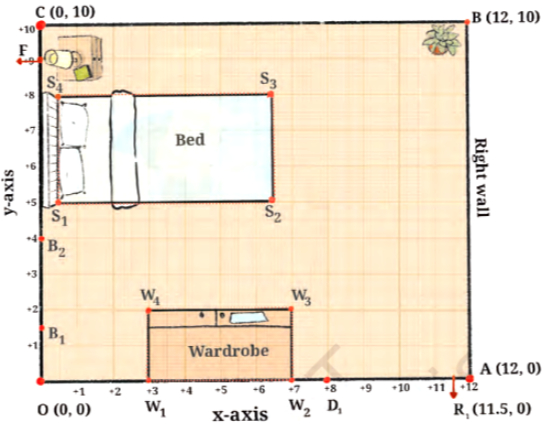
- If {tex}D_1 R_1{/tex} represents the door to Reiaan’s room, how far is the door from the left wall (the y-axis) of the room? How far is the door from the x -axis? (1)
- What are the coordinates of {tex}D_1{/tex}? (1)
- If {tex}R_1{/tex} is the point {tex}(11.5,0){/tex}, how wide is the door? Do you think this is a comfortable width for the room door? If a person in a wheelchair wants to enter the room, will he/she be able to do so easily? (2)
OR
If {tex}{B}_1(0,1.5){/tex} and {tex}{B}_2(0,4){/tex} represent the ends of the bathroom door, is the bathroom door narrower or wider than the room door? (2)
Solution:
- The room door lies on the {tex}x{/tex}-axis, so its distance from the {tex}x{/tex}-axis {tex}=0{/tex} units.
From the figure, {tex} {D}_1=(8,0) \text { and } {R}_1=(11.5,0) \text {. }{/tex} So the door begins 8 units from the {tex}y{/tex}-axis. - The coordinates of {tex}{D}_1{/tex} are {tex}(8,0){/tex}.
- Coordinates of {tex}{D}_1=(8,0){/tex} and {tex}{R}_1=(11.5,0){/tex}. So, the width of the door
{tex}={/tex} distance between {tex}{D}_1{/tex} and {tex}{R}_1{/tex} {tex} \text { = } 11.5-8{/tex} {tex}=3.5{/tex} units If the unit represents feet, then {tex}3.5 {ft} \approx 42{/tex} inches, which is quite comfortable for a room door. Standard residential doors are usually 30-36 inches wide, so this is actually slightly wider than average, which is good. For wheelchair accessibility: A wheelchair typically needs at least 32 inches {tex}(\sim 2.7 {ft}){/tex} clear width. Since {tex}3.5 {ft}>2.7 {ft}{/tex}, the door is wide enough. So, we can say yes, this door width is comfortable and a person using a wheelchair should be able to enter easily without difficulty.
OR Coordinates of {tex}{B}_1=(0,1.5){/tex} and {tex}{B}_2=(0,4){/tex}. So, the width of the bathroom door
{tex}={/tex} distance between {tex}{B}_1{/tex} and {tex}{B}_2{/tex}
{tex}=4-1.5=2.5{/tex} units
Since {tex}2.5<3.5{/tex}, the bathroom door is narrower than the room door.
Q.2:
On a graph sheet, mark the x -axis and y -axis and the origin O. Mark points from {tex}(-7,0){/tex} to {tex}(13,0){/tex} on the {tex}x{/tex}-axis and from {tex}(0,-15){/tex} to {tex}(0,12){/tex} on the y-axis. (Use the scale {tex}1 {~cm}=1{/tex} unit.) Using Figure, answer the given question-
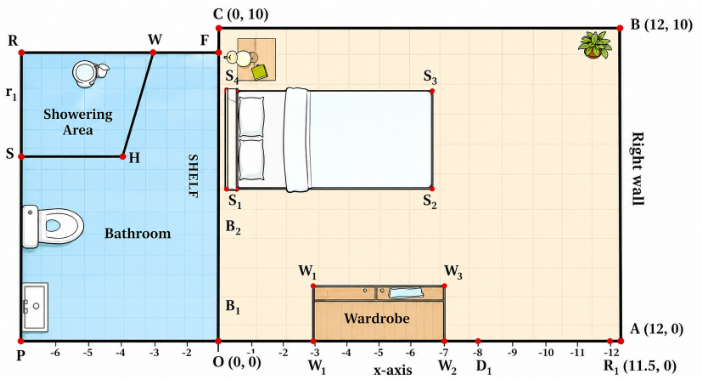
Place Reiaan’s rectangular study table with three of its feet at the points {tex}(8,9),(11,9){/tex} and {tex}(11,7){/tex}.
- Where will the fourth foot of the table be?
- Is this a good spot for the table?
- What is the width of the table? The length? Can you make out the height of the table?
Solution:
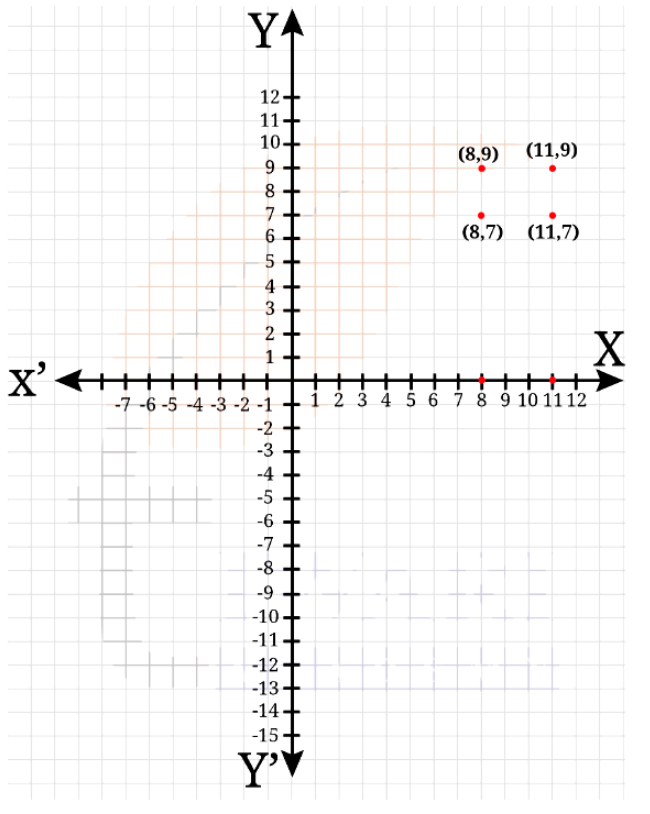
- The given three points form three corners of a rectangle: {tex}A=(8,9){/tex}
{tex}B=(11,9){/tex}
{tex}C=(11,7){/tex} To complete the rectangle, the fourth point must have:- same {tex}x{/tex}-coordinate as {tex}A \rightarrow 8{/tex}
- same y -coordinate as {tex}{C} \rightarrow 7{/tex} Therefore, the fourth foot is at: {tex}(8,7){/tex}
- Yes, this is a good spot because:
- The table is placed neatly inside the room.
- It does not block doors or pathways.
- It is positioned near the wall, which is practical for study.
- Width:
Distance between {tex}(8,9){/tex} and {tex}(11,9){/tex} {tex} =11-8=3 \text { units }{/tex} Length:
Distance between (11, 9) and (11, 7) {tex} =9-7=2 \text { units }{/tex} Height:
The height of the table cannot be determined from the given diagram because the figure represents only a top view (2D), not vertical dimensions.
Q.3:
On a graph sheet, mark the x -axis and y -axis and the origin O. Mark points from {tex}(-7,0){/tex} to {tex}(13,0){/tex} on the {tex}x{/tex}-axis and from {tex}(0,-15){/tex} to {tex}(0,12){/tex} on the y -axis. (Use the scale {tex}1 {~cm}=1{/tex} unit.) Using Figure, answer the given question-
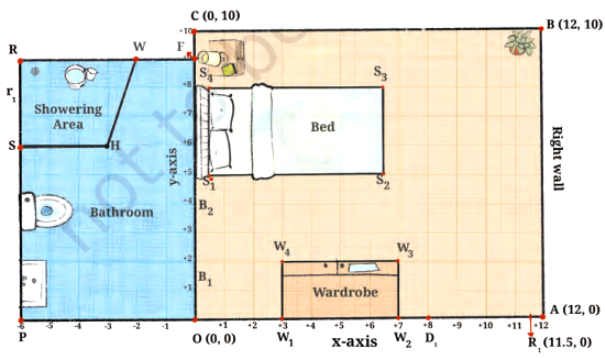
If the bathroom door has a hinge at B1 and opens into the bedroom, will it hit the wardrobe? Are there any changes you would suggest if the door is made wider?
Solution:
From Figure:
{tex}-B_1=(0,1.5){/tex}
{tex}-B_2=(0,4){/tex}
So, the bathroom door has width:
{tex}=4-1.5{/tex}
{tex}=2.5 \text { units }{/tex}
If the door is hinged at {tex}{B}_1{/tex} and opens into the bedroom, it will sweep an arc of radius 2.5 units from {tex}B_1{/tex}.
Now the wardrobe begins at:
{tex}W_1=(3,0){/tex}
{tex}W_4=(3,2){/tex}
The nearest point of the wardrobe from {tex}{B}_1(0,1.5){/tex} is around {tex}{x}=3{/tex}, which is farther than the door width 2.5 units.
Therefore, the bathroom door will not hit the wardrobe.
Suggestion if the door is made wider:
- If the door becomes much wider, it may come close to or hit the wardrobe.
- In that case, the door could be made to open inward into the bathroom, or
- the wardrobe could be shifted slightly to the right or
- the door width could be kept limited for comfortable movement.
Q.4:
On a graph sheet, mark the x -axis and y -axis and the origin O. Mark points from {tex}(-7,0){/tex} to {tex}(13,0){/tex} on the {tex}x{/tex}-axis and from {tex}(0,-15){/tex} to {tex}(0,12){/tex} on the y -axis. (Use the scale {tex}1 {~cm}=1{/tex} unit.) Using Figure, answer the given question-
Look at Reiaan’s bathroom.
- What are the coordinates of the four corners {tex}{O}, {F}, {R}{/tex}, and P of the bathroom?
- What is the shape of the showering area SHWR in Reiaan’s bathroom? Write the coordinates of the four corners.
- Mark off a {tex}3 {ft} \times 2 {ft}{/tex} space for the washbasin and a {tex}2 {ft} \times 3 {ft}{/tex} space for the toilet. Write the coordinates of the corners of these spaces.
Solution:
- From the figure:
The coordinates of the four corners {tex}{O}, {F}, {R}{/tex}, and P of the bathroom are: {tex}O=(0,0){/tex}
{tex}F=(0,9){/tex}
{tex}R=(-6,9){/tex}
{tex}P=(-6,0){/tex} - From the figure: {tex}{S}=(-6,5){/tex}
{tex}{H}=(-3,5){/tex}
{tex}{W}=(-2,9){/tex}
{tex}{R}=(-6,9){/tex} Since one pair of opposite sides is parallel, SHWR is a trapezium.
Shape of SHWR = Trapezium
Coordinates of the corners: {tex}{S}=(-6,5){/tex}
{tex}{H}=(-3,5){/tex}
{tex}{W}=(-2,9){/tex}
{tex}{R}=(-6,9){/tex} - Washbasin space ({tex}3 {ft} \times 2 {ft}{/tex}):
Take the rectangle at the bottom-left corner of the bathroom.
Coordinates of Corners: {tex} (-6,0),(-3,0),(-3,2) \text { and }(-6,2){/tex} Toilet space ( {tex}2 {ft} \times 3 {ft}{/tex} ):
Take a rectangle above the washbasin.
Coordinates of Corners: {tex} (-6,2),(-4,2),(-4,5) \text { and }(-6,5){/tex} Coordinates of Washbasin corners: {tex} (-6,0),(-3,0),(-3,2) \text { and }(-6,2){/tex} Coordinates of Toilet corners: {tex} (-6,2),(-4,2),(-4,5) \text { and }(-6,5){/tex}
Q.5:
On a graph sheet, mark the x -axis and y -axis and the origin O. Mark points from {tex}(-7,0){/tex} to {tex}(13,0){/tex} on the {tex}x{/tex}-axis and from {tex}(0,-15){/tex} to {tex}(0,12){/tex} on the y -axis. (Use the scale {tex}1 {~cm}=1{/tex} unit.) Using Figure, answer the given question-
Other rooms in the house:
- Reiaan’s room door leads from the dining room which has the length 18 ft and width 15 ft. The length of the dining room extends from point P to point A. Sketch the dining room and mark the coordinates of its corners.
- Place a rectangular {tex}5 {ft} \times 3 {ft}{/tex} dining table precisely in the centre of the dining room. Write down the coordinates of the feet of the table.
Solution:
- From the Figure:
Coordinates of {tex}{P}=(-6,0){/tex}
Coordinates of {tex}{A}=(12,0){/tex}
So, the length of {tex}{PA}=12-(-6)=18 {ft}{/tex}, which matches the given length.
If the dining room is 15 ft wide and lies below PA, then its upper side is PA and it extends downward 15 units. Hence the coordinates of four corners are:- {tex}{P}=(-6,0){/tex}
- {tex}{A}=(12,0){/tex}
- {tex}{Q}=(12,-15){/tex}
- {tex}{S}=(-6,-15){/tex} The coordinates of the dining room corners are: {tex} (-6,0),(12,0),(12,-15),(-6,-15){/tex}
- The dining room extends:
From {tex}{x}=-6{/tex} to {tex}{x}=12{/tex}
From {tex}y=0{/tex} to {tex}y=-15{/tex}
Centre of the dining room:
x -coordinate of centre {tex}=(-6+12) / 2=3{/tex}
{tex}y{/tex}-coordinate of centre {tex}=(0+(-15)) / 2=-7.5{/tex}
Now place a {tex}5 {ft} \times 3 {ft}{/tex} table at the centre.
Taking length {tex}=5{/tex} units along the {tex}x{/tex}-axis and width {tex}=3{/tex} units along the {tex}y{/tex}-axis:
Half-length = 2.5
Half-width = 1.5 So the coordinates of corners (feet) of the table are:- {tex}(3-2.5,-7.5-1.5)=(0.5,-9){/tex}
- {tex}(3+2.5,-7.5-1.5)=(5.5,-9){/tex}
- {tex}(3+2.5,-7.5+1.5)=(5.5,-6){/tex}
- {tex}(3-2.5,-7.5+1.5)=(0.5,-6){/tex} The coordinates of the four feet of the dining table are:
{tex}(0.5,-9),(5.5,-9),(5.5,-6),(0.5,-6){/tex}
Q.6:
What are the x-coordinate and y-coordinate of the point of intersection of the two axes?
Solution:
The {tex}x{/tex}-axis and {tex}y{/tex}-axis intersect at the origin.
Therefore:
The x -coordinate {tex}=0{/tex}
The y -coordinate {tex}=0{/tex}
So, the point of intersection is {tex}(0,0){/tex}.
Q.7:
Point W has x-coordinate equal to -5. Can you predict the coordinates of point H which is on the line through W parallel to the y-axis? Which quadrants can H lie in?
Solution:
If point {tex}W{/tex} has {tex}x{/tex}-coordinate -5, then any point on the line through {tex}W{/tex} parallel to the {tex}y{/tex}-axis will also have {tex}x{/tex}-coordinate -5.
Therefore, the coordinates of H will be of the form:
{tex}H=(-5, y){/tex}, where {tex}y{/tex} can be any real number.
Now, depending on the value of {tex}y{/tex}:
- If {tex}y>0{/tex}, then H lies in Quadrant II.
- If {tex}y<0{/tex}, then {tex}H{/tex} lies in Quadrant III.
- If {tex}y=0{/tex}, then {tex}H{/tex} lies on the {tex}x{/tex}-axis.
So, H can lie in:
- Quadrant II
- Quadrant III
- or on the x-axis
Q.8:
Consider the points {tex}{R}(3,0), {A}(0,-2), {M}(-5,-2){/tex} and {tex}{P}(-5,2){/tex}. If they are joined in the same order, predict:
- Two sides of RAMP that are perpendicular to each other.
- One side of RAMP that is parallel to one of the axes.
- Two points that are mirror images of each other in one axis. Which axis will this be?
Now plot the points and verify your predictions.
Solution:
- Let us observe:
AM joins {tex}{A}(0,-2){/tex} to {tex}{M}(-5,-2){/tex}, so it is horizontal.
MP joins {tex}{M}(-5,-2){/tex} to {tex}{P}(-5,2){/tex}, so it is vertical.
A horizontal line and a vertical line are perpendicular.
Therefore:
{tex}{AM} \perp {MP}{/tex}
The two perpendicular sides are AM and MP. - {tex}A M{/tex} is parallel to the {tex}x{/tex}-axis because both points {tex}A{/tex} and {tex}M{/tex} have the same {tex}y{/tex}-coordinate {tex}(-2){/tex}. MP is parallel to the {tex}y{/tex}-axis because both points {tex}M{/tex} and {tex}P{/tex} have the same {tex}x{/tex}-coordinate {tex}(-5){/tex}. One side parallel to an axis is:
AM, which is parallel to the x -axis or MP, which is parallel to the y -axis - Compare {tex}{M}(-5,-2){/tex} and {tex}{P}(-5,2){/tex}:
They have the same x -coordinate.
Their {tex}y{/tex}-coordinates are equal in magnitude but opposite in sign.
So, they are mirror images of each other in the x-axis.
The points M and P are mirror images of each other.
The axis is the x-axis.
Q.9:
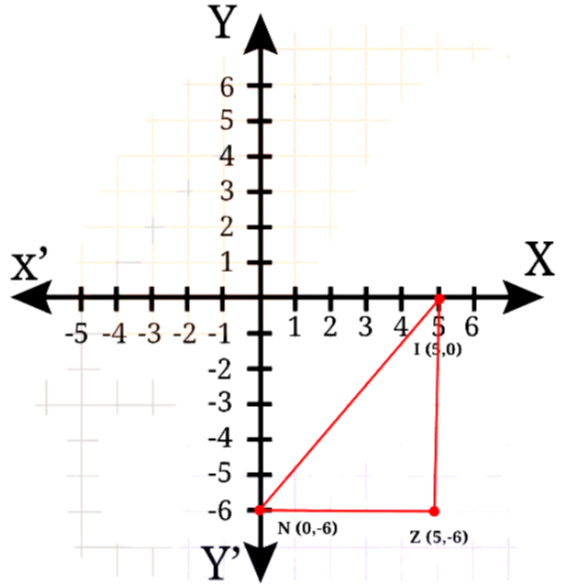
Plot point {tex}Z(5,-6){/tex} on the Cartesian plane. Construct a right-angled triangle IZN and find the lengths of the three sides.
(Comment: Answers may differ from person to person.)
Solution:
Point Z is {tex}(5,-6){/tex}.
To form a right-angled triangle easily, take:
{tex}I=(5,0){/tex} on the {tex}x{/tex}-axis
{tex}{N}=(0,-6){/tex} on the y-axis
Then triangle {tex}I Z N{/tex} is right-angled at {tex}Z{/tex}? Let’s check:
IZ is vertical
ZN is horizontal
So, triangle IZN is right-angled at Z.
Coordinates of the points:
{tex}I=(5,0){/tex}
{tex}Z=(5,-6){/tex}
{tex}N=(0,-6){/tex}Now find the lengths of the sides:
- IZ: Distance between {tex}(5,0){/tex} and {tex}(5,-6){/tex}
{tex}=0-(-6)=6{/tex} units - ZN: Distance between {tex}(5,-6){/tex} and {tex}(0,-6){/tex} {tex} =5-0=5 \text { units }{/tex}
- IN: Using distance formula: {tex}\text { IN }=\sqrt{ \left[(5-0)^2+(0-(-6))^2\right]}{/tex}
{tex}=\sqrt{ \left(5^2+6^2\right)}{/tex}
{tex}=\sqrt{ (25+36)}{/tex}
{tex}=\sqrt{61 } \text { units }{/tex}
Therefore, one possible right-angled triangle is formed by:
{tex}I=(5,0){/tex}
{tex}Z=(5,-6){/tex}
{tex}N=(0,-6){/tex}
Lengths of the sides:
IZ {tex}=6{/tex} units
{tex}{ZN}=5{/tex} units
IN {tex}=\sqrt{ 61} {/tex} units
Q.10:
What would a system of coordinates be like if we did not have negative numbers? Would this system allow us to locate all the points on a 2-D plane?
Solution:
If we did not have negative numbers, then coordinates could only be zero or positive.
So:
- On the {tex}x{/tex}-axis, we could mark only the points to the right of the origin.
- On the {tex}y{/tex}-axis, we could mark only the points above the origin.
This means we could locate points only in:
- Quadrant I
- the positive part of the {tex}x{/tex}-axis
- the positive part of the {tex}y{/tex}-axis
- and the origin
We would not be able to locate:
- points in Quadrant II
- points in Quadrant III
- points in Quadrant IV
- points on the negative parts of the axes
Therefore, such a system would not allow us to locate all the points on a 2-D plane.
Q.11:
Are the points {tex}{M}(-3,-4), {A}(0,0){/tex} and {tex}{G}(6,8){/tex} on the same straight line? Suggest a method to check this without plotting and joining the points.
Solution:
To check whether the points {tex}{M}(-3,-4), {A}(0,0){/tex}, and {tex}{G}(6,8){/tex} lie on the same straight line using the Distance formula:
{tex}d=\sqrt{ \left[\left(x_2-x_1\right)^2+\left(y_2-y_1\right)^2\right]}{/tex}
{tex}M A=\sqrt{ \left[(0+3)^2+(0+4)^2\right]}{/tex}
{tex}=\sqrt{ \left(3^2+4^2\right)}{/tex}
{tex}=\sqrt{ (9+16)=\sqrt{ } 25=5}{/tex}
{tex}A G=\sqrt{ \left[(6-0)^2+(8-0)^2\right]}{/tex}
{tex}=\sqrt{ (36+64)}{/tex}
{tex}=\sqrt{ } 100=10{/tex}
{tex}M G=\sqrt{ \left[(6+3)^2+(8+4)^2\right]}{/tex}
{tex}=\sqrt{ \left(9^2+12^2\right)}{/tex}
{tex}=\sqrt{ (81+144)}{/tex}
{tex}=\sqrt{ 225=15} {/tex}
Now checking: {tex}{MA}+{AG}=5+10=15={MG}{/tex}
Since the sum of two distances equals the third, the points {tex}{M}, {A}{/tex} and G lie on the same straight Line.
Q.12:
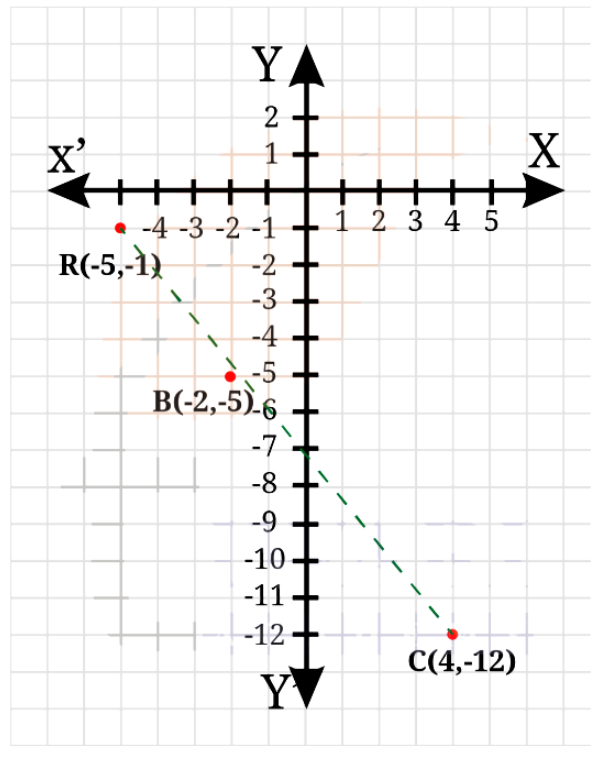
Use your method (from Problem 6) to check if the points {tex}{R}(-5,-1), {B}(-2,-5){/tex} and {tex}{C}(4,-12){/tex} are on the same straight line. Now plot both sets of points and check your answers.
Solution:
To check whether the points {tex}{R}(-5,-1), {B}(-2,-5){/tex} and {tex}{C}(4,-12){/tex} lie on the same straight line using the distance formula: {tex}d=\sqrt{ \left[\left(x_2-x_1\right)^2+\left(y_2-y_1\right)^2\right]}{/tex}
{tex}R B=\sqrt{ \left[(-2+5)^2+(-5+1)^2\right]}{/tex}
{tex}=\sqrt{ \left(3^2+(-4)^2\right)}{/tex}
{tex}=\sqrt{ (9+16)=\sqrt{ } 25=5}{/tex}
{tex}B C=\sqrt{ \left[(4+2)^2+(-12+5)^2\right]}{/tex}
{tex}=\sqrt{ \left(6^2+(-7)^2\right)}{/tex}
{tex}=\sqrt{ (36+49)=\sqrt{ } 85}{/tex}
{tex}{RC}=\sqrt{ \left[(4+5)^2+(-12+1)^2\right]}{/tex}
{tex}=\sqrt{ \left(9^2+(-11)^2\right)}{/tex}
{tex}=\sqrt{ (81+121)=\sqrt{ } 202}{/tex}
Now: {tex}{RB}+{BC}=5+\sqrt{85} \neq \sqrt{202}{/tex}
Since the sum of two distances is not equal to the third, the points {tex}{R}, {B}{/tex} and C do not lie on the same straight line.
Q.13:
Using the origin as one vertex, plot the vertices of:
- A right-angled isosceles triangle.
- An isosceles triangle with one vertex in Quadrant III and the other in Quadrant IV.
Solution:
- One possible set of vertices of triangle {tex}O A B{/tex} is: {tex}O=(0,0){/tex}
{tex}A=(4,0){/tex}
{tex}B=(0,4){/tex} Because:
{tex}{OA}=4{/tex} units
{tex}O B=4{/tex} units
OA is perpendicular to OB
So triangle OAB is a right-angled isosceles triangle.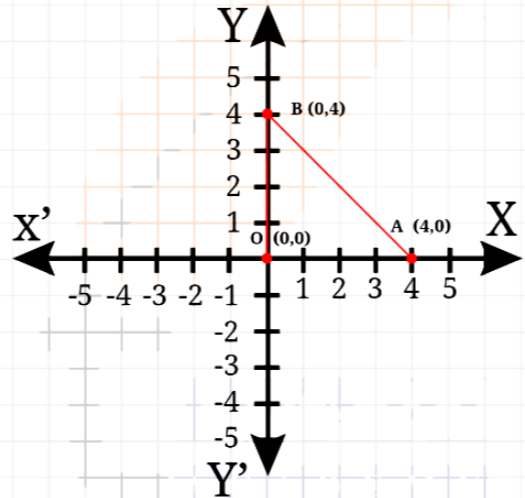
- One possible set of vertices is: {tex} O=(0,0), P=(-3,-4), Q=(3,-4){/tex} Explanation:
P lies in Quadrant III
Q Lies in Quadrant IV
{tex}O P=O Q=5{/tex} units
So triangle OPQ is an isosceles triangle.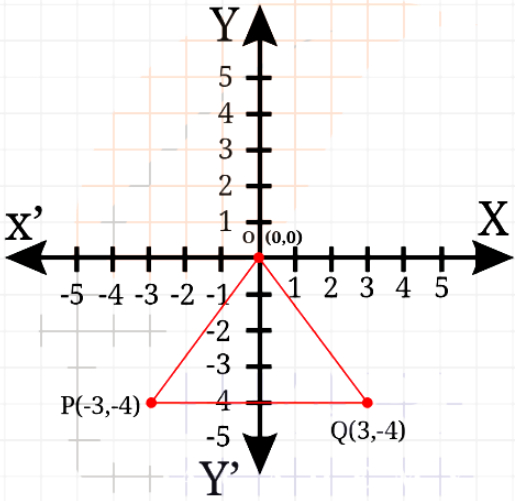
Q.14:
The following table shows the coordinates of points {tex}{S}, {M}{/tex} and T. In each case, state whether M is the midpoint of segment ST. Justify your answer.
| S | M | T | Is M the midpoint of ST? Yes or No | Reason for your answer |
| {tex}(-3,0){/tex} | {tex}(0,0){/tex} | {tex}(3,0){/tex} | ||
| {tex}(2,3){/tex} | {tex}(3,4){/tex} | {tex}(4,5){/tex} | ||
| {tex}(0,0){/tex} | {tex}(0,5){/tex} | {tex}(0,-10){/tex} | ||
| {tex}(-8,7){/tex} | {tex}(0,-2){/tex} | {tex}(6,-3){/tex} |
When M is the mid-point of ST, can you find any connection between the coordinates of {tex}{M}, {S}{/tex} and T?
Solution:
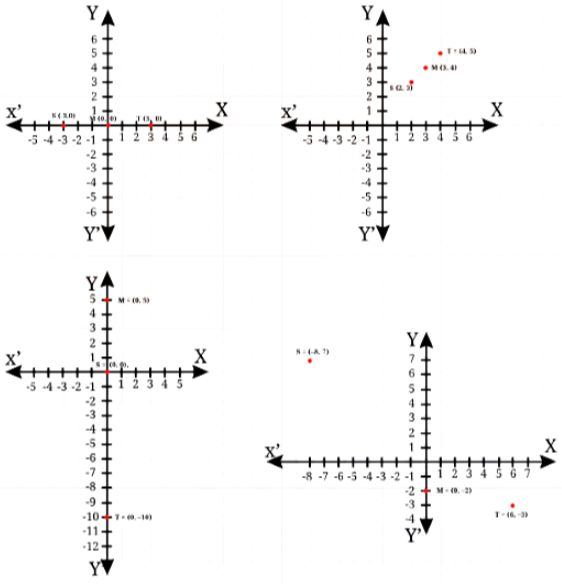
Using Distance Formula: {tex}d=\sqrt{ \left[\left(x_2-x_1\right)^2+\left(y_2-y_1\right)^2\right]}{/tex}
- Row 1: {tex}{S}(-3,0), {M}(0,0), {T}(3,0){/tex} {tex}S M=\sqrt{ \left[(0-(-3))^2+(0-0)^2\right]}={/tex}{tex}\sqrt{ [9+0]=3}{/tex}
{tex}M T=\sqrt{ \left[(3-0)^2+(0-0)^2\right]}={/tex}{tex}\sqrt{ [9+0]}=3{/tex}
{tex}S M=M T=3{/tex} Yes, {tex}M{/tex} is the midpoint - Row 2: {tex}{S}(2,3), {M}(3,4), {T}(4,5){/tex} {tex}S M=\sqrt{ \left[(3-2)^2+(4-3)^2\right]}={/tex}{tex}\sqrt{ [1+1]}=\sqrt{ 2}{/tex}
{tex}M T=\sqrt{ \left[(4-3)^2+(5-4)^2\right]}={/tex}{tex}\sqrt{ [1+1]}=\sqrt{ 2}{/tex}
{tex}S M=M T=\sqrt{ } 2{/tex} Yes, {tex}M{/tex} is the midpoint - Row 3: {tex}{S}(0,0), {M}(0,5), {T}(0,-10){/tex} {tex}S M=\sqrt{ \left[(0-0)^2+(5-0)^2\right]}={/tex}{tex}\sqrt{ [0+25]}=5{/tex}
{tex}M T=\sqrt{ \left[(0-0)^2+(-10-5)^2\right]}={/tex}{tex}\sqrt{ [0+225]}=15{/tex}
{tex}S M \neq M T(5 \neq 15){/tex} No, M is NOT the midpoint - {tex}{S}(-8,7), {M}(0,-2), {T}(6,-3){/tex} {tex}S M=\sqrt{ \left[(0-(-8))^2+(-2-7)^2\right]}={/tex}{tex}\sqrt{ [64+81]}=\sqrt{ }145 {/tex}
{tex}M T=\sqrt{ \left[(6-0)^2+(-3-(-2))^2\right]}={/tex}{tex}\sqrt{ [36+1]}=\sqrt{ 37} {/tex}
{tex}S M \neq M T(\sqrt{ 14} 5 \neq \sqrt{37 } ){/tex} No, M is NOT the midpoint.
Q.15:
Use the connection you found to find the coordinates of B given that {tex}{M}(-7,1){/tex} is the midpoint of {tex}{A}(3,-4){/tex} and {tex}{B}(x, y){/tex}.
Solution:
Given: {tex}M(-7,1){/tex} is the midpoint of {tex}A(3,-4){/tex} and {tex}B(x, y){/tex}.
So, using the concept of distance formula, point {tex}M{/tex} will be equidistant from {tex}A{/tex} and {tex}B{/tex}.
Using distance formula: {tex}{AM}=\sqrt{ }\left[(-7-3)^2+(1-(-4))^2\right]{/tex}
{tex}=\sqrt{ \left[(-10)^2+(5)^2\right]}{/tex}
{tex}=\sqrt{ (100+25)}{/tex}
{tex}=\sqrt{ 125}{/tex}
Now, {tex}M B=\sqrt{ \left[(x+7)^2+(y-1)^2\right]}{/tex}
Since Distance {tex}{AM}={/tex} Distance MB
So, {tex}\sqrt{ \left[(x+7)^2+(y-1)^2\right]=\sqrt{ } 125}{/tex}
Squaring both sides:
{tex} \begin{equation*} (x+7)^2+(y-1)^2=125 {1} \end{equation*}{/tex}
Also, since {tex}M{/tex} is the midpoint, it lies between {tex}A{/tex} and {tex}B{/tex}, so coordinates of {tex}B{/tex} will be such that {tex}M{/tex} divides AB into two equal parts. From symmetry (or balancing coordinates):
From {tex}x{/tex}-coordinates:
Distance from A to M is {tex}-7-3=-10{/tex}
So from {tex}M{/tex} to {tex}B{/tex} must also be -10
{tex} x=-7-10=-17{/tex}
From y-coordinates:
Distance from {tex}A{/tex} to {tex}M{/tex} is {tex}1-(-4)=5{/tex}
So from {tex}M{/tex} to {tex}B{/tex} must also be 5
{tex} y=1+5=6{/tex}
Therefore, the coordinates of {tex}B=(-17,6){/tex}.
Q.16:
Let {tex}{P}, {Q}{/tex} be points of trisection of AB, with P closer to A, and Q closer to B. Using your knowledge of how to find the coordinates of the midpoint of a segment, how would you find the coordinates of {tex}P{/tex} and {tex}Q{/tex}? Do this for the case when the points are {tex}A(4,7){/tex} and B {tex}(16,-2){/tex}.
Solution:
To trisect {tex}{AB}, {P}{/tex} and Q divides the segment into 3 equal parts.
Given: {tex}{A}(4,7), {B}(16,-2){/tex}
Let {tex}{P}\left({x}_1, {y}_1\right){/tex} and {tex}{Q}\left({x}_2, {y}_2\right){/tex}

Here, {tex}P{/tex} is midpoint of {tex}A{/tex} and {tex}Q{/tex}, so
{tex}x_1=\left(4+x_2\right) / 2\ …(1){/tex}
{tex}y_1=\left(7+y_2\right) / 2\ …(2){/tex}
So, Q is midpoint of P and B, so
{tex}x_2=\left(x_1+16\right) / 2 \ldots(3){/tex}
{tex}y_2=\left(y_1-2\right) / 2 \ldots(4){/tex}
Solving for x-coordinates, from (1):
{tex} x_1=\left(4+x_2\right) / 2 \text { and }{/tex}
From (3): {tex}{x}_2=\left({x}_1+16\right) / 2{/tex}
Substituting (1) into (3), we get
{tex}x_2=\left(\left(4+x_2\right) / 2+16\right) / 2{/tex}
{tex}=\left(4+x_2+32\right) / 4{/tex}
{tex}=\left(x_2+36\right) / 4{/tex}
So, {tex}4 {x}_2={x}_2+36{/tex}
{tex}\Rightarrow 3 x_2=36{/tex}
{tex}\Rightarrow x_2=12{/tex}
Then from (1): {tex}{x}_1=(4+12) / 2=8{/tex}
Solving for y -coordinates, from (2):
{tex}y_1=\left(7+y_2\right) / 2{/tex} and
From (4): {tex}{y}_2=\left({y}_1-2\right) / 2{/tex}
Substituting (2) into (4):
{tex}y_2=\left(\left(7+y_2\right) / 2-2\right) / 2{/tex}
{tex}=\left(7+y_2-4\right) / 4{/tex}
{tex}=\left(y_2+3\right) / 4{/tex}
So, {tex}4 y_2=y_2+3{/tex}
{tex} \Rightarrow 3 y_2=3{/tex}
{tex} \Rightarrow y_2=1{/tex}
Then from (2): {tex}{y}_1=(7+1) / 2=4{/tex}
Therefore, {tex}P=(8,4){/tex} and {tex}Q=(12,1){/tex}.
Q.17:
- Given the points {tex}{A}(1,-8), {B}(-4,7){/tex} and {tex}{C}(-7,-4){/tex}, show that they lie on a circle K whose center is the origin {tex}{O}(0,0){/tex}. What is the radius of circle K ?
- Given the points {tex}{D}(-5,6){/tex} and {tex}{E}(0,9){/tex}, check whether D and E lie within the circle, on the circle, or outside the circle K.
Solution:
- Distance OA: {tex}=\sqrt{ \left(1^2+(-8)^2\right)}{/tex}
{tex}=\sqrt{ (1+64)}{/tex}
{tex}=\sqrt{ 65}{/tex} Distance OB: {tex}=\sqrt{ \left((-4)^2+7^2\right) }{/tex}
{tex}=\sqrt{ (16+49)}{/tex}
{tex}=\sqrt{65 }{/tex} Distance {tex}O C{/tex}: {tex}=\sqrt{ \left((-7)^2+(-4)^2\right)}{/tex}
{tex}=\sqrt{ (49+16)}{/tex}
{tex}=\sqrt{ 65}{/tex} Since all three points are at the same distance from origin, they lie on a circle centred at {tex}(0,0){/tex}.
Radius {tex}=\sqrt{ 65}{/tex}
Points {tex}A, B{/tex} and {tex}C{/tex} lie on circle {tex}K{/tex} with center {tex}(0,0){/tex} and radius {tex}\sqrt{ 65}{/tex}.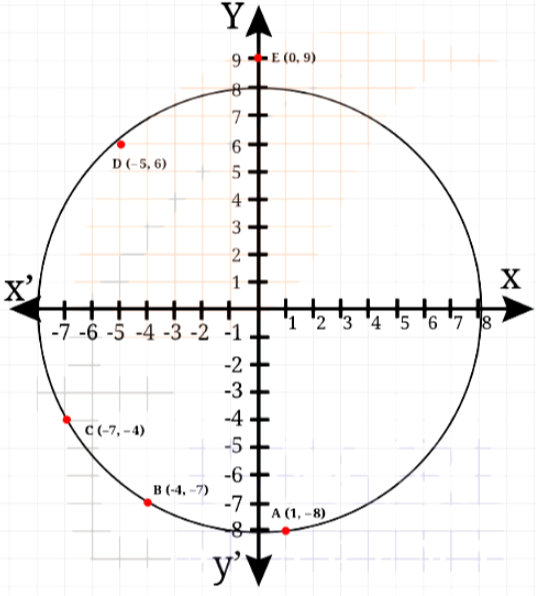
- Distance OD: {tex}=\sqrt{ \left((-5)^2+6^2\right)}{/tex}
{tex}=\sqrt{ (25+36)}{/tex}
{tex}=\sqrt{ 61}{/tex} Distance OE: {tex}=\sqrt{ \left(0^2+9^2\right)}{/tex}
{tex}=9{/tex} Compare with radius {tex}\sqrt{ } 65 \approx 8.06{/tex}
{tex}-\sqrt{ 61} \approx 7.81<\sqrt{ 65} \rightarrow{/tex} D lies inside the circle {tex}-9>\sqrt{ 65} \rightarrow{/tex} E Lies outside the circle
D lies inside the circle.
E lies outside the circle.
Q.18:
The midpoints of the sides of triangle ABC are the points {tex}{D}, {E}{/tex}, and {tex}F{/tex}. Given that the coordinates of {tex}D, E{/tex}, and {tex}F{/tex} are {tex}(5,1),(6,5){/tex}, and {tex}(0,3){/tex}, respectively, find the coordinates of A, B and C.
Solution:
Let the vertices of triangle {tex}A B C{/tex} be {tex}A\left(x_1, y_1\right), B\left(x_2, y_2\right){/tex}, and {tex}C\left(x_3, y_3\right){/tex}.
Given midpoints: {tex}{D}(5,1), {E}(6,5), {F}(0,3){/tex}
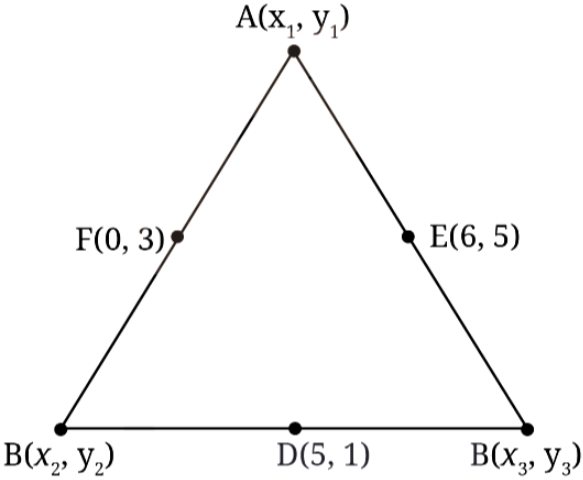
D is midpoint of BC, so using midpoint formula:
{tex}x_2+x_3=10\ \ldots(1){/tex}
{tex}y_2+y_3=2 \ \ldots(2){/tex}
E is midpoint of CA, therefore:
{tex}x_2+x_1=12 \ \ldots(3){/tex}
{tex}y_2+y_1=10\ \ldots(4){/tex}
F is midpoint of AB, therefore:
{tex}x_1+x_2=0 \ \ldots(5){/tex}
{tex}y_1+y_2=6 \ \ldots(6){/tex}
Solving for x -coordinates, from (5):
{tex} x_2=-x_1{/tex}
Substitute into (1): {tex}-{x}_1+{x}_2=10{/tex}
{tex} \Rightarrow x_3=10+x_1 \ …{7}{/tex}
Substituting into (3): {tex}\left(10+x_1\right)+x_1=12{/tex}
{tex}\Rightarrow 2 {x}_1+10=12{/tex}
{tex}\Rightarrow 2 {x}_1=2{/tex}
{tex}\Rightarrow {x}_1=1{/tex}
Then: {tex}{x}_2=-1{/tex}
{tex} \Rightarrow x_3=10+1=11{/tex}
Solving {tex}y{/tex}-coordinates, from (6):
{tex} y_2=6-y_1{/tex}
Substituting into (2): (6-y1) {tex}+y_3=2{/tex}
{tex}\Rightarrow y_2=y_1-4 \ …{8}{/tex}
Substituting into (4): {tex}\left(y_1-4\right)+y_1=10{/tex}
{tex}\Rightarrow 2 y_1-4=10{/tex}
{tex}\Rightarrow 2 y_1=14{/tex}
{tex}\Rightarrow y_1=7{/tex}
Then: {tex}y=6-7=-1{/tex}
{tex} \Rightarrow y_3=7-4=3{/tex}
Therefore, the coordinates of the points are {tex}{A}(1,7), {B}(-1,-1){/tex} and {tex}{C}(11,3){/tex}.
Q.19:
A city has two main roads which cross each other at the centre of the city. These two roads are along the North-South (N-S) direction and East-West (E-W) direction. All the other streets of the city run parallel to these roads and are 200 m apart. There are 10 streets in each direction.
- Using {tex}1 {~cm}=200 {~m}{/tex}, draw a model of the city in your notebook. Represent the roads/streets by single lines.
- There are street intersections in the model. Each street intersection is formed by two streets-one running in the {tex}{N}-{S}{/tex} direction and another in the E-W direction. Each street intersection is referred to in the following manner: If the second street running in the N-S direction and 5th street in the E-W direction meet at some crossing, then we call this street intersection (2,5). Using this convention, find:
- how many street intersections can be referred to as {tex}(4,3){/tex}.
- how many street intersections can be referred to as {tex}(3,4){/tex}.
Solution:
- Drawing the model of the city
Since: Scale is {tex}1 \ {cm}=200 \ {m}{/tex}
Each pair of adjacent streets is 200 m apart
Given that:
10 streets in the {tex}{N}-{S}{/tex} direction
10 streets in the E-W direction Hence, the model will consist of:
10 vertical parallel lines (for N-S streets)
10 horizontal parallel lines (for E-W streets)
Each consecutive line 1 cm apart, which forms a square grid.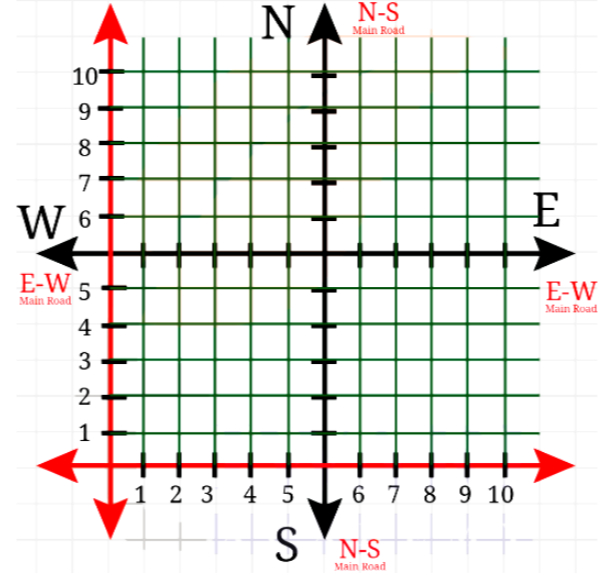
- A street intersection is named by: (first number, second number)
{tex}=({N}-{S}{/tex} street number, {tex}{E}-{W}{/tex} street number{tex}){/tex}
So:
{tex}(4,3){/tex} means the intersection of the 4th {tex}{N}-{S}{/tex} street and the 3rd {tex}{E}-{W}{/tex} street {tex}(3,4){/tex} means the intersection of the 3rd N-S street and the 4th E-W street Now, one {tex}{N}-{S}{/tex} street and one {tex}{E}-{W}{/tex} street can meet at only one point.
Therefore:
(a) Only one intersection can be called {tex}(4,3){/tex}.
(b) Only one intersection can be called {tex}(3,4){/tex}.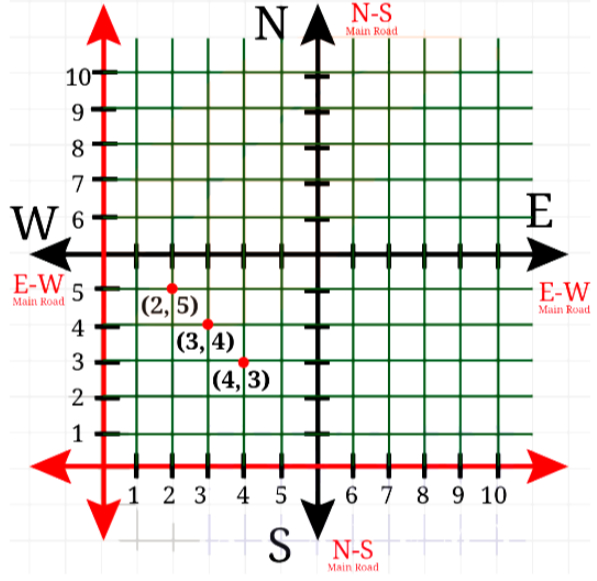
Q.20:
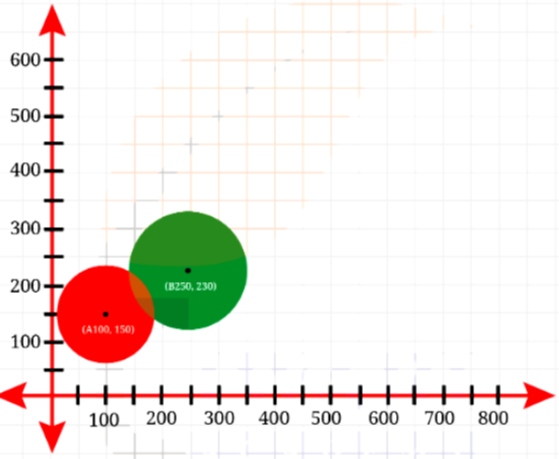
A computer graphics program displays images on a rectangular screen whose coordinate system has the origin at the bottom-left corner. The screen is 800 pixels wide and 600 pixels high. A circular icon of radius 80 pixels is drawn with its centre at the point {tex}{A}(100,150){/tex}. Another circular icon of radius 100 pixels is drawn with its centre at the point {tex}{B}(250,230){/tex}. Determine:
- whether any part of either circle lies outside the screen.
- whether the two circles intersect each other.
Solution:
- No. Each of the two circles lies inside the screen.
- Yes. The two circles intersect each other as shown in the picture.
Q.21:
Plot the points {tex}{A}(2,1), {B}(-1,2), {C}(-2,-1){/tex}, and {tex}{D}(1,-2){/tex} in the coordinate plane. Is ABCD a square? Can you explain why? What is the area of this square?
Solution:
Yes, {tex}A B C D{/tex} is a square.
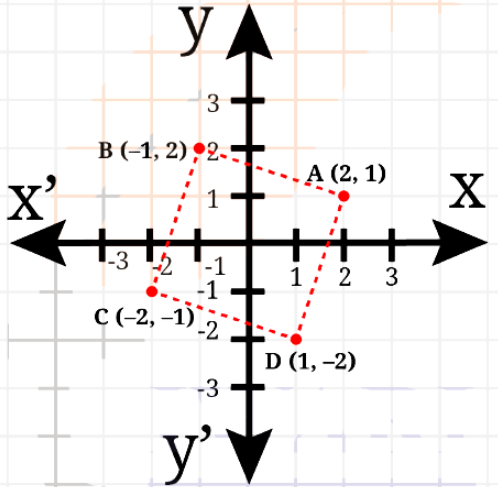
We can check it finding the lengths of sides and diagonals.
Finding the lengths of all sides:
{tex}A B=\sqrt{ \left[(-1-2)^2+(2-1)^2\right]}{/tex}
{tex}=\sqrt{ \left[(-3)^2+1^2\right]}{/tex}
{tex}=\sqrt{ (9+1)}{/tex}
{tex}=\sqrt{ 10}{/tex}
{tex}B C=\sqrt{ \left[(-2-(-1))^2+(-1-2)^2\right]}{/tex}
{tex}=\sqrt{ \left[(-1)^2+(-3)^2\right]}{/tex}
{tex}=\sqrt{ (1+9)}{/tex}
{tex}=\sqrt{10 }{/tex}
{tex}C D={/tex}{tex}\sqrt{ \left[(1-(-2))^2+(-2-(-1))^2\right]}{/tex}
{tex}=\sqrt{ \left[3^2+(-1)^2\right] }{/tex}
{tex}=\sqrt{ (9+1)}{/tex}
{tex}=\sqrt{10}{/tex}
{tex}D A=\sqrt{ \left[(2-1)^2+(1-(-2))^2\right]}{/tex}
{tex}=\sqrt{ \left[1^2+3^2\right]}{/tex}
{tex}=\sqrt{ (1+9)}{/tex}
{tex}=\sqrt{ 10}{/tex}
All four sides are equal.
Now finding diagonals:
{tex}A C=\sqrt{ \left[(-2-2)^2+(-1-1)^2\right]}{/tex}
{tex}=\sqrt{ \left[(-4)^2+(-2)^2\right]}{/tex}
{tex}=\sqrt{ (16+4)}{/tex}
{tex}=\sqrt{ 20}{/tex}
{tex}B D=\sqrt{ \left[(1-(-1))^2+(-2-2)^2\right]}{/tex}
{tex}=\sqrt{ \left[2^2+(-4)^2\right]}{/tex}
{tex}=\sqrt{ (4+16)}{/tex}
{tex}=\sqrt{ 20}{/tex}
Diagonals are equal.
All sides are equal and diagonals are equal, so ABCD is a square.
Area of {tex}{ABCD}=(\text {side})^2{/tex}
{tex}=(\sqrt{ 10^2}){/tex}
{tex}=10 \text { square units. }{/tex}
Q.22:
What is the x-coordinate of a point on the y-axis?
Solution:
The {tex}{x}{/tex}-coordinate of any point located on the {tex}{y}{/tex}-axis is always {tex}{0}{/tex}. This is a fundamental property of the Cartesian coordinate system because the {tex}y{/tex}-axis itself is defined by the vertical line where no horizontal displacement has occurred from the origin.
In a coordinate pair {tex}(x, y){/tex}, the {tex}x{/tex} value represents the horizontal distance from the center. Since points on the {tex}y{/tex}-axis do not move left or right, the value remains at the starting point of the scale. Therefore, every point on this axis follows the general form {tex}(0, y){/tex}, where {tex}y{/tex} can be any real number.
This concept is essential when identifying intercepts in geometry. For instance, when you are looking for the y-intercept of a line or a circle’s equation, you mathematically set {tex}x=0{/tex} to find where the shape crosses the vertical axis. Understanding this “zero” placement helps in accurately plotting graphs and solving algebraic equations involving coordinate geometry.
Q.23:
Is there a similar generalization for a point on the x-axis?
Solution:
Yes, there is a mirror generalization for the horizontal axis. The {tex}{y}{/tex}-coordinate of any point located on the x -axis is always {tex}{0}{/tex}. Just as the y -axis represents the line where {tex}x{/tex} is zero, the x axis represents the horizontal boundary where there is no vertical movement.
In the Cartesian system, a point is written as {tex}(x, y){/tex}. For a point to lie exactly on the x -axis, it cannot have any upward or downward displacement from the origin. This means its vertical position must be exactly at the starting level of the grid, which corresponds to {tex}y=0{/tex}. Consequently, all points on this axis follow the general form ({tex}x, 0{/tex}), where {tex}x{/tex} can be any positive or negative value.
This rule is particularly useful when solving for the x-intercepts of a circle or a line. To find where a curve crosses the horizontal axis, you simply set {tex}y=0{/tex} in the equation and solve for {tex}x{/tex}. This symmetry between the two axes forms the basis for navigating and plotting data in a two dimensional plane.
Q.24:
Does point Q (y, x) ever coincide with point P (x, y)? Justify your answer.
Solution:
Point {tex}Q(y, x){/tex} coincides with point {tex}P(x, y){/tex} only when the coordinates are equal, meaning {tex}x=y{/tex}. This occurs for every point located on the identity line.
Mathematically, for two points to be identical, their corresponding coordinates must match exactly. This requires the {tex}x{/tex}-value of {tex}P{/tex} to equal the {tex}x{/tex}-value of {tex}Q(x=y){/tex} and the {tex}y{/tex}-value of {tex}P{/tex} to equal the {tex}y{/tex}-value of {tex}Q(y=x){/tex}.
Both conditions lead to the same requirement: the horizontal and vertical distances from the origin must be identical. If {tex}x \neq y{/tex}, the points are reflections of each other across the line {tex}y=x{/tex} but occupy different positions in the plane. For example, {tex}(2,3){/tex} and {tex}(3,2){/tex} are distinct points, whereas {tex}(4,4){/tex} remains the same regardless of which coordinate you read first. Thus, the points coincide if and only if they lie on the diagonal line passing through the origin at a {tex}45^{\circ}{/tex} angle.
Q.25:
If {tex}x \neq y{/tex}, then {tex}(x, y) \neq(y, x){/tex}; and {tex}(x, y)=(y, x){/tex} if and only if {tex}x=y{/tex}. Is this claim true?
Solution:
The claim is entirely true because ordered pairs are defined by the specific position of each element within the parentheses. For two points ({tex}x, y{/tex}) and ({tex}y, x{/tex}) to be identical, the first components must match ({tex}x=y{/tex}) and the second components must match ({tex}y=x{/tex}).
When {tex}x \neq y{/tex}, the horizontal displacement of the first point differs from that of the second, placing them at different locations. These points act as reflections of one another across the diagonal line {tex}y=x{/tex} but remain distinct. For example, the point {tex}(1,5){/tex} is located in a completely different position than {tex}(5,1){/tex} on the coordinate grid.
The “if and only if” condition establishes that {tex}x=y{/tex} is both necessary and sufficient for the points to coincide. This means the only way to swap coordinates without changing the point’s location is if the values are identical. This fundamental principle ensures that every unique location in a plane corresponds to a specific, unique ordered pair.
Q.26:
In moving from {tex}A(3,4){/tex} to {tex}D(7,1){/tex}, what distance has been covered along the {tex}x{/tex}-axis? What about the distance along the {tex}y{/tex}-axis?
Solution:
The distance covered along the {tex}x{/tex}-axis is 4 units and along the {tex}y{/tex}-axis is 3 units, found by calculating the differences between coordinates.
Q.27:
Would these observations be the same if {tex}\triangle {ADM}{/tex} is reflected in the x-axis (instead of the {tex}y{/tex}-axis)?
Solution:
Reflecting {tex}\triangle {ADM}{/tex} in the {tex}x{/tex}-axis would yield similar observations regarding magnitude, but the vertical direction and specific coordinates would change. In an {tex}x{/tex}-axis reflection, the horizontal distance ({tex}x{/tex}-distance) between points remains exactly the same as the original because x coordinates are unaffected.
However, the {tex}y{/tex}-coordinates swap signs, meaning the distance along the {tex}y{/tex}-axis remains 3 units in magnitude but moves in the opposite vertical direction. If the original movement from {tex}A{/tex} to {tex}D{/tex} was “downward,” the reflected movement would appear “upward” relative to the new points.
Essentially, the “gap” between the values stays constant, but the orientation flips. Just as a circle maintains its radius regardless of where it is reflected, the absolute distances covered along each axis remain identical to your previous calculations. Only the signs of the {tex}y{/tex}-values and the final positions in the quadrants would differ from a {tex}y{/tex}-axis reflection.
NCERT Solutions Class 9 Ganita Manjari
- The Use of Coordinates
- Introduction to Linear Polynomials
- The World of Numbers
- Exploring Algebraic Identities
- I’m Up and Down, and Round and Round
- Measuring Space: Perimeter and Area
- The Mathematics of Maybe: Introduction to Probability
- Exploring Sequences and Progressions

Test Generator
Create question paper PDF and online tests with your own name & logo in minutes.
Create Now
Learn8 App
Practice unlimited questions for Entrance tests & government job exams at ₹99 only
Install Now