Describing Motion Around Us – NCERT Solutions Class 9 Science Exploration includes all the questions with solutions given in NCERT Class 9 Science Exploration textbook.
NCERT Solutions Class 9
English Kaveri Hindi Ganga Sanskrit Sharada Maths Ganita Manjari Science Exploration Social Understanding SocietyDescribing Motion Around Us – NCERT Solutions
Q.1: How much distance should we maintain from the truck ahead to avoid a collision if it suddenly applies the brakes?
Solution: This involves stopping distance and relative motion using kinematic equations.
The time-gap rule (3-4 seconds) is essentially a practical version of:
Safe distance {tex}\propto{/tex} speed
Q.2: Does this distance depend upon the speed with which we are moving?
Solution: Yes. The safe distance depends on speed – higher speed ⇒ larger stopping distance (distance increases rapidly, ∝ speed2).
Q.3: As shown in fig, a ball is thrown vertically upwards from O. It moves up straight till B and then falls back to O. Can this be considered a motion in a straight line?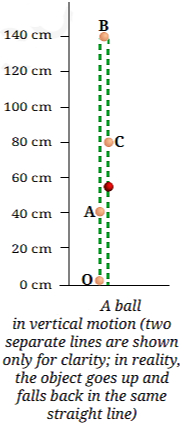
Solution: Yes, because the ball moves along a single vertical straight path (up and down along the same line).
Q.4: In the example of an athlete running back and forth on a straight track, when will the displacement of the athlete be zero? What will be the total distance travelled in that case?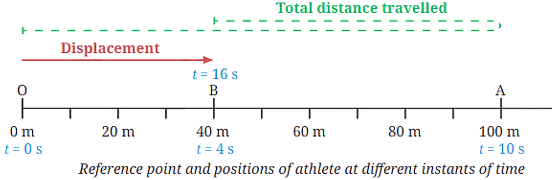
Solution:
- Displacement = 0 when the athlete returns to the starting point (A).
- Total distance travelled = length of path covered = A → B → A = 2 × AB.
Q.5: Fuel used up in a vehicle depends on which of the following? Justify your answer.
- Total distance travelled
- Displacement
Solution: Fuel used depends on total distance travelled, not displacement.
Justification:
Fuel consumption is related to the actual path covered by the vehicle. Even if displacement is zero (returning to the start), fuel is still used because distance travelled is not zero. Hence, fuel depends on distance, not displacement.
Q.6: A ball rolls down an inclined track as shown in the figure 1.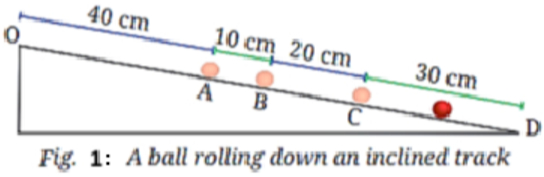
Is its motion, a straight line motion? Assuming the starting point of the ball (O) to be the origin, can its motion from O to D be depicted using a horizontal line as shown in the figure 2?
Are the values of total distance travelled and magnitude of displacement from O equal or different at positions A, B, C and D?
Solution: The motion of the ball on the inclined track is not a straight line motion, because it follows a curved path along the track.
Yes, its motion from O to D can be represented by a horizontal straight line if we only consider the distance covered along the track (path length), ignoring the actual shape of the path.
At positions A, B, C, and D:
- The total distance travelled is always greater than the magnitude of displacement, except at the starting point.
- This is because distance depends on the actual path, while displacement is the shortest straight-line distance between two points.
Q.7: During a family road trip, you drive 200 km north in three hours. Afterwards, you drive 200 km south in two hours. Find the average speed and average velocity for your entire trip.
Solution: Total distance = 200 + 200 = 400 km
Total time = 3 + 2 = 5 h
Average speed = 400 / 5 = 80 km/h
Displacement = 0 (back to starting point)
Average velocity = 0 km/h
Q.8: Under what condition(s) is the
- magnitude of average velocity of an object equal to its average speed?
- magnitude of average velocity of an object zero while its average speed is not zero?
Solution: The magnitude of average velocity equals average speed when the object moves in a straight line without changing direction, making displacement equal to distance. When an object returns to its starting point, its displacement becomes zero, so average velocity is zero. However, since it has covered some distance, its average speed remains non-zero.
Q.9: Consider two postmen. They start walking towards each other from a distance of 210 yojanas (Yojana is a unit of distance used in ancient India). One travels 9 yojanas per day and the other covers 5 yojanas per day. Can you determine in how many days they will meet each other?
Solution: Total of distance covered by each postman in one day {tex}=9{/tex} yojanas +5 yojanas {tex}=14{/tex} yojanas.
To meet with each other, the postmen need to cover 210 yojanas together.
Time taken by them to cover 210 yojanas together {tex}=\frac{210}{14}=15{/tex} days.
So, both postmen will meet each other after 15 days.
(In 15 days, first postman will cover 135 yojanas and the second postman will cover 75 yojanas).
Q.10: Sarang takes 50 seconds to swim from one end to the other end and back in the swimming pool shown in figure. Find his average speed and average velocity within the time interval of 50 s.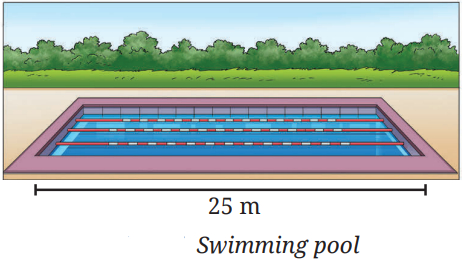
Solution: Total distance travelled by Sarang in 50 s = 50 m
displacement of Sarang in 50 s = 0 m
{tex}\text {average speed }=\frac{\text { total distance travelled }}{\text { time interval }}=\frac{50 {~m}}{50 {~s}}=1 {~m} {~s}^{-1}{/tex}
{tex}\text {average velocity }=\frac{\text { displacement }}{\text { time interval }}=\frac{0 {~m}}{50 {~s}}=0 {~m} {~s}^{-1}{/tex}
During the 50 s time interval, the average speed of Sarang is approximately 1 m s-1 while his average velocity is 0 m s -1.
Q.11: A bus is moving on a long straight highway with a velocity of 36 km h-1. The driver presses the accelerator for a time interval of 10 s and velocity of the bus increases to 54 km h-1. For some time, the bus moves at a constant velocity. Then, the driver notices an obstacle on the road ahead and presses the brake. The bus comes to a stop in a time interval of 5 s. Find the average acceleration in the two time intervals, (i) when the accelerator was pressed, and (ii) when the brakes were pressed.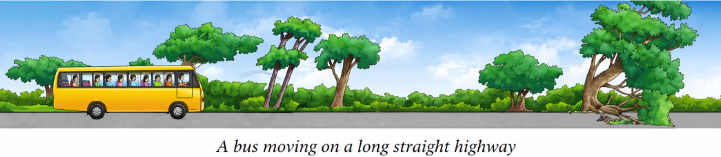
Solution:
- When the driver presses the accelerator
{tex} u=36 {~km} {~h}^{-1}=36 \times \frac{1000 {~m}}{60 \times 60 {~s}}=10 {~m} {~s}^{-1}, {/tex} {tex}v=54 {~km} {~h}^{-1}=15 {~m} {~s}^{-1}, t=10 {~s}, a=?{/tex}
Using Eq. {tex}a=\frac{v-u}{t_2-t_1}{/tex}, we obtain the average acceleration
{tex} a=\frac{15 {~m} {~s}^{-1}-10 {~m} {~s}^{-1}}{10 {~s}}=\frac{5 {~m} {~s}^{-1}}{10 {~s}}=0.5 {~m} {~s}^{-2}{/tex}
Since the magnitude of velocity of the bus is increasing, the acceleration is acting in the direction of velocity. - When the driver presses the brake
{tex} u=54 {~km} {~h}^{-1}=15 {~m} {~s}^{-1}, v=0 {~m} {~s}^{-1}, t=5 {~s}, a=?{/tex}
Using Eq. {tex}a=\frac{v-u}{t_2-t_1}{/tex} again, we obtain
{tex} a=\frac{0 {~m} {~s}^{-1}-15 {~m} {~s}^{-1}}{5 {~s}}=\frac{-15 {~m} {~s}^{-1}}{5 {~s}}=-3 {~m} {~s}^{-2}{/tex}
The minus sign indicates that the acceleration is acting opposite to the direction of velocity (since the magnitude of velocity of the bus is decreasing).
Q.12: As we learnt earlier, when an object is dropped from a height, it takes a straight vertical path downwards before touching the ground. While coming down, the velocity of the object increases as shown in figure at different instants.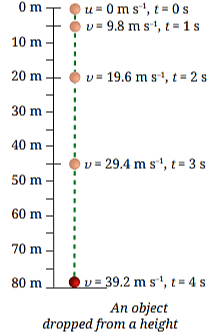
Find the magnitude of the average acceleration of the object in every successive interval of a second. Is the average acceleration constant across all intervals? What is the direction of this average acceleration?
Solution: The magnitude of the average acceleration in every successive interval is
average acceleration between 0 s and {tex}1 {~s}=\frac{(9.8-0) {m} {s}^{-1}}{(1-0) {s}}=9.8 {~m} {~s}^{-2}{/tex}
average acceleration between 1 s and {tex}2 {~s}=\frac{(19.6-9.8) {m} {s}^{-1}}{(2-1) {s}}=9.8 {~m} {~s}^{-2}{/tex}
average acceleration between 2 s and {tex}3 {~s}=\frac{(29.4-19.6) {m} {s}^{-1}}{(3-2) {s}}=9.8 {~m} {~s}^{-2}{/tex}
average acceleration between 3 s and {tex}4 {~s}=\frac{(39.2-29.4) {m} {s}^{-1}}{(4-3) {s}}=9.8 {~m} {~s}^{-2}{/tex}
We note that the average acceleration is constant and equal to 9.8 m s-2. As the velocity is increasing in the direction of motion, the acceleration is in the direction of motion. This acceleration is called the acceleration due to gravitational force by the Earth and is denoted by g.
Q.13: For a vehicle starting from rest and speeding up, the data for position and time are given in table. Plot the position-time graph corresponding to it.
Positions of vehicle at different instants of time
| Time | Position |
| 0 s | 0 m |
| 2 s | 1 m |
| 4 s | 4 m |
| 6 s | 9 m |
| 8 s | 16 m |
| 10 s | 25 m |
| 12 s | 36 m |
Solution: Choosing the scale to be
x-axis: 5 divisions = 2 s
y-axis: 5 divisions = 5 m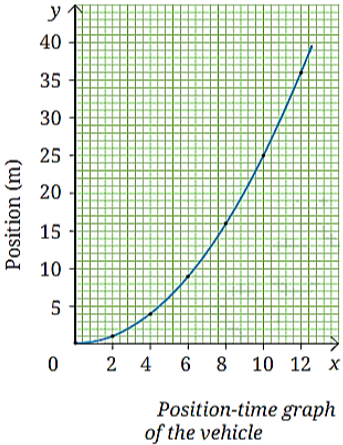
Q.14: What does the graph shown in figure indicate about the nature of motion of the vehicle?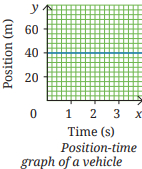
Solution: The position of the vehicle is 40 m from the origin and is not changing with time. Thus, the vehicle is at rest at 40 m from the origin. A straight line parallel to the time axis on a position-time graph represents a stationary object (In this case, the position-time graph is not the distance-time graph).
Q.15: The position-time graphs of two objects A and B are given in the figure. Which object of the magnitude of average velocity is higher?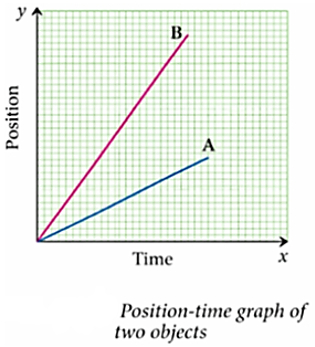
Solution: By making lines parallel to axes as shown in figure b, it is found that the displacement of object B is more than object A for the same time interval. That is, the slope of line for B is steeper than the slope for line A. Thus, the velocity of B is higher than that of A.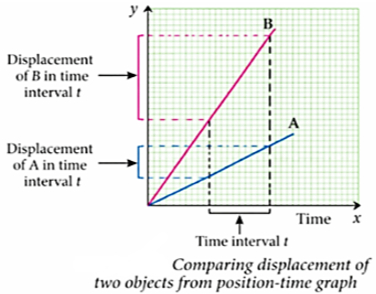
Q.16: Suppose a car is moving on a highway and brakes are applied, which cause an acceleration of -4 m s-2. How much will be the distance travelled by the car before coming to a stop, if the car was moving with a velocity of (i) 54 km h-1, and (ii) 108 km h-1 when the brakes were applied?
Solution: Given: {tex}a=-4 {~m} {s}^{-2}, v=0 {~m} {s}^{-1}{/tex}
Suppose the initial velocity is {tex}u{/tex} and the distance travelled is {tex}s{/tex}.
- {tex}u=54 {~km} {h}^{-1}=15 {~m} {s}^{-1}{/tex}
- {tex}u=108 {~km} {h}^{-1}=30 {~m} {s}^{-1}{/tex}
Using Eq. {tex}v^2=u^2+2 a s{/tex}
{tex}\left(0 {~m} {~s}^{-1}\right)^2=u^2+2 \times\left(-4 {~m} {~s}^{-2}\right) \times s{/tex}
{tex}0=u^2-8 \times s \Rightarrow s=\frac{u^2}{8}{/tex}
Substituting the value of {tex}u{/tex}, we obtain (i) 28.1 m, and (ii) 112.5 m.
Q.17: My father went to a shop from home which is located at a distance of 250 m on a straight road. On reaching there, he discovered that he forgot to carry a cloth bag. He came home to take it, went to the shop again, bought provisions and came back home. How much was the total distance travelled by him? What was his displacement from home?
Solution: Total distance = 250 + 250 + 250 + 250 = 1000 m
Displacement = 0 m (came back to starting point)
Q.18: A student runs from the ground floor to the fourth floor of a school building to collect a book and then comes down to their classroom on the second floor. If the height of each floor is 3 m, find:
- the total vertical distance travelled, and
- their displacement from the starting point.
Solution: Given: Each floor = 3 m
Ground → 4th floor = 4 × 3 = 12 m
4th → 2nd floor = 2 × 3 = 6 m
- Total distance = 12 + 6 = 18 m
- Displacement = final – initial = 2nd floor − ground = 6 m upward
Q.19: A girl is riding her scooter and finds that its speedometer reading is constant. Is it possible for her scooter to be accelerating and if so, how?
Solution: Yes, it is possible. Even if the speed (speedometer reading) is constant, the scooter can still be accelerating if its direction is changing. For example, when moving in a circular path, velocity changes continuously due to change in direction, so acceleration exists even with constant speed.
Q.20: A car starts from rest and its velocity reaches 24 m s-1 in 6 s. Find the average acceleration and the distance travelled in these 6 s.
Solution: Given:
{tex} {u}=0 {~m} / {s}, {v}=24 {~m} / {s}, {t}=6 {~s}{/tex}
- Average acceleration
{tex} {a}=({v}-{u}) / {t}=(24-0) / 6=4 {~m} / {s}^2{/tex} - Distance travelled
{tex}s=u t+1 / 2 a t^2{/tex}
{tex}s=0+1 / 2 \times 4 \times 6^2=2 \times 36=72 {~m}{/tex}
Acceleration {tex}=4 {~m} / {s}^2{/tex}
Distance {tex}=72 {~m}{/tex}
Q.21: A motorbike moving with initial velocity 28 m s-1 and constant acceleration stops after travelling 98 m. Find the acceleration of the motorbike and the time taken to come to a stop.
Solution: Given:
{tex}u=28 {~m} / {s}{/tex}
{tex}v=0 {~m} / {s}{/tex}
{tex}s=98 {~m}{/tex}
- Acceleration Using: {tex}v^2=u^2+2 a s{/tex}
{tex}0=28^2+2 a(98){/tex}
{tex}0=784+196 a{/tex}
{tex}196 a=-784{/tex}
{tex}a=-4 {~m} / {s}^2{/tex} - Time Using:
{tex}{v}={u}+{at}{/tex} {tex}0=28+(-4) t{/tex}
{tex}4 t=28{/tex}
t = 7s
Acceleration = -4 m/s2 (retardation)
Time taken = 7 s
Q.22: Figure shows a position-time graph of two objects A and B that are moving along the parallel tracks in the same direction. Do objects A and B ever have equal velocity? Justify your answer.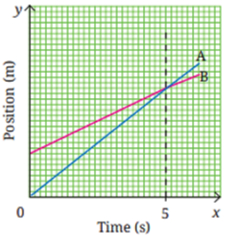
Solution: Velocity is the slope of a position–time graph. In the given graph, objects A and B have different slopes at all points.
Since their slopes are never equal, their velocities are never equal at any time.
Q.23: A graph in the figure shows the change in position with time for two objects A and B moving in a straight line from 0 to 10 seconds. Choose the correct option(s).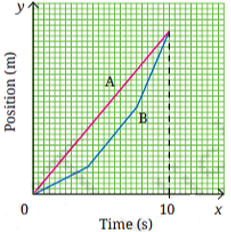
Options:
(1) The average velocity of both over the 10 s time interval is equal since they have the same initial and final positions. ✅
(2) The average speeds of both over the 10 s time interval are equal since both cover equal distance in equal time.
(3) The average speed of A over the 10 s time interval is lower than that of B since it covers a shorter distance than B in 10 seconds.
(4) The average speed of A over the 10 s time interval is greater than that of B since B’s speed is lower than A’s in some segments.
Explanation: From the position-time graph: both A and B start and end at the same position, so displacement is same → average velocity same. But distance covered is different (B is curved, so longer path).
Q.24: A truck driver driving at the speed of 54 km h-1 notices a road sign with a speed limit of 40 km h-1 (figure) for trucks. He slows down to 36 km h-1 in 36 s. What was the distance travelled by him during this time? Assume the acceleration to be constant while slowing down.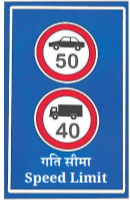
Solution: Convert speeds to {tex}{m} / {s}{/tex}:
- Initial speed, {tex}u=54 {~km} / {h}=15 {~m} / {s}{/tex}
- Final speed, {tex}v=36 {~km} / {h}=10 {~m} / {s}{/tex}
- Time, {tex}t=36 {~s}{/tex}
For constant acceleration, distance travelled:
{tex}s=\frac{u+v}{2} \times t{/tex}
{tex}s=\frac{15+10}{2} \times 36=\frac{25}{2} \times 36=12.5 \times 36=450 {~m}{/tex}
Distance travelled {tex}=450 {~m}{/tex}
Q.25: A car starts from rest and accelerates uniformly to 20 m s-1 in 5 seconds. It then travels at 20 m s-1 for 10 seconds and finally applies the brake (with uniform acceleration) to stop in 6 seconds. Find the total distance travelled.
Solution:
- Acceleration phase (0 to {tex}20 {~m} / {s}{/tex} in 5 s):
{tex} s_1=\frac{u+v}{2} t=\frac{0+20}{2} \times 5=10 \times 5=50 {~m}{/tex} - Constant speed phase ( {tex}20 {~m} / {s}{/tex} for 10 s):
{tex} s_2=v t=20 \times 10=200 {~m}{/tex} - Braking phase (20 to {tex}0 {~m} / {s}{/tex} in 6 s):
{tex} s_3=\frac{20+0}{2} \times 6=10 \times 6=60 {~m}{/tex}
Total distance:
{tex} s=50+200+60=310 {~m}{/tex}
Q.26: A bus is travelling at 36 km h-1 when the driver sees an obstacle 30 m ahead. The driver takes 0.5 seconds to react before pressing the brake. Once the brake is applied, the velocity of the bus reduces with constant acceleration of 2.5 m s-2. Will the bus be able to stop before reaching the obstacle?
Solution: Step 1: Convert speed
{tex} 36 {~km} / {h}=10 {~m} / {s}{/tex}
Step 2: Reaction distance
During reaction time (0.5 s), speed is constant:
{tex} s_1=v t=10 \times 0.5=5 {~m}{/tex}
Step 3: Braking distance
Initial speed {tex}u=10 {~m} / {s}{/tex}, final speed {tex}v=0{/tex}, acceleration {tex}a=-2.5 {~m} / {s}^2{/tex}
Use:
{tex}v^2=u^2+2 a s{/tex}
{tex}0=100+2(-2.5) s{/tex}
{tex}0=100-5 s{/tex}
{tex}s_2=20 {~m}{/tex}
Q.27: A student said, “The Earth moves around the Sun”. In this context, discuss whether an object kept on the Earth can be considered to be at rest.
Solution: An object kept on Earth cannot be considered truly at rest because motion is relative.
Even though the student says “the Earth moves around the Sun,” the object shares the same motion as the Earth. So, relative to the Earth’s surface, it is at rest. However, relative to the Sun (or space), it is continuously moving along with the Earth’s orbital motion.
Conclusion:
An object on Earth is at rest only in the Earth’s frame of reference, but not in an absolute sense.
Q.28: The velocity-time graph from 0 s to 120 s for a cyclist is shown in the figure.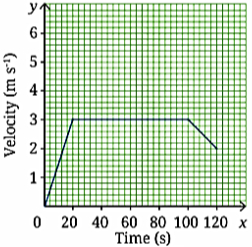
Shade the areas (in different colours) representing the displacement of the cyclist
- while cyclist is moving with constant velocity.
- when the velocity of cyclist is decreasing.
Also, calculate the displacement and average acceleration in the 120 s time interval.
Solution: Displacement is found from the area under a velocity-time graph. The cyclist moves with constant velocity for the first 40 s, so the area is a rectangle: {tex}20 \times 40=800 {~m}{/tex}. From 40 s to 120 s, velocity decreases uniformly to zero, forming a triangle with area {tex}\frac{1}{2} \times 80 \times 20=800 {~m}{/tex}. Total displacement {tex}=1600 {~m}{/tex}. Average acceleration {tex}=(0- 20) / 120=-0.167 {~m} / {s}^2{/tex}.
Q.29: A girl is preparing for her first marathon by running on a straight road. She uses a smartwatch to calculate her running speed at different intervals. The graph depicts her velocity versus time. Estimate the running distance based on the graph.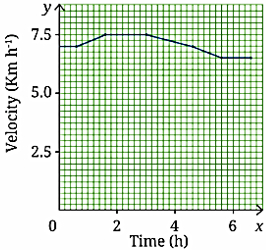
Solution: To estimate distance, we calculate the area under the velocity–time graph (since displacement = area under v–t graph).
From the graph:
- First part (constant velocity): rectangle area
- Second part (changing velocity): triangle area
Adding both areas gives the total running distance.
Estimated distance ≈ 900 m (from graph area).
Q.30: On entering a state highway, a car continues to move with a constant velocity of 6 m s-1 for 2 minutes and then accelerates with a constant acceleration 1 m s-2 for 6 seconds. Find the displacement of the car on the state highway in the 2 min 6 s time interval by drawing a velocity-time graph for its motion.
Solution: Given:
- Constant velocity {tex}=6 {~m} / {s}{/tex} for {tex}2 {~min}=120 {~s}{/tex}
- Acceleration {tex}=1 {~m} / {s}^2{/tex} for 6 s
- Initial velocity for acceleration phase {tex}=6 {~m} / {s}{/tex}
- (constant velocity)
{tex} s_1=v t=6 \times 120=720 {~m}{/tex} - (uniform acceleration)
Final velocity:
{tex} v=u+a t=6+(1 \times 6)=12 {~m} / {s}{/tex}
Displacement:
{tex} s_2=\frac{u+v}{2} \times t=\frac{6+12}{2} \times 6=9 \times 6=54 {~m}{/tex} - Total displacement {tex} s=720+54=774 {~m}{/tex}
Q.31: Two cars A and B start moving with a constant acceleration from rest in a straight line. Car A attains a velocity of 5 m s-1 in 5 s. Car B attains a velocity of 3 m s-1 in 10 s. Plot the velocity-time graphs for both the cars in the same graph. Using the graph, calculate the displacement mentioned in the two time intervals (Hint: Calculate the acceleration in both cases. Then calculate their velocities at five instants of time to plot the graph).
Solution: Step 1: Find accelerations
Car A: {tex} a_A=\frac{5}{5}=1 {~m} / {s}^2{/tex}
Car B: {tex} a_B=\frac{3}{10}=0.3 {~m} / {s}^2{/tex}
Step 2: Velocities at 5 s intervals
{tex}\operatorname{CarA}({v}={at}):{/tex}
{tex} t=0,1,2,3,4,5 \rightarrow v=0,1,2,3,4,5{/tex}
Car B ({tex}{v}=0.3 {t}{/tex}):
{tex} t=0,2,4,6,8,10 \rightarrow v=0,0.6,1.2,1.8,2.4,3{/tex}
(Plot both straight-line graphs on same axes.)
Step 3: Displacement (area under v–t graph)
Since both are triangles:
Car A: {tex}s_A=12.5 \mathrm{~m}{/tex}
Car B: {tex}s_B=15 \mathrm{~m}{/tex}
Q.32: Rohan studies science from 6 PM to 7:30 PM at home. Consider the tip of the minute’s hand of the wall clock.
During the given time interval, what is its:
- distance travelled,
- displacement,
- speed, and
- velocity.
The length of the minute’s hand is 7 cm.
Solution: Time interval = 6:00 PM to 7:30 PM = 90 min
Radius of minute hand = 7 cm
The minute hand completes 1 rotation in 60 min → in 90 min it completes 1.5 rotations.
- Distance travelled {tex} \text { Distance }=1.5 \times 2 \pi r={/tex} {tex}1.5 \times 2 \pi \times 7=21 \pi {~cm}{/tex}
- Displacement At 6:00 → tip at 12
At 7:30 → tip at 6 (opposite point)
So displacement = diameter: {tex} =2 r=14 {~cm}{/tex} - Speed {tex} \text { Speed }=\frac{21 \pi}{90}=\frac{7 \pi}{30} {~cm} / {min}{/tex}
- Velocity
Velocity {tex}=\frac{14}{90}=\frac{7}{45} {~cm} / {min}{/tex}
(direction from 12 to 6 in a straight line)
Class 9 Science Exploration NCERT Solutions
- Exploration: Entering the World of Secondary Science
- Cell: The Building Block of Life
- Tissues in Action
- Describing Motion Around Us
- Exploring Mixtures and Their Separation
- How Forces Affect Motion
- Work, Energy and Simple Machines
- Journey Inside the Atom
- Atomic Foundations of Matter
- Sound Waves: Characteristics and Applications
- Reproduction: How Life Continues
- Patterns in Life: Diversity and Classification
- Earth as a System: Energy, Matter and Life

Test Generator
Create question paper PDF and online tests with your own name & logo in minutes.
Create Now
Learn8 App
Practice unlimited questions for Entrance tests & government job exams at ₹99 only
Install Now