I’m Up and Down, and Round and Round – NCERT Solutions Class 9 Maths Ganita Manjari includes all the questions with solutions given in NCERT Class 9 Ganita Manjari textbook.
NCERT Solutions Class 9
English Kaveri Hindi Ganga Sanskrit Sharada Maths Ganita Manjari Science Exploration Social Understanding SocietyI’m Up and Down, and Round and Round – NCERT Solutions
Q.1:
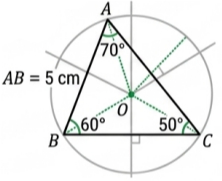
Draw {tex}\triangle {ABC}{/tex} with {tex}{AB}=5 \ {cm}, \angle \ {A}=70^{\circ}{/tex} and {tex}\angle {B}=60^{\circ}{/tex}. Draw the circumcircle of {tex}\triangle {ABC}{/tex}. Is the centre inside or outside the triangle?
Solution:
- Triangle: Draw {tex}A B=5 {~cm}{/tex}. At {tex}A{/tex}, draw a {tex}70^{\circ}{/tex} angle; at {tex}B{/tex}, draw a {tex}60^{\circ}{/tex} angle. Their intersection is {tex}C{/tex}.
- Circumcircle: Draw perpendicular bisectors for {tex}A B{/tex} and {tex}B C{/tex}. Their intersection is the circumcentre {tex}O{/tex}.
- Result: Since the triangle is acute, the centre is inside the triangle.
Q.2:
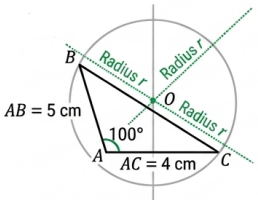
Draw {tex}\triangle {ABC}{/tex} with {tex}{AB}=5 \ {cm}, \angle \ {A}=100^{\circ}, {AC}=4 \ {cm}{/tex}. Draw the circumcircle of {tex}\triangle A B C{/tex}. Is the centre inside or outside the triangle?
Solution:
In triangle {tex}A B C{/tex} where {tex}\angle A=100^{\circ}{/tex}, the circumcentre {tex}O{/tex} is located outside the triangle because it is obtuse-angled.
Q.3:
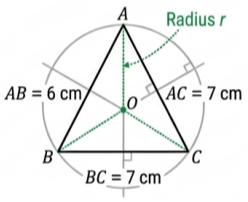
Draw {tex}\triangle {ABC}{/tex}, with {tex}{AB}=6 \ {cm}, {BC}=7 \ {cm}{/tex} and {tex}{CA}=7 \ {cm}{/tex}. Draw the circumcircle of {tex}\triangle {ABC}{/tex}. Let the circumcentre be O. Measure OA , {tex}{OB}, {OC}{/tex}.
Solution:
In an isosceles triangle ({tex}6 {~cm}, 7 {~cm}, 7 {~cm}{/tex}), the distances from the circumcentre to the vertices ({tex}O A, O B, O C{/tex}) are all equal as they represent the radius {tex}r{/tex}.
Q.4:
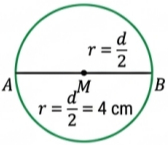
What is the least possible radius of a circle through two points A and B?
Solution:
The smallest circle passing through two points {tex}A{/tex} and {tex}B{/tex} uses the segment {tex}A B{/tex} as the diameter. The radius is exactly half the distance between the two points ({tex}r=d / 2{/tex}).
Q.5:
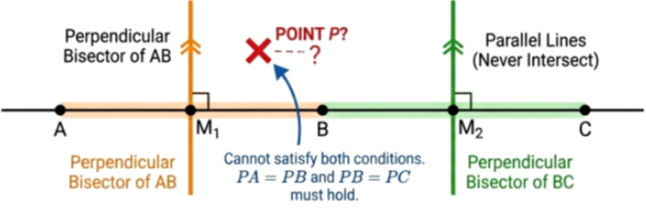
{tex}{A}, {B}{/tex} and C are three collinear points. Can you find a point P such that {tex}{PA}={PB}={PC}{/tex}? What can you say about the perpendicular bisectors of AB and BC? Draw and check. Can you show that for three collinear points {tex}{A}, {B}{/tex} and C, the perpendicular bisector of AB and BC are parallel? Is it possible for a circle to pass through collinear points? Can you draw a line that cuts a given circle in three distinct points?
Solution:
No point {tex}{P}{/tex} exists because the perpendicular bisectors of {tex}{A B}{/tex} and {tex}{B C}{/tex} are parallel and never intersect.
Parallel lines cannot meet at a centre.
Thus, no circle can pass through three collinear points. A straight line can only cut a circle at a maximum of two points.
Key Conclusions:
- Parallel Bisectors: Bisectors of collinear segments are always parallel.
- Non-Existence: No circumcentre exists for points on a line.
- Circle Limit: A line never intersects a circle at three points.
Q.6:
The circumcircle of a given {tex}\triangle {ABC}{/tex} is drawn. Can there be other triangles congruent to {tex}\triangle {ABC}{/tex} that share the same circumcircle?
Solution:
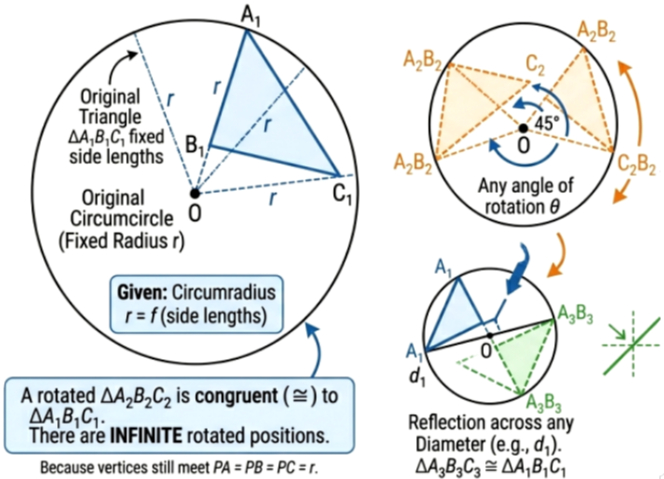
Yes, there can be infinitely many triangles congruent to {tex}\triangle A B C{/tex} that share the same circumcircle. Since a circle has complete rotational symmetry, you can rotate {tex}\triangle A B C{/tex} around the circumcentre {tex}O{/tex} by any angle. The resulting triangle will remain congruent to the original and its vertices will still lie on the same circle. Additionally, you can reflect the triangle across any diameter to create another congruent triangle sharing the same circle.
Key Conclusions:
- Rotational Symmetry: Rotating the triangle doesn’t change its shape or its relationship to the centre.
- Infinite Positions: You can “slide” the triangle along the edge of the circle to find new positions.
- Congruence: All such triangles will have the same side lengths and angles as the original.
Q.7:
Show that the triangle formed by a chord and the centre of the circle is isosceles.
Solution:
Let’s prove that {tex}\triangle A C B{/tex} in the figure above is isosceles.
Given:
- A circle with centre {tex}C{/tex}.
- A chord {tex}A B{/tex}.
Proof:
- {tex}C A{/tex} is the line segment connecting the centre {tex}C{/tex} to point {tex}A{/tex} on the circumference. By definition, {tex}C A{/tex} is a radius (r) of the circle.
- Similarly, {tex}C B{/tex} connects the centre {tex}C{/tex} to point {tex}B{/tex} on the circumference. Therefore, {tex}C B{/tex} is also a radius {tex}(r){/tex}.
- Since all radii of the same circle are equal in length, we can conclude that:
{tex} C A=C B=r{/tex}
Conclusion:
By mathematical definition, any triangle with at least two equal sides is an isosceles triangle. Since {tex}\triangle A C B{/tex} has two equal sides ({tex}C A=C B{/tex}), it is always an isosceles triangle.
Q.8:
Show that if two such isosceles triangles (occurring in the previous question) have equal base length, they are congruent to each other.
Solution:
Given:
- A circle with centre {tex}C{/tex}.
- Two chords, {tex}A B{/tex} and {tex}D E{/tex}.
- We are told the chords have equal length: {tex}A B=D E{/tex} (This is the ‘equal base length’ condition).
Proof:
We need to show that {tex}\triangle C A B{/tex} is congruent {tex}(\cong){/tex} to {tex}\triangle C D E{/tex}. We can use the Side-Side-Side (SSS) congruence criteria.
- From the previous proof, we know that all lines from the centre to the circumference are equal to the radius ({tex}r{/tex}). {tex}C A=r{/tex}
{tex}C D=r{/tex} Therefore: {tex}C A=C D{/tex} (First matching side). - Similarly, for the other radii: {tex}C B=r{/tex}
{tex}C E=r{/tex} Therefore: {tex}C B=C E{/tex} (Second matching side). - Finally, we were given that the chords are equal: {tex} A B=D E \text { (Third matching side, the base). }{/tex}
Conclusion:
Since all three corresponding sides of the two triangles are equal ({tex}C A=C D, C B=C E{/tex}, and {tex}A B=D E{/tex}), the triangles are congruent by the SSS congruence criterion:
{tex} \triangle C A B \cong \triangle C D E{/tex}
This proves that if two triangles formed by chords and the centre have equal bases, they must be perfectly identical (congruent) to each other.
Q.9:
Can you explain why the converse to Theorem 4 is true, i.e., why does the perpendicular from the centre of a circle to a chord of the circle bisect the chord?
Solution:
Show that if {tex}C M \perp A B{/tex}, then {tex}A M=B M{/tex}.
Proof:
Consider right-angled triangles {tex}\triangle C M A{/tex} and {tex}\triangle C M B{/tex} from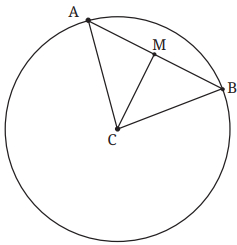
- Hypotenuse: {tex}C A=C B{/tex} (Both are radii of the circle).
- Side: {tex}C M=C M{/tex} (Common side to both triangles).
- Right Angle: {tex}\angle C M A=\angle C M B=90^{\circ}{/tex} (Given).
By the RHS (Right-Angle Hypotenuse Side) congruence criterion, {tex}\triangle C M A \cong \triangle C M B{/tex}. Therefore, by CPCT (Corresponding Parts of Congruent Triangles), {tex}A M=B M{/tex}. This proves the perpendicular bisects the chord.
Q.10:
An isosceles triangle ABC is inscribed in a circle, with {tex}{AB}={AC}{/tex}. Show that the altitude from {tex}A{/tex} to {tex}B C{/tex} passes through the centre of the circle.
Solution:
Show the altitude from vertex {tex}A{/tex} to {tex}B C{/tex} passes through centre {tex}O{/tex}.
Proof:
In isosceles {tex}\triangle A B C, A B=A C{/tex}. Let the altitude from {tex}A{/tex} to {tex}B C{/tex} meet {tex}B C{/tex} at point {tex}M{/tex}. By the properties of isosceles triangles, this altitude is also the perpendicular bisector of the base {tex}B C{/tex}.
According to Theorem 5, the perpendicular bisector of any chord (in this case, {tex}B C{/tex}) must pass through the centre of the circle. Since the altitude {tex}A M{/tex} is the perpendicular bisector of chord {tex}B C{/tex}, it must pass through the centre {tex}O{/tex}.
Q.11:
Two parallel chords of lengths 6 cm and 8 cm are on opposite sides of the centre of a circle. If the radius of the circle is 5 cm, find the distance between the midpoints of the chords.
Solution:
Let the chords be {tex}A B=8 {~cm}{/tex} and {tex}C D=6 {~cm}{/tex}, with radius {tex}r=5 {~cm}{/tex}.
- Distance to {tex}{A B}\left(d_1\right){/tex}: The perpendicular from the centre bisects {tex}A B{/tex}, so the half-length is 4 cm.
Using the Baudhāyana-Pythagoras theorem: {tex} d_1=\sqrt{5^2-4^2}={/tex}{tex}\sqrt{25-16}=\sqrt{9}=3 {~cm}{/tex} - Distance to CD ({tex}d_2{/tex}): The perpendicular bisects {tex}C D{/tex}, so the half-length is 3 cm.
Using the Baudhāyana-Pythagoras theorem: {tex} d_2=\sqrt{5^2-3^2}={/tex}{tex}\sqrt{25-9}=\sqrt{16}=4 {~cm}{/tex} - Total Distance: Since the chords are on opposite sides of the centre, the distance between their midpoints is {tex}d_1+d_2=3+4={7 ~ c m}{/tex}.
Q.12:
Use the Baudhāyana-Pythagoras theorem to show why Theorem 6 must be true.
Solution:
Let a circle have centre {tex}C{/tex} and radius {tex}r{/tex}. Consider two chords {tex}A B{/tex} and {tex}D E{/tex} of equal length ({tex}A B=D E=L{/tex}). Let {tex}C M{/tex} and {tex}C N{/tex} be perpendiculars from the centre to these chords.
- Bisect the Chords: By Theorem 5, the perpendicular from the centre bisects the chord. So, the half-lengths are: {tex} A M=\frac{L}{2} \text { and } D N=\frac{L}{2}{/tex}
- Apply the Theorem: In right-angled {tex}\triangle C M A{/tex} and {tex}\triangle C N D{/tex} :
- For {tex}\triangle C M A: r^2=C M^2+A M^2 {/tex} {tex}\Longrightarrow C M^2=r^2-\left(\frac{L}{2}\right)^2{/tex}
- For {tex}\triangle C N D: r^2=C N^2+D N^2 {/tex} {tex}\Longrightarrow C N^2=r^2-\left(\frac{L}{2}\right)^2{/tex}
- Compare Results: Since both {tex}C M^2{/tex} and {tex}C N^2{/tex} equal {tex}r^2-\left(\frac{L}{2}\right)^2{/tex}, it follows that: {tex} C M^2=C N^2 \Longrightarrow C M=C N{/tex}
Conclusion:
The distances from the centre are equal, confirming that equal chords are always equidistant from the centre.
Q.13:
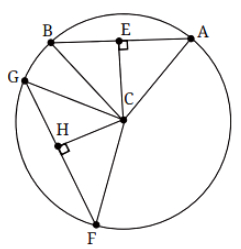
Consider figure. If CE is perpendicular to {tex}{AB}, {CH}{/tex} is perpendicular to GH, and CE {tex}={CH}{/tex}, show that {tex}{AB}={GF}{/tex}.
Solution:
Using the radius {tex}r{/tex}, the Baudhāyana-Pythagoras theorem for right triangles {tex}\triangle C E A{/tex} and {tex}\triangle C H F{/tex} shows {tex}A E^2=r^2-C E^2{/tex} and {tex}F H^2=r^2-C H^2{/tex}.
Since we are given {tex}C E=C H{/tex}, it follows that {tex}A E^2=F H^2{/tex}, meaning {tex}A E=F H{/tex}. Because the perpendicular bisects the chord, {tex}A B=2 A E{/tex} and {tex}G F=2 F H{/tex}. Therefore, the chord lengths {tex}A B{/tex} and {tex}G F{/tex} are equal.
Q.14:
Find the length of the chord of a circle where the radius is 7 cm and perpendicular distance is 6 cm.
Solution:
Let {tex}r=7 \ {cm}{/tex} be the radius and {tex}d=6 \ {cm}{/tex} be the perpendicular distance from the centre to the chord.
Using the Baudhāyana-Pythagoras theorem, we first find half the length of the chord ({tex}a{/tex}):
{tex}a^2=r^2-d^2{/tex}
{tex}a^2=7^2-6^2=49-36=13{/tex}
{tex}a=\sqrt{13} \ {cm}{/tex}
Since the perpendicular from the centre bisects the chord, the total length is {tex}2 a{/tex}:
Length of Chord {tex}=2 \sqrt{13} \ {cm}{/tex} (approx. 7.21 cm).
Q.15:
Explain why the following statement is true: If the perpendicular distance of a chord from the centre is {tex}d{/tex} and the radius is {tex}r{/tex}, then the chord length is {tex}2 \sqrt{r^2-d^2}{/tex}.
Solution:
This statement is true because of the Baudhāyana-Pythagoras theorem and the property of perpendicular bisectors in a circle.
- Forming a Right Triangle: In a circle with centre {tex}O{/tex} and radius {tex}r{/tex}, let {tex}A B{/tex} be a chord. Draw a perpendicular {tex}O M{/tex} from the centre to the chord, where {tex}O M=d{/tex}. This creates a right-angled triangle {tex}\triangle O M A{/tex}.
- Finding Half-Length: In {tex}\triangle O M A{/tex}, the hypotenuse is the radius {tex}r{/tex}, and one side is the distance {tex}d{/tex}. According to the Baudhāyana-Pythagoras theorem: {tex}A M^2+d^2=r^2{/tex}
{tex}A M^2=r^2-d^2 {/tex} {tex}\Longrightarrow A M=\sqrt{r^2-d^2}{/tex} - Bisection Property: According to Theorem 5, the perpendicular from the centre to a chord bisects the chord. This means the total length of chord {tex}A B{/tex} is exactly twice the length of {tex}A M{/tex}. {tex} \text { Chord Length }={/tex} {tex}2 \times A M=2 \sqrt{r^2-d^2}{/tex}
This formula allows us to calculate the exact length of any chord if its distance from the centre and the radius are known.
Q.16:
In a circle, if the distance of chord AB from the centre is twice the distance of another chord CD from the centre, then can we conclude that {tex}{CD}=2 {AB}{/tex}? Give reasons for your answer.
Solution:
No, we cannot conclude that {tex}C D=2 A B{/tex}. While a chord closer to the centre is indeed longer, the relationship between its length and distance is not linear.
Reasons:
Using the chord length formula {tex}L=2 \sqrt{r^2-d^2}{/tex}:
- Let distance of {tex}C D{/tex} be {tex}x{/tex}, then its length is {tex}2 \sqrt{r^2-x^2}{/tex}.
- Let distance of {tex}A B{/tex} be {tex}2 x{/tex}, then its length is {tex}2 \sqrt{r^2-(2 x)^2}=2 \sqrt{r^2-4 x^2}{/tex}.
The ratio of these lengths depends on the radius {tex}r{/tex}. For example, if {tex}r=5{/tex} and {tex}x=1{/tex}:
- {tex}C D=2 \sqrt{25-1} \approx 9.8{/tex}
- {tex}A B=2 \sqrt{25-4} \approx 9.16{/tex}
Here, {tex}C D{/tex} is clearly not twice the length of {tex}A B{/tex}. Doubling the distance does not result in halving the chord length.
Q.17:
In a circle with centre O, the central angle AOB is {tex}60^{\circ}{/tex}. If the radius of the circle is 12 cm, what is the length of the chord AB?
Solution:
The triangle OAB is equilateral because {tex}O A=O B=12 {~cm}{/tex} and the central angle {tex}\angle A O B{/tex} is {tex}60^{\circ}{/tex}.
In an isosceles triangle with a {tex}60^{\circ}{/tex} angle, all angles must be {tex}60^{\circ}{/tex}, making it equilateral.
Therefore, the chord {tex}{A B}{/tex} equals {tex}{1 2 ~ c m}{/tex}.
Q.18:
Let A and B be two points on a circle with centre O.
- Are there points {tex}{X}, {Y}{/tex} on the circle, on the same side of AB, such that {tex}\angle {AXB}{/tex} is different from {tex}\angle {AYB}{/tex}?
- Is it true that if {tex}\angle {AXB}=\angle {AYB}{/tex}, then X and Y lie on the same side of the circle?
- If {tex}\angle {AXB}=\angle {AYB}{/tex}, and X and Y do not lie on the circle, does the circle through {tex}{A}, {B}{/tex} and X also pass through Y?
Solution:
No, for (i), all points on the same arc subtend equal angles. For (ii), they must lie on the same side of chord {tex}{A B}{/tex}.
For (iii), if {tex}\angle A X B=\angle A Y B{/tex}, points {tex}{A}, {B}, {X}{/tex}, and Y are concyclic, meaning the circle through {tex}{A}, {B}, {X}{/tex} also passes through {tex}{Y}{/tex}.
- Same Arc: Angles in the same segment of a circle are always equal.
- Concyclic Points: Equal angles subtended by a segment at two points on the same side imply the points lie on the same circle.
Q.19:
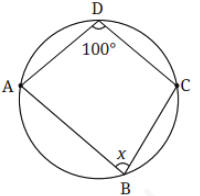
Find x in figure.
Solution:
The quadrilateral ABCD in your image is cyclic because all its vertices lie on the circle. In a cyclic quadrilateral, opposite angles add up to {tex}180^{\circ}{/tex}.
Since {tex}\angle D=100^{\circ}{/tex} and {tex}\angle B=x{/tex} are opposite angles, {tex}x+100^{\circ}=180^{\circ}{/tex}. Therefore, the value of {tex}x{/tex} is {tex}{80}^{\circ}{/tex}.
Q.20:
In a circle, a chord is 5 cm away from the centre. If the radius of the circle is 13 cm, what is the length of the chord?
Solution:
Using the Baudhāyana-Pythagoras theorem, half the chord length is {tex}\sqrt{13^2-5^2}=12 {~cm}{/tex}. Doubling this, the total chord length is {tex}{24 }\ {cm}{/tex}.
Q.21:
An arc of a circle subtends an angle of {tex}70^{\circ}{/tex} at the centre. What is the measure of the angle subtended by the arc at a point on the circle?
Solution:
In a circle, the angle subtended by an arc at the centre is twice the angle subtended at any point on the remaining part of the circle.
So,
{tex} \text { Angle at centre }=2 \times \text { Angle at circumference }{/tex}
Angle at centre {tex}=2 \times{/tex} Angle at circumference
Given:
{tex}\text { Angle at centre }=70^{\circ}{/tex}
{tex}\text {Angle at circumference }=\frac{70^{\circ}}{2}=35^{\circ}{/tex}
Q.22:
The diameter of a circle is 26 cm. A chord of length 24 cm is drawn in the circle. Find the distance from the centre of the circle to the chord.
Solution:
Given the diameter is 26 cm, the radius {tex}r{/tex} is 13 cm. The chord length is 24 cm, so its half-length is 12 cm.
Applying the Baudhāyana-Pythagoras theorem, distance {tex}d{/tex} equals {tex}\sqrt{13^2-12^2}= \sqrt{169-144}=\sqrt{25}{/tex}. The distance from the centre is 5 cm.
Q.23:
A circle has a radius of 15 cm. A chord is drawn. The distance from the centre of the circle to the chord is 9 cm. What is the length of the chord?
Solution:
Given a radius {tex}(r){/tex} of 15 cm and a distance from center {tex}(d){/tex} of 9 cm.
Step-by-Step Calculation:
- Find Half-Chord ({tex}a{/tex}): Use {tex}a=\sqrt{r^2-d^2}{/tex}.
- Substitute values: {tex}a=\sqrt{15^2-9^2}=\sqrt{225-81}=\sqrt{144}=12 \ {cm}{/tex}.
- Full Chord Length: Since the center bisects the chord, {tex}2 \times 12=24 \ {cm}{/tex}.
The chord length is {tex}{2 4 ~ c m}{/tex}.
Q.24:
Prove that the perpendicular bisector of a chord passes through the centre of the circle.
Solution:
Given: A circle with centre {tex}O{/tex} and a chord {tex}A B{/tex}. Let {tex}M{/tex} be the midpoint of {tex}A B{/tex}, and {tex}O M \perp A B{/tex}.
To Prove: The perpendicular bisector of {tex}A B{/tex} passes through {tex}O{/tex}.
Construction: Join {tex}O A{/tex} and {tex}O B{/tex}.
Congruence: In triangles {tex}\triangle O M A{/tex} and {tex}\triangle O M B{/tex}:
- {tex}O A=O B{/tex} (Radii of the same circle)
- {tex}A M=B M{/tex} ({tex}M{/tex} is the midpoint)
- {tex}O M=O M{/tex} (Common side)
Conclusion: By SSS Congruence, {tex}\triangle O M A \cong \triangle O M B{/tex}. Thus, {tex}\angle O M A=\angle O M B{/tex}. Since they form a linear pair and are equal, both are {tex}90^{\circ}{/tex}.
This confirms that the line from the centre to the midpoint is perpendicular, so the perpendicular bisector must pass through the centre.
Q.25:
The diameter of a circle is AB. Point C is on the circumference. What is the measure of the {tex}\angle {ACB}{/tex}? Explain your reasoning.
Solution:
The measure of {tex}\angle A C B{/tex} is exactly {tex}90^{\circ}{/tex}. This is a specific case of the central angle theorem.
Reasoning:
- Central Angle: Since {tex}A B{/tex} is the diameter, it forms a straight line passing through the centre {tex}O{/tex}. The angle subtended by the diameter at the centre is a straight angle, which is {tex}180^{\circ}{/tex}.
- Theorem: The angle subtended by an arc at the centre is double the angle subtended by it at any point on the remaining part of the circle.
- Calculation: Therefore, {tex}\angle A C B=\frac{1}{2} \times 180^{\circ}=90^{\circ}{/tex}.
In geometry, this is often simply referred to as the property that the angle in a semicircle is a right angle.
Q.26:
ABCD is a cyclic quadrilateral inscribed in a circle. If {tex}\angle {A}{/tex} measures {tex}75^{\circ}{/tex}, what is the measure of {tex}\angle {C}{/tex}? If {tex}\angle {B}{/tex} measures {tex}110^{\circ}{/tex}, what is the measure of {tex}\angle {D}{/tex}?
Solution:
To find {tex}\angle C{/tex}:
Since {tex}\angle A{/tex} and {tex}\angle C{/tex} are opposite angles:
{tex}\angle A+\angle C=180^{\circ}{/tex}
{tex}75^{\circ}+\angle C=180^{\circ}{/tex}
{tex}\angle C=180^{\circ}-75^{\circ}=105^{\circ}{/tex}
To find {tex}\angle D{/tex}:
Since {tex}\angle B{/tex} and {tex}\angle D{/tex} are opposite angles:
{tex}\angle B+\angle D=180^{\circ}{/tex}
{tex}110^{\circ}+\angle D=180^{\circ}{/tex}
{tex}\angle D=180^{\circ}-110^{\circ}=70^{\circ}{/tex}
The measure of {tex}\angle C{/tex} is {tex}105^{\circ}{/tex} and the measure of {tex}\angle D{/tex} is {tex}70^{\circ}{/tex}.
Q.27:
Quadrilateral PQRS is inscribed in a circle. If {tex}\angle {P}=(2 x+10)^{\circ}{/tex} and {tex}\angle {R}=(3 x-20)^{\circ}{/tex}, find the value of {tex}x{/tex} and the measures of {tex}\angle {P}{/tex} and {tex}\angle {R}{/tex}.
Solution:
Set up the equation:
Since {tex}\angle P{/tex} and {tex}\angle R{/tex} are opposite, {tex}\angle P+\angle R=180^{\circ}{/tex}.
{tex} (2 x+10)+(3 x-20)=180{/tex}
Solve for {tex}x{/tex}:
Combine like terms: {tex}5 x-10=180{/tex}
Add 10 to both sides: {tex}5 x=190{/tex}
Divide by 5: {tex}x=38{/tex}
Find the angle measures:
{tex}\angle P=2(38)+10=76+10={8 6}^{\circ}{/tex}
{tex}\angle R=3(38)-20=114-20={9 4}^{\circ}{/tex}
The value of {tex}x{/tex} is 38, while {tex}\angle P=86^{\circ}{/tex} and {tex}\angle R=94^{\circ}{/tex}.
Q.28:
The distance of a chord of length 16 cm from the centre of a circle is 6 cm. Find the radius of the circle.
Solution:
Given a chord of length {tex}L=16 {~cm}{/tex} and its perpendicular distance from the centre {tex}d=6 {~cm}{/tex}.
Step-by-Step Calculation:
- Find Half-Chord ({tex}a{/tex}): The perpendicular from the centre bisects the chord, so {tex}a=16 \div 2=8 {~cm}{/tex}.
- Apply Theorem: Using the Baudhayana-Pythagoras theorem, the radius {tex}r{/tex} is the hypotenuse: {tex}r^2=a^2+d^2{/tex}.
- Substitute values: {tex}r=\sqrt{8^2+6^2}=\sqrt{64+36}=\sqrt{100}{/tex}.
The radius of the circle is 10 cm.
Q.29:
A cyclic quadrilateral has sides 5, 5, 12, 12 units. Find its area.
Solution:
A cyclic quadrilateral is formed when four points are concyclic, meaning they all lie on the circumference of a single circle.
The semi-perimeter {tex}s{/tex} is 17.
Using the formula {tex}\sqrt{(s-a)(s-b)(s-c)(s-d)}{/tex}, the area is {tex}\sqrt{12 \times 12 \times 5 \times 5}{/tex}.
The area is 60 square units.
Q.30:
Consider a cyclic quadrilateral. Without drawing its circumcircle, how can we find out whether the centre of the circumcircle lies inside the quadrilateral or outside? What is the best way of finding out?
Solution:
In a cyclic quadrilateral, the position of the circumcentre depends on its angles. If all interior angles are acute (less than 90o), the circumcentre lies inside the quadrilateral. If any angle is obtuse (greater than 90o), the circumcentre lies outside it. If one angle is exactly 90o, the circumcentre lies on the quadrilateral (on its side). Thus, the easiest way to determine the position is by simply examining the measures of the angles.
Q.31:
When two chords intersect, each of them is divided into two line segments. Show that if the intersecting chords are of equal length, then the line segments of one chord are equal to the corresponding line segments of the other chord.
Solution:
To prove that equal chords have equal segments, we use the properties of perpendiculars from the centre and congruent triangles.
Proof:
- Setup: Let {tex}A B{/tex} and {tex}C D{/tex} be two equal chords {tex}(A B=C D){/tex} intersecting at point {tex}P{/tex}. Let {tex}O{/tex} be the centre.
- Construction: Draw {tex}O M \perp A B{/tex} and {tex}O N \perp C D{/tex}. Join {tex}O P{/tex}.
- Congruence: In {tex}\triangle O M P{/tex} and {tex}\triangle O N P{/tex}:
- {tex}O M=O N{/tex} (Equal chords are equidistant from the centre)
- {tex}\angle O M P=\angle O N P=90^{\circ}{/tex} (By construction)
- {tex}O P=O P{/tex} (Common hypotenuse)
- Result: By RHS Congruence, {tex}\triangle O M P \cong \triangle O N P{/tex}, so {tex}M P=N P{/tex}.
- Final Step: Since {tex}A B=C D{/tex}, their halves are equal ({tex}A M=C N{/tex}).
- {tex}A M+M P=C N+N P \Longrightarrow A P=C P{/tex} (Larger segments equal)
- {tex}A B-A P=C D-C P \Longrightarrow P B=P D{/tex} (Smaller segments equal)
Conclusion: The corresponding segments of the two equal chords are equal.
Q.32:
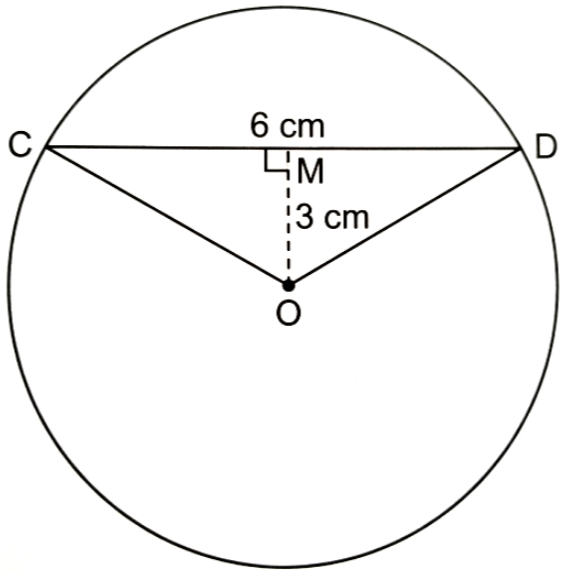
Draw a circle in which a chord of 6 cm length stands at a distance of 3 cm from the centre.
Solution:
A chord of length 6 cm that is 3 cm from the centre of a circle belongs to a specific circle with a unique radius.
Q.33:
Show that a rectangle is the only parallelogram that can be inscribed in a circle.
Solution:
Let a parallelogram {tex}A B C D{/tex} be inscribed in a circle (i.e., it is cyclic).
In a cyclic quadrilateral, opposite angles are supplementary:
{tex} \angle A+\angle C=180^{\circ}{/tex}
But in a parallelogram, opposite angles are equal:
{tex} \angle A=\angle C{/tex}
Hence,
{tex} \angle A+\angle A=180^{\circ} \Rightarrow 2 \angle A=180^{\circ} \Rightarrow \angle A=90^{\circ}{/tex}
Thus, all angles of the parallelogram are {tex}90^{\circ}{/tex}, so it is a rectangle.
Conversely, every rectangle has all angles {tex}90^{\circ}{/tex}, so opposite angles are supplementary. Hence, it can be inscribed in a circle.
Q.34:
Show that if a rectangle is inscribed in a circle, then the point of intersection of its diagonals must lie at the centre of the circle.
Solution:
Property of Rectangles: Each interior angle of a rectangle is {tex}90^{\circ}{/tex}. For rectangle {tex}A B C D{/tex}, {tex}\angle A B C=90^{\circ}{/tex}.
Property of Circles: An angle of {tex}90^{\circ}{/tex} on the circumference is subtended by the diameter. Therefore, the diagonal {tex}A C{/tex} must be a diameter of the circle.
Similarly: Since {tex}\angle B C D=90^{\circ}{/tex}, the diagonal {tex}B D{/tex} must also be a diameter of the circle.
Centre Definition: By definition, all diameters of a circle intersect at exactly one point: the centre {tex}(O){/tex}.
Conclusion:
Since both diagonals {tex}A C{/tex} and {tex}B D{/tex} are diameters, their point of intersection is necessarily the centre of the circle.
Q.35:
Consider all chords of a circle of a fixed length. What is the shape formed by the midpoints of all these chords?
Solution:
The shape formed by the midpoints of all chords of a fixed length in a circle is a smaller concentric circle.
Reasoning:
- Constant Distance: Chords of equal length in a circle are always at an equal distance from the center.
- Geometric Locus: Since the distance from the center {tex}(O){/tex} to the midpoint {tex}(M){/tex} of each chord is constant, the set of all such midpoints maintains a fixed radius.
- Result: A collection of points at a constant distance from a fixed center creates a circle sharing the same center.
The midpoints of these chords form a concentric circle with a radius equal to the perpendicular distance from the center.
Q.36:
In a circle with centre O, chords AB and AC are congruent. Explain why this statement is true: “The centre of the circle lies on the angle bisector of {tex}\angle {BAC}^{\prime \prime}{/tex}.
Solution:
The centre {tex}O{/tex} lies on the angle bisector because congruent chords {tex}A B{/tex} and {tex}A C{/tex} are equidistant from {tex}O{/tex}, forming two congruent triangles.
Step-by-Step Explanation:
- Equidistance: Since chord {tex}A B=A C{/tex}, they are at the same distance from centre {tex}O{/tex}.
- Triangles: Consider {tex}\triangle O A B{/tex} and {tex}\triangle O A C{/tex}. Here, {tex}O A{/tex} is common, {tex}A B=A C{/tex} (given), and {tex}O B=O C{/tex} (radii).
- Congruence: By SSS congruence, {tex}\triangle O A B \cong \triangle O A C{/tex}. Therefore, {tex}\angle O A B=\angle O A C{/tex}.
- Result: This equality shows that the line segment {tex}A O{/tex} bisects {tex}\angle B A C{/tex}.
Thus, the centre {tex}O{/tex} must lie on the angle bisector of {tex}\angle B A C{/tex}.
Q.37:
Two parallel chords of lengths 10 cm and 24 cm are on the same side of the centre of a circle. The distance between the chords is 7 cm. Find the radius of the circle.
Solution:
To find the radius {tex}r{/tex}, we use the perpendicular distance from the centre to both chords and the Baudhāyana-Pythagoras theorem. Step-by-Step Calculation:
- Identify Half-Chords: Let the chords be {tex}A B=24 {~cm}{/tex} and {tex}C D=10 {~cm}{/tex}. Their half lengths are 12 cm and 5 cm.
- Set up Variables: Let {tex}x{/tex} be the distance from the centre to the 24 cm chord. The distance to the 10 cm chord is {tex}x+7{/tex}.
- Form Equations: Using {tex}r^2=a^2+d^2{/tex}:
- {tex}r^2=12^2+x^2=144+x^2{/tex}
- {tex}r^2=5^2+(x+7)^2=25+x^2+14 x+49={/tex}{tex}x^2+14 x+74{/tex}
- Solve for {tex}x{/tex}: {tex}144+x^2=x^2+14 x+74{/tex}
{tex}144=14 x+74 \Rightarrow {/tex}{tex}14 x=70 \Rightarrow x=5 {~cm}{/tex} - Calculate {tex}r{/tex}:
{tex} r^2=144+5^2=144+25=169{/tex}{tex} \Rightarrow r=13 {~cm}{/tex}
The radius of the circle is {tex}{1 3 ~ c m}{/tex}.
Q.38:
A regular hexagon is inscribed in a circle of radius r. Find the length of the sides of the hexagon and the distance of each side from the centre of the circle.
Solution:
Side Length (s):
The angle subtended by each side at the centre is {tex}360 / 6=60^{\circ}{/tex}. Since the two other angles in the triangle are equal (radii), each is {tex}60^{\circ}{/tex}. Thus, the side length is exactly {tex}r{/tex}.
Distance from Centre (d):
Using the Baudhāyana-Pythagorean theorem on a triangle formed by the radius, distance, and half-side {tex}(r / 2){/tex}:
{tex}d^2+(r / 2)^2=r^2{/tex}
{tex}d^2=r^2-r^2 / 4=3 r^2 / 4{/tex}
{tex}d=\frac{\sqrt{3}}{2} r{/tex}
The hexagon side is {tex}r{/tex} and its distance from the centre is {tex}\frac{\sqrt{3}}{2} r{/tex}.
Q.39:
A quadrilateral MNOP is inscribed in a circle. If MN is a diameter, what can you say about {tex}\angle {MOP}{/tex} and {tex}\angle {MNP}{/tex}? Explain your reasoning.
Solution:
In a cyclic quadrilateral MNOP where MN is a diameter, {tex}\angle {MOP}{/tex} and {tex}\angle {MNP}{/tex} both subtend the same arc MP.
According to the theorem, the angle subtended by an arc at the center is double the angle at the circumference. Therefore, {tex}\angle {MOP}=2 \angle {MNP}{/tex}. Additionally, since MN is a diameter, {tex}\angle {MPN}{/tex} must be {tex}90^{\circ}{/tex}, making triangle MPN a right-angled triangle.
The angle at the center {tex}\angle {MOP}{/tex} is twice the angle {tex}\angle {MNP}{/tex} because they both subtend the same arc MP.
Q.40:
Let ABCD be a cyclic quadrilateral. Explain why the exterior angle at any vertex is equal to the interior opposite angle (e.g., {tex}\angle {CDE}=\angle {ABC}{/tex}, where E is a point on the extension of side CD).
Solution:
Exterior angles of cyclic quadrilaterals match interior opposites because they both share a supplementary relationship with the same adjacent interior angle.
Let {tex}\angle A D C{/tex} be the interior angle. Since {tex}A D E{/tex} is a straight line, {tex}\angle A D C+\angle C D E=180^{\circ}{/tex}. In a cyclic quadrilateral, opposite angles {tex}\angle A D C{/tex} and {tex}\angle A B C{/tex} also sum to {tex}180^{\circ}{/tex}. By equating these, we find {tex}\angle C D E{/tex} must equal {tex}\angle A B C{/tex}.
Q.41:
“There is no chord of a circle that is longer than its diameter.” How do you justify this statement?
Solution:
A diameter is the longest chord because it passes through the centre, maximizing the distance between two points on the circle.
Any chord {tex}A B{/tex} and the centre {tex}O{/tex} form {tex}\triangle O A B{/tex}. By the triangle inequality, the side {tex}A B{/tex} must be less than {tex}O A+O B{/tex}. Since {tex}O A{/tex} and {tex}O B{/tex} are radii, {tex}A B<2 r{/tex}. Because the diameter equals {tex}2 r{/tex}, no chord can exceed it.
Q.42:
Let A be any point within a given circle with centre O. Show that the shortest chord of the circle that passes through point A is the one that is perpendicular to OA.
Solution:
The shortest chord through {tex}A{/tex} is perpendicular to {tex}O A{/tex} because it maximizes the distance from the centre, resulting in a smaller length.
Proof:
- Let {tex}P Q{/tex} be the chord perpendicular to {tex}O A{/tex} at {tex}A{/tex}. Let {tex}R S{/tex} be any other chord passing through {tex}A{/tex}.
- Draw {tex}O M \perp R S{/tex}. In right {tex}\triangle O M A{/tex}, the hypotenuse {tex}O A{/tex} is longer than the side {tex}O M{/tex}.
- Since chord {tex}P Q{/tex} is at distance {tex}O A{/tex} and chord {tex}R S{/tex} is at distance {tex}O M, P Q{/tex} is further from the centre.
- Chords further from the centre are shorter; therefore, {tex}P Q{/tex} is shorter than {tex}R S{/tex}.
The chord perpendicular to the radius at a given point is the shortest chord through that point.
Q.43:
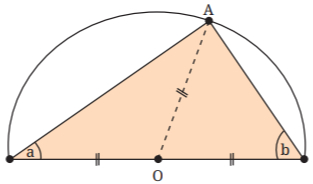
How would you use the following figure to justify the statement that the angle in a semicircle is 90o?
Solution:
Isosceles Triangles: Segment {tex}O A{/tex} is a radius, just like the segments from {tex}O{/tex} to the base. This creates two isosceles triangles within the larger triangle.
Equal Angles: In the left triangle, the base angles are both {tex}a{/tex}. In the right triangle, the base angles are both {tex}b{/tex}.
Angle Sum Property: For the large triangle, the sum of all interior angles must be {tex}180^{\circ}{/tex}.
Calculation:
{tex}a+(a+b)+b=180^{\circ}{/tex}
{tex}2 a+2 b=180^{\circ}{/tex}
{tex}2(a+b)=180^{\circ}{/tex}
{tex}a+b=90^{\circ}{/tex}
Conclusion:
Since the angle at vertex {tex}A{/tex} is exactly {tex}a+b{/tex}, it must be {tex}90^{\circ}{/tex}, proving the theorem for any point on the semicircle.
Q.44:
In a circle, two chords {tex}{CC}^{\prime}{/tex} and {tex}{DD}^{\prime}{/tex} are drawn perpendicular to a diameter AB. Prove that the segment {tex}{MM}^{\prime}{/tex} joining the midpoints of the chords {tex}C D{/tex} and {tex}C^{\prime} D^{\prime}{/tex} is perpendicular to {tex}A B{/tex}.
Solution:
The symmetry of chords perpendicular to a diameter ensures their midpoints align on a line parallel to the diameter.
The diameter {tex}A B{/tex} acts as the perpendicular bisector for both chords {tex}C C^{\prime}{/tex} and {tex}D D^{\prime}{/tex}. Consequently, {tex}C^{\prime}{/tex} is the reflection of {tex}C{/tex} across {tex}A B{/tex}, and {tex}D^{\prime}{/tex} is the reflection of {tex}D{/tex}. This vertical symmetry ensures the midpoint {tex}M{/tex} of {tex}C D{/tex} and the midpoint {tex}M^{\prime}{/tex} of {tex}C^{\prime} D^{\prime}{/tex} are reflections of each other. The line {tex}M M^{\prime}{/tex} connecting these symmetric points must therefore be perpendicular to the axis of symmetry, {tex}A B{/tex}.
Q.45:
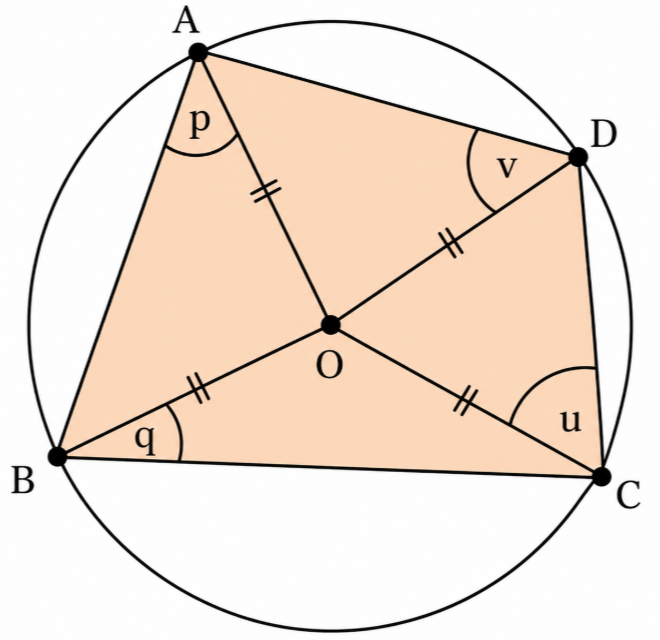
How would you use the following figure to justify the statement that the sum of the opposite angles of a cyclic quadrilateral is {tex}180^{\circ}{/tex}?
Solution:
The figure uses radii to create four isosceles triangles, proving that opposite angles {tex}p+q{/tex} and {tex}u+v{/tex} sum to {tex}180^{\circ}{/tex}.
The radii {tex}O A, O B, O C, O D{/tex} form four isosceles triangles where base angles are equal. The sum of all angles in quadrilateral {tex}A B C D{/tex} is {tex}2 p+2 q+2 u+2 v=360^{\circ}{/tex}. Dividing by two shows {tex}(p+q)+(u+v)=180^{\circ}{/tex}, proving opposite angles are supplementary.
Q.46:
What are the rotational symmetries of a square? How many lines of reflection symmetry does it have? What about a regular pentagon? A regular hexagon?
Solution:
A square possesses rotational symmetry of order 4, meaning it looks identical every {tex}90^{\circ}{/tex}, and has 4 distinct lines of reflectional symmetry. For a regular pentagon, the rotational order is 5 {tex}\left(72^{\circ}\right.{/tex} turns) with 5 lines of reflection passing through each vertex. A regular hexagon has rotational symmetry of order {tex}6\left(60^{\circ}\right.{/tex} turns) and 6 lines of reflection. Generally, any regular polygon with {tex}n{/tex} sides has {tex}n{/tex} lines of reflectional symmetry and rotational symmetry of order {tex}n{/tex}. These geometric properties help define the balance and uniformity of shapes relative to their central points.
Q.47:
What is the length of the longest chord in a circle of radius 5 units? Is there a smallest chord?
Solution:
The longest chord in any circle is its diameter, which passes directly through the center. Since the diameter is twice the length of the radius, in a circle with a radius of 5 units, the longest chord measures exactly 10 units.
Regarding a smallest chord, there is no single “smallest” chord because you can draw chords that are arbitrarily close to a length of zero. As the endpoints of a chord move closer together on the circumference, the length decreases. Theoretically, as the distance between endpoints approaches zero, the chord becomes a point, meaning a minimum length doesn’t exist in a defined geometric sense.
Q.48:
The locus of points at a given distance from a given point is a circle. What can we say about the locus of points equidistant from two given points?
Solution:
The locus of points equidistant from two given points {tex}A{/tex} and {tex}B{/tex} is indeed the perpendicular bisector of the segment {tex}A B{/tex}. This means that every point on this line is the same distance from {tex}A{/tex} as it is from {tex}B{/tex}, and no point outside this line satisfies that condition.
To prove this, consider a point {tex}P{/tex} on the perpendicular bisector that meets {tex}A B{/tex} at midpoint {tex}M{/tex}. By definition, {tex}A M=M B{/tex} and {tex}\angle P M A=\angle P M B=90^{\circ}{/tex}. Since {tex}P M{/tex} is a common side, triangles {tex}\triangle P M A{/tex} and {tex}\triangle P M B{/tex} are congruent by the SAS (Side-Angle-Side) criterion.
Because the triangles are congruent, the corresponding sides {tex}P A{/tex} and {tex}P B{/tex} must be equal ({tex}P A=P B{/tex}). This confirms that any arbitrary point on the bisector is equidistant from the two given points. Consequently, the perpendicular bisector represents the complete set of all such points, fulfilling the definition of a locus in a two-dimensional plane.
Q.49:
How many circles pass through two points on a plane?
Solution:
There are infinitely many circles that can pass through any two given points on a plane. This is because the center of any such circle must be equidistant from both points, which means it can lie anywhere on the perpendicular bisector of the line segment connecting them.
As you move a potential center point further away along this perpendicular bisector, the radius of the circle increases. Conversely, moving the center closer to the midpoint of the segment decreases the radius until the segment itself becomes the diameter.
If we denote the two points as {tex}A{/tex} and {tex}B{/tex}, the smallest circle passing through them has its center exactly at the midpoint of {tex}A B{/tex}. For every other point chosen on the infinite perpendicular bisector, a unique circle can be drawn, leading to an inexhaustible number of possibilities. This geometric property demonstrates that two points are insufficient to uniquely define a single circle, unlike three non-collinear points.
Q.50:
Are there circles of all possible radii passing through A and B? What is the radius of the smallest circle passing through A and B? What is the radius of the largest circle passing through A and B?
Solution:
There are not circles of all possible radii passing through points {tex}A{/tex} and {tex}B{/tex}. While there are infinitely many circles, the radius cannot be smaller than half the distance between the two points. Any value less than this would make it impossible for the circle to bridge the gap between {tex}A{/tex} and {tex}B{/tex}.
The smallest circle passing through {tex}A{/tex} and {tex}B{/tex} is the one where the segment {tex}A B{/tex} acts as the diameter. In this case, the radius is exactly {tex}\frac{1}{2} A B{/tex}. The center of this circle is located at the midpoint of the segment {tex}A B{/tex}, which is the closest possible center point to both {tex}A{/tex} and {tex}B{/tex} simultaneously.
There is no largest circle passing through {tex}A{/tex} and {tex}B{/tex}. As the center of the circle moves further away along the perpendicular bisector of {tex}A B{/tex}, the radius {tex}r{/tex} continues to increase toward infinity. As the radius grows extremely large, the arc of the circle passing through {tex}A{/tex} and {tex}B{/tex} begins to look more and more like a straight line.
In summary, the radii of circles passing through two points {tex}A{/tex} and {tex}B{/tex} can be any value in the interval {tex}\left[\frac{1}{2} A B, \infty\right){/tex}. You can have a circle with a radius of {tex}1,000 {~km}{/tex} passing through two points just 1 cm apart, but you can never have one with a radius of 0.4 cm.
Q.51:
You are given two points A and B on a plane. How many squares can you draw on the same plane with A and B on the boundary? How many squares can you draw on the plane with A and B as the corners of the square?
Solution:
When points {tex}A{/tex} and {tex}B{/tex} are just anywhere on the boundary, there are infinitely many squares possible. This is because {tex}A{/tex} and {tex}B{/tex} could be on the same side, opposite sides, or adjacent sides at any position, allowing the square to be rotated or scaled around them in countless configurations.
However, if {tex}A{/tex} and {tex}B{/tex} must be corners, the number of squares is limited to exactly three distinct cases based on their relative positions:
Case 1: {tex}A B{/tex} is a Side (Left). One square is formed by extending a side perpendicular to {tex}A B{/tex} on one side of the line.
Case 2: {tex}A B{/tex} is a Side (Right). A second square is formed by extending the sides on the opposite side of the line {tex}A B{/tex}.
Case 3: {tex}A B{/tex} is a Diagonal. Only one square exists where {tex}A{/tex} and {tex}B{/tex} are opposite vertices, as the other two corners are fixed by the perpendicular bisector of {tex}A B{/tex}.
In summary, requiring points to be specific vertices significantly constrains the geometry compared to simply being on the perimeter. For the “corners” condition, the total number of unique squares you can draw is three.
NCERT Solutions Class 9 Ganita Manjari
- The Use of Coordinates
- Introduction to Linear Polynomials
- The World of Numbers
- Exploring Algebraic Identities
- I’m Up and Down, and Round and Round
- Measuring Space: Perimeter and Area
- The Mathematics of Maybe: Introduction to Probability
- Exploring Sequences and Progressions

Test Generator
Create question paper PDF and online tests with your own name & logo in minutes.
Create Now
Learn8 App
Practice unlimited questions for Entrance tests & government job exams at ₹99 only
Install Now