Work Energy and Simple Machines – NCERT Solutions Class 9 Science Exploration includes all the questions with solutions given in NCERT Class 9 Science Exploration textbook.
NCERT Solutions Class 9
English Kaveri Hindi Ganga Sanskrit Sharada Maths Ganita Manjari Science Exploration Social Understanding SocietyWork, Energy, and Simple Machines – NCERT Solutions
Q.1: What will be the magnitude of velocity of the child at the bottom of the blue slide?
Solution: When the child is at the top of the slide, they have gravitational potential energy due to height.
As the child slides down:
- Potential energy decreases
- Kinetic energy increases
At the bottom of the slide, almost all the potential energy gets converted into kinetic energy (assuming negligible friction).
So we apply conservation of mechanical energy:
{tex} m g h=\frac{1}{2} m v^2{/tex}
- {tex}m{/tex} = mass of child
- {tex}g={/tex} acceleration due to gravity {tex}\left(9.8 {~m} / {s}^2\right){/tex}
- {tex}h={/tex} height of slide
- {tex}v={/tex} velocity at bottom
Mass cancels out, so:
{tex} v=\sqrt{2 g h}{/tex}
Q.2: Will two children of different masses reach the bottom of the same slide with the same velocity?
Solution: At the top of the slide, each child has gravitational potential energy:
- Heavier child → more potential energy
- Lighter child → less potential energy
But when they slide down, this potential energy converts into kinetic energy.
Using conservation of mechanical energy:
{tex} m g h=\frac{1}{2} m v^2{/tex}
Here, mass (m) cancels out, giving:
{tex} v=\sqrt{2 g h}{/tex}
So, the velocity depends only on:
- height of the slide {tex}h{/tex}
- gravity g
Q.3: Which of the slides will result in the largest magnitude of velocity for the child at its bottom?
Solution: When a child starts from the top of a slide, they have gravitational potential energy. As they move down, this energy converts into kinetic energy.
Using conservation of mechanical energy:
{tex} m g h=\frac{1}{2} m v^2{/tex}
This simplifies to:
{tex} v=\sqrt{2 g h}{/tex}
- This shows that velocity depends only on the vertical height (h) of the slide.
- It does not depend on:
- shape of the slide
- length of the slide
- steepness (directly)
Q.4: When you pedal a bicycle on a flat road, your muscles supply energy. In what forms does this muscular energy appear as you ride?
Solution: When you pedal a bicycle, your muscles convert chemical energy (from food) into other forms of energy.
This muscular energy appears mainly as:
- Kinetic Energy
- The bicycle and rider are moving, so energy is present as motion.
- Heat Energy
- Due to friction in the chain, tyres, and contact with the road, some energy is lost as heat.
- Your body also releases heat while working.
- Sound Energy
- Small amount of energy is converted into sound (from tyres, chain, etc.).
Q.5: Two objects A and B of mass m and 4 m have the same kinetic energy. What is the ratio of the magnitude of velocities of A and B?
Solution: Kinetic energy is given by:
{tex} K E=\frac{1}{2} m v^2{/tex}
Since both objects have the same kinetic energy:
{tex} \frac{1}{2} m v_A^2=\frac{1}{2}(4 m) v_B^2{/tex}
Cancel common terms:
{tex}m v_A^2 =4 m v_B^2{/tex}
{tex}v_A^2 =4 v_B^2{/tex}
{tex}v_A =2 v_B{/tex}
Ratio of velocities {tex}\left(v_A: v_B\right)=2: 1{/tex}
Q.6: Does the kinetic energy of an object which moves with constant velocity change with its position?
Solution: Kinetic energy depends on mass and velocity:
{tex} K E=\frac{1}{2} m v^2{/tex}
- If an object is moving with constant velocity, then its speed does not change
- Since mass is also constant, the kinetic energy remains constant
Position does not affect kinetic energy directly-only velocity does.
No, the kinetic energy does not change with position if the object moves with constant velocity.
Q.7: Does the potential energy of an object near the surface of the Earth change if it moves with constant velocity in the horizontal direction? What if the object is gradually raised in the vertical direction?
Solution:
- Horizontal motion (constant velocity):
No, the potential energy does not change. Gravitational potential energy depends only on height, and since the object moves horizontally, its height remains the same. - Vertical motion (raised upward):
Yes, the potential energy increases. As the object is raised, its height increases, so its gravitational potential energy increases according to PE = mgh
Q.8: For the situation depicted in, calculate the mechanical energy of the ball just before it hits the ground and show that at this position, it is mgh.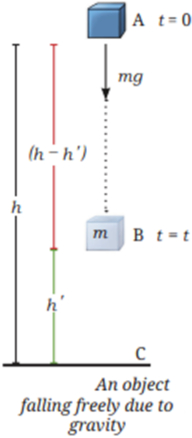
Solution: Just before hitting the ground (point C):
- Height {tex}h=0 \rightarrow{/tex} Potential Energy {tex}=0{/tex}
- Velocity is maximum → Kinetic Energy is maximum
Using energy conservation:
Total Mechanical Energy {tex}={/tex} constant
So at the bottom:
{tex} M E=K E=\frac{1}{2} m v^2{/tex}
But since total energy was {tex}m g h{/tex}:
{tex} M E=m g h{/tex}
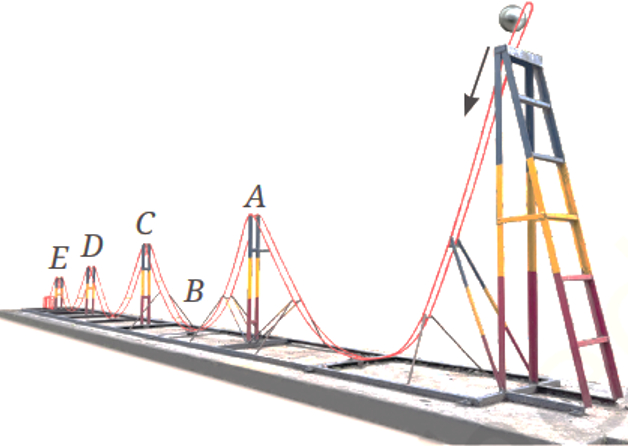
Q.9: You may have seen an exhibit like that (in Fig) in a science park, where a ball is released from the highest point. Describe how the kinetic energy and potential energy change at points A, B and C. Why do subsequent points, such as C, D and E, usually have lower heights compared to the previous ones? Could it have anything to do with the energy lost due to friction?
Solution:
- At A: Potential energy is maximum, kinetic energy is zero.
- At B: Potential energy decreases, kinetic energy increases.
- At C: Kinetic energy is maximum, potential energy is minimum.
- At D and E: Kinetic energy decreases and potential energy increases, but both are less than at A.
The heights at C, D, and E are lower than the previous ones because some mechanical energy is lost due to friction and air resistance, mainly as heat and sound energy.
Q.10: To reach a higher floor, we find climbing an inclined ladder easier in comparison to climbing a vertical ladder (in fig). Explain why.
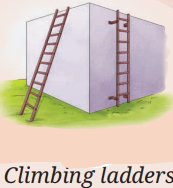
Solution: Climbing an inclined ladder is easier because it acts like an inclined plane, which reduces the force required to move upward.
In a vertical ladder, the entire body weight must be lifted directly upward, requiring more effort.
In an inclined ladder, the same height is reached over a longer distance, so less force is needed, making climbing easier.
Q.11: Why is it easier to open the lid of a can by using a spoon as shown in the figure?
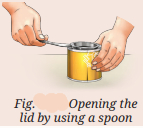
Solution: Using a spoon as shown in the figure acts as a lever (specifically a Class 1 lever).
- The Principle: A lever allows you to overcome a large resistance (the tight lid) by applying a smaller force over a longer distance.
- Mechanical Advantage: The spoon handle serves as a long effort arm, while the tip under the lid serves as a short load arm. The rim of the can acts as the fulcrum.
- Torque/Moment of Force: Since the effort arm is much longer than the load arm, the small force you apply at the handle is multiplied, creating enough force at the tip to pop the lid open easily.
Q.12: Why do you push an object closer to scissors (fulcrum) when you want to cut an object which is hard?
Solution: Scissors work as a lever with a fulcrum (pivot point).
When the object is placed closer to the fulcrum:
- The effort arm becomes longer
- The load arm becomes shorter
- This increases the mechanical advantage
Q.13: Throughout history, many designs of perpetual machines (using wheels, weights or magnets) have been proposed but none actually work. Why do all real machines eventually slow down and stop? Explain in terms of work and energy.
Solution: All real machines slow down and stop because external forces like friction and air resistance do negative work on them.
This means:
- The machine’s mechanical energy decreases
- Energy is continuously converted into heat and sound
- No machine can perfectly conserve its mechanical energy
Since energy is being lost to the surroundings, the machine gradually loses motion and finally stops.
Q.14: While exercising, a girl lifts a dumbbell and slowly lowers it down. Identify when the girl does positive work on the dumbbell and when she does negative work on it.
Solution: The girl applies a force equal to the weight of dumbbell to lift it up. When she moves the dumbbell up, the force is in the direction of displacement, so she does positive work on it. When moving the dumbbell down, the force she applies to hold it is in a direction opposite to the displacement, so she does negative work on it.
Q.15: While saving a goal, a goalkeeper’s hand moved back by 15 cm as she stopped a ball while applying a force of 200 N. How much work did the goalkeeper do on the ball in stopping it?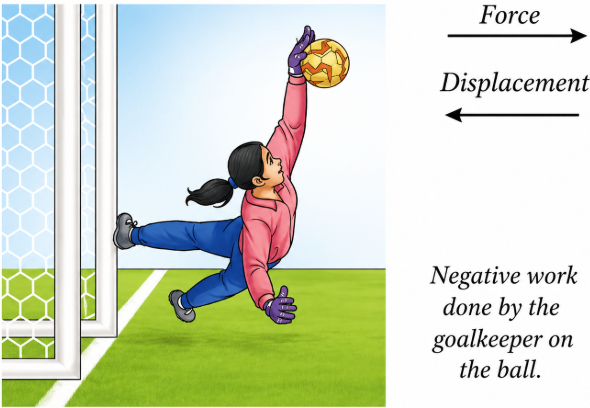
Solution: The goalkeeper applied a force opposite to the motion of the ball, so she did negative work on the ball. The displacement should be taken as negative because the ball moves in a direction opposite to the direction of the applied force.
Work done by the goalkeeper on the ball {tex}={/tex} force × displacement of ball in the direction of force.
{tex} =200 {~N} \times(-0.15 {~m})=-30 {~J}{/tex}
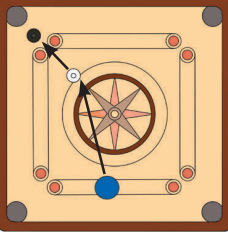
Q.16: In a game of carrom, a player struck the shot shown in the figure to pocket the black coin. Identify who does work, and the changes in energy that occur at each collision.
Solution: The moving striker collides with the white coin, which in turn collides with the black coin. The moving striker applies force in the direction of displacement of the white coin. The striker, thus, does positive work on the white coin, increasing its energy. By Newton’s third law, the white coin applies an opposite force and does negative work on the striker, decreasing its energy. Similarly, the white coin does positive work on the black coin increasing its energy, while the black coin does negative work on the white coin, decreasing its energy
Q.17: If the velocity of a vehicle doubles in magnitude, what will its kinetic energy be compared to its original value?
Solution: Let the mass of the vehicle be {tex}m{/tex} and its initial velocity be {tex}v{/tex}. Its initial kinetic energy will be {tex}\frac{1}{2} m v^2{/tex}. If the vehicle travels with a velocity of {tex}2 v{/tex}, its kinetic energy will be {tex}\frac{1}{2} m(2 v)^2=4 \times \frac{1}{2} m v^2{/tex}. The new value of the kinetic energy will be 4 times the previous value.
Q.18: In one of their fastest deliveries, an Indian cricketer bowled a cricket ball with an approximate mass of 0.2 kg at a velocity of about 154.8 km h-1. Calculate the kinetic energy of the ball at the time of its delivery.
Solution:
{tex}\text { Mass of the cricket ball }=0.2 {~kg}{/tex}
{tex}\text { Velocity of the ball }=154.8 {~km} {h}^{-1}=43 {~m} {s}^{-1}{/tex}
{tex}K=\frac{1}{2} m v^2=\frac{1}{2} \times 0.2 {~kg} \times\left(43 {~m} {~s}^{-1}\right)^2=184.9 {~J}{/tex}
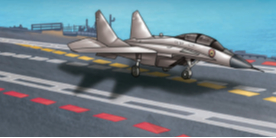
Q.19: A jet aircraft of mass 15000 kg lands on the deck of an aircraft carrier in fig. To stop the aircraft within the short length of the deck a hook on the aircraft’s tail is caught in a wire stretched across the deck. The wire exerts an approximately constant backward force of 367500 N and stops the jet within 100 m. What was the velocity of the aircraft just before the wire caught the hook?
Solution: Let the aircraft approach with a velocity {tex}v{/tex}
Initial kinetic energy of the aircraft {tex}K=\frac{1}{2} \times 15000 {~kg} \times v^2{/tex}
Final kinetic energy of the aircraft {tex}K=0 {~J}{/tex}
Change in the kinetic energy {tex}=0 {~J}-\frac{1}{2} \times 15000 {~kg} \times v^2{/tex}
From Eq. (work done on an object = change in its energy),
Change in the kinetic energy = the work done by the wire.
The displacement of the aircraft and the force that the wire applies are in opposite directions. Therefore, the work done by the force applied by the wire will be negative.
Change in the kinetic energy = the work done by the wire.
The displacement of the aircraft and the force that the wire applies are in opposite directions. Therefore, the work done by the force applied by the wire will be negative.
Using Eq. (W = F × s), the work done by the wire {tex}=F \times s=367500 {~N} \times(-100 {~m}){/tex} Substituting the values in Eq. (work done on an object = change in its energy), we obtain
{tex}-\frac{1}{2} \times 15000 {~kg} \times v^2=-(367500 {~N} \times 100 {~m}){/tex}
{tex}v^2=\frac{36750 \times 2}{15} {Nm} {~kg}^{-1}{/tex} {tex}=4900 {~kg} {~m} {~s}^{-2} {~m} {~kg}^{-1}=4900 {~m}^2 {~s}^{-2}{/tex}
{tex}v=70 {~m} {~s}^{-1}=252 {~km} {~h}^{-1} \text { towards the aircraft carrier. }{/tex}
Q.20: After taking a catch, a fielder threw the cricket ball of mass 200 g high up in the air about 10 m above the ground in celebration. How much potential energy does the ball have when the ball reaches its maximum height? Assume {tex}g=10 {~m} {~s}^{-2}{/tex}.
Solution: Using Eq. (U = mgh), the potential energy of the ball will be equal to {tex}m g h=0.2 {~kg} \times 10 {~m} {s}^{-2} \times 10 {~m}=20 {~J}{/tex}
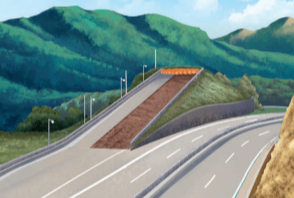
Q.21: Escape ramps (in Fig) are inclined planes filled with sand or gravel that help stop trucks when their brakes fail on a highway. A truck of mass 10000 kg is moving at {tex}72 {~km} {~h}^{-1}{/tex} when its brakes fail. The driver steers it onto an escape ramp inclined at {tex}30^{\circ}{/tex}, where the truck comes to a rest. If the sand exerts a force of 50000 N opposite to truck’s motion, what is the minimum length of the ramp to be able to stop such a truck? Take 0{tex}g=10 {~m} {~s}^{-2}{/tex}
Solution:
Velocity of the truck {tex}=72 {~km} {~h}^{-1}=20 {~m} {~s}^{-1}{/tex}
Initial kinetic energy of the truck {tex}=\frac{1}{2} m v^2=\frac{1}{2} \times 10000 {~kg} \times\left(20 {~m} {~s}^{-1}\right)^2{/tex}
{tex} =2000000 {~J}{/tex}
Initial potential energy of truck {tex}=0 {~J}{/tex}
Total initial energy of truck = Initial kinetic energy + Initial potential energy
{tex} =2000000 {~J}+0 {~J}=2000000 {~J}{/tex}
Let us assume that the truck travels a distance {tex}d{/tex} along the ramp. Then,
Height gained by the truck on ramp {tex}=\frac{d}{2}{/tex} (using hint given in the question)
Final kinetic energy of truck {tex}=0 {~J}{/tex}
Final potential energy of truck {tex}=m g \times \frac{d}{2}=10000 {~kg} \times 10 {~m} {~s}^{-2} \times \frac{d}{2}=50000 {~N} \times d{/tex}
Total final energy {tex}=0 {~J}+50000 {~N} \times d{/tex}
Change in total energy of the truck {tex}={/tex} Final energy – Initial energy
{tex} =(50000 {~N} \times d)-2000000 {~J}{/tex}
Work done by sand on truck {tex}=-50000 {~N} \times d{/tex}
Using work-energy theorem,
Work done by sand on truck = Change in total energy of the truck
{tex} -50000 {~N} \times d=(50000 {~N} \times d)-2000000 {~J}{/tex}
{tex}2000000 {~J}=(50000+50000) {N} \times d{/tex}
{tex}d=\frac{2000000 {~J}}{100000 {~N}}=\frac{2000000 {~N} {~m}}{100000 {~N}}=20 {~m}{/tex}
Thus, the minimum length of the ramp to be able to stop such a truck is 20 m.
Q.22: A weightlifter lifts a 75 kg mass by 2 m in 5 seconds. How much power would she require for this task?
Solution: The work done would be equal to {tex}m g h=75 {~kg} \times 10 {~m} {s}^{-2} \times 2 {~m}{/tex}
{tex} =1500 {~J}{/tex}
Thus, the power required will be {tex}\frac{1500 {~J}}{5 {~s}}=300 {~W}{/tex}
Q.23: A car of mass 1000 kg starts from rest and reaches a speed of {tex}72 {~km} {~h}^{-1}{/tex} in 10 seconds. Calculate the power of the engine required to achieve this start.
Solution: Final velocity, {tex}v=72 {~km} {~h}^{-1}=\frac{72000 {~m}}{3600 {~s}}=20 {~m} {~s}^{-1}{/tex}
while initial velocity {tex}u=0 {~m} {~s}^{-1}{/tex}
Work done by the engine in 10 s
{tex}=\text { final kinetic energy – initial kinetic energy }{/tex}
{tex}=\frac{1}{2} m v^2-\frac{1}{2} m u^2{/tex}
{tex}=\frac{1}{2} \times 1000 {~kg} \times\left(20 {ms}^{-1}\right)^2-0 {~J}=200000 {~J}{/tex}
{tex} \text { Power }=\frac{\text { work }}{\text { time }}=\frac{200000 {~J}}{10 {~s}}=20000 {~W}{/tex}
Q.24: A person uses an inclined ramp to raise an object over a step 30 cm high. The ramp has a width of 40 cm. What is the mechanical advantage of the ramp that helps the person achieve the task?
Solution: As shown in Fig, when the height {tex}A B{/tex} is 30 cm and the width {tex}B C{/tex} is 40 cm , the length AC of the ramp is 50 cm (right-angled triangle property).
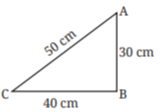
Using Eq. (mechanical advantage {tex}=\frac{\text { load }}{\text { effort }}=\frac{m g}{F^{\prime}}=\frac{L}{h}{/tex}), mechanical advantage {tex}=\frac{L}{6}=\frac{50 {~cm}}{20 {~cm}}=1.67{/tex}
Q.25: For a seesaw having four seats A, B, D, E and fulcrum at C (Fig), {tex}{AC}={EC}=2 {~m}{/tex} and {tex}{BC}={DC}=1 {~m}{/tex}. On which seats should children of masses 15 kg and 30 kg sit to make the seesaw balanced?
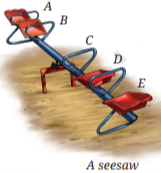
Solution: Suppose the child of mass 15 kg sits on seat A and the other child sits at a distance {tex}L{/tex} from the fulcrum. Using Eq. (effort × effort arm {tex}={/tex} load × load arm), we obtain
{tex}15 {~kg} \times 2 {~m}=30 {~kg} \times L{/tex}
{tex}L=1 {~m}{/tex}
Thus, the other child should sit at seat D.
Q.26: Work is said to be done when a force is applied, even if the object does not move.
Options:
(1) True
(2) False ✅
Explanation: Work is done only when force causes displacement. If the object does not move, no work is done.
Q.27: Lifting a bucket vertically upward results in positive work done on the bucket.
Options:
(1) True ✅
(2) False
Explanation: True
Q.28: The SI unit for both work and energy is joule (J).
Options:
(1) True ✅
(2) False
Explanation: True
Q.29: A motionless stretched rubber band has kinetic energy.
Options:
(1) True
(2) False ✅
Explanation: A motionless stretched rubber band has potential energy, not kinetic energy.
Q.30: Energy can change from one form to another.
Options:
(1) True ✅
(2) False
Explanation: True
Q.31: Work done = ________ × ________ (in the direction of force).
Solution: Force × Displacement
Q.32: 1 joule of work is done when a force of ________ newton displaces an object by 1 metre in the direction of the force.
Solution: 1 newton
Q.33: The expression for kinetic energy of a body of mass m and velocity v is ________.
Solution: {tex}\frac{1}{2} m v^2{/tex}
Q.34: The potential energy of an object of mass m at a small height h from the Earth’s surface is ________.
Solution: mgh
Q.35: Power is defined as the ________ at which work is done.
Solution: rate
Q.36: When a ball thrown upwards reaches its highest point, tick which of the following statement(s) are correct?
- The force acting on the ball is zero.
- The acceleration of the ball is zero.
- Its kinetic energy is zero.
- Its potential energy is maximum
Options:
(1) Both i and ii
(2) Both ii and iii
(3) Both iii and iv ✅
(4) All of these
Explanation: Let’s be precise so there’s no confusion:
- At the highest point, the velocity becomes zero (instantaneously)
→ so kinetic energy = 0 (iii is correct) - At that same point, the height is maximum
→ so potential energy is maximum (iv is correct)
Q.37: For each of the following situations, identify the energy transformation that takes place:
- a truck moving uphill,
- unwinding of a watch spring,
- photosynthesis in green leaves,
- water flowing from a dam,
- burning of a matchstick,
- explosion of a firecracker,
- speaking into a microphone,
- a glowing electric bulb, and
- a solar panel
Solution:
- Chemical energy → Kinetic energy + Potential energy
- Potential energy (elastic) → Kinetic energy
- Light energy → Chemical energy
- Potential energy → Kinetic energy
- Chemical energy → Heat energy + Light energy
- Chemical energy → Heat energy + Light energy + Sound energy
- Sound energy → Electrical energy
- Electrical energy → Light energy + Heat energy
- Light energy → Electrical energy
Q.38: A student is slowly lifted straight up in an elevator from the ground level to the top floor of a building. Later, the same student climbs the staircase, all the way to the top. Given that the height of the building is h = 72.5 m, acceleration due to gravity is g = 10 m s-2, and student’s mass is m = 50 kg.
- Find the gain in the potential energy if the student is lifted straight up to the top.
- Find the gain in the potential energy when the student climbs the stairs to the same top.
- What do you conclude about the dependence of the potential energy on the path taken?
Solution:
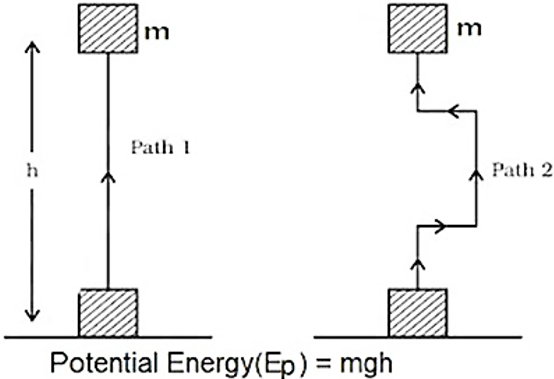
- Gain in potential energy (lifted straight up)
{tex}P E=50 \times 10 \times 72.5=36250 {~J}{/tex} - Gain in potential energy (climbing stairs)
{tex}P E=50 \times 10 \times 72.5=36250 {~J}{/tex} - The gain in potential energy is the same in both cases.
Q.39: A crane lifts a mass m to the 10th floor of a building in a certain time. It then raises the same mass to the 20th floor of the same building in double the time. How much more energy and power are required? Assume that the height of all floors is equal.
Solution:
Let height of each floor {tex}=h{/tex}
Energy required:
Potential energy:
{tex} P E=m g h{/tex}
For 10th floor {tex}\rightarrow{/tex} height {tex}=10 h{/tex}
{tex} E_1=m g(10 h)=10 m g h{/tex}
For 20th floor {tex}\rightarrow{/tex} height {tex}=20 {~h}{/tex}
{tex} E_2=m g(20 h)=20 m g h{/tex}
So,
{tex} E_2=2 E_1{/tex}
Power required:
{tex} \text {Power }=\frac{\text { Work }}{\text { Time }}{/tex}
Let time for 10th floor {tex}=t{/tex}
Time for 20th floor {tex}=2 t{/tex}
- Power for 10th floor:
{tex} P_1=\frac{10 m g h}{t}{/tex} - Power for 20 th floor:
{tex} P_2=\frac{20 m g h}{2 t}=\frac{10 m g h}{t}{/tex}
So,
{tex} P_2=P_1{/tex}
Q.40: Which factors determine the energy required to raise a flag from the ground to the top of a tall flagpole using a pulley? Does raising the flag slowly or quickly change the amount of work done? If the speed at which the flag is raised is doubled, how does the power requirement change? Explain your answers.
Solution:
- The energy required to raise the flag depends on its mass and the height to which it is raised (i.e., mgh).
- Raising the flag slowly or quickly does not change the work done, because the same height is reached.
- If the speed is doubled, the power required also doubles, since the same work is done in less time.
Q.41: A man of mass 60 kg rides a scooter of mass 100 kg. He accelerates the scooter to a velocity v. The next day, his son with a mass of 40 kg joins him as a passenger. If the scooter reaches the same speed on both days in the same time interval, what is the ratio of the fuel of the tank used on the two days? Assume that the energy transfer to the scooter happens entirely due to fuel, and no other losses occur due to air resistance and friction.
Solution:
Fuel used {tex}\propto{/tex} energy required {tex}\propto{/tex} kinetic energy gained
{tex} K E=\frac{1}{2} m v^2{/tex}
Day 1 (man + scooter):
Total mass {tex}=60+100=160 {~kg}{/tex}
{tex} K E_1=\frac{1}{2}(160) v^2{/tex}
Day 2 (man + son + scooter):
Total mass {tex}=60+40+100=200 {~kg}{/tex}
{tex} K E_2=\frac{1}{2}(200) v^2{/tex}
Ratio of fuel used:
{tex} \frac{F u e l_1}{F u e l_2}=\frac{K E_1}{K E_2}=\frac{160}{200}=\frac{4}{5}{/tex}
Final Answer:
Ratio of fuel used (Day 1 : Day 2) {tex}=4: 5{/tex}
Q.42: On a seesaw with sliding seats, a child is sitting on one side and an adult on the other side. The adult weighs twice that of the child. The seesaw however is balanced. Draw a figure which depicts this situation showing the distances from the fulcrum where the child and the adult are seated.
Solution:
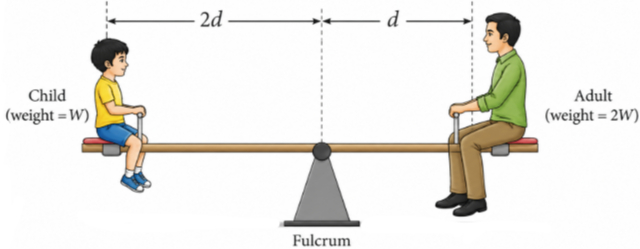
For balance (clockwise moment = anticlockwise moment):
{tex} W \times 2 d=2 W \times d{/tex}
Hence, the seesaw is balanced.
Q.43: A ball of mass 2 kg is thrown up with a velocity of 20 m s–1.
- Identify the sign of the work done by gravity on the ball during its upward motion and its downward motion.
- If the ball reaches a height of 19.4 m, how much work was done by air resistance (assume g = 10 m s–2).
Solution:
- During upward motion:
Displacement is upward, gravity acts downward
Work done by gravity = negative
During downward motion:
Displacement is downward, gravity acts downward
Work done by gravity = positive - Step 1: Initial kinetic energy {tex} K E=\frac{1}{2} m v^2=\frac{1}{2} \times 2 \times(20)^2=400 {~J}{/tex}
Step 2: Potential energy at height 19.4 m {tex} P E=m g h=2 \times 10 \times 19.4=388 {~J}{/tex}
Step 3: Work done by air resistance Energy lost = Initial KE – Final PE {tex} =400-388=12 {~J}{/tex} This energy is lost due to air resistance
Q.44: A 10.0 kg block is moving on horizontal floor with negligible friction. As shown in the figure, a variable force is applied on the block in its direction of motion from its position at 0 m till 4 m. If the block had a kinetic energy of 180 J when it was at 0 m, find the block’s speed
- at 0 m, and
- at 4 m.
Does the block have negative acceleration in any portion of its motion?
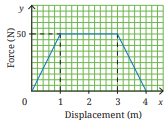
Solution:
- The kinetic energy ({tex}K{/tex}) formula is {tex}K=\frac{1}{2} m v^2{/tex}. At {tex}x=0{/tex}: {tex}180=\frac{1}{2} \times 10 \times v^2{/tex}
{tex}180=5 v^2{/tex}
{tex}v^2=36{/tex}
{tex}v=6 {~m} / {s}{/tex}
The speed at 0 m is {tex}6 {~m} / {s}{/tex}. - To find the speed at 4 m, we first need to calculate the Total Work Done {tex}(W){/tex} from 0 to 4 m. In a Force-Displacement graph, work done is the area under the curve. The shape is a trapezium:
- Parallel side 1 (base): 4 units (from 0 to 4)
- Parallel side 2 (top): 2 units (from 1 to 3)
- Height: 50 N {tex}\text { Area }=\frac{1}{2} \times(\text {sum of parallel sides}) \times \text { height }{/tex}
{tex}W=\frac{1}{2} \times(4+2) \times 50{/tex}
Q.45: The gravitational attraction on the surface of the Moon (lunar surface) is about {tex}\frac{1}{6}{/tex}th of that on the surface of the Earth. An astronaut can throw a ball up to a height of 8 m from the surface of the Earth. How far up will the ball thrown with the same upward velocity travel from the surface of the Moon?
Solution: For a ball thrown upward:
{tex} h=\frac{v^2}{2 g}{/tex}
Height is inversely proportional to gravity.
On Earth:
{tex} h_{\text {earth }}=8 {~m}{/tex}
On Moon:
{tex}g_{\text {moon }}=\frac{g}{6}{/tex}
{tex}h_{\text {moon }}=\frac{v^2}{2(g / 6)}=6 \times \frac{v^2}{2 g}{/tex}
{tex}h_{\text {moon }}=6 \times h_{\text {earth }}=6 \times 8=48 {~m}{/tex}
Q.46: A 1000 kg car is moving along a road at a constant speed. Suddenly, the driver notices some obstruction ahead and applies the brakes to come to a complete stop. The graphical representation of motion of the car starting from the instant the driver spots the traffic ahead is shown in Figure.
- Describe how the car moves between positions A and B.
- Calculate the kinetic energy of the car at A.
- State the work done by the brakes in bringing the car to a halt between B and C.
- What does the kinetic energy of the car transform into?
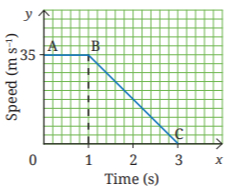
Solution:
- Between A and B, the graph is a horizontal straight line.
- Observation: The speed remains constant at 35 m/s as time progresses from 0 to 1 second.
- Description: The car is moving with uniform motion (constant velocity). During this 1-second interval, the driver is likely reacting to the obstruction before actually hitting the brakes.
- To find the kinetic energy {tex}(K){/tex}, we use the formula: {tex} K=\frac{1}{2} m v^2{/tex}
Given:
Mass {tex}(m)=1000 {~kg}{/tex}
Speed {tex}(v){/tex} at point {tex}{A}=35 {~m} / {s}{/tex} Calculation: {tex}K=\frac{1}{2} \times 1000 \times(35)^2{/tex}
{tex}K=500 \times 1225{/tex}
{tex}K=612,500 {~J}(\text { or } 612.5 {~kJ}){/tex}
The kinetic energy of the car at {tex}A{/tex} is 612,500 Joules. - According to the Work-Energy Theorem, the work done by the force (brakes) is equal to the change in kinetic energy.
At point B: The speed is still {tex}35 {~m} / {s}{/tex}, so {tex}K_B=612,500 {~J}{/tex}.
At point C: The car has come to a complete stop, so speed is {tex}0 {~m} / {s}{/tex} and {tex}K_C=0 {~J}{/tex}. Calculation: {tex}W=K_{\text {final }}-K_{\text {initial }}{/tex}
{tex}W=0-612,500{/tex}
{tex}W=-612,500 {~J}{/tex}
The work done by the brakes is 612,500 Joules. (The negative sign indicates that the work is done in the opposite direction of motion to stop the car). - When the brakes are applied, the kinetic energy does not disappear; it follows the Law of Conservation of Energy and transforms into other forms:
Heat Energy: Most of the kinetic energy is converted into heat due to friction between the brake pads and the discs, as well as between the tires and the road.
Sound Energy: Some energy is converted into the screeching sound often heard when brakes are applied suddenly.
Q.47: The potential energy-displacement graph of a 0.5 kg ball moving along a frictionless track is shown in Fig. At O, the velocity of the ball is {tex}0 {~m} {~s}^{-1}{/tex} and potential energy is 30 J. Calculate the velocity of the ball at {tex}{P}, {Q}{/tex} and R.
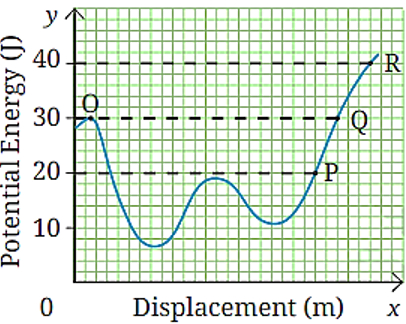
Solution:
- The car moves with constant speed between A and B.
This means no acceleration and no net force acting on it. - Let speed at {tex}{A}=v{/tex} (from graph) {tex}K E=\frac{1}{2} m v^2{/tex}
{tex}=\frac{1}{2} \times 1000 \times v^2=500 v^2 {~J}{/tex} (Substitute the value of {tex}v{/tex} from the graph if given) - Car comes to rest → final {tex}{KE}=0{/tex}
Initial KE at {tex}{B}=\frac{1}{2} m v^2{/tex} {tex}\text { Work done by brakes }=\text { change in } {KE}{/tex}
{tex}=0-\frac{1}{2} m v^2=-\frac{1}{2} m v^2{/tex}
Work is negative (brakes oppose motion) - The kinetic energy of the car is converted into:
- Heat energy (due to friction in brakes)
- Sound energy (small amount)
Q.48: A coconut of mass 1.5 kg falls from the top of a coconut tree onto the wet sand on a beach. The height of the tree is 10 m. On impact, the coconut comes to rest by making a depression in the sand.
- Calculate the velocity of the coconut just before it hits the sand.
- Assume that the average resistive force of sand is 3000 N and all of the coconut’s energy is used to create the depression in the sand. Calculate the depth of the depression the coconut makes in the sand. Assume g = 10 m s–2.
Solution:
- Using energy conservation: {tex} m g h=\frac{1}{2} m v^2{/tex}
Mass cancels: {tex} v=\sqrt{2 g h}=\sqrt{2 \times 10 \times 10}=\sqrt{200} \approx 14.1 {~m} / {s}{/tex} - Step 1: Initial energy {tex} P E=m g h=1.5 \times 10 \times 10=150 {~J}{/tex}
Step 2: Work done by sand {tex}\text { Work }=\text { Force × distance }{/tex}
{tex}150=3000 \times d{/tex}
{tex}d=\frac{150}{3000}=0.05 {~m}{/tex}
Class 9 Science Exploration NCERT Solutions
- Exploration: Entering the World of Secondary Science
- Cell: The Building Block of Life
- Tissues in Action
- Describing Motion Around Us
- Exploring Mixtures and Their Separation
- How Forces Affect Motion
- Work, Energy and Simple Machines
- Journey Inside the Atom
- Atomic Foundations of Matter
- Sound Waves: Characteristics and Applications
- Reproduction: How Life Continues
- Patterns in Life: Diversity and Classification
- Earth as a System: Energy, Matter and Life

Test Generator
Create question paper PDF and online tests with your own name & logo in minutes.
Create Now
Learn8 App
Practice unlimited questions for Entrance tests & government job exams at ₹99 only
Install Now