Earth as a System: Energy Matter and Life – NCERT Solutions Class 9 Science Exploration includes all the questions with solutions given in NCERT Class 9 Science Exploration textbook.
NCERT Solutions Class 9
English Kaveri Hindi Ganga Sanskrit Sharada Maths Ganita Manjari Science Exploration Social Understanding SocietyEarth as a System: Energy Matter and Life – NCERT Solutions
Q.1: How does the warming of Arabian Sea water affect the southwest monsoon in India?
Solution: The warming of the Arabian Sea directly affects the Southwest Monsoon because monsoon winds are driven by temperature differences (uneven heating) between land and sea.
When the Arabian Sea becomes warmer:
- It increases evaporation, adding more moisture to the air.
- Moisture-laden winds blow towards the Indian subcontinent.
- This leads to heavier and sometimes more intense rainfall over regions like the west coast of India.
- However, excessive warming can also disturb normal wind patterns, making the monsoon irregular or unpredictable.
Q.2: If a large forest is cleared, how can that affect the flow of a river in that area?
Solution: Clearing a large forest (deforestation) can significantly affect the flow of a river in that area:
- Reduced infiltration: Trees and plant roots help water seep into the ground. Without them, less water is absorbed, and more flows over the surface.
- Increased runoff: Rainwater quickly flows into rivers, causing sudden floods during heavy rainfall.
- Soil erosion: Without roots to hold soil, it gets washed into the river, leading to siltation (mud deposition), which can make the river shallow.
- Irregular flow: Rivers may have too much water during rains (floods) and too little during dry periods (drought-like conditions).
- Reduced groundwater recharge: This decreases the base flow of rivers, especially in dry seasons.
Q.3: What might happen to coastal cities in India if glaciers and polar ice keep melting faster?
Solution: If glaciers and polar ice continue to melt faster, it will lead to a rise in sea level, which can seriously affect coastal cities in India.
Possible impacts include:
- Flooding of coastal areas: Cities like Mumbai, Chennai, and Kolkata may experience frequent flooding, especially during high tides and storms.
- Submergence of low-lying regions: Some areas may go permanently underwater.
- Damage to infrastructure: Roads, buildings, and ports near the coast can be destroyed.
- Saltwater intrusion: Seawater may enter freshwater sources, making drinking water scarce and harming agriculture.
- Displacement of people: Many people living in coastal areas may be forced to migrate.
Q.4: How would increasing carbon dioxide levels in the atmosphere affect the ocean plankton?
Solution: Increasing levels of carbon dioxide (CO2) in the atmosphere affect ocean plankton mainly through ocean acidification.
- CO2 dissolves in seawater, forming carbonic acid, which lowers the pH of the ocean.
- This makes it harder for plankton like phytoplankton and zooplankton (especially those with calcium carbonate shells) to build and maintain their shells.
- As a result, many plankton species may decline in number or become weaker.
- Since plankton form the base of the marine food chain, their decline can affect fish and other marine organisms.
Q.5: How does the cool mountain breeze benefit agriculture activity, particularly the crops and soil?
Solution: Cool mountain breeze (air flowing from mountains toward valleys, especially at night) benefits agriculture in several ways:
- Reduces heat stress on crops: Cooler air helps plants recover from daytime heat, improving growth and preventing damage.
- Maintains soil moisture: Lower temperatures reduce evaporation, so the soil retains more water for longer periods.
- Prevents crop drying and wilting: Crops stay fresh and hydrated due to the cooling effect.
- Improves air circulation: Gentle winds help in gas exchange (CO2 intake and oxygen release), supporting photosynthesis and respiration.
- Reduces pest and disease spread (in some cases): Cooler and well-ventilated conditions can limit certain pests and fungal growth.
Q.6: The CO2 dissolved in the ocean is disturbed when the global temperature increases. What will happen to marine life?
Solution: When global temperature increases, the balance of CO2 dissolved in the oceans gets disturbed, which affects marine life in several ways:
- Reduced CO2 absorption: Warmer ocean water holds less carbon dioxide, so more CO2 remains in the atmosphere, worsening climate change.
- Ocean acidification changes: Fluctuations in dissolved CO2 can still lead to acidic conditions, harming marine organisms.
- Damage to shell-forming organisms: Creatures like plankton, corals, and shellfish find it difficult to build and maintain calcium carbonate shells.
- Disruption of food chains: Since plankton are the base of the marine food web, their decline affects fish and larger marine animals.
Q.7: What would happen to plants and animals on Earth if the biogeochemical cycles were disrupted and stopped? Explain by giving a few examples.
Solution: Biogeochemical cycles (like the carbon, oxygen, nitrogen, and water cycles) are essential for maintaining life on Earth. If these cycles were disrupted or stopped, plants and animals would not survive.
What would happen?
- Lack of essential nutrients:
Plants need nutrients like nitrogen and carbon. Without cycles, these would not be recycled, so plants would stop growing and eventually die. - No oxygen–carbon balance:
If the carbon and oxygen cycles stop, oxygen would not be replenished and carbon dioxide would accumulate, making it impossible for animals to breathe. - Water shortage:
If the water cycle stops, there would be no rainfall, leading to drought and death of plants and animals.
Q.8: What if photosynthesis stopped, what would happen on the Earth?
Solution: If photosynthesis stopped, the consequences for Earth would be catastrophic:
What would happen?
- Food chains would collapse:
Plants (producers) would no longer make food. Herbivores would starve first, followed by carnivores → entire food chains collapse. - Oxygen would decrease:
Photosynthesis is the main source of oxygen. Without it, oxygen levels would gradually fall, making survival impossible for most organisms. - Carbon dioxide would increase:
CO2 would not be used by plants and would build up in the atmosphere, causing extreme warming.
Q.9: Discuss how human activities increase the concentration of greenhouse gases in the atmosphere. What would you do as an individual to reduce the emission of greenhouse gas?
Solution: Human actions add large amounts of gases like CO2, methane (CH4), and nitrous oxide (N2O) to the atmosphere:
- Burning fossil fuels:
Vehicles, industries, and power plants burn coal, petrol, and diesel, releasing large amounts of carbon dioxide (CO2). - Deforestation:
Cutting forests reduces the number of trees that absorb CO2, and burning trees releases stored carbon. - Agriculture and livestock:
Cattle and rice fields produce methane (CH4), a powerful greenhouse gas. - Industrial activities:
Factories release gases like CO2 and other pollutants during production processes. - Waste and landfills:
Decomposing garbage releases methane into the atmosphere.
Q.10: How much solar energy will be received by a {tex}1 {m}^2{/tex} area in one hour, if the insolation on the surface of the Earth were {tex}1 {kWm}^{-2}{/tex}?
Solution:
{tex}{E}=\text { Intensity } \times \text { area × time }{/tex}
{tex}{E}=1 \times 1000 {~J} {~s}^{-1} {~m}^{-2} \times 1 {~m}^2 \times 3600 {~s}{/tex}
{tex}{E}=3600000 {~J}=3.6 \times 10^6 {~J}{/tex}
(This amount of energy is approximately equal to the energy needed to melt 5 kg of ice and heat the water obtained to 100 °C. It is also equal to one unit of electricity used in a household, as shown on an electricity bill).
Q.11: What happens to the warm surface of water from the equator as it travels toward the poles? What impact does this movement have on the area?
Solution: What happens to the warm water?
- Warm surface water from the equator moves toward the poles through ocean currents.
- As it reaches higher latitudes, it loses heat and becomes cooler.
- The cooled water becomes denser and sinks into deeper ocean layers.
What impact does this movement have?
- Warms nearby coastal regions: Places near warm currents experience a milder climate than expected.
- Regulates global temperature: Heat is redistributed from the equator to colder regions.
- Affects weather patterns: It influences winds, rainfall, and storms.
- Supports marine ecosystems: The movement helps circulate nutrients, benefiting marine life.
Q.12: Choose the most appropriate option to describe the role of biogeochemical cycles in an ecosystem.
Options:
(1) To provide food directly to all organisms.
(2) To recycle essential nutrients between biotic and abiotic components. ✅
(3) To create new elements for use by living things.
(4) To remove pollutants and toxins from the organism.
Explanation: Biogeochemical cycles (like the carbon, nitrogen, and water cycles) are responsible for circulating nutrients between living organisms (biotic components) and the environment (abiotic components such as air, water, and soil).
Q.13: Which of the following is primarily responsible for warming of the Earth?
Options:
(1) Solar radiation is immediately absorbed by carbon dioxide, which then releases it as heat.
(2) The atmosphere’s tiny particles absorb incoming solar radiation, which directly heats the Earth.
(3) The Earth’s surface absorbs solar radiation, which is then re-radiated and trapped by greenhouse gases. ✅
(4) The Earth’s environment is heated only by the solar radiation reflected by the clouds.
Explanation:
- Sunlight reaches Earth and is absorbed by land and oceans.
- The Earth then re-emits this energy as heat (infrared radiation).
- Greenhouse gases (like CO2, methane) trap this heat, leading to warming.
Q.14: Explain how climate change affects the water cycle. Illustrate with examples.
Solution: Climate change strongly alters the water cycle by affecting evaporation, rainfall, and water distribution.
How it affects the water cycle:
- Increased evaporation:
Rising temperatures cause more water to evaporate from oceans, rivers, and soil. - Changes in rainfall patterns:
Some areas receive heavy rainfall and floods, while others face droughts. - Melting of glaciers:
Glaciers melt faster, increasing river flow initially but reducing long-term water availability.
Q.15: Describe how albedo affects the Earth’s surface temperature and its climate.
Solution: Albedo is the measure of how much sunlight a surface reflects.
How albedo affects temperature:
- High albedo (more reflection):
Surfaces like ice, snow, and clouds reflect most sunlight back into space → less heat is absorbed → cooler temperatures. - Low albedo (more absorption):
Surfaces like oceans, forests, and dark soil absorb more sunlight → more heat is retained → warmer temperatures.
Impact on climate:
- Polar regions stay cold:
Ice and snow have high albedo, helping maintain low temperatures. - Global warming feedback:
When ice melts, it exposes darker surfaces (like ocean water), which absorb more heat → further warming (positive feedback loop). - Regional climate differences:
Areas with low albedo (like deserts or cities) tend to be hotter compared to areas with high albedo.
Q.16: How are mountain and valley breezes formed? Suppose there are two mountains, one covered with grass and another covered with barren rocks; would the temperature of the two mountain breezes be different? If so, how?
Solution: Mountain and valley breezes are formed due to uneven heating of mountain slopes.
- During the day, slopes heat up faster, warm air rises, and cool air from the valley moves upward → valley breeze.
- At night, slopes cool quickly, cold dense air flows down into the valley → mountain breeze.
Yes, the temperature differs:
- A rocky mountain heats and cools faster, producing warmer daytime breezes and colder nighttime breezes.
- A grass-covered mountain has milder and cooler breezes due to slower heating and cooling.
Q.17: You have witnessed weather phenomena, such as winds, storms, rainfall, etc. Which atmospheric layer is mainly responsible for such phenomena and what is the primary reason for its occurrence?
Solution: The Troposphere is mainly responsible for weather phenomena like winds, storms, and rainfall.
This is because:
- It contains most of the air and water vapour, which are essential for weather changes.
- It is heated unevenly by the Earth’s surface, causing air movement and formation of winds, clouds, and rain.
Q.18: Explain the processes involved in the nitrogen cycle. How would life on Earth be affected if nitrogen were not cycled?
Solution: The nitrogen cycle involves:
- Nitrogen fixation: Conversion of atmospheric nitrogen into usable forms by bacteria.
- Nitrification and assimilation: Formation of nitrates and their absorption by plants; animals obtain nitrogen by eating plants.
- Denitrification: Conversion of nitrates back to nitrogen gas.
If nitrogen were not cycled:
- Soil would become infertile, plants could not grow.
- Proteins and DNA could not be formed, so life processes would stop.
Hence, life on Earth would not survive.
Q.19: What are the impacts of deforestation on the Earth’s oxygen and carbon cycles? What are the other consequences of deforestation?
Solution: Impact on oxygen and carbon cycles:
- Reduced photosynthesis: Fewer trees → less CO2 absorbed and less oxygen released.
- Increase in CO2 levels: Cutting and burning trees releases stored carbon → enhances global warming.
Other consequences:
- Soil erosion and loss of fertility
- Loss of biodiversity (plants and animals lose habitat)
- Disturbed water cycle leading to floods and droughts
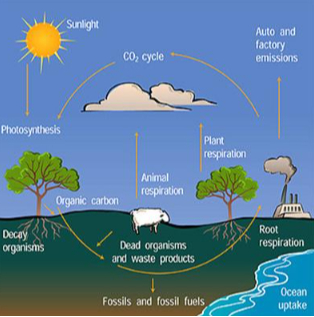
Q.20: Explain with suitable diagram the path that carbon takes to go back to the atmosphere. You may start from plants using CO2 from the atmosphere.
Solution: Photosynthesis: Plants take in CO2 from the atmosphere and convert it into food.
Transfer through food chain: Animals eat plants, so carbon moves into animals.
Return to atmosphere:
- Respiration by plants and animals releases CO2 back into the air.
- Decomposition of dead organisms releases CO2.
- Burning of fuels/wood also releases CO2.
Q.21: Why is an excess of CO2 in the atmosphere considered undesirable even though it is required by plants?
Solution:
- Although CO2 is needed for photosynthesis, excess CO2 enhances the greenhouse effect, trapping more heat in the atmosphere.
- This leads to global warming and climate change, causing melting of glaciers, rising sea levels, and extreme weather.
- It also disturbs the balance of gases in the atmosphere and can harm ecosystems.
Q.22: How is heat lost from the surface of the Earth? What is its significance?
Solution: How heat is lost:
- The Earth’s surface loses heat mainly by radiation in the form of infrared waves to the atmosphere.
- Some heat is also transferred by conduction and convection to the surrounding air.
Significance:
- Helps maintain the Earth’s temperature balance.
- Drives winds and weather patterns due to uneven heating.
- Prevents excessive heating of the Earth’s surface.
Q.23: If the Earth were a flat disc instead of a sphere, how would the patterns of solar radiation and temperature be different?
Solution: If the Earth were a flat disc:
- Uniform solar radiation: Sunlight would fall more evenly on most areas instead of being spread over a curved surface → less variation in heating.
- No clear climatic zones: There would be little or no distinction between equatorial, temperate, and polar regions.
- Reduced temperature differences: Without curvature, differences in angle of sunlight would be minimal → weaker winds and ocean currents.
Q.24: Suppose there is a rise in atmospheric temperature on Earth. How would this affect the cryosphere, hydrosphere and biosphere?
Solution:
- Cryosphere (ice regions):
Rising temperature causes melting of glaciers and polar ice, leading to loss of ice cover. - Hydrosphere (water bodies):
Melting ice increases sea levels and causes changes in ocean currents and rainfall patterns. - Biosphere (living organisms):
Plants and animals face habitat loss, migration, or extinction, and ecosystems get disturbed.
Q.25: Explain how the Earth’s atmosphere helps in maintaining a suitable temperature for life to survive on the Earth.
Solution:
- The atmosphere allows sunlight to reach the Earth and warms its surface.
- It traps some of the outgoing heat by greenhouse gases (like CO2 and water vapour), preventing excessive cooling.
- It also distributes heat through winds and air circulation, reducing extreme temperature differences.
Q.26: Describe the interrelationship between different spheres of the Earth. Illustrate with example how these spheres function in a delicate balance.
Solution: The Earth has four main spheres- lithosphere (land), hydrosphere (water), atmosphere (air), and biosphere (living organisms)- which are closely interconnected.
- These spheres exchange matter and energy continuously (like water, gases, and nutrients).
- A change in one sphere affects the others, maintaining a delicate balance.
Example:
Plants (biosphere) take CO2 from the atmosphere and water from the hydrosphere to make food, and release oxygen back into the atmosphere. Soil (lithosphere) provides nutrients.
Class 9 Science Exploration NCERT Solutions
- Exploration: Entering the World of Secondary Science
- Cell: The Building Block of Life
- Tissues in Action
- Describing Motion Around Us
- Exploring Mixtures and Their Separation
- How Forces Affect Motion
- Work, Energy and Simple Machines
- Journey Inside the Atom
- Atomic Foundations of Matter
- Sound Waves: Characteristics and Applications
- Reproduction: How Life Continues
- Patterns in Life: Diversity and Classification
- Earth as a System: Energy, Matter and Life

Test Generator
Create question paper PDF and online tests with your own name & logo in minutes.
Create Now
Learn8 App
Practice unlimited questions for Entrance tests & government job exams at ₹99 only
Install Now