
Ask questions which are clear, concise and easy to understand.
Ask QuestionPosted by Naina Rathi 5 years, 6 months ago
- 1 answers
Posted by Dεερακ Ȿιηɠꜧ 5 years, 6 months ago
- 1 answers
Posted by ꧁༒Gamer༒꧂ Jena 5 years, 6 months ago
- 1 answers
Posted by Aman Sahni 5 years, 6 months ago
- 1 answers
Posted by Natasha Mishra 5 years, 6 months ago
- 1 answers
Gaurav Seth 5 years, 6 months ago
Global Depository Receipts (GDR) are the depository receipts denominated in US dollars issued by depository bank to which the local currency shares of a company are delivered. GDR is a negotiable instrument and can be traded freely like any other security. In the Indian context, a GDR is an instrument issued abroad by an Indian company to raise funds in some foreign currency and is listed and traded on a foreign stock exchange.
American Depository Receipts (ADR) The depository receipts issued by a company in the USA are known as American Depository Receipts. ADRs are bought and sold in American markets like regular stocks. ADR is similar to a GDR except that it can be issued only to American citizens and can be listed and traded on a stock exchange of USA.
Indian Depository Receipt- IDR is a financial instrument. It is issued by domestic depository to the Indian citizens against the shares of foreign company. IDR is denominated in Indian rupees. It helps issuing company, i.e. foreign companies to raise capital from Indian securities market.
Posted by Deepak Kumar 5 years, 6 months ago
- 1 answers
Posted by Pranav Bhalani 5 years, 6 months ago
- 1 answers
Yogita Ingle 5 years, 6 months ago
E-banking means any user with a PC and a browser can get connected to the banks’ website to perform any of the virtual banking functions and avail of any of the banks services. There is no human operator to respond to the needs of the customer.
Posted by Natasha Mishra 5 years, 6 months ago
- 2 answers
Gaurav Seth 5 years, 6 months ago
lassification of Sources of Funds
Period Basis
- On the basis of period, the different sources of funds can be categorized into three parts. These are long-term sources, medium-term sources and short-term sources.
- The long-term sources fulfill the financial requirements of an enterprise for a period exceeding 5 years and include sources such as shares and debentures, long-term borrowings and loans from financial institutions.
- Such financing is generally required for the acquisition of fixed assets such as equipment, plant, etc.
- Where the funds are required for a period of more than one year but less than five years, medium-term sources of finance are used. These sources include borrowings from commercial banks, public deposits, lease financing and loans from financial institutions.
- Short-term funds are those which are required for a period not exceeding one year. Trade credit, loans from commercial banks and commercial papers are some of the examples of the sources that provide funds for short duration.
- Short-term financing is most common for financing of current assets such as accounts receivable and inventories. Seasonal businesses that must build inventories in anticipation of selling requirements often need short-term financing for the interim period between seasons. Wholesalers and manufacturers with a major portion of their assets tied up in inventories or receivables also require large amount of funds for a short period.
Ownership Basis
- On the basis of ownership, the sources can be classified into ‘owner’s funds’ and ‘borrowed funds’.
- Owner’s funds means funds that are provided by the owners of an enterprise, which may be a sole trader or partners or shareholders of a company. Apart from capital, it also includes profits reinvested in the business.
- The owner’s capital remains invested in the business for a longer duration and is not required to be refunded during the life period of the business.
- Such capital forms the basis on which owners acquire their right of control of management. Issue of equity shares and retained earnings are the two important sources from where owner’s funds can be obtained.
- ‘Borrowed funds’ on the other hand, refer to the funds raised through loans or borrowings.
- The sources for raising borrowed funds include loans from commercial banks, loans from financial institutions, issue of debentures, public deposits and trade credit.
- Such sources provide funds for a specified period, on certain terms and conditions and have to be repaid after the expiry of that period. A fixed rate of interest is paid by the borrowers on such funds.
- At times it puts a lot of burden on the business as payment of interest is to be made even when the earnings are low or when loss is incurred. Generally, borrowed funds are provided on the security of some fixed assets.
Source of Generation Basis
- Another basis of categorizing the sources of funds can be whether the funds are generated from within the organization or from external sources.
- Internal sources of funds are those that are generated from within the business. A business, for example, can generate funds internally by accelerating collection of receivables, disposing of surplus inventories and Ploughing back its profit. The internal sources of funds can fulfill only limited needs of the business.
- External sources of funds include those sources that lie outside an organization, such as suppliers, lenders, and investors. When large amount of money is required to be raised, it is generally done through the use of external sources.
- External funds may be costly as compared to those raised through internal sources. In some cases, business is required to mortgage its assets as security while obtaining funds from external sources. Issue of debentures, borrowing from commercial banks and financial institutions and accepting public deposits are some of the examples of external sources of funds commonly used by business organizations.
Gaurav Seth 5 years, 6 months ago
NEED OF BUSINESS FINANCE:
1. Fixed Capital Requirement: In order to start a business, funds are needed to purchase fixed assets like land and building, plant and machinery.The funds required in fixed assest remain invested in the business for a long period of time.
2. Working Capital Requirement: A business needs funds for its day to day operation. This is known as working Capital requirements. Working capital is required for purchase of raw materials, to pay salaries, wages, rent and taxes.
3. Diversification: A company needs more funds to diversify its operation to become a multi-product company e.g. ITC.
4. Technology upgradation: Finance is needed to adopt modern technology for example uses of computers in business.
5. Growth and expansion: Higher growth of a business enterprise requires higher investment in fixed assets. So finance is needed for growth and expansion.
Posted by Infinite Thoughts 5 years, 6 months ago
- 1 answers
Gaurav Seth 5 years, 6 months ago
Let r cos θ = –1 and r sin θ = 1
On squaring and adding, we obtain r2 (cos2 θ + sin2 θ) = 1+ 1
⇒ r2 (cos2 θ + sin2 θ) = 2
⇒ r2 = 2 [cos2 θ + sin2 θ = 1]
This is the required polar form.
Posted by Natasha Mishra 5 years, 6 months ago
- 1 answers
Gaurav Seth 5 years, 6 months ago
FINANCIAL INSTITUTION:
The state and central government have established many financial institutions to provide finance to companies. They are called development Bank. These are IFCI, ICICI, IDBI, LIC and UTI. etc.
MERITS:
1. Long term Finance: Financial Institution provide long term finance which is not provided by Commercial Bank.
2. Managerial Advice: They provide financial, managerial and technical advice to business firm.
3. Easy installments: Loan can be made in easy installments. It does not prove to be much of a burden on business.
4. Easy availibility: The funds are made available even during periods of depression.
LIMITATIONS/ DEMERITS:
1. More time Consuming: The procedure for granting loan is time consuming due to rigid criteria and many formalities.
2. Restrictions: Financial Institution place restrictions on the company’s board of Directors.
Posted by Natasha Mishra 5 years, 6 months ago
- 1 answers
Gaurav Seth 5 years, 6 months ago
following are the two sources of finance that an established company can opt to expand its production capacity-
- Issue of shares- the company can issue share (equity and preference) as per its requirement in order to finance its expansion project. company has to pay an annual dividend on these shares. the decision regarding providing dividend is totally in the hands of management.
- issue of debentures- another source through which a company can finance its project is Debentures, it is th fixed charge liability against which company has to pay interest on regular intervals. debenture may be issued for short term and long term period but practically it is issued for a long term period.
other sources are loan from banks, loans from financial institutions etc
Posted by Natasha Mishra 5 years, 6 months ago
- 1 answers
Gaurav Seth 5 years, 6 months ago
As a finance manager of the company, I would advice the directors to issue the preference shares as by issuing preference shares, a company is benefited in the following ways.
1. Lifetime retention - A company need is not bound to repay the preference share capital amount during its lifetime.
2. No charge on company's assets - The preference shareholders have no right on the assets of the concerned company. So in this manner, they have no right to claim any amount (by selling-off company's assets) in case the company fails to make dividend payments.
3. No obligation - In case, the company incurs losses, then it is not required to pay dividend to its preference shareholders.
On the other hand, debentures will not be chosen because of the following demerits of debentures.
1. The legal boundation of a company to pay interest on debentures increases its payment obligations .
2. The borrowing capacity of a company gets limited with further issue of debentures.
Posted by Anas Shaikh 5 years, 6 months ago
- 2 answers
Yogita Ingle 5 years, 6 months ago
Linear Expansion means expansion in length due to increase in temperature. Linear expansion means fractional change in length i.e. how the length is changing with respect to original length.
As we can seefrom above images the length has been increased from
l to l+Δl.
Coefficient of Linear Expansion is a parameter which tells us how the size of the object changes with change in temperature. It is defined as degree of linear expansion divided by the change in temperature.
- If the solid is in the form of long rod, then for small change in temperature, ΔT, the fractional change in length, Δl/l, is directly proportional to ΔT.
Mathematically can be written as:-

Where αl= the coefficient of linear expansion
It is denoted by αl
- It is characteristic of the material of the rod.It varies for different substance.
Posted by Natasha Mishra 5 years, 6 months ago
- 1 answers
Gaurav Seth 5 years, 6 months ago
PUBLIC DEPOSITS: The deposits that are raised by company direct from the public are known as public deposits. The rate of interest offered on public deposits are higher than the rate of interest on bank deposits. This is regulated by the R.B.I. and cannot exceed 25% of share capital and reserves.
MERITS:
1. No charge on assets: The company does not have to mortgage its assets.
2. Tax Saving: Interest paid on public deposits is tax deductable, hence there is tax saving.
3. Simple procedure: The procedure for obtaining public deposits is simpler than share and Debenture.
4. Control: They do not have voting right therefore the control of the company is not diluted.
LIMITATIONS:
1. For Short Term Finance: The maturity period is short. The company cannot depend on them for long term.
2. Limited fund: The quantum of public deposit is limited because of legal restrictions 25% of share capital and free reserves.
3. Not Suitable for New Company: New company generally find difficulty to raise funds through public deposits.
Posted by Natasha Mishra 5 years, 6 months ago
- 1 answers
Gaurav Seth 5 years, 6 months ago
Retained Profits: For any company, the amount of earnings retained within the business has a direct impact on the amount of dividends. Profit re-invested as retained earnings is profit that could have been paid as a dividend. The management of many companies believes that retained earnings are funds which do not cost anything, although this is not true. However, it is true that the use of retained earnings as a source of funds does not lead to a payment of cash. The dividend policy of the company is in practice determined by the directors. From their standpoint, retained earnings are an attractive source of finance because investment projects can be undertaken without involving either the shareholders or any outsiders. The use of retained earnings as opposed to new shares or debentures avoids issue costs. The use of retained earnings avoids the possibility of a change in control resulting from an issue of new shares. Another factor that may be of importance is the financial and taxation position of the company’s shareholders. For example, because of taxation considerations, they would rather make a capital profit (which will only be taxed when shares are sold) than receive current income, and then finance through retained earnings would be preferred to other methods.
Advantages of Retained Earnings
- The management of many companies believe that retained earnings are funds which do not cost anything, although this is not true. However, it is true that the use of retained earnings as a source of funds does not lead to a payment of cash.
- The dividend policy of the company is in practice determined by the directors. From their standpoint, retained earnings are an attractive source of finance because investment projects can be undertaken without involving either the shareholders or any outsiders.
- The use of retained earnings as opposed to new shares or debentures avoids issue costs. The use of retained earnings avoids the possibility of a change in control resulting from an issue of new shares.
- Another factor that may be of importance is the financial and taxation position of the company’s shareholders. If, for example, because of taxation considerations, they would rather make a capital profit (which will only be taxed when shares are sold) than receive current income, then finance through retained earnings would be preferred to other methods.
Disadvantages of Retained Earnings
- A company must restrict its self-financing through retained profits because shareholders should be paid a reasonable dividend, in line with realistic expectations, even if the directors would rather keep the funds for re-investing.
- At the same time, a company that is looking for extra funds will not be expected by investors (such as banks) to pay generous dividends, nor over-generous salaries to owner-directors.
- Scope of retained earnings is limited by amount of profits. A loss incurring firm has no source called retained earnings.
Posted by Natasha Mishra 5 years, 6 months ago
- 1 answers
Gaurav Seth 5 years, 6 months ago
- The sources for raising borrowed funds include loans from commercial banks, loans from financial institutions, issue of debentures, public deposits and trade credit.
- Such sources provide funds for a specified period, on certain terms and conditions and have to be repaid after the expiry of that period. A fixed rate of interest is paid by the borrowers on such funds.
- At times it puts a lot of burden on the business as payment of interest is to be made even when the earnings are low or when loss is incurred. Generally, borrowed funds are provided on the security of some fixed assets.
Posted by Kanan Jagotra 5 years, 6 months ago
- 3 answers
Gaurav Seth 5 years, 6 months ago
Economic factors –
a) Agriculture
- The economic condition of the Islamic world, during medieval period was very prosperous.
- Agriculture was the principal occupation of the settled populations in the newly conquered territories
- The lands conquered by the Arabs that remained in the hands of the owners were subject to a tax (kharaj), which varied from half to a fifth of the produce, according to the conditions of cultivation.
- When non-Muslims started to convert to Islam to pay lower taxes, this reduced the income of the state. To address the shortfall, the caliphs first discouraged conversions and later adopted a uniform policy of taxation.
- Agricultural prosperity went hand in hand with political stability
- Islamic law gave tax concessions to people who brought land under cultivation.
b) Urbanisation
- Islamic civilisation flourished as the number of cities grew phenomenally.
- Among this class of garrison-cities, called misr (the Arabic name for Egypt), were Kufa and Basra in Iraq, and Fustat and Cairo in Egypt.
- Their size and population surged, supported by an expansion in the production of foodgrains and raw materials such as cotton and sugar for urban manufactures
- A vast urban network developed, linking one town with another and forming a circuit.
c) Commerce
- Political unification and urban demand for foodstuffs and luxuries enlarged the circuit of exchange.
- Geography favoured the Muslim empire, which spread between the trading zones of the Indian Ocean and the Mediterranean
- For five centuries, Arab and Iranian traders monopolised the maritime trade between China, India and Europe.
- This trade passed through two major routes, namely, the Red Sea and the Persian Gulf.
- High-value goods suitable for long-distance trade, such as spices, textile, porcelain and gunpowder, were shipped from India and China to the Red Sea ports of Aden and Aydhab and the Gulf ports of Siraf and Basra.
Posted by Mithun G Kumar 5 years, 6 months ago
- 1 answers
Gaurav Seth 5 years, 6 months ago
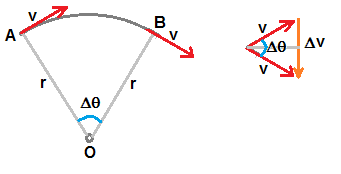
Let us consider a particle travel with constant speed from A to B in a circular path of radius r in a short time Δt
making an angular displacement Δθ as shown in figure.
distance S travelled is the arc length AB and it is given by, S = v×Δt ..................(1)
Arc distance S also written geometrically as, S = r×Δθ ...........................(2)
from (1) and (2), we write , Δθ/Δt = v/r ...............(3)
Eqn.(3) is rate of angular displacement or angular velocity.
For small angular displacement made in short time Δt, we can write = dθ/dt = v/r ......................(4)
In right side figure, velocity vectors at A and B are drawn by merging their initial points.
The angle between these vectors also Δθ.
from the right side figure, we write, sin (Δθ/2) = (Δv/2) / v or Δv/2 = v sin(Δθ/2) .................(5)
For small angle Δθ, eqn.(5) is written as, Δv/2 = v Δθ/2 or Δv/Δθ = v or dv/dθ = v .....................(6)
using eqn.(4) and eqn(6), acceleration directed towards centre, dv/dt = ( dv/dθ ) (dθ/dt) = v×(v/r) = ( v2 / r )
If m is mass, then force F = mass×acceleration = m×(v2 / r )
Posted by Natasha Mishra 5 years, 6 months ago
- 1 answers
Gaurav Seth 5 years, 6 months ago
| Meaning | The shares are the owned funds of the company. | The debentures are the borrowed funds of the company. |
| What is it? | Shares represent the capital of the company. | Debentures represent the debt of the company. |
| Holder | The holder of shares is known as shareholder. | The holder of debentures is known as debenture holder. |
| Status of Holders | Owners | Creditors |
| Form of Return | Shareholders get the dividend. | Debenture holders get the interest. |
| Payment of return | Dividend can be paid to shareholders only out of profits. | Interest can be paid to debenture holders even if there is no profit. |
| Allowable deduction | Dividend is an appropriation of profit and so it is not allowed as deduction. | Interest is a business expense and so it is allowed as deduction from profit. |
| Security for payment | No | Yes |
| Voting Rights | The holders of shares have voting rights. | The holders of debentures do not have any voting rights. |
| Conversion | Shares can never be converted into debentures. | Debentures can be converted into shares. |
| Repayment in the event of winding up | Shares are repaid after the payment of all the liabilities. | Debentures get priority over shares, and so they are repaid before shares. |
Posted by Natasha Mishra 5 years, 6 months ago
- 0 answers
Posted by Chandnita Saini 5 years, 6 months ago
- 3 answers
Gaurav Seth 5 years, 6 months ago
The Salient Features of the Constitution (74th Amendment) Act, 1992:
(a) Constitution of Municipalities.
(b) Composition of Municipalities.
(c) Constitution of wards committees.
(d) Reservation of seats.
(e) Fixed duration of Municipalities.
(f) Power, Authority and responsibilities of Municipalities.
(g) Appointment of State Election Commission.
(h) Appointment of State Finance Commission.
(i) Constitution of Metropolitan and District Planning Committees.
Action has been taken by the State/Union Territory Governments to set up State Finance Commission/State Election Commissions. All states set up their Finance Commissions. Most of the State Finance Commissions submitted their report to the concerned State Government.
The concerned states accepted nearly all the recommendations made by their respective finance commissions. All State Governments/Union Territories set up their Election Commissions for conducting elections to urban Local Bodies.
Gaurav Seth 5 years, 6 months ago
The passage of the Constitution (73rd Amendment) Act, 1992 marks a new era in the federal democratic set up of the country and provides constitutional status to the Panchayati Raj Institutions (PRIs).
The main features of the Act are:
- Establishment of a three-tier structure: Village Panchayat (Gram Panchayat); intermediate panchayat (Panchayat Samiti; and the district panchayat (Zila Parishad);
- Regular elections, every five years;
- Reservation of seats for the Scheduled Castes and Scheduled Tribes in proportion to their population;
- Not less than one-third reservation of seats for women at three different levels of PRIs;
- Establishment of State Finance Commissions to recommend measures to improve the finances of panchayats;
- Establishment of State Election Commissions to conduct election to the PRIs;
- Establishment of District Planning Committees to prepare development plans for the districts;
- Preparation of plans for economic development and social justice and their execution concerning 29 subjects listed in the 11th Schedule of the Constitution;
- Establishment of Grama Sabha (village assemblies) and their empowerment as a decision making body at the village level; and
- Rotation in accordance with the reservation of seats for women and the Scheduled Castes in the PRIs.
Powers and responsibilities
By the Constitution (73rd Amendment) Act, the Panchayati Raj Institutions have been given such powers and authority as may be necessary to enable them to function. It contains provisions for devolution of powers and responsibilities related to
- The preparation of plans for economic development and social justice; and
- The implementation of such schemes for economic development and social justice as may be entrusted to them.
This amendment bars the interference by courts in the electoral matters of panchayats.
- The validity of any law relating to the delimitation of constituencies or the allotment of seats to such constituencies cannot be questioned in any court.
- No election to any panchayat is to be questioned except by an election petition presented to such authority and in such manner as provided by the state legislature.
Posted by Natasha Mishra 4 years, 11 months ago
- 1 answers
Sia ? 4 years, 11 months ago
Long-term financing sources can be in the form of any of them: Share Capital or Equity Shares. Preference Capital or Preference Shares. Retained Earnings or Internal Accruals.
Posted by Ayush Prasad 5 years, 6 months ago
- 1 answers
Gaurav Seth 5 years, 6 months ago
Notes on the contents of the Passage:
A.Freedom of the Press:
(i) vital but can be abused
(ii) infiltration into „the personal life of individuals undesirable.
(iii) can cause serious damage not only to individuals but also to govts.
B. The story of a poor couple who had quintuplets :
(i) lived in obscurity before they had the quints.
(ii) shot into fame after the birth of quints.
(iii) their personal life commercialised.
(iv) knew no peace or rest now.
Heading: Freedom of the Press v/s Private Life
(b) Summary of the Passage :
Freedom of the Press is, no doubt, very vital and any attempt to restrict it is condemned in a democratic country. But this freedom can be misused also. It can cause great damage and bring untold suffering to an individual when it infiltrates into his or her private chambers. The story of a poor Aberdeenian couple who had quintuplets shows how the Press can destroy the peace of an individual’s private life by commercialising it and thus exposing it to the embarrassment of public glare.
Posted by Natasha Mishra 5 years, 6 months ago
- 1 answers
Tec Om 5 years, 6 months ago
Posted by Preeti Thakur 5 years, 6 months ago
- 2 answers
Gaurav Seth 5 years, 6 months ago
The poem is a tribute to the poet’s mother. She is looking at an old photograph of her mother which has a frame of cardboard. The picture has three girls in which the middle one is the oldest and tallest.
It is her mother when she was twelve years old or so. Beside her, on both sides are her two cousins, Betty and Dolly, who are holding her hands and are younger than her. They went for paddling on a beach holiday. Her uncle took the photograph then. The poet could not help but notice her mother’s sweet face. The sea touched her terribly transient feet which depicted that she changed over the years and the sea remained the same.
After twenty-thirty years, her mother would laugh at the photograph. She would make the poet look at the photograph and tell her how their parents would dress them up for the beach holiday. The beach holiday was her mother’s favourite past memories while her laugh was the poet's favourite memory. Both of them lost something which they cherished a lot and yet cannot live that moment again.
Those sweet moments were memories now.
Now, the poet’s mother had been dead for the past twelve years, which is the same number as of her age when the photograph was taken back then. She cannot express the grief that she has from her mother’s absence.
Posted by Taniya Sharma 5 years, 6 months ago
- 1 answers
Gaurav Seth 5 years, 6 months ago
गृह विज्ञान दो शब्दों से मिलकर बना है-‘गृह’ तथा ‘विज्ञान’। गृह का अर्थ है ‘घर’ और विज्ञान का अर्थ है ‘व्यवस्थित ज्ञान’। इस प्रकार, गृह विज्ञान का अर्थ गृह से सम्बन्धित विभिन्न पहलुओं; जैसे आवास, भोजन, वेशभूषा आदि का व्यवस्थित अध्ययन करना है। सर्वप्रथम गृह विज्ञान; अर्थशास्त्र की शाखा के रूप में अमेरिका में विकसित हुआ। अमेरिकन होम इकोनोमिक्स एसोसिएशन के अनुसार, “गृह-अर्थशास्त्र शिक्षा का विशिष्ट विषय है, जिसके अन्तर्गत आय-व्यय, भोजन की स्वच्छता एवं रुचिपूर्णता, वेशभूषा और आवास आदि के रुचिपूर्ण एवं उपयुक्त चुनाव तथा तैयारी और परिवार एवं अन्य मानव समुदायों द्वारा उनके उपयोग का अध्ययन किया जाता है।” समय के साथ-साथ इस विषय ने अधिक व्यापक रूप धारण कर (UPBoardSolutions.com) लिया तथा इसमें शरीर विज्ञान, स्वास्थ्य एवं रोगाणु विज्ञान, आहार एवं पोषण तथा पर्यावरण सम्बन्धी महत्त्वपूर्ण विषय भी सम्मिलित किए गए हैं।
जापान में इस विषय को गृह-प्रशासन के नाम से जाना जाता है। गुड जॉनसन के अनुसार, “गृह व्यवस्था सामान्य देशों में अत्यधिक सामान्य व्यवस्था है जिसमें अधिकांश व्यक्ति कार्यरत होते हैं तथा अधिकतर धन का उपयोग किया जाता है और यह व्यक्तियों के स्वास्थ्य की दृष्टि से अत्यन्त महत्त्वपूर्ण है।”
‘गृह विज्ञान’ नामक विषय को कुछ अन्य नामों से भी जाना जाता है; जैसे कि ‘गृह विज्ञान तथा गृह-कला’ (Home Science and Household Art), ‘घरेलू विज्ञान एवं गृह-कला’ (Domestic Science and Home Craft) गृह विज्ञान के विस्तृत विषय-क्षेत्र को ध्यान में रखते हुए इस विषय की एक ब्यवस्थित परिभाषा इन शब्दों में प्रस्तुत की जा सकती है
“गृह विज्ञान वह सामाजिक विज्ञान है जो घर-परिवार से सम्बन्धित समस्त आवश्यकताओं एवं योजनाओं का व्यवस्थित अध्ययन करता है तथा पारिवारिक सुख-सुविधाओं में वृद्धि करने के लिए सैद्धान्तिक एवं व्यावहारिक ज्ञान प्रदान करता है।”
गृह विज्ञान की एक परिभाषा दिल्ली के लेडी इरविन कॉलेज के “गृह विज्ञान संस्थान’ ने इन शब्दों में प्रस्तुत की है, ”गृह विज्ञान वह व्यावहारिक विज्ञान है जो अपने अध्ययनकर्ताओं को सफल पारिवारिक जीवन व्यतीत करने, सामाजिक तथा आर्थिक समस्याओं को हल करने और सुखमय जीवन-यापन करने की दशाओं का ज्ञान कराता है।”
Posted by Amar Kagra 5 years, 6 months ago
- 1 answers
Yogita Ingle 5 years, 6 months ago
The narrator was very good nature person.He always used to give love and respect for his village.he always used to consider his village as the most beautiful village in the world.Also the narrator called english language a priceless commodity.The narrator was a very witting person.

myCBSEguide
Trusted by 1 Crore+ Students

Test Generator
Create papers online. It's FREE.

CUET Mock Tests
75,000+ questions to practice only on myCBSEguide app

R. D. 5 years, 5 months ago
0Thank You