
Ask questions, doubts, problems and we will help you..
Ask questions which are clear, concise and easy to understand.
Ask Question
CBSE, JEE, NEET, CUET
Question Bank, Mock Tests, Exam Papers
NCERT Solutions, Sample Papers, Notes, Videos
Posted by Rubi Kumari 5 years, 1 month ago (3708143)
- 1 answers
Posted by Rubi Kumari 5 years, 1 month ago (3708143)
- 2 answers
Yogita Ingle 5 years, 1 month ago (2577571)
| Non-cooperation |
Civil-Disobedience |
| It was launched on September 5th, 1920 it ended on 5th February 1922 | It began on March 12, 1930, through the launch of the Salt Satyagraha |
| The Non-Cooperation Movement sought to bring the working of the government to a standstill by not cooperating with the administration. | The Civil Disobedience Movement was an attempt at paralysing the administration by breaking some specific rules & regulations. |
| There was large scale participation of Muslim working class in the Non-Cooperation movement | The Civil-Disobedience movement saw less participation from the Muslim community due to the policy of divide and rule by the British and the communal propaganda of the Muslim League and the Hindu Mahasabha |
| The non-cooperation movement was geographically confined to certain parts of India | The civil disobedience movement saw widespread geographical coverage and mass participation in comparison to the non-cooperation movement |
| The movement was called off in 1922 due to the Chauri-Chaura incident (Occured on Feb 5th, 1922) | The movement was withdrawn after the signing of the Gandhi-Irwin pact |
Paru ? 5 years, 1 month ago (9124897)
Posted by Kanchan Jadhav 5 years, 1 month ago (9145320)
- 3 answers
Yogita Ingle 5 years, 1 month ago (2577571)
Mitosis is that step in the cell cycle where the newly formed DNA is separated and two new cells are formed with the same number and kind of chromosomes as the parent nucleus.
Posted by Arpit Ar 5 years, 1 month ago (9701151)
- 1 answers
Meghna Thapar 4 years, 11 months ago (6237)
Calculate compound interest on an investment or savings. Using the compound interest formula, calculate principal plus interest or principal or rate or time. Includes compound interest formulas to find principal, interest rates or final investment value including continuous compounding A = Pe^rt.
Compound Interest Equation
A = P(1 + r/n)nt
Where:
- A = Accrued Amount (principal + interest)
- P = Principal Amount
- I = Interest Amount
- R = Annual Nominal Interest Rate in percent
- r = Annual Nominal Interest Rate as a decimal
- r = R/100
- t = Time Involved in years, 0.5 years is calculated as 6 months, etc.
- n = number of compounding periods per unit t; at the END of each period
Compound Interest Formulas and Calculations:
- Calculate Accrued Amount (Principal + Interest)
- A = P(1 + r/n)nt
- Calculate Principal Amount, solve for P
- P = A / (1 + r/n)nt
- Calculate rate of interest in decimal, solve for r
- r = n[(A/P)1/nt - 1]
- Calculate rate of interest in percent
- R = r * 100
- Calculate time, solve for t
- t = ln(A/P) / n[ln(1 + r/n)], then also
- t = [ ln(A) - ln(P) ] / n[ln(1 + r/n)]
Formulas where n = 1 (compounded once per period or unit t)
- Calculate Accrued Amount (Principal + Interest)
- A = P(1 + r)t
- Calculate Principal Amount, solve for P
- P = A / (1 + r)t
- Calculate rate of interest in decimal, solve for r
- r = (A/P)1/t - 1
- Calculate rate of interest in percent
- R = r * 100
- Calculate time, solve for t
- t = ln(A/P) / ln(1 + r), then also
- t = [ ln(A) - ln(P) ] / ln(1 + r)
Posted by Himanshu Sharma 5 years, 1 month ago (10003580)
- 2 answers
Yogita Ingle 5 years, 1 month ago (2577571)
In the figure, when a charge q is placed at corner A of the cube, it is being shared equally by 8 cubes
∴ total flux through the faces of the given cube=q/8ε0
Ashwani Kumar Singh 5 years, 1 month ago (3726401)
Posted by Vikas Kumar 5 years, 1 month ago (929090)
- 3 answers

Posted by Prachi Saxena 5 years, 1 month ago (9994304)
- 2 answers
Yogita Ingle 5 years, 1 month ago (2577571)
Meteors are the celestial bodies from the sky which we see as a bright streak of light that flashes for a moment across the sky. The meteors are commonly called shooting stars. When a meteor enters into the atmosphere of Earth with high speed, a lot of heat is produced due to the resistance of air
Posted by Prachi Saxena 5 years, 1 month ago (9994304)
- 3 answers
Yogita Ingle 5 years, 1 month ago (2577571)
Four main castes were prevalent in India in those days- Brahmans, Kshatriyas, Vaisyas and Shudras.
Brahmans and Kshatriyas considered themselves as “upper castes”. Traders and moneylenders were called Vaisyas. Peasants, weavers and potters were called Shudras.
At the lowest rung were people who laboured to keep cities and villages clean. They were treated as “untouchable”. They were not allowed to enter temples, draw water from the wells used by the upper castes, or bathe in ponds where upper castes bathed. They were seen as inferior human beings.
Posted by Sneha Yadav 4 years, 8 months ago (9430858)
- 1 answers
Sia ? 4 years, 8 months ago (6945213)
Posted by Prachi Saxena 5 years, 1 month ago (9994304)
- 2 answers
Yogita Ingle 5 years, 1 month ago (2577571)
We know that,
Area of rectangle = Length × Width
=> 544 = 32 × Width
=> Width = 544 / 32
=> Width = 17 cm
Posted by Prachi Saxena 5 years, 1 month ago (9994304)
- 2 answers
Yogita Ingle 5 years, 1 month ago (2577571)
The circumference of the circle=2πr=44cm
⇒2×22/7 ×r=44
⇒r= 2×22/44×7=7cm
Now, Area of the circle=πr
= 22/7 ×7×7=154cm
Now the wire is converted into square,
Then perimeter of square=44cm
⇒4× side=44
⇒ side= 4
44=11cm
Now, area of square=side×side=11×11=121cm 2
Posted by Merina Tuzzahan 5 years, 1 month ago (9915912)
- 4 answers
Merina Tuzzahan 5 years ago (9915912)
Ayushmaan Singh 5 years, 1 month ago (9987500)
Yogita Ingle 5 years, 1 month ago (2577571)

Let L is a line And A is a point not on the line L.
Now draw AC perpendicular to L.
Again let D is a point on L other than C.
Now in triangle ACD
∠C = 90
Since ∠A + ∠C + ∠D = 180
=> ∠A + ∠D = 180 - ∠C
=> ∠A + ∠D = 180 - 90
=> ∠A + ∠D = 90
So ∠D is an acute angle.
So ∠C > ∠D
=> AD > AC (since opposite to greater angle is greater)
=> AC < AD
So all line segments drawn from a given point not on it, the perpendicular line segment is the shortest.
Posted by Unnati Sindhu 5 years, 1 month ago (10015560)
- 1 answers
Yogita Ingle 5 years, 1 month ago (2577571)
The three essential features of democracy can be listed as follows
(i) Democracy is a form of government in which rulers are elected by the people on the principle of one person, one vote.
(ii) Democracy must be based on free and fair elections, where those who are currently in power have a fair chance of losing. Voters should have a choice of candidates.
(iii)In a democracy, the final decision-making power must rest with those elected by the people.
Posted by Anjali Singh 5 years, 1 month ago (9808014)
- 2 answers
Yogita Ingle 5 years, 1 month ago (2577571)
A legal, binding partnership that may occur where previously, no formal partnership agreement was in place. A person who exhibits such conduct, or says words which represent, or allow him to be represented, as a partner in any firm becomes liable to any loans or credits that are obtained by the firm. It is also known as the presumption of partnership.
.... .... 5 years, 1 month ago (9982496)
Posted by Diwakar Kumar Gautam Abc 5 years, 1 month ago (7172488)
- 1 answers
Yogita Ingle 5 years, 1 month ago (2577571)
(a)Causes : Students started agitation due to rising prices, food scarcity, unemployment and corruption.
(b)Leadership: Jayaprakash Narayan joined the movement on the condition that the movement will remain non violent and will not limit to Bihar.
(c) Demands : Jayaprakash Narayan demanded the dismissal of Congress government in Bihar and gave a call for total revolution in the social, economic and political spheres in order to establish true democracy.
(d) Activities : (i) A series of bandhs, gheraos and strikes were organised.
(ii) In March, Jayaprakash Narayan led a people’s march to the Parliament.
Posted by Diwakar Kumar Gautam Abc 5 years, 1 month ago (7172488)
- 1 answers
Yogita Ingle 5 years, 1 month ago (2577571)
Students organized the movement against:
1. Rising prices of food grains, cooking oil and other essential commodities.
2. Corruption in high places.
Assess Role played by Jai Prakash Narayan:
Satyagraha was organized by Jayaprakash Narayan for Indira Gandhi’s resignation, he appealed to people not to obey illegal and immoral orders by a massive demonstration on 25 June 1975. All these changed the political mood of the country against Congress.
Posted by Ankit Kumar 5 years, 1 month ago (10015568)
- 0 answers
Posted by Diwakar Kumar Gautam Abc 5 years, 1 month ago (7172488)
- 0 answers
Posted by Diwakar Kumar Gautam Abc 5 years, 1 month ago (7172488)
- 0 answers
Posted by Diwakar Kumar Gautam Abc 5 years, 1 month ago (7172488)
- 0 answers
Posted by Swagger_Zack_ Knight 5 years, 1 month ago (9182632)
- 0 answers
Posted by Samruddhi Ippar 5 years, 1 month ago (10015373)
- 1 answers
Yogita Ingle 5 years, 1 month ago (2577571)
Factors of 20
List of positive integer factors of 20 that divides 20 without a remainder.
1, 2, 4, 5, 10
Factors of 40
List of positive integer factors of 40 that divides 20 without a remainder.
1, 2, 4, 5, 8, 10, <mark>20</mark>
Greatest Common Factor
We found the factors and prime factorization of 20 and 40. The biggest common factor number is the GCF number.
So the greatest common factor 20 and 40 is 20.
Posted by Honey Yadav 5 years, 1 month ago (9998993)
- 3 answers
Sarthak Gajanan Pole Gajanan Pole 5 years, 1 month ago (10104390)
Shwetang Anshul 5 years, 1 month ago (8964913)
Posted by Shivam Singh 5 years, 1 month ago (9969715)
- 2 answers
Posted by Sumit Kumar 5 years, 1 month ago (7008737)
- 1 answers
Yogita Ingle 5 years, 1 month ago (2577571)
The earth’s lithosphere is composed of seven or eight major plates and many minor plates. The lithosphere is a rigid outermost shell of earth and is broken up into tectonic plates. When these plates meet, their relative motion determines the type of boundary like convergent, divergent, or transform.
Volcanic activity, earthquakes, mountain-building, and oceanic trench formation occur along these plate boundaries. The relative movement of the plates typically ranges from zero to 100 mm annually.
Posted by Nikhil Kumar 5 years, 1 month ago (10015404)
- 0 answers
Posted by Aditya Singh 5 years, 1 month ago (9857462)
- 1 answers
Yogita Ingle 5 years, 1 month ago (2577571)
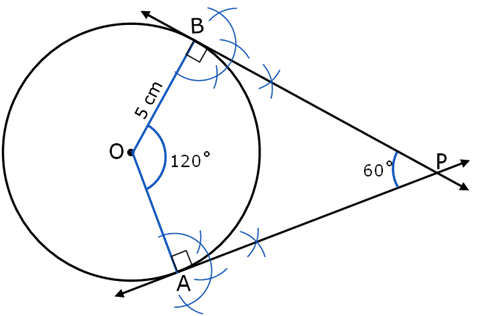
Steps of construction:
- Draw circle with centre O and radius OA = 5 cm, .
- Mark another point B on the circle such that ∠AOB = 120°, supplementary to the angle between the tangents. Since the angle between the tangents to be constructed is 60°.
∴ ∠AOB = 180° – 60° = 120°.
3.Construct angles of 90° at A and B and extend the lines so as to intersect at point P.
4. Thus, AP and BP are the required tangents to the circle.
Posted by Vikas Pal 5 years, 1 month ago (9400961)
- 2 answers
Yogita Ingle 5 years, 1 month ago (2577571)
The prophase I of meiosis occurs in the following stages:
1. Leptotene- This phase is the start of prophase-I. It is marked by the condensation of the chromosomes.
2. Zygotene- In this phase the homologous chromosomes start pairing up, called the synapsis. The synaptonemal complex starts building up. This complex is required to hold the homologous chromosomes at a place close to each other. Bivalent chromosomes are visible at this stage.
3. Pachytene- In this stage, this non-sister chromatids of homologous chromosomes exchange their parts, the process is called the crossing over. The attachment point of the crossing-over of the non-sister chromatids is called chiasma.
4. Diplotene- The crossing-over process is completed by this stage. The homologous chromosomes remain attched at the point of chiasma.
5. Diakinesis- The homologous chromosomes start to separate and synaptonemal complex disappears. The nuclear membrane also disappears.
Yogita Ingle 5 years, 1 month ago (2577571)
The prophase I of meiosis occurs in the following stages:
1. Leptotene- This phase is the start of prophase-I. It is marked by the condensation of the chromosomes.
2. Zygotene- In this phase the homologous chromosomes start pairing up, called the synapsis. The synaptonemal complex starts building up. This complex is required to hold the homologous chromosomes at a place close to each other. Bivalent chromosomes are visible at this stage.
3. Pachytene- In this stage, this non-sister chromatids of homologous chromosomes exchange their parts, the process is called the crossing over. The attachment point of the crossing-over of the non-sister chromatids is called chiasma.
4. Diplotene- The crossing-over process is completed by this stage. The homologous chromosomes remain attched at the point of chiasma.
5. Diakinesis- The homologous chromosomes start to separate and synaptonemal complex disappears. The nuclear membrane also disappears.
Posted by Kratika Dalela 5 years, 1 month ago (9940207)
- 0 answers
Posted by Sahil Khan 5 years, 1 month ago (9920757)
- 2 answers
Pardhan Ji 5 years, 1 month ago (10000633)
myCBSEguide
Trusted by 1 Crore+ Students

Test Generator
Create papers online. It's FREE.

CUET Mock Tests
75,000+ questions to practice only on myCBSEguide app

King Adithya H M... 5 years, 1 month ago (9827241)
1 Thank You