
Ask questions, doubts, problems and we will help you..
Ask questions which are clear, concise and easy to understand.
Ask Question
CBSE, JEE, NEET, CUET
Question Bank, Mock Tests, Exam Papers
NCERT Solutions, Sample Papers, Notes, Videos
Posted by Mehthab Sudeer 5 years ago (9378301)
- 2 answers
Yogita Ingle 5 years ago (2577571)
Chord – A line segment with its end-points lying on a circle is called the chord of the circle.

DE is the chord of the circle.
Posted by Aakriti Rustagi 5 years ago (4981969)
- 1 answers
Abhinav Jaju 5 years ago (8012538)
Posted by Kanishka R. 5 years ago (10066664)
- 3 answers
?☺️?☺️?Neha W(°O°)W Bharati 5 years ago (5698478)
Posted by Dhruv Kumar 5 years ago (10146508)
- 4 answers
Aastha Kumari Kumari 5 years ago (10146868)
Posted by Ajay Pareek 5 years ago (10143961)
- 1 answers
Posted by Amruta Shinde 5 years ago (10146538)
- 2 answers

Posted by Sakshi Tiwari 5 years ago (10145302)
- 2 answers
Yogita Ingle 5 years ago (2577571)
Italy was divided into smaller kingdoms namely Sardinia, Lombardy, Venetia and Sicily. Among these, Sardinia was the most powerful one. The Papal states, comprising Rome and Central Italy were under the Pope.Cavour was able to annex the kingdoms of Parma, Lombardy, Modena, Tuscany and parts of the Papal states in 1859. A bold sailor called Giuseppe Garibaldi annexed the rest of the territories of Naples. Venetia, which was under Austria was ceded to Italy by Austria in 1866 when Austria was weakened by the Prussian war. Rome refused to become part of the Italian state. In 1870, Prussia attacked France and the Pope stopped getting support from the French king. Rome was forcibly entered into and occupied by the Italians. Finally, the state of Italy emerged as an independent nation state in 1871 with Victor Emmanuel as the king.
Abhinav Jaju 5 years ago (8012538)
Posted by Priyanshi Zankat 5 years ago (8608906)
- 2 answers
Priyanshi Zankat 5 years ago (8608906)
Posted by Ajay Pareek 5 years ago (10143961)
- 0 answers
Posted by Vikram Kumar Vikram Kumar 5 years ago (9255630)
- 0 answers
Posted by Yash Baldev 5 years ago (10146514)
- 1 answers
Posted by Anisha Tayade 5 years ago (10146486)
- 1 answers
Om Deshmukh 5 years ago (9718361)
Posted by Madhura Rodge 5 years ago (9627809)
- 1 answers
Posted by Reya Chettri 5 years ago (10146414)
- 1 answers
Sakshi Solanki 5 years ago (10105037)
Posted by Ashni Sermaraja1104 5 years ago (9161954)
- 0 answers
Posted by Aishwarya Rajan 5 years ago (10146331)
- 1 answers
Diksha Laniya🐥 5 years ago (10085318)
Posted by Subhash Ramna 5 years ago (10146321)
- 2 answers
Posted by Ziyan Shaikh 5 years ago (10146265)
- 0 answers
Posted by Lazy Chazy 5 years ago (10081386)
- 2 answers
Versha Kawaliya 5 years ago (9109030)
Posted by Praachi Sharma 5 years ago (9985470)
- 1 answers
Yogita Ingle 5 years ago (2577571)
Nature’s bounty becomes significant only when people find it useful. It is people with their demands and abilities that turn them into ‘resources’. Hence, human resource is the ultimate resource.
Posted by Sonam 7C 5 years ago (10103018)
- 0 answers
Posted by Ashmit Tiwari 5 years ago (9603439)
- 1 answers
Posted by Raj Raj 5 years ago (8671917)
- 2 answers
Yogita Ingle 5 years ago (2577571)
Narmada Bachao Andolan also was known as NBA is a social movement formed by activist Medha Patkar. NBA consists of human activist, farmers, Adivasis, and people established on the bank of Narmada river. The main aim of the movement is against the large dams built or in process across the Narmada river. The Narmada flows across Madhya Pradesh, Gujarat, Maharashtra and ends up in the Arabian sea.
Posted by Swarali Kadam 5 years ago (10010131)
- 2 answers
Yogita Ingle 5 years ago (2577571)
The title,” on KILLING A tree’’ indicates the ironical fate of a tree .A tree is a generous helper. But man’s selfish greed annihilates it. As a simple jab or chopping cannot kill a tree, cruel man uses a number of cruel methods to kill a tree. So a tree is uprooted and snapped out of earth .then it is exposed to sunlight for drying. It passes through the process of scorching, choking, browning, hardening and twisting. The act of killing becomes complete when the tree becomes completely withered. The poet treats trees as sensitive living organisms. He adds human qualities to them to highlight their struggle for existence. Hence both from thematic and symbolical point of view the title is significance and justified.
Posted by Pooja Gulia 5 years ago (6654933)
- 2 answers
Yogita Ingle 5 years ago (2577571)
Joe Biden elected 46th President of the United States
Posted by Divyansh Babbar 5 years ago (8319254)
- 1 answers
Posted by Aaradhya Kumari 5 years ago (10128312)
- 1 answers
Yogita Ingle 5 years ago (2577571)
A prime number has exactly two factors, 1 and the number itself. So, Total numbers of a factor of a prime numbers is 2.
Posted by Ayush Kumar 5 years ago (9170636)
- 1 answers
Gaurav Seth 5 years ago (2898529)
STEP 1: Focus on the leftmost terms of both the dividend and divisor.
STEP 2: Divide the leftmost term of the dividend by the leftmost term of the divisor.
STEP 3: Place the partial answer on top.
<figure>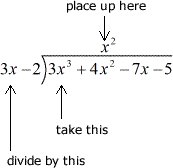 </figure>
STEP 4: Use that partial answer, x2, to multiply into the divisor (3x−2).
STEP 5: Place their product under the dividend. Make sure to align them by similar terms.
<figure>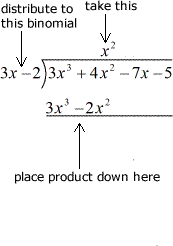 </figure>
STEP 6: Perform subtraction by alternating the signs of the bottom polynomial.
<figure>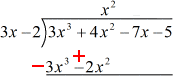 </figure>
STEP 7: Proceed with regular addition vertically. Again the first column cancels each other out. Looks like a pattern to me!
STEP 8: Carry down the next adjacent “unused” term of the dividend
<figure>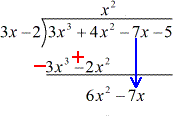 </figure>
STEP 9: Take the leftmost term of the bottom polynomial, and divide by the leftmost term of the divisor.
STEP 10: Place the answer on top, as usual.
<figure>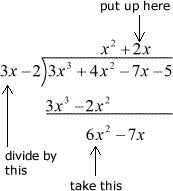 </figure>
STEP 11: Okay, perform another multiplication by the partial answer 2x and divisor (3x−2). Bring the product below.
<figure>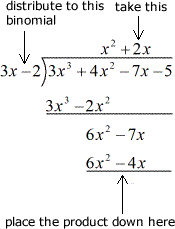 </figure>
STEP 12: Perform subtraction by switching signs and proceed with normal addition.
STEP 13: Carry down the last unused term of the dividend. We’re almost there!
<figure>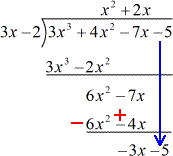 </figure>
STEP 14: We are going up one more time. Divide the leading term of the bottom polynomial by the leading term of the divisor. Place the answer up there!
<figure>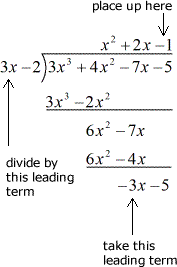 </figure>
STEP 15: This is our “last trip” going down so we distribute the partial answer −1 by the divisor (3x−2), and placing the product “downstairs”.
<figure>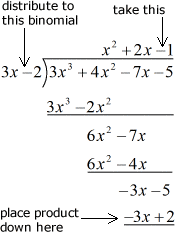 </figure>
STEP 16: Finish this off by subtraction leaving as with a remainder of −7.
<figure>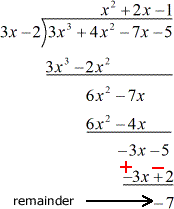 </figure>
STEP 17: Write the final answer in the following form.
<figure>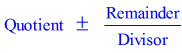 </figure>
<figure>
</figure>
<figure> </figure>
<hr />
</figure>
<hr />
Example 3: Divide using the long division method
<figure> </figure>
Solution: If you observe the dividend, it is missing some powers of variable x which are x3 and x2. I need to insert zero coefficients as placeholders for missing powers of the variable. This is a critical part to correctly apply the procedures in long division.
So I rewrite the original problem as . Now all x‘s are accounted for!
<figure> </figure>
STEP 1: Focus on the leading terms inside and outside the division symbol.
STEP 2: Divide the first term of the dividend by the first term of the divisor.
STEP 3: Position the partial answer on top.
<figure>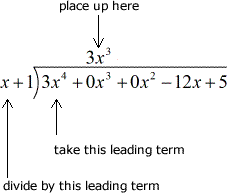 </figure>
STEP 4: Use that partial answer placed on top, 3x2 to distribute into the divisor (x + 1).
STEP 5: Put the result under the dividend. Make sure to align them by similar terms.
<figure>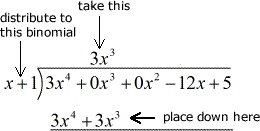 </figure>
STEP 6: Subtract them together by making sure to switch the signs of the bottom terms before adding.
<figure>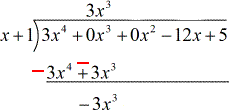 </figure>
STEP 7: Carry down the next unused term of the dividend.
<figure>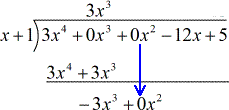 </figure>
STEP 8: Looking at the bottom polynomial, −3x3 + 0x2, use the leading term −3x3 and divide it by the leading term of the divisor, x. Put the answer above the division symbol.
<figure>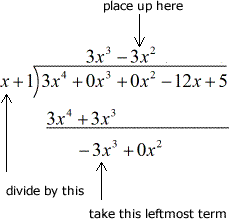 </figure>
STEP 9: Multiply the answer you got previously, −3x3, and distribute into the divisor (x + 1).
STEP 10: Place the answer below then perform subtraction.
<figure>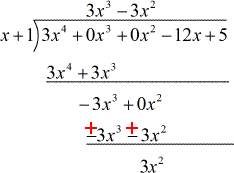 </figure>
STEP 11: Bring down the next adjacent term of the dividend
<figure> </figure>
STEP 12: Go up again by dividing the leading term below by the leading term of the divisor.
<figure>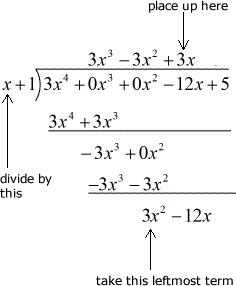 </figure>
STEP 13: Go down by distributing the answer in partial quotient into the divisor, followed by subtraction.
I believe the pattern makes sense now. Yes?
<figure>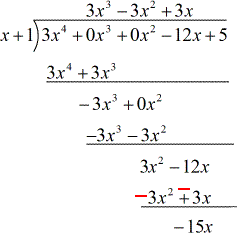 </figure>
STEP 14: Carry down the last term of the dividend.
<figure>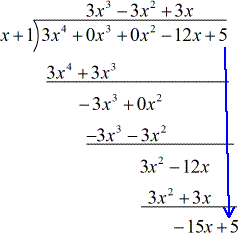 </figure>
STEP 15: Go up again while performing division.
<figure>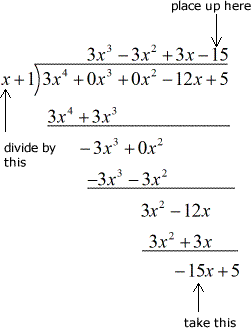 </figure>
STEP 16: Go down again while performing multiplication.
<figure>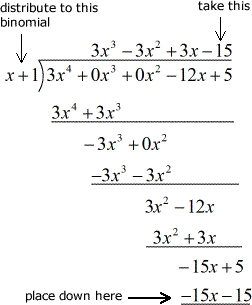 </figure>
STEP 17: Do the final subtraction, and we are done! The remainder is equal to 20.
<figure>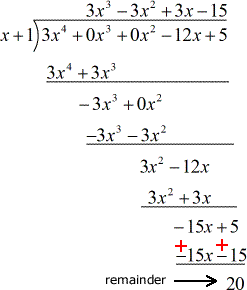 </figure>
STEP 18: The final answer is
<figure></figure>
<figure> </figure>
<hr />
</figure>
<hr />
Example 4: Divide the given polynomial using long division method
<figure>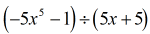 </figure>
Solution: The dividend is obviously missing a lot of variable x. That means I need to insert zero coefficients in every missing power of the variable.
I need to rewrite the problem this way to include all exponents of x in descending order:
<figure> </figure>
Remember the Main Steps in Long Division:
- When going up, we divide
- When going down, we distribute
- Subtract
- Carry down
- Repeat the process until done
Verify if the steps are being applied correctly in the example below.
<figure>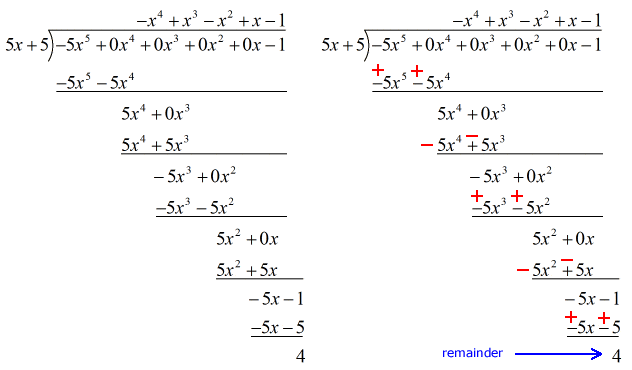 </figure>
So the final answer is
<figure>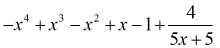 </figure>
Posted by Manuel Murmu 5 years ago (9679197)
- 2 answers
Yogita Ingle 5 years ago (2577571)
The speaker of the above lines is Vikram Seth. The extract is taken from 'The Frog and the Nightingale'.
myCBSEguide
Trusted by 1 Crore+ Students

Test Generator
Create papers online. It's FREE.

CUET Mock Tests
75,000+ questions to practice only on myCBSEguide app

Saneha Yadav 5 years ago (9731205)
0 Thank You