
Ask questions which are clear, concise and easy to understand.
Ask QuestionPosted by Arjyasini Mahapatro 3 years, 2 months ago
- 4 answers
Lakshmishree Lekana 3 years, 2 months ago
Dibyanshi Satapathy 3 years, 2 months ago
イシャントク ゲーマー 3 years, 2 months ago
Posted by Md Shahwali 3 years, 2 months ago
- 5 answers
Posted by Jay And Jiya Chaubal 3 years, 2 months ago
- 4 answers
Posted by Shehzad C 3 years, 2 months ago
- 1 answers
Posted by Darshan Darshan 3 years, 2 months ago
- 5 answers
Posted by Lakshay S2 3 years, 2 months ago
- 0 answers
Posted by Devyanshi Singh 3 years, 2 months ago
- 4 answers
Saini.Satwinder Saini Satwinder 3 years, 1 month ago
Goldi Kumari 3 years, 2 months ago
Aayushi Pundir 3 years, 2 months ago
Posted by Ashmit Kumar 3 years, 2 months ago
- 0 answers
Posted by Yoshini G7 3 years, 1 month ago
- 1 answers
Preeti Dabral 3 years, 1 month ago
{tex}\begin{aligned} &\frac{3 x}{4-2 x}-\frac{2 x+5}{3}=\frac{5}{2} \\ &\frac{3 x}{4-2 x}=\frac{5}{2}-\frac{5}{3} \\ &\frac{3 x}{4-2 x}=\frac{5}{6} \\ &18 x=5(4-2 x) \\ &18 x=20-10 x \\ &18 x+10 x=20 \\ &38 x=20 \\ &x=\frac{20}{38} \\ &x=\frac{10}{16} \\ &x=\frac{5}{8} \end{aligned}{/tex}
Posted by Priyanshi Maurya 3 years, 2 months ago
- 0 answers
Posted by Shaurya Agarwal 3 years, 2 months ago
- 1 answers
Abdur Raheem 3 years, 1 month ago
Posted by Priyanshi Maurya 3 years, 2 months ago
- 0 answers
Posted by Harshpreet Kaur 3 years, 2 months ago
- 0 answers
Posted by Samar Boyal 3 years, 2 months ago
- 1 answers
Posted by Danish Khan 3 years, 1 month ago
- 2 answers
Preeti Dabral 3 years, 1 month ago
As the depth increased the mass of the earth decreases. At the surface of earth this value will be maximum because radius will be maximum. When radius becomes less this value also decreases. Hence acceleration due to gravity decreases with increase in the depth.
Posted by K_Hushii 🍁 3 years, 2 months ago
- 4 answers
Posted by Amal Krishna 3 years, 2 months ago
- 2 answers
Posted by Kanishka Parmar Kanishka 3 years, 1 month ago
- 1 answers
Preeti Dabral 3 years, 1 month ago
A solid cylinder rolling up an inclination is shown in the following figure.
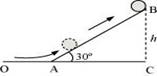
Initial velocity of the solid cylinder, v = 5 m/s
Angle of inclination, {tex}\theta = 30 ^ { \circ }{/tex}
Height reached by the cylinder = h
- Energy of the cylinder at point A will be purely kinetic due to the rotation and translational motion. Hence, total energy at A
= KErot + KEtrans
= {tex}\frac { 1 } { 2 } I \omega ^ { 2 } + \frac { 1 } { 2 } m v ^ { 2 }{/tex}The energy of the cylinder at point B will be purely in the form of gravitational potential energy = mgh
Using the law of conservation of energy, we can write:
{tex}\frac { 1 } { 2 } I \omega ^ { 2 } +\frac { 1 } { 2 } m v ^ { 2 } = m g h{/tex}
Moment of inertia of the solid cylinder, {tex}I = \frac { 1 } { 2 } m r ^ { 2 }{/tex}
{tex}\therefore \frac { 1 } { 2 } \left( \frac { 1 } { 2 } m r ^ { 2 } \right) \omega ^ { 2 } + \frac { 1 } { 2 } m v ^ { 2 } = m g h{/tex}
{tex}\frac { 1 } { 4 } I \omega ^ { 2 } + \frac { 1 } { 2 } m v ^ { 2 } = m g h{/tex}
But we have the relation, {tex}v = r \omega{/tex}
{tex}\therefore \frac { 1 } { 4 } v ^ { 2 } + \frac { 1 } { 2 } v ^ { 2 } = g h{/tex}
{tex}\frac { 3 } { 4 } v ^ { 2 } = g h{/tex}
{tex}\therefore h = \frac { 3 } { 4 } \frac { v ^ { 2 } } { g }{/tex}
{tex}= \frac { 3 } { 4 } \times \frac { 5 \times 5 } { 9.8 } = 1.91 \mathrm { m }{/tex}To find the distance covered along the inclined plane
In {tex}\Delta A B C{/tex}:
{tex}\sin \theta = \frac { B C } { A B }{/tex}
{tex}\sin 30 ^ { \circ } = \frac { h } { A B }{/tex}
{tex}A B = \frac { 1.91 } { 0.5 } = 3.82 \mathrm { m }{/tex}
Hence, the cylinder will travel 3.82 m up the inclined plane. -
{tex}v = \left( \frac { 2 g h } { 1 + \frac { K ^ { 2 } } { R ^ { 2 } } } \right) ^ { \frac { 1 } { 2 } }{/tex}
{tex}\therefore v = \left( \frac { 2 g A B \sin \theta } { 1 + \frac { K ^ { 2 } } { R ^ { 2 } } } \right) ^ { \frac { 1 } { 2 } }{/tex}
For the solid cylinder, {tex}K ^ { 2 } = \frac { R ^ { 2 } } { 2 }{/tex}
{tex}\therefore v = \left( \frac { 2 g A B \sin \theta } { 1 + \frac { 1 } { 2 } } \right) ^ { \frac { 1 } { 2 } }{/tex}
{tex}= \left( \frac { 4 } { 3 } g A B \sin \theta \right) ^ { \frac { 1 } { 2 } }{/tex}
The time taken to return to the bottom is:
{tex}t = \frac { A B } { v }{/tex}
{tex}= \frac { A B } { \left( \frac { 4 } { 3 } g A B \sin \theta \right) ^ { \frac { 1 } { 2 } } } = \left( \frac { 3 A B } { 4 g \sin \theta } \right) ^ { \frac { 1 } { 2 } }{/tex}
{tex}= \left( \frac { 11.46 } { 19.6 } \right) ^ { \frac { 1 } { 2 } } = 0.7645{/tex}
So the total time taken by the cylinder to return to the bottom is (2 {tex}\times{/tex} 0.764)= 1.53 s.as time of ascend is equal to time of descend for the following problem.
Posted by Account Deleted 3 years, 2 months ago
- 2 answers
Omya Aryan 3 years, 2 months ago
Akshat Mishra 3 years, 2 months ago
Posted by Luxmi Bhardwaj 3 years, 2 months ago
- 1 answers
Posted by Pratibha Patel 3 years, 1 month ago
- 1 answers
Posted by Ankit Thakur 3 years, 2 months ago
- 1 answers
Ram Avtar Kumar 2 years, 2 months ago
Posted by Vansh Nagar 3 years, 2 months ago
- 1 answers
Posted by Aryan Kesarwani 3 years, 1 month ago
- 2 answers
Preeti Dabral 3 years, 1 month ago
sharpening,bluring,Lens correction,lens. blur,noise reduction and liquify vanishing filters.
Posted by Vaibhav Tiwari 3 years, 1 month ago
- 1 answers
Posted by Shashank Thakur 3 years, 2 months ago
- 2 answers
Posted by Anku Mandal 3 years, 2 months ago
- 2 answers
Vibha .. 3 years, 2 months ago
Divit Singh 3 years, 2 months ago
Posted by Anku Mandal 3 years, 1 month ago
- 1 answers
Preeti Dabral 3 years, 1 month ago
- In olden times, the best way to present an idea was through symbolic personifications. This was the most common and appealing way to invite people's attention.
- From 1789, females appeared in paintings as a symbol of liberty and revolution. Artists, in the eighteenth and nineteenth centuries, often made efforts to represent a country as if it were a person. The female figures were chosen to express an abstract idea of a nation. These female figures, thus, became an allegory of the nation.
- During the French Revolution, many symbolic personifications of 'Liberty' and 'Reason' appeared. In France, the female figure was christened Marianne, which was characterized by Liberty and the Republic - the red cap. the tricolour, the cockade. Statues of Marianne stood in public squares to remind the people of the national symbol of unity.
- Statues of Marianne were erected in public places to remind the public of the national symbol of unity and to persuade them to identify with it.
- Marianne images were marked on coins and stamps,
- Similarly, Germania became the symbol of the German nation. This work was done by the artist Philip Veit. He depicted Germania as a female figure standing against a background where beams of sunlight shone through the tricolour fabric of the national flag. In visual representations, Germania wore the crown of oak leaves, as the German oak stood for heroism. Germania became the allegory of the German nation.
- During the French Revolution, artists used the formal allegory to portray ideas such as Liberty, Justice and the Republic.

myCBSEguide
Trusted by 1 Crore+ Students

Test Generator
Create papers online. It's FREE.

CUET Mock Tests
75,000+ questions to practice only on myCBSEguide app

Soumya Sanjan Swain 3 years, 1 month ago
0Thank You