
Ask questions which are clear, concise and easy to understand.
Ask QuestionPosted by Pankaj Kumar 5 years, 7 months ago
- 2 answers
Posted by Basketball Player 5 years, 7 months ago
- 1 answers
Yogita Ingle 5 years, 7 months ago
Statistics as aggregate of numerical facts : Some quantitative information relating to an individual like Ram has two brothers cannot be taken as statistics. In the same way Ram has 100 rupees in his pocket cannot be taken as statistics. Only the aggregates of data will be taken as statistics. Given below are some examples of statistics.
1. Birth rate in India is 18 per thousand as compared to 8 per thousand in USA.
2. There are 40 students in Class XI compared to just 20 students in Class XII.
3. Over the past 5 years, India has won 40 test matches in cricket and lost 20.
Posted by Gungun Arya Gupta 5 years, 7 months ago
- 2 answers
Gaurav Seth 5 years, 7 months ago
1. Understand the contents and weightage of the syllabus
Firstly, go through the latest CBSE Class 12th Maths syllabus 2020, where you will find the weightage of different units
2. Preparation from NCERT textbooks is the most important part
Though supplementary books may be used as references, the NCERT textbooks offer an exhaustive range of exercise questions and solved examples on every topic, which is more than enough to do well in your board examinations.
3. Strategize and THEN prepare!
The long form questions (5-6 marks), which are the most feared aspect of a paper, usually come from one of the following sections:
- Calculus, which carries a whopping 44% weightage, and can be really scoring
- Differential Equations consisting of the application based difficult questions.
- Vectors and 3D geometry carry the next highest 17% weightage.
The aforementioned topics are practice-based and the best way to gain perfection in them is to practice and solve more and more problems on them. Then,
- Probability, Relations and Functions and Algebra have a weightage of 10%, 10% and 13% respectively.
- Linear Programming: 6%
4. Practice sample papers and previous years’ papers
Examiners follow a pattern of repetition for specific important questions over a number of years, which is why it is very important to go through previous years’ papers.
Make sure that you solve the last few year’s papers on a timer, it will improve your speed, reasoning ability, and time management skills.
5. Say goodbye to rote learning!
Mathematics is all about understanding the concepts. So mugging up is not going to be of much help on the day of the examination.
Try to understand the fundamentals of the formulas; usually, they are all based on a single conceptual framework, and once you understand that, you can automatically do away with the mugging up of endless formulas.
6. Self-evaluation
As a step toward feeling less anxious, start by acknowledging your grey areas and your weaknesses.
Devote more time to improving them instead of making yourself feel bad about it. Maintaining a peaceful frame of mind is more significant than any preparation.
7. Presentation is very important
Neat work is a non-negotiable perk that always benefits a student. Make sure to label the graphs and figures properly.
Avoid overwriting and scribbling, if you’ve made a mistake then strike it off and start from below. Always leave some space between two questions, and start a new section on a fresh page.
8. Time management
The reading time is the most crucial and must be used judiciously. This involves reading the paper thoroughly, especially the ones involving statements, underlining keywords and then choosing the most scoring questions based on your understanding.
If you’re stuck on a question, leave some space and keep moving forward. You can revisit it later with a fresh mind.
Always keep 15-20 minutes buffer time for revising and rectifying your answers at the end.
Posted by Priya Minj 5 years, 7 months ago
- 0 answers
Posted by Komal Meena 5 years, 7 months ago
- 2 answers
Gaurav Seth 5 years, 7 months ago
A n s w e r :
Garrison towns are those towns which are established for security functions during the British rule. Their main function is related to defense. For example, Ambala, Jalandhar, Babina, etc.
Yogita Ingle 5 years, 6 months ago
The towns that have troops permanently stationed in it
The functions:
(i) to defend national security
(ii) to maintain safely the military equipments.
Posted by K Hariharan 5 years, 7 months ago
- 1 answers
Gaurav Seth 5 years, 7 months ago
The last lesson’ written by Alphonse Daudet narrates about the year 1870 when the Prussian forces under Bismarck attacked and captured France. The French districts of Alsace and Lorraine went into Prussian hands. The new Prussian rulers discontinued the teaching of French in the schools of these two districts The French teachers were asked to leave. Now M. Hamel could no longer stay in his school. Still he gave lesson to his students with utmost devotion and sincerity as ever. One such student of M. Hamel, Franz who dreaded French class and M. Hamel’s iron rod, came to the school that day thinking he would be punished as he had not learnt his lesson on participles. But on reaching school he found Hamel dressed in his fine Sunday clothes and the old people of the village sitting quietly on the back benches. It was due to an order from Berlin. That was the first day when he realized for the first time that how important French was for him, but it was his last lesson in French. The story depicts the pathos of the whole situation about how people feel when they don’t learn their own language. It tells us about the significance of one’s language in one’s life for the very existence of a race and how important it is to safeguard it.
Posted by ಹರ್ಷನಂದ ಹರ್ಷನಂದ 4 years, 10 months ago
- 1 answers
Sia ? 4 years, 10 months ago
Electric flux is the rate of flow of the electric field through a given area (see ). Electric flux is proportional to the number of electric field lines going through a virtual surface.
An electric motor is an electrical machine that converts electrical energy into mechanical energy. Most electric motors operate through the interaction between the motor's magnetic field and electric current in a wire winding to generate force in the form of torque applied on the motor's shaft.
Posted by Satyapriya Boro Boro 5 years, 7 months ago
- 2 answers
Shyam Meema 5 years, 7 months ago
Posted by Taslim Khan 5 years, 7 months ago
- 0 answers
Posted by Shruti Sharma 5 years, 7 months ago
- 2 answers
Shanjay Piranav 5 years, 7 months ago
Gaurav Seth 5 years, 7 months ago
MOVING COIL GALVANOMETER:
- Moving coil galvanometer is an electromagnetic device that can measure small values of current. It is also known as Weston galvanometer.
- It works on the principle that when a current loop is placed in an external magnetic field, it experiences torque, and the value of torque can be changed by changing the current in the loop
- Moving coil galvanometer consists of permanent horse-shoe magnets, coil, soft iron core, pivoted spring, non-metallic frame, scale and pointer
- We know that a current loop having N number of turns,and the cross sectional area A, carrying current i, when placed in and along the direction of external magnetic field B, experiences a torque given by:
ԏ = NiAB

The pivoted spring of spring constant k would oppose the above torque with restoring torque C given by: C = kΦ
Here, Φ is the angular deflection of spring
- Both, the torque, and the restoring torque would be equal:
kΦ = NiAB
Φ = NiAB/k
- In the above equation, except for current, every other quantity on the right hand side is constant for a galvanometer, hence:
Φ ∝ i
- So, the angular deflection Φ produced in the pointer could be measured in terms of current in the scale calibrated on the basis of above equations.
- To use galvanometer as an ammeter (to measure higher values of current), we need to connect a shunt wire, with very small resistance(Rs), in parallel with the galvanometer (which have very low resistance of Rg

Equivalent resistance R of ammeter will be:
R = RgRs/(Rg + Rs)
Rg ˃˃ Rs
∴ R = RgRs/Rg = Rs
- So, the equivalent resistance of ammeter is very less, which is a must for sensitivity of ammeter to be higher. Also, most of the current will pass through the shunt, thus protecting the galvanometer from any damage.
- Ammeter is connected in series with the circuit where current is to be measured
- Current sensitivity(deflection per unit current) of galvanometer is given by:
Φ/i = NAB/k
- To use galvanometer as a voltmeter, we need to connect a wire, with very high resistance(Rw˃˃Rg), in series with the galvanometer to ensure that our voltmeter equivalent resistance is high and so that it will draw a very small current. Equivalent resistance will be given by:
R = Rg + Rw = Rw

Voltmeter is connected in parallel with the circuit where voltage is to be measured
- Voltage sensitivity (deflection per unit voltage) of galvanometer is given by:
Φ/V = NAB/(kR)
Posted by B Anwesha 5 years, 7 months ago
- 1 answers
Gaurav Seth 5 years, 7 months ago
When grease or oil on the cloth comes in contact with soap solution, the stearate ions arrange themselves in such a way that its hydrophobic part is in the oil (or grease) and the hydrophilic parts project outside the grease droplet like bristles.
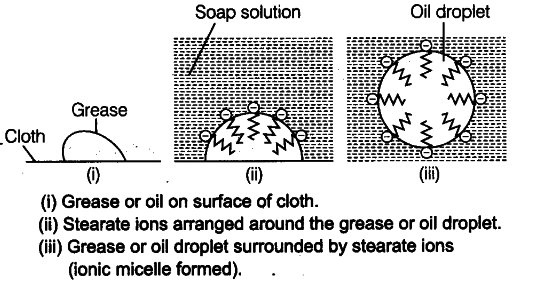
As the hydrophilic part is polar, these polar groups can interact with the water molecules present around the oil droplet which is pulled away from the surface of the cloth into water to form ionic micelle. Thus, soap helps in emulsification and washing away of oils and fats. The negatively charged sheath around the globules prevent them from coming together and forming aggregates. It is then washed away with the excess of water
Posted by Teena Verma 5 years, 7 months ago
- 0 answers
Posted by Teena Verma 5 years, 7 months ago
- 0 answers
Posted by Poorvika Poorvika 5 years, 7 months ago
- 2 answers
Yogita Ingle 5 years, 7 months ago
When goods and services included in GDP are valued at current prices, i.e., prices prevailing in the year for which GDP is being measured, it is called nominal GDP. For example, Nominal GDP of 2010 is the value of output produced in 2010 calculated at the market prices prevailing in 2010. In short Nominal GDP values current year's output in an economy at current year prices.
Posted by Mihir Shah 5 years, 7 months ago
- 0 answers
Posted by Shubham Beriwal 5 years, 7 months ago
- 2 answers
Shweta? Dhama? 5 years, 7 months ago
Yogita Ingle 5 years, 7 months ago
Transition elements are those elements that have partially or incompletely filled d orbital in their ground state or the most stable oxidation state. The partially filled subshells of d-block elements incorporate (n-1) d subshell. All the d-block elements carry a similar number of electrons in their furthest shell.
The transition elements are placed between S and P block elements. They are divided as first transition series (the elements from Sc to Cu), the second transition series (the elements from Y to Ag), and the third transition series (the element La and the elements from Hf to Au).
Posted by Komal Chhillar 5 years, 7 months ago
- 1 answers
Gagan Jaat 5 years, 7 months ago
Posted by Satnam Kaur 5 years, 7 months ago
- 2 answers
Posted by Satnam Kaur 5 years, 7 months ago
- 1 answers
Posted by Vicky Wani 5 years, 7 months ago
- 1 answers
Gaurav Seth 5 years, 7 months ago
k = (2.303/t)log a/(a - x)
K = specific reaction rate
Let initial conc. (a) = 100g, t = 10min
Posted by Vicky Wani 5 years, 7 months ago
- 1 answers
Yogita Ingle 5 years, 7 months ago
(a) Copper wire at 25˚C because with increase in temperature, resistance increase, metallic conduction decrease with increase in temp .due to vibration of kernels.
(b) 0.1 M acetic acid solution because with dilution degree of dissociation increases and hence number of ions.
Posted by Vicky Wani 5 years, 7 months ago
- 1 answers
Gaurav Seth 5 years, 7 months ago
Answer
(a) Molar mass of KI = 39 + 127 = 166 g mol - 1
20% (mass/mass) aqueous solution of KI means 20 g of KI is present in 100 g of solution.
That is,
20 g of KI is present in (100 - 20) g of water = 80 g of water
Therefore, molality of the solution = Moles of KI / Mass of water in kg
= 20/166 / 0.08 m
= 1.506 m
= 1.51 m (approximately)
(b) It is given that the density of the solution = 1.202 g mL - 1
∴Volume of 100 g solution = Mass / Density
= 100g / 1.202g mL-1
= 83.19 mL
= 83.19 × 10 - 3 L
Therefore, molarity of the solution = 20/166 mol / 83.19 × 10 - 3 L
= 1.45 M
(c) Moles of KI = 20/166 = 0.12 mol
Moles of water = 80/18 = 4.44 mol
Therefore, mole fraction of KI = Moles of KI / (Moles of KI + Moles of water)
= 0.12 / (0.12+4.44)
= 0.0263
Posted by Sakshi Kushwaha 5 years, 7 months ago
- 0 answers
Posted by Abhishek Gupta 5 years, 7 months ago
- 4 answers

myCBSEguide
Trusted by 1 Crore+ Students

Test Generator
Create papers online. It's FREE.

CUET Mock Tests
75,000+ questions to practice only on myCBSEguide app

Yogita Ingle 5 years, 7 months ago
Gauss’s Law
According to Gauss’s law, the total of the electric flux out of a closed surface is equal to the charge enclosed divided by the permittivity. The total electric flux through a closed surface is zero if no charge is enclosed by the surface.
0Thank You