
Ask questions which are clear, concise and easy to understand.
Ask QuestionPosted by Unique #Seraj Ali ??? 5 years, 3 months ago
- 3 answers
Shikshita Naryal 5 years, 3 months ago
Posted by Unique #Seraj Ali ??? 5 years, 3 months ago
- 3 answers
Princy Rawat 5 years, 3 months ago
Blessy Boban 5 years, 3 months ago
Yashvi Prabhune 5 years, 3 months ago
Posted by Hardik Desai 5 years, 3 months ago
- 1 answers
Ganika Arora 5 years, 3 months ago
Posted by Satyendra Kumar??✌?? 5 years, 3 months ago
- 1 answers
Shreya Kumari 5 years, 3 months ago
Posted by Satyendra Kumar??✌?? 5 years, 3 months ago
- 0 answers
Posted by Aj Kashyap 5 years, 3 months ago
- 4 answers
Posted by Sonakshi Suneja 5 years, 3 months ago
- 1 answers
Meghna Thapar 5 years, 3 months ago
In a true experiment, participants are randomly assigned to either the treatment or the control group, whereas they are not assigned randomly in a quasi-experiment. Randomized trials are experiments in which the division into treatment and control groups is determined at random (for example, by tossing a coin). ... In some cases, quasi-experiments also involve random assignment, such as in the lotteries sometimes used to distribute school vouchers. In a true experiment, each participant who volunteered would have an equal chance of being assigned to any of the three groups. Quasi-experiments are employed when the researcher is interested in independent variables that cannot be randomly assigned. Quasi-experimental research involves the manipulation of an independent variable without the random assignment of participants to conditions or orders of conditions. Among the important types are nonequivalent groups designs, pretest-posttest, and interrupted time-series designs.
Posted by Sonakshi Suneja 5 years, 3 months ago
- 1 answers
Meghna Thapar 5 years, 3 months ago
Largely, there are four approaches by which the effect of the extraneous variables can be controlled.
1) Randomization: In this approach, treatments are randomly assigned to the experimental groups. It is assumed that the extraneous factors are present equally in all the groups. This technique is only workable when the sample size is very large.
2)Matching: Another important technique is to match the different groups of confounding variables. Different confounding variables like gender, age, income etc. could be distributed equally amongst the group. It sometimes does become difficult to extend matching within all the groups and another drawback of the same is that, sometime the matched characteristics may be irrelevant to the dependant variable.
3)The use experimental designs: In certain studies, the experimental designs may play a crucial role in reducing or completely removing the role and impact of the extraneous variables.
4)Statistical Control: There may be situations, when all the above mentioned methods to control the extraneous variables do not show any significant outcome. It brings the entire research into question as then causal inferences are difficult to make. Another method that may work to bring down the effect of extraneous variables is the method of statistical control. Among the various statistical tools and techniques, Analysis of Covariance ( ANOVA) helps in reducing the impact of the extraneous factors on the study.
Posted by Sonakshi Suneja 5 years, 3 months ago
- 1 answers
Meghna Thapar 5 years, 3 months ago
Case study is a descriptive qualitative form of research that is used to look at subjects, a small group, or a group as a whole. Researchers collect data on participants using participants and direct observations, interviews, tests, and record exams.
The important characteristics of the case study method are as under:
- Under this method the researcher can take one single social unit or more of such units for his study purpose; he may even take a situation to study the same comprehensively.
- Here the selected unit is studied intensively i.e., it is studied in minute details. Generally, the study extends over a long period of time to ascertain the natural history of the unit so as to obtain enough information for drawing correct inferences.
- In the context of this method we make complete study of the social unit covering all facets. Through this method we try to understand the complex of factors that are operative within a social unit as an integrated totality.
- Under this method the approach happens to be qualitative and not quantitative. Mere quantitative information is not collected. Every possible effort is made to collect information concerning all aspects of life. As such, case study deepens our perception and gives us a clear insight into life. For instance, under this method we not only study how many crimes a man has done but shall peep into the factors that forced him to commit crimes when we are making a case study of a man as a criminal. The objective of the study may be to suggest ways to reform the criminal.
- In respect of the case study method an effort is made to know the mutual inter-relationship of causal factors.
- Under case study method the behaviour pattern of the concerning unit is studied directly and not by an indirect and abstract approach.
- Case study method results in fruitful hypotheses along with the data which may be helpful in testing them, and thus it enables the generalised knowledge to get richer and richer. In its absence, generalised social science may get handicapped.
Posted by Sakshi Naik 5 years, 3 months ago
- 1 answers
Posted by Nandita Madhivanan 5 years, 3 months ago
- 1 answers
Meghna Thapar 5 years, 3 months ago
Glu-Lys is a dipeptide composed of L-glutamic acid and L-lysine joined by a peptide linkage. It has a role as a metabolite. It derives from a L-glutamic acid and a L-lysine. Glutamyllysine is a dipeptide composed of glutamate and lysine, and is a proteolytic breakdown product of larger proteins.
Posted by Siddharth Roy 5 years, 3 months ago
- 1 answers
Ganika Arora 5 years, 3 months ago
Posted by Shailesh Maurya 5 years, 3 months ago
- 1 answers
Meghna Thapar 5 years, 3 months ago
Photons are electrically neutral. Photons have no mass, but they have energy E = hf = hc/λ. Here h = 6.626*10-34 Js is a universal constant called Planck's constant. The energy of each photon is inversely proportional to the wavelength of the associated EM wave. The energy associated with a single photon is given by E = h ν , where E is the energy (SI units of J), h is Planck's constant (h = 6.626 x 10⁻³⁴ J s), and ν is the frequency of the radiation (SI units of s–1 or Hertz, Hz)
Posted by Alina Shaikh 5 years, 3 months ago
- 1 answers
Posted by Charu Soni 5 years, 3 months ago
- 0 answers
Posted by Suman Chaudhary 5 years, 3 months ago
- 0 answers
Posted by Suman Chaudhary 5 years, 3 months ago
- 5 answers
Posted by Shreya Dubey 5 years, 3 months ago
- 4 answers
Priyvrat Rautela 5 years, 3 months ago
Posted by Vijayaraghavan Nair 5 years, 3 months ago
- 1 answers
Meghna Thapar 5 years, 3 months ago
The process of defragmentation moves the data blocks on the hard drive around to bring all the parts of a file together. Defragmentation reduces file system fragmentation, increasing the efficiency of data retrieval and thereby improving the overall performance of the computer. When a program saves a file on a disk, it puts the file into an empty space on the disk. Disk defragmentation takes all the pieces of each file, and stores them in one place. ... It also makes sure programs are each in one place, and that unused space on the hard disk is all together.
Posted by Somnathsahu Somnathsahu 5 years, 3 months ago
- 1 answers
Dakshil Sanchaniya 5 years, 3 months ago
Posted by Shubham Kumar 5 years, 3 months ago
- 1 answers
Posted by Pallavi Vishwakarma 5 years, 3 months ago
- 0 answers
Posted by Gagan Preet 5 years, 3 months ago
- 2 answers
Manpreet Kaur 5 years, 3 months ago
Yogita Ingle 5 years, 3 months ago
The tendency of a body to continue in its state of motion is called inertia of motion .
Example: Rider Falls forwards when a galloping horse stop suddenly. When the horse stops, the Rider on account of inertia of motion, continues moving and hence falls in forward direction.
Posted by Gagan Preet 5 years, 3 months ago
- 1 answers
Yogita Ingle 5 years, 3 months ago
Following are the different methods that are used for reducing the friction:
- For objects that move in fluids such as boats, planes, cars, etc, the shape of their body is streamlined in order to reduce the friction between the body of the objects as the fluid.
- By polishing the surface, as polishing makes the surface smooth and friction can be reduced.
- Using lubricants such as oil or grease can reduce the friction between the surfaces.
- When objects are rolled over the surface, the friction between the rolled object and surface can be reduced by using ball bearings
Posted by Gagan Preet 5 years, 3 months ago
- 1 answers
Yogita Ingle 5 years, 3 months ago
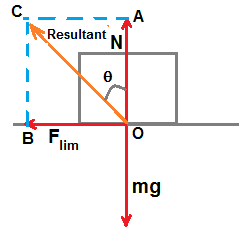
Angle of Friction beween any two surface in contact is defined as the angle which the resultant
of the force of limiting friction Flim and normal reaction N makes with the direction of normal reaction N
as shown in figure. It is marked in the figure as θ.
The value of angle of friction depends on the material and nature of surfaces in contact.
It can be seen from figure, tanθ = AC/OA = Flim / N = μ , where μ is coefficient of limiting friction
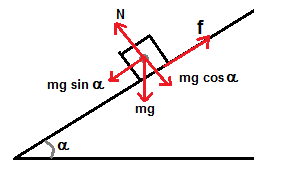
The angle of repose or angle of sliding α is defined as the minimum angle of inclination of a plane
with the horizontal such that a body placed on the plane just begins to slide down.
Its value depends on the material and nature of the surface in contact.
from the figure it can be seen that, f =mg sinα ...............(1)
N = mg cosα ....................(2)
hence we get, f / N = tan α = μ

myCBSEguide
Trusted by 1 Crore+ Students

Test Generator
Create papers online. It's FREE.

CUET Mock Tests
75,000+ questions to practice only on myCBSEguide app

Unique #Seraj Ali ??? 5 years, 3 months ago
0Thank You