
Ask questions which are clear, concise and easy to understand.
Ask QuestionPosted by Viviane Deb 5 years, 6 months ago
- 0 answers
Posted by Do You Know Me 5 years, 6 months ago
- 1 answers
Meghna Thapar 5 years, 6 months ago
Posted by Niket Kumar Shoryavan ? 5 years, 6 months ago
- 0 answers
Posted by Niket Kumar Shoryavan ? 5 years, 6 months ago
- 0 answers
Posted by Niket Kumar Shoryavan ? 5 years, 6 months ago
- 0 answers
Posted by Niket Kumar Shoryavan ? 5 years, 6 months ago
- 0 answers
Posted by Uttam Rajput 5 years, 6 months ago
- 1 answers
Posted by Aakash Kumar 5 years, 6 months ago
- 1 answers
Gaurav Seth 5 years, 6 months ago
One molecule of Ca(NO3)2 contains 2 atoms of N.
Mass of nitrogen in one mole Ca(NO3)2 molecule = 28 g ( 2 x molar mass of nitrogen)
28g N = one mole molecule of Ca(NO3)2.
20 g N = 1x 20 /28 = 0.71 mole of Ca(NO3)2.
One molecule of Ca(NO3)2 contains 2 atoms of N.
1 mole Ca(NO3)2 = 40 g Ca
0.71 mole Ca(NO3)2 = 40 x 0.71 = 28.4 g Ca.
Posted by Simran Kamboj 5 years, 6 months ago
- 1 answers
Gaurav Seth 5 years, 6 months ago
- Pachytene is the third stage of meiosis prophase-1 (a five-stage process). It is preceded by the zygotene stage, where synapsis, i.e. pairing of homologous chromosomes take place.
- In pachytene, exchange of genetic material between two homologous chromosomes known as crossing over takes place between non-sister chromatids of the homologous chromosomes.
-
Recombination or crossing over takes place at this stage. In this process, there is an exchange of genetic material between non-sister chromatids of homologous chromosomes. There is rearrangement and reshuffling of the genetic material of two parental homologous chromosomes. It is an enzyme-mediated process. The enzyme involved in crossing over is known as recombinase.
Recombination nodules appear and homologous chromosomes are linked to each other at the site of crossing over.
Recombination is accompanied by the formation of chiasmata, which appear in the next stage called diplotene.
Posted by Vinay Dwivedi 5 years, 6 months ago
- 1 answers
Gaurav Seth 5 years, 6 months ago
The Bronfenbrenner's contextual view of development is based on four sytems.
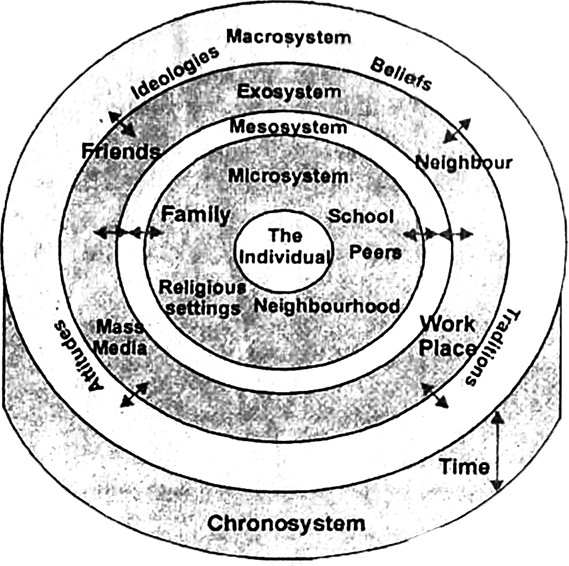
(i) Microsystem: It is the immediate environment/setting in which the individuals lives. It is in these settings where the child directly interact with the social agents like family, peer, teachers and neighbourhood.
(ii) Mesosystem: Relations between teacher and parents or family and neighbourhood etc.
(iii) Exosystem: Events in the social settings where the child does not participate directly but influence the child experiences in the immediate context. For example the transfer of father or mother may effect the interaction with child.
(iv) Chronosystem: It involves the events socio-historical circumstances, divorce etc.
In nutshell the child development significantly affect by complex world.
Posted by Paidi Sandhya 5 years, 6 months ago
- 1 answers
Gaurav Seth 5 years, 6 months ago
Aramaic is an ancient language of the Middle East, still spoken in parts of Syria and the Lebanon
Semitic language known since the ninth century b.c. as the speech of the Aramaeans and later used extensively in southwest Asia as a commercial and governmental language and adopted as their customary speech by various non-Aramaean peoples including the Jews after the Babylonian exile.
Posted by Sachi Kariya 5 years, 6 months ago
- 2 answers
Ruchi Rao 5 years, 6 months ago
Raghvendra Chouksey 5 years, 6 months ago
Posted by Pardeep Kumar 5 years, 6 months ago
- 1 answers
Yogita Ingle 5 years, 6 months ago
Society is a system of usage and procedures of authority and mutual aid, of many groupings and divisions, of controls of human behaviour and of liberties. It is the web of social relationship. It is always changing.
Posted by Pardeep Kumar 5 years, 6 months ago
- 1 answers
Yogita Ingle 5 years, 6 months ago
Sociology is a science as it involves objectives and systematic methods of investigation and evaluation of social reality in the light of empirical evidence and interpretation.
It is not a natural science because human behaviour is not exacting and varies from person to person.
Sociology is a categorical science because it relates to “what is”. It is a pure science because sociology collects the knowledge about human society only and not concerned with its application. Sociology is an abstract science because it studies the design and norms of the society. It is a science of generalisation. It provides understanding about groups, social actions, subject matter and structure. Sociology presents general principles related to social interaction so it is a general science. Sociology is a science because it uses scientific methodology. It uses method of observation and believes in theory of causation and objectivity.

Posted by Aadya Singh 5 years, 6 months ago
- 2 answers
Posted by Sahil Manchanda 5 years, 6 months ago
- 1 answers
Posted by Komal Kashyap 5 years, 6 months ago
- 3 answers
Manshu Dhoundiyal 5 years, 6 months ago
Posted by Abhay Shyam 5 years, 6 months ago
- 2 answers
Yogita Ingle 5 years, 6 months ago
{tex}Momentum=3.313×10^-24kgms-{/tex}
Explanation:
Here,de-broglie wavelength.
wavelenght=h/mv
200× 10-12=6.626×10⁻³⁴/p[1pm=10-12m,h=6.626×10-34]
p=6.626×10⁻³⁴/200×10-12
p=6.626×10⁻³⁴/2×10-10
p=3.313×10 -34+10
p=3.313×10⁻²⁴kgms-
Posted by Lalnun Fima 5 years, 6 months ago
- 1 answers
Gaurav Seth 5 years, 6 months ago
The Constitution makes the following provisions under Article 45 of the Directive Principles of State Policy that, “The state shall endeavour to provide within a period of ten years from the commencement of this Constitution, for free and compulsory Education for all children until they complete the age of fourteen years.”
Article 29(1) states “Any section of the citizen, residing in the territory of India or any part there of having a distinct language, script or culture of its own, hall have the right to conserve the same.” Article 350 B provides for the appointment of special officer for linguistic minorities to investigate into all matters relating to safeguards provided for linguistic minorities under the Constitution.
Article 15, 17, 46 safeguard the educational interests of the weaker sections of the Indian Community, that is, socially and educationally backward classes of citizens and scheduled castes and scheduled tribes. Article 15 states, “Nothing in this article or in clause (2) of Article 29 shall prevent the state from making any special provision for the advancement of any socially and educationally backward classes of citizens or for the scheduled castes and the scheduled tribes.”
Under Article 46 of the Constitution, the federal government is responsible for the economic and educational development of the Scheduled Castes and Scheduled Tribes
Article 29(1) states “No citizen shall be denied admission into any educational institution maintained by the State or receiving aid out of State funds, on grounds only of religion, race, caste, language or any of them.”
Posted by Bhavya Prakash 5 years, 6 months ago
- 0 answers
Posted by ? Kirtika 5 years, 6 months ago
- 3 answers
Posted by ? ? 5 years, 6 months ago
- 5 answers
? ? 5 years, 6 months ago
? ? 5 years, 6 months ago
? ? 5 years, 6 months ago
? ? 5 years, 6 months ago
Posted by Bramesh Mohkud 5 years, 6 months ago
- 0 answers
Posted by Lenjing Saring 5 years, 6 months ago
- 2 answers
Aviral Goyal 5 years, 6 months ago
Yogita Ingle 5 years, 6 months ago
- All natural earthquakes occur in the lithosphere.
- Seismic wave studies offer a full picture of the layered interior.
- An earthquake is, simply put, shaking of the earth’s crust.
- It is caused due to the energy release, which triggers waves that travel in all directions.
- The emanation of energy occurs along a fault.
- A fault is a sharp break in the crustal rocks.
- Rocks along a fault generally move in opposing directions.
Posted by Lenjing Saring 4 years, 9 months ago
- 1 answers
Sia ? 4 years, 9 months ago
Posted by Diya .S. Harish 5 years, 6 months ago
- 1 answers
Yogita Ingle 5 years, 6 months ago
A questionnaire is a research instrument that consists of a set of questions or other types of prompts that aims to collect information from a respondent. A research questionnaire is typically a mix of close-ended questions and open-ended questions. Open-ended, long-form questions offer the respondent the ability to elaborate on their thoughts. Research questionnaires were developed in 1838 by the Statistical Society of London.

myCBSEguide
Trusted by 1 Crore+ Students

Test Generator
Create papers online. It's FREE.

CUET Mock Tests
75,000+ questions to practice only on myCBSEguide app
