
Ask questions which are clear, concise and easy to understand.
Ask QuestionPosted by Garima Verma 5 years, 6 months ago
- 0 answers
Posted by Bhagwanti Aaswani 5 years, 6 months ago
- 0 answers
Posted by Buttar Jass 5 years, 6 months ago
- 1 answers
Gaurav Seth 5 years, 6 months ago
Indian constitution has borrowed a great deal of provisions from the Constitution of other countries:
a. Our political leaders were inspired from the various constitutions of the World.
b. Like they borrowed provision of bill of rights from US constitution, idea of Parliamentary form of government from the British.
c. Ideas of socialism were borrowed from Russian constitution , ideals of liberty , equality and fraternity from the French.
d. But it may be noted that all these provisions were not blindly incorporated . They were thoroughly discussed and debated.
e. They were modified to suit Indian conditions.
Posted by Mon Basnet 5 years, 6 months ago
- 1 answers
Gaurav Seth 5 years, 6 months ago
(i) The lessons taught in the city school were in English and the topics such as little things of Western science, law of gravity etc were all beyond grandmother's comprehension. She could not help her grandson with his lessons so, she was unhappy. (ii) She had no faith in the things that were taught in the English school and was distressed that there was no teaching about God and scriptures. (iii) She was very unhappy when she came to know that music lessons were taught in her grandson's school. She always associated music with harlots and beggars and not with gentle folk.
Posted by Asmita Mukherjee 5 years, 6 months ago
- 0 answers
Posted by Bhawana Singh 5 years, 6 months ago
- 3 answers
Posted by Ved Doshi 5 years, 6 months ago
- 2 answers
Yogita Ingle 5 years, 6 months ago
Open System: - In this system there is exchange of energy and matter. For Example: - Water boils in a pan without lid, a cup of coffee.
Example: Water is boiling in a pan without lid.
Ved Doshi 5 years, 6 months ago
Posted by Anamika Varak 5 years, 6 months ago
- 1 answers
Ruby Shukla 5 years, 6 months ago
Posted by Shashwat Singh 5 years, 6 months ago
- 5 answers
Posted by Aman Kumar 5 years, 6 months ago
- 1 answers
Posted by Ñîràv Ñp 5 years, 6 months ago
- 1 answers
Gaurav Seth 5 years, 6 months ago
The stomach has four parts :
(1) Cardiac stomach : It is proximal part. The opening of oesophagus into cardiac stomach is guarded by cardiac sphincter which prevents the regurgitation of food.
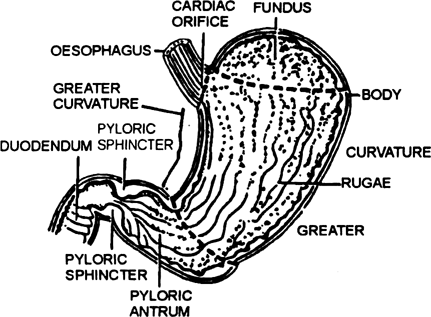
Section of the stomach
(2) Fundus : It extends above cardiac aperture and is filled with air. The part of cardiac stomach which extends towards anterior end above level of cardiac aperture is called fundus.
(3) Body : It is the middle large part of the stomach.
(4) Pyloric stomach : It is the distal narrowest part of stomach which opens into duodenum. Its opening is guarded by pyloric sphincter which permits the passage of fine-food particles into duodenum.
Posted by Saniya Bano 5 years, 6 months ago
- 2 answers
Gaurav Seth 5 years, 6 months ago
भारतीय संविधान एक जीवंत दस्तावेज है:
भारतीय संविधान एक जीवंत दस्तावेज है इसका तात्पर्य यह है कि हमारे संविधान में समय की जरूरतों को देखते हुए इसके अनुकूल संविधान में संशोधन किये जा सकते है | यही कारण है कि भारतीय संविधान को एक जीवंत दस्तावेज कहा जाता है |
यह निम्नलिखित बिन्दुओं से स्पष्ट हो जाता है |
(i) यह भविष्य में होने वाले परिवर्तनों के साथ-साथ चलने वाला संविधान है | यदि कभी भविष्य में किसी विषय को लेकर यदि कोई परिवर्तन करना हो तो हमें अन्य संविधान की आवश्यकता नहीं है वरन हम इसी संविधान में संशोधन कर इसे जीवंत बना सकते है |
(ii) हमारा संविधान कुछ मामलों में लचीला है तो कुछ में कठोर है |
(iii) अदालती फैसले और राजनीतिक व्यवहार-बरताव दोनों ने संविधान के अमल में अपनी परिपक्वता और लचीलेपन का परिचय दिया है। इन्हीं वजहों से हमारा संविधान कानूनों की एक बंद और जड़ किताब न बनकर एक जीवंत दस्तावेश के रूप में विकसित हो सका है।
(iv) समय के एक खास मोड़ पर अपने समाज के लिए संविधान तैयार कर रहे लोगों को एक आम चुनौती का सामना करना पड़ता है। इसलिए, किसी भी संविधान को भविष्य में पैदा होने वाली चुनौतियों का समाधान प्रस्तुत करने में भी सक्षम होना चाहिए। हमारा संविधान ऐसे मामलों में बिलकुल सक्षम है |
(v) हमारे संविधान निर्माता ये जानते थे कि भविष्य में इस दस्तावेज में संशोधन की आवश्यकता पड़ सकती है इसलिए संविधान बनाते समय दोनों बातों का ध्यान रखा गया अर्थात इसे पवित्र दस्तावेज मानने के साथ-साथ इतना लचीला भी बनाया गया कि समय की आवश्यकता के अनुरूप इसमें बदलाव किया जा सके |
Posted by Ishita Budhwar 5 years, 6 months ago
- 1 answers
Teresa Singh ✌🏻 5 years, 6 months ago
Posted by Labhya Yadav 5 years, 6 months ago
- 0 answers
Posted by Ishita Budhwar 5 years, 6 months ago
- 2 answers
Kanan Jagotra 5 years, 6 months ago
Gaurav Seth 5 years, 6 months ago
The Crisis of the Fourteenth Century
In Europe economic expansion slowed down. This was due to three factors:
- In Northern Europe, by the end of the thirteenth century the warm summers of the previous 300 years had given way to bitterly cold summers. Seasons for growing crops were reduced by a month.
- Trade was hit by a severe shortage of metal money because of a shortfall in the output of silver mines in Austria and Serbia. This forced government to reduce the silver content of the currency and to mix it with cheaper metals.
- Ships carrying goods from distant countries had started arriving in European ports. The ships came with rats carrying deadly bubonic plague infection (the Black Death).
Posted by Khushpreet Kaur 5 years, 6 months ago
- 1 answers
Gaurav Seth 5 years, 6 months ago
- Vegetative characters
- Plants mostly, herbs, shrubs and small trees Stem: herbaceous rarely woody, aerial; erect, cylindrical, branched, solid or hollow, hairy or glabrous, underground stem in potato
- Leaves: alternate, simple, rarely pinnately compound, exstipulate; venation reticulate
Posted by Rajnish Sharma 5 years, 6 months ago
- 1 answers
Yogita Ingle 5 years, 6 months ago
The economic value of an obligation or debt that is payable by the enterprise to other establishment or individual is referred to liability. To put it in other words, liabilities are the obligations that are rising out of previous transactions, which is payable by the enterprise, through the assets possessed by the enterprise.
Posted by Devansh Kumar 5 years, 6 months ago
- 2 answers
Gaurav Seth 5 years, 6 months ago
The central problems of an economy revolve around these factors.
- What to produce?
- How to produce?
- For whom to produce?
1. What to produce?
It is one of the central problems that arise in an economy. It is related to the type of goods and services that need to be produced and the quantity to be produced.
Since resources are in limited quantities, producing more of one good will result in less production of the other.
2. How to produce?
This aspect deals with the process or technique by which the goods and services can be produced. Generally, there are two techniques that can be used for producing, which are:
- Labour Intensive Techniques
- Capital Intensive Techniques
The choice of technique for production depends on the availability of the resource in that nation, and hence resource allocation becomes a challenge.
3. For whom to produce?
This problem deals with determining the people who will be the final consumers of the goods produced. As the resources are scarce in an economy, it becomes difficult to cater to all sections of society.
It leads to the creation of a problem of choice in an economy as a good that may be in demand among a section, may not be in demand for another section of the society.
Such a situation arises due to the difference in income distribution among the population, which causes a change in buying behaviour.
Saumya Shukla 5 years, 6 months ago
Posted by Riteah Paswan 5 years, 6 months ago
- 1 answers
Gaurav Seth 5 years, 6 months ago
Accounting is the process of recording financial transactions pertaining to a business. The accounting process includes summarizing, analyzing and reporting these transactions to oversight agencies, regulators and tax collection entities. The financial statements used in accounting are a concise summary of financial transactions over an accounting period, summarizing a company's operations, financial position and cash flows.
Posted by Sameer Yadav 5 years, 6 months ago
- 1 answers
C_Nitin Pandit 5 years, 6 months ago
Posted by Mohd Tabis 5 years, 6 months ago
- 2 answers
Posted by Aayesha Jain 5 years, 6 months ago
- 1 answers
Ruhi Rao 5 years, 6 months ago
Posted by Charanjit Singh 5 years, 6 months ago
- 2 answers
Posted by Shreya Dubey 5 years, 6 months ago
- 0 answers
Posted by Priyanshi Kumawat 5 years, 6 months ago
- 3 answers
Gaurav Seth 5 years, 6 months ago
Speed after 25 s = 180 km/h = 180 ×(5/18) m/s = 50 m/s
From equation v = u + a t , we get acceleration. where v is final speed, u is initial speed which is zero because
the car strats from rest, a is acceleration and t is time taken to attain the final speed.
hence v = a t or 50 = a×25 or acceleration a = 50/25 = 2 m/s2 .
distance travelled, S = (1/2)a t2 = (1/2)×2×25×25 = 625 m
Posted by Sugosh Patra 5 years, 6 months ago
- 1 answers
Gaurav Seth 5 years, 6 months ago
M. Hamel began to speak but could not continue as he was overpowered by his emotions. He took a piece of chalk and wrote the words “Vive La France” meaning ‘Long Live France’ on the blackboard as large as he could.
Posted by Wali Mohd 5 years, 6 months ago
- 0 answers

myCBSEguide
Trusted by 1 Crore+ Students

Test Generator
Create papers online. It's FREE.

CUET Mock Tests
75,000+ questions to practice only on myCBSEguide app
