
Ask questions which are clear, concise and easy to understand.
Ask QuestionPosted by Aadya Singh 5 years, 5 months ago
- 1 answers
Posted by Arihant Jain 5 years, 5 months ago
- 2 answers
Gaurav Seth 5 years, 5 months ago
Follow the following steps:
Step 1 : (i)Read the passage carefully.
(ii)Try to get the theme and subject of the passage. You may ask yourself: “What is this passage about?” This will provide you the gist.
Step 2 : Read carefully. Identify main ideas and important supporting details.
Step 3 : Make notes of the main ideas under headings and add sub-points under sub-headings.
Step 4 : Use proper layout/format, e.g.,
(a) Indented, linear form
(b) Sequential form
(c) Tabular form
(d) Flow chart
(e) Pie chart, graphs or diagrams, etc.
Step 5 : Use recognisable abbreviations wherever possible
Note making Examples Solved Questions
Read the following passages carefully:
Note making Example – Passage 1:
- Conversation is indeed the most easily teachable of all arts. All you need to do in order to become a good conversationalist is to find a subject that interests you and your listeners. There are, for example, numberless hobbies to talk about. But the important
thing is that you must talk about other fellow’s hobby rather than your own. Therein lies the secret of your popularity. Talk to your friends about the things that interest them, and you will get a reputation for good fellowship, charming wit, and a brilliant mind. There is nothing that pleases people so much as your interest in their interest. - It is just as important to know what subjects to avoid and what subjects to select for good conversation. If you don’t want to be set down as a wet blanket or a bore, be careful to avoid certain unpleasant subjects. Avoid talking about yourself, unless you are asked to do so. People are interested in their own problems not in yours. Sickness or death bores everybody. The only one who willingly listens to such talk is the doctor, but he gets paid for it.
- To be a good conversationalist you must know not only what to say, but how also to say it. Be mentally quick and witty. But don’t hurt others with your wit. Finally try to avoid mannerism in your conversation. Don’t bite your lips or click your tongue, or roll your eyes or use your hands excessively as you speak.
- Don’t be like that Frenchman who said, “How can I talk if you hold my hand?”
2.1 Make notes an the contents of above paragraph in any format, using abbreviations. Supply a suitable title also. 5
2.2 Make a summary of the passage. 3
Answers:
2.1 Title: The Art of Conversation Notes:
- Conv’n—most easily tch’ble art
(a) Reqd. interest’g subject – hobbies
(b) Talk about other fellow’s int./hobby
(c) Win’g reptn. as good conversationalist
(i) good f’ship
(ii) charm’g wit
(iii) brl. mind - Fit subs, for conversationalist
(a) What subs, to avoid/select?
(b) Avoid unpl’nt subs.
(i) sickness
(ii) death
(c) Avoid talk’g about self - Qualities of a good conversationalist
(a) What to say & how to say it
(b) ment’y quick & witty
(c) pleasant & unhurt’g
(d) avoid mannerisms.
2.2 Conversation is the easiest and the most effective tool than other arts. To have such attractive quality, you need to pick a subject that interest your listners more than you. Talk to your friends on topics that can indulge your friends in the conversation for a longer period of time. Being a good conversationalist, you have to quick and witty. You should have a pleasant and unhurting quality. Mannerism should be avoided.
Posted by Kim Genie 5 years, 5 months ago
- 1 answers
Sia ? 4 years, 11 months ago
In linguistics, according to J. Richard et al., an error is the use of a word, speech act or grammatical items in such a way it seems imperfect and significant of an incomplete learning.
Posted by Kashish Singh 6646 5 years, 5 months ago
- 0 answers
Posted by Priya Yadav 5 years, 5 months ago
- 1 answers
Gaurav Seth 5 years, 5 months ago
Consumer equilibrium refers to a situation, in which a consumer derives maximum satisfaction, with no intention to change it and subject to given prices and his given income. The point of maximum satisfaction is achieved by studying indifference map and budget line together. On an indifference map, higher indifference curve represents a higher level of satisfaction than any lower indifference curve. So, a consumer always tries to remain at the highest possible indifference curve, subject to his budget constraint.
Conditions of Consumer’s Equilibrium:
The consumer’s equilibrium under the indifference curve theory must meet the following two conditions:
(i) MRSXY = Ratio of prices or PX/PY:
Let the two goods be X and Y. The first condition for consumer’s equilibrium is that
MRSXY = PX/PY
(a) If MRSXY > PX/PY, it means that the consumer is willing to pay more for X than the price prevailing in the market. As a result, the consumer buys more of X. As a result, MRS falls till it becomes equal to the ratio of prices and the equilibrium is established.
(b). If MRSXY < PX/PY, it means that the consumer is willing to pay less for X than the price prevailing in the market. It induces the consumer to buys less of X and more of Y. As a result, MRS rises till it becomes equal to the ratio of prices and the equilibrium is established.
(ii) MRS continuously falls:
The second condition for consumer’s equilibrium is that MRS must be diminishing at the point of equilibrium, i.e. the indifference curve must be convex to the origin at the point of equilibrium. Unless MRS continuously falls, the equilibrium cannot be established.
Thus, both the conditions need to be fulfilled for a consumer to be in equilibrium.
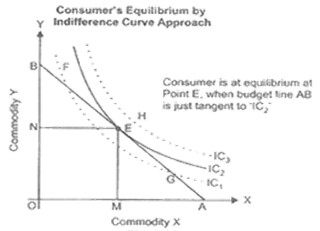
In Fig, IC1, IC2 and IC3 are the three indifference curves and AB is the budget line. With the constraint of budget line, the highest indifference curve, which a consumer can reach, is IC2. The budget line is tangent to indifference curve IC2 at point ‘E’. This is the point of consumer equilibrium, where the consumer purchases OM quantity of commodity ‘X’ and ON quantity of commodity ‘Y. All other points on the budget line to the left or right of point ‘E’ will lie on lower indifference curves and thus indicate a lower level of satisfaction.
Thus, we can conclude that if the consumer is consuming any bundle other than the optimum one, then he would rearrange his consumption bundle in such a manner that the equality between the MRS and the price ratio is established and he attains the state of equilibrium.
Posted by Muskan Chouhan 5 years, 5 months ago
- 0 answers
Posted by A Thirisha 5 years, 5 months ago
- 0 answers
Posted by Aman Kumar 5 years, 5 months ago
- 1 answers
Gaurav Seth 5 years, 5 months ago
Word Meaning
Pages 22-23
Saga– long story of events or adventures,लम्बी कहान ी; heir–successor, उत्तराधिकारी; was laid to rest–died; eventually–finally,अंततः;speculated–guessed. अनुमान लगाय ा; clues–link, information, सूचना; precise–exact, accurate, सह ी; data–account; forensic–use of scientific methods in crime investigation, अपराध की जाँच –पड़ताल में वैज्ञानिक परीक्षण; pharaoh–the title of the ancient egyptian kings; stirredup–caused to rise, blew, चली; ancient–of very old times; cemetery–graveyard, burial– ground, कब्रिस्तान ; dark-bellied–bulging, फूले हुए ; scuddedacross–moved fast and smoothly,वेग से चलना;veiling–covering, hiding, आवरण डाल रहे ; casketgrey–ash or lead coloured coffin, धूसर शवपेटिका ; mummy–embalmed human body for burial, रक्षित शव; glided–moved, was pushed, अन्दर गया ; probe–examine closely, जाँच के लिए ; lingering–slow in motion; descended–arrived, climbed down into, आ गए थे; cramped–small in size, सिकुड़ा हुआ; murals–wall paintings,भित्तिचित्र; peered–looked intently,ध्यानपूर्वक देखा ; lid–cover, ढक्कन; pondering–thinking deeplyविचार करते हुए ; shiver–tremble; curse–bad luck, अभिशाप; antiquities–remains of ancient times; archaeologist–पुरातत्ववेत्ता ; futile–unsuccessful, असफल ; contents–treasure; hastily–swiftly: ransacked–looted; antiquity–long past years; legend–a myth, story; stunning–surprising, amazing, विस्मित कर देने वाले ; artefacts–things made by human hand, मानव कृतियाँ; eternal–everlasting,अमर; resurrection–recovered from grave,पुनरुत्थान; sensation–excitement. हलचल; afterlife–next life, life after death; bronze–mixture of brass and copper; linen–cotton; undergarments–under dress, अधोवस्त्र; cases–boxes, पेटियाँ; funerary–relating to burial,कब्र से प्राप्त; coffin–the chest in which a dead body is placed for burial. Shroud–sheet to wrap a dead body, कफन; adorned–decorated; celery–a kind of plant; petals–leaves,पत्ते; faded–not very sure or clear ;evidence–proof; ritual–ceremonial, विधिसंगत; resins–a kind of gum, राल; cementing–uniting,पक्का चिपका दिया ; legitimate–lawful, genuine, न्यायोचित; hammer–a tool for driving nails, हथौड़ा ; loosen–to soften the glue, ढीला करना l
Page-25
Blazing–scorching, तपतीहुई; budged–moved; detachment–aloofness, objectivity, तटस्थता; consolidated–solidified, ठोस; chiselled away–cut with a tool,छेनी से छीलना पड़ा ; beneath–under,trunk–the main part of the body, शरीर का धड़ ; circumvented–cheated, befooled, धोखा दे देते ; ripped it apart–separated, torn, अलग कर देते; fabulously–excessively, अत्याधिक; lavished–gifted, restored greatly, युक्त किया गया ; glittering–shining, चमकदार; precious–valuable, बहुमूल्य; inlaid–fine material inserted, नगीने जड़े; bracelets–an ornament band for the wrist, कंगन ; amulets–magic chains, रक्षा यंत्र; sheaths–a covering, आवरण; iconic–pertaining to an image; mask–a covering to conceal the faceमुखौटा; adornments–ornaments,श्रृंगार वस्तुएँ ; severed–cut off; reassembled– joined again. पुनः जोड़ दिया ; padding–fill out, भराव ; concealed–hid,छिपा दिया ; damage–harm done, क्षति ; archaeology–the science of ancient ruins; substantially–greatly; intervening–lying between, बीच में; decades–ten years, दशक ; focussing–giving attention to; fascinating–interesting; intriguing–secret mysterious, रहस्यमय; sophisticated–advanced: anatomy–the science of body- structure, शरीर –रचना शास्त्र ; startling–shock giving,चौंका देने वाली ;cakes–covers; diagnostic–ascertain disease by symptoms; imaging–taking the pictures of the inside of body: slices–pieces. टुकड़े ; virtual–almost real; reveal–show; lingering–remaining unsolved; demise–death, अंत , मृत्यु; royal standards–criterion, शाही तौर –तरीके या स्तर ; death rattle–death knell, मौत की घंटी ;dynasty–succession of kings of the same family, राज कुल ; particulars–details,सही विवरण ; aftermath–what followed thereafter. बाद की घटनाए ँ; four decades–forty years; succeeded–came to the throne, सिंहासन रूढ़ हुआ; initiated–began, प्रारम्भ किया I
Page 26
Promoted–encouraged, बढ़ावा दिया; shocked–caused disgust, आघात पहुँचाया; smashing–breaking down, तोड़ दिया ; images–statues, मूर्तियाँ; horrific–causing fear, horrifying, डरावना; site–location, स्थान ; wacky–crazy.सनकी ; exited–departed, बाहर निकल गया ; trace–sign, चिह्न; living image of Amun–life- like idol.सूर्य देवता की जीवंत मूर्ति ;restoration–reestablishment, पुनरुद्धार ; reigned–ruled; regardless–in spite of. ignoring; speculation–guess, supposition, अनुमान; inventory–preparing a detailed list. सूची; phase–step; scanning–examining scientifically, वैज्ञानिक परीक्षण; portable–light enough to be carried, हल्की; images–pictures, photos,छायाचित्र; slices–bits, pieces. टुकड़ े; intricate–complex, जटिल; structures–forms. ढाँच े; detail–detail exciting fear, डरावनी; anatomy–science of the structure of the human body; probe–investigate, examine; gilded–coated with gold, सोने का पानी चढ़ा हुआ; pallbearers–those who carry a dead body. शव उठाने वाल ा; ramp–the slope.ढलान; flight of stairs
–a series of steps, सीढ़ियाँ; swirling–moving in a circular motion. अधिक चक्कर खाती; hydraulic–moving with the pressure of water. जलशक्ति से चलने वाल ा; trailer–a vehicle drawn by another; held–contained; emerged–came out; sprinted–ran fast, तेज दौड़ े; quit–left, went out: nervously–in fear, घबराहट के साथ I
Page 27
Eventually–finally, अंततः; substitute–alternative, another, प्रतिस्थापित; procedure–work; data–details; funerary–relating to the funeral or burial; astonishing–amazing, विस्मयकारी; Images–pictures,प्रतिमा ; scattering–spread out, small-sized, बिखरे हुए ; pixels–small areas of light which make up an image on a screen; tilted–bent.झुकाया ; revealed–showed; transaction–a part, भाग ;visibly–clearly;relieved–at ease; descending–climbing down, नीचे उतरते ; departed–long last or dead kings. Of Egypt; constellation– a number of stars grouped together, तारामंडलI
Posted by Aman Kumar 5 years, 5 months ago
- 1 answers
Gaurav Seth 5 years, 5 months ago
Word Meaning
Pages 22-23
Saga– long story of events or adventures,लम्बी कहान ी; heir–successor, उत्तराधिकारी; was laid to rest–died; eventually–finally,अंततः;speculated–guessed. अनुमान लगाय ा; clues–link, information, सूचना; precise–exact, accurate, सह ी; data–account; forensic–use of scientific methods in crime investigation, अपराध की जाँच –पड़ताल में वैज्ञानिक परीक्षण; pharaoh–the title of the ancient egyptian kings; stirredup–caused to rise, blew, चली; ancient–of very old times; cemetery–graveyard, burial– ground, कब्रिस्तान ; dark-bellied–bulging, फूले हुए ; scuddedacross–moved fast and smoothly,वेग से चलना;veiling–covering, hiding, आवरण डाल रहे ; casketgrey–ash or lead coloured coffin, धूसर शवपेटिका ; mummy–embalmed human body for burial, रक्षित शव; glided–moved, was pushed, अन्दर गया ; probe–examine closely, जाँच के लिए ; lingering–slow in motion; descended–arrived, climbed down into, आ गए थे; cramped–small in size, सिकुड़ा हुआ; murals–wall paintings,भित्तिचित्र; peered–looked intently,ध्यानपूर्वक देखा ; lid–cover, ढक्कन; pondering–thinking deeplyविचार करते हुए ; shiver–tremble; curse–bad luck, अभिशाप; antiquities–remains of ancient times; archaeologist–पुरातत्ववेत्ता ; futile–unsuccessful, असफल ; contents–treasure; hastily–swiftly: ransacked–looted; antiquity–long past years; legend–a myth, story; stunning–surprising, amazing, विस्मित कर देने वाले ; artefacts–things made by human hand, मानव कृतियाँ; eternal–everlasting,अमर; resurrection–recovered from grave,पुनरुत्थान; sensation–excitement. हलचल; afterlife–next life, life after death; bronze–mixture of brass and copper; linen–cotton; undergarments–under dress, अधोवस्त्र; cases–boxes, पेटियाँ; funerary–relating to burial,कब्र से प्राप्त; coffin–the chest in which a dead body is placed for burial. Shroud–sheet to wrap a dead body, कफन; adorned–decorated; celery–a kind of plant; petals–leaves,पत्ते; faded–not very sure or clear ;evidence–proof; ritual–ceremonial, विधिसंगत; resins–a kind of gum, राल; cementing–uniting,पक्का चिपका दिया ; legitimate–lawful, genuine, न्यायोचित; hammer–a tool for driving nails, हथौड़ा ; loosen–to soften the glue, ढीला करना l
Page-25
Blazing–scorching, तपतीहुई; budged–moved; detachment–aloofness, objectivity, तटस्थता; consolidated–solidified, ठोस; chiselled away–cut with a tool,छेनी से छीलना पड़ा ; beneath–under,trunk–the main part of the body, शरीर का धड़ ; circumvented–cheated, befooled, धोखा दे देते ; ripped it apart–separated, torn, अलग कर देते; fabulously–excessively, अत्याधिक; lavished–gifted, restored greatly, युक्त किया गया ; glittering–shining, चमकदार; precious–valuable, बहुमूल्य; inlaid–fine material inserted, नगीने जड़े; bracelets–an ornament band for the wrist, कंगन ; amulets–magic chains, रक्षा यंत्र; sheaths–a covering, आवरण; iconic–pertaining to an image; mask–a covering to conceal the faceमुखौटा; adornments–ornaments,श्रृंगार वस्तुएँ ; severed–cut off; reassembled– joined again. पुनः जोड़ दिया ; padding–fill out, भराव ; concealed–hid,छिपा दिया ; damage–harm done, क्षति ; archaeology–the science of ancient ruins; substantially–greatly; intervening–lying between, बीच में; decades–ten years, दशक ; focussing–giving attention to; fascinating–interesting; intriguing–secret mysterious, रहस्यमय; sophisticated–advanced: anatomy–the science of body- structure, शरीर –रचना शास्त्र ; startling–shock giving,चौंका देने वाली ;cakes–covers; diagnostic–ascertain disease by symptoms; imaging–taking the pictures of the inside of body: slices–pieces. टुकड़े ; virtual–almost real; reveal–show; lingering–remaining unsolved; demise–death, अंत , मृत्यु; royal standards–criterion, शाही तौर –तरीके या स्तर ; death rattle–death knell, मौत की घंटी ;dynasty–succession of kings of the same family, राज कुल ; particulars–details,सही विवरण ; aftermath–what followed thereafter. बाद की घटनाए ँ; four decades–forty years; succeeded–came to the throne, सिंहासन रूढ़ हुआ; initiated–began, प्रारम्भ किया I
Page 26
Promoted–encouraged, बढ़ावा दिया; shocked–caused disgust, आघात पहुँचाया; smashing–breaking down, तोड़ दिया ; images–statues, मूर्तियाँ; horrific–causing fear, horrifying, डरावना; site–location, स्थान ; wacky–crazy.सनकी ; exited–departed, बाहर निकल गया ; trace–sign, चिह्न; living image of Amun–life- like idol.सूर्य देवता की जीवंत मूर्ति ;restoration–reestablishment, पुनरुद्धार ; reigned–ruled; regardless–in spite of. ignoring; speculation–guess, supposition, अनुमान; inventory–preparing a detailed list. सूची; phase–step; scanning–examining scientifically, वैज्ञानिक परीक्षण; portable–light enough to be carried, हल्की; images–pictures, photos,छायाचित्र; slices–bits, pieces. टुकड़ े; intricate–complex, जटिल; structures–forms. ढाँच े; detail–detail exciting fear, डरावनी; anatomy–science of the structure of the human body; probe–investigate, examine; gilded–coated with gold, सोने का पानी चढ़ा हुआ; pallbearers–those who carry a dead body. शव उठाने वाल ा; ramp–the slope.ढलान; flight of stairs
–a series of steps, सीढ़ियाँ; swirling–moving in a circular motion. अधिक चक्कर खाती; hydraulic–moving with the pressure of water. जलशक्ति से चलने वाल ा; trailer–a vehicle drawn by another; held–contained; emerged–came out; sprinted–ran fast, तेज दौड़ े; quit–left, went out: nervously–in fear, घबराहट के साथ I
Page 27
Eventually–finally, अंततः; substitute–alternative, another, प्रतिस्थापित; procedure–work; data–details; funerary–relating to the funeral or burial; astonishing–amazing, विस्मयकारी; Images–pictures,प्रतिमा ; scattering–spread out, small-sized, बिखरे हुए ; pixels–small areas of light which make up an image on a screen; tilted–bent.झुकाया ; revealed–showed; transaction–a part, भाग ;visibly–clearly;relieved–at ease; descending–climbing down, नीचे उतरते ; departed–long last or dead kings. Of Egypt; constellation– a number of stars grouped together, तारामंडलI

Posted by ? S. S. ? 5 years, 5 months ago
- 2 answers
? S. S. ? 5 years, 5 months ago
Posted by Priyanjali Choudhury 5 years, 5 months ago
- 1 answers
Gaurav Seth 5 years, 5 months ago
Indian Constitution was framed by the Constituent Assembly which was elected in 1946. All the members of this Assembly were Indians who represented all the political parties, though Congress Party was in majority. There was no restriction on the powers of the Assembly and it was authorised to enact any type of Constitutionit liked. The Constitution has been framed after thoughtful consideration which exhibits and fulfilsthe ideals, aspirations, values, wishes and requirements of the Indian people.
Main Sources of Indian Constitution—1. The Government of India Act, 1935: Indian Constitution is mainly based on the Government of India Act, 1935. This Act had accepted many of the demands of the Indian National Congress i.e., provincial autonomy, parliamentary system, federal system, federalcourt, etc. When we got freedom we were accustomed of the administrative set up under this Act and we changed the provisions of the Act according to our requirement and suitability in the new Constitution. Thus about two-thirds of Indian Constitution is derived from the Act of 1935.
2. British Constitution: Many of the provisions of the Constitution have been taken from the British Constitution. Parliamentary system is on British pattern except that in India, we have opted for a President as Head of the State, not a king. Our procedure of law making, single citizenship, single integrated judiciary are based on British Constitution. Thus British Constitution is also a big source of Indian Constitution.
3. American Constitution: Idea of Preamble to the Constitution was derived from the American Constitution. Declaration of Fundamental Rights in the Constitution, provision of Judicial Review are also derived from the American Constitution. Preamble to the Indian Constitution and the position of Indian Supreme Court, and those of American Constitution are similar.
4. Constitution of Canada: Our Federal structure is similar to that of Canada. Like Canadian Constitution, we have a more powerful centre than the states and have given residuary powers to the Central Government. Our federal system is not based on American pattern.
5. Constitution of Ireland: Constitution of Ireland had provided for the guidelines to the states. This inspired the makers of the Indian Constitution and they have included the Directive Principles of the State Policy in the Constitution.
6. German Constitution: The makers of the Constitution were inspired by the Weimer Constitution regarding the emergency provisions and they armed the Indian President with emergency powers to face external and internal emergencies.
Posted by Pk✍️ . 5 years, 5 months ago
- 1 answers
Sia ? 4 years, 11 months ago
Condition of pure rolling: Pure rolling occurs when rolling is done without any resistance. Pure rolling is a case when the point of lowest contact of rolling body with ground remains at rest and body is deliberated to be rotating about this point of contact.
Posted by Damendra Singh 5 years, 5 months ago
- 1 answers
Gaurav Seth 5 years, 5 months ago
- The shadow zone is the zone of the earth from angular distances of 104 to 140 degrees from a given earthquake that does not receive any direct P waves.
- The shadow zone results from P waves being refracted by the liquid core and S waves being stopped completely by the liquid core.
- A zone between 105° and 145° from the epicenter was recognized as the shadow zone for both the wave types.
- The entire zone beyond 105° does not receive S-waves.
- The shadow zone of S-wave is larger than that of the P-waves.
- The shadow zone of P-waves appears as a band around the earth between 105° and 145° away from the epicenter.
Posted by Royal Thakur ? 5 years, 5 months ago
- 0 answers
Posted by Sunanda Devi 5 years, 5 months ago
- 1 answers
Sia ? 4 years, 11 months ago
The ultimate aim of political theory ought to be the protection of individual rights, since that is the proper role of government. Individual rights are a moral concept and it means that one has the right to live one’s own life so long as one acknowledges the equal rights of others to live their lives. Politics is basically ethics applied in a social context, but that does not mean that an ethics or a morality will be imposed upon the people, aside from the fundamental aspect that a man has the right to have his own standards and to live his own life according to his own understanding of existence and life and the nature of man.
Posted by Sunanda Devi 5 years, 5 months ago
- 2 answers
Gaurav Seth 5 years, 5 months ago
- Mesopotamia is a flat plain. The excavation work started here about 150 years ago. Sumer region was the lower part of the Mesopotamian civilization. It was the heart of the civilization. Sumerians were the first to develop a civilization in Mesopotamia. That is why the civilization has been named after them i.e. Sumerian civilization.
- As per excavations, there were three types of cities in Mesopotamia. They were religious, commercial and royal cities. Ur, Lagash, Kish, Uruk and Mari were some of the most important cities of Mesopotamian civilization.
Posted by Sunanda Devi 5 years, 5 months ago
- 1 answers
Gaurav Seth 5 years, 5 months ago
• A gulf is a large body of water almost encircled by land except for a small mouth that opens out to the sea. A strait is a strip of water that separates two lands or two large bodies of water. • Straits are used for navigational purposes and have played an integral part when it comes to shipping routes. Gulfs are more useful for human settlements, as such areas provide easy access to the ocean while being well protected as well. • Gulfs can be easily associated with inland bodies of water as well as the ocean. Straits are mostly discussed with regards to the ocean.
Posted by Kunal Sharma 5 years, 5 months ago
- 0 answers
Posted by Kunal Sharma 5 years, 5 months ago
- 1 answers
Gaurav Seth 5 years, 5 months ago
Party systems:
One-party system:
. In some countries, only one party is allowed to control and run the government. It is called one-party system.
. We cannot consider one-party system as a good option because this is not a democratic option.
. Any democratic system must allow at least two parties to compete in elections and provide a fair chance for the competing parties to come to power.
Example: Communist Party of China.
Two-party system:
Describe the various party systems existing in different countries?
. In some countries, power usually changes between two main parties.
. Here, only the two main parties have a serious chance of winning majority seats to form the government.
Example: USA and UK.
Multi-party system:
. If several parties compete for power and more than two parties have a reasonable chance of coming to power, either on their own or in alliance with others, it is called a multi-party system.
. The multi-party system often appears very messy and leads to political instability.
. At the same time, this system allows a variety of interests and opinions to enjoy political representation.
Example: India.
Major Coalitions—NDA, UPA, Left Front.
Posted by Kunal Sharma 5 years, 5 months ago
- 1 answers
Gaurav Seth 5 years, 5 months ago
Differences between Political Executives and Permanent Executives :
| <i>Political Executive</i> | <i>Permanent Executive</i> |
| 1. Executives who are elected by the people for a specific period are called the political executives. | 1. The permanent executives are salaried civil servants who are appointed on a long-term basis. |
| 2. Example-Political leaders like the Prime Minister, Council of Ministers and so on. | 2. Persons working in civil services. For example - IAS, IFS, IPS etc. |
| 3. They remain in office only so long as they command the confidence of the majority members of Parliament. | 3. They remain in office even when the ruling party changes.Their tenure of office is fixed. |
| 4. They are answerable to people for all the consequences of their decisions. | 4. They are not answerable to the people. |
| 5. They are more powerful. They take all the final decisions. | 5. They are less powerful. They do not take decisions. Instead they assist political executives in carrying out day-to-day administration. |
Posted by Kunal Sharma 5 years, 5 months ago
- 1 answers
Vanshi Choudhary 5 years, 5 months ago
Posted by Kunal Sharma 5 years, 5 months ago
- 1 answers
Posted by Shubham Kumar 5 years, 5 months ago
- 1 answers
Gaurav Seth 5 years, 5 months ago
Just as the Indian Constitution lists the fundamental right (FRs) that are available to the people of India under its Part III, the South African Constitution contains analogous rights in Chapter 2 titled Bill of Rights (BoRs). The following are some similarities and dissimilarities between the FRs and BoRs:
Similarities:
(1) Both FRs and BoRs form the bedrock of the constitution and democracy under the Indian and SA Constitutions respectively.
(2) Just as the FRs under Indian Constitution, the BoRs under the SA Constitution are available against the State. In fact some limited rights under both Constitutions are available against private citizens also.
(3) Under both Constitutions, while most rights are available to citizens alone, some universally recognised rights such as the right to life and equality are available to all persons.
(4) Neither the FRs nor BoRs are absolute. Both are subject to reasonable restrictions and limitations.
Differences:
(1) Given the SA Constitution was framed in 1996, it had the benefit of hindsight and was able to learn lot more from experiences of other vibrant democracies like India. This advantage is reflected in the fact that the BoRs is the most elaborate and extensive set of rights endowed upon citizens anywhere in the world including India. For e.g., rights such as the right to privacy and the right to healthy environment which had to be read into FRs in India by the judiciary are explicitly mentioned in the BoRs.
(2) Right to vote which finds a place in the BoRs is only a statutory/legal right in India i.e., it does not have the status of a FR.
(3) Right to property, which finds a place in the BoRs, was removed from Part III of the Constitution by the 44nd Constitutional Amendment and has been placed under Art 300A thereby reducing its status to that of a legal right.
(4) Right to information, which is included in BoRs, is only a statutory right in India.
(5) The SA Constitution provides for creation of a special constitutional court for the enforcement of BoRs. This court has jurisdiction only over constitutional matters and controversies. Under the Indian Constitution, the Supreme Court is endowed with writ jurisdiction. However, it also exercises many other kinds of jurisdictions concurrently. This makes a difference because the special constitution court is less burdened and therefore can spend larger amount of time and expertise in adjudicating and interpreting the provisions of BoRs.
Posted by Shubham Kumar 5 years, 5 months ago
- 2 answers
Krishna Vaishist 5 years, 4 months ago
Yogita Ingle 5 years, 5 months ago
The Right against Exploitation enshrined in the Indian Constitution guarantees dignity of the individual. It also prohibits the exploitation or misuse of service by force or inducement in the following ways:
- It prohibits human trafficking i.e. it criminalises buying and selling of human beings like a commodity. It also prohibits use of women or girls for immoral purposes.
- It prohibits slavery, begar, bonded labour or other forms of forced labour. Begar is a term used for practice wherein the worker has to render free service to his master or at a nominal rate. The State has been given the authority to introduce compulsory service for such persons in order to stop the practice. The government cannot discriminate on the basis of religion, race, colour, etc.
- It prohibits the employment of children below the age of 14 years in factories, mines and other hazardous activities.
Posted by Bhavana Yadav 5 years, 5 months ago
- 1 answers
Sia ? 4 years, 11 months ago
By the second equation of motion,
s = ut + 1/2 at 2
S is directly proportional to the time only when there is no external force acting on it.
In the absence of external force, acceleration ‘a’ of the object becomes zero and the equation of motion becomes
s = ut
Since acceleration is zero so speed ‘u’ of the object remains constant.
Hence, it can be concluded that S is directly proportional to t.
Posted by Priyanjali Choudhury 5 years, 5 months ago
- 1 answers
Yogita Ingle 5 years, 5 months ago
The Unique Features of the Indian Constitution:
1. The Lengthiest Constitution: Indian Constitution is a written constitution. It is the lengthiest constitution in the world. It has 395 articles and schedules (now 12). It is a book of more than 250 pages.
2. The Fundamental Rights and the Directive Principles of State Policies: In our Constitution Indian citizens have been provided with six fundamental rights. And for the establishment of social and economic democracy and for the welfare of its citizens, some directives have been given to the central and the state governments.
3. A unique blend of Unitary and Federal Governments: According to the constitution, India has been declared federal and it looks federal but it has the unitary bias. Thus Indian constitution is federal in form but unitary in spirit.
4. The Fundamental Duties: By the 42nd Amendment in 1976, 10 fundamental duties have been also incorporated in the Indian Constitution.
5. Blend of Flexibility and Rigidity: The Indian Constitution is a blend of flexibility and rigidity. Some of the articles as change in the name of any state or in the boundaries, etc. are amended by a simple majority of the Parliament.

myCBSEguide
Trusted by 1 Crore+ Students

Test Generator
Create papers online. It's FREE.

CUET Mock Tests
75,000+ questions to practice only on myCBSEguide app

Siddarth Asati Asati 5 years, 5 months ago
1Thank You