
Ask questions, doubts, problems and we will help you..
Ask questions which are clear, concise and easy to understand.
Ask Question
CBSE, JEE, NEET, CUET
Question Bank, Mock Tests, Exam Papers
NCERT Solutions, Sample Papers, Notes, Videos
Posted by Chitralekha Khaund 5 years, 4 months ago (8262306)
- 1 answers
Posted by Sheetal Neriya 5 years, 4 months ago (9736512)
- 2 answers
Posted by Nikita Khedar 5 years, 4 months ago (9736036)
- 2 answers
Shreya Mittal 5 years, 4 months ago (3926662)
Gaurav Seth 5 years, 4 months ago (2898529)
द्विगु समास की परिभाषा
'संख्यापूर्वो द्विगुः' - जिस समास का पहला पद संख्यावाची और दूसरा पद कोई संज्ञा हो अर्थात द्विगु समास का पहला पद संख्यावाचक होता है और सम्पूर्ण पद समूह का बोध कराता है।
द्विगु समास के उदाहरण :
- दोपहर : दो पहरों का समाहार
- शताब्दी : सौ सालों का समूह
- पंचतंत्र : पांच तंत्रों का समाहार
- सप्ताह : सात दिनों का समूह
Posted by Praneash Balasubramaniyan 5 years, 4 months ago (9607221)
- 3 answers
Gaurav Seth 5 years, 4 months ago (2898529)
Let the adjacent angles of a parallelogram be x and 8c.
Then, we have x + (3 x) = 180° [adjacent angles of parallelogram are supplementary]
=> 4 x = 180°
=> x = 45°
Thus, the angles are 45°, 135°.
Hence, the angles are 45°, 135, 45°, 135°. [ opposite angles in a parallelogram are equal]
Posted by Rohit Tiwari 5 years, 4 months ago (6825516)
- 1 answers
Gaurav Seth 5 years, 4 months ago (2898529)
What was the Bastille?
The Bastille was a fortress built in the late 1300s to protect Paris during the Hundred Years' War. By the late 1700s, the Bastille was mostly used as a state prison by King Louis XVI.
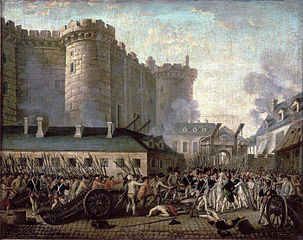
<i>Storming of the Bastille</i>
Who stormed the Bastille?
The revolutionaries who stormed the Bastille were mostly craftsmen and store owners who lived in Paris. They were members of a French social class called the Third Estate. There were around 1000 men who participated in the attack.
Why did they storm the Bastille?
The Third Estate had recently made demands of the king and had demanded that the commoners have more of a say in government. They were worried that he was preparing the French army for an attack. In order to arm themselves, they first took over the Hotel des Invalides in Paris where they were able to get muskets. However, they didn't have gun powder.
The Bastille was rumored to be full of political prisoners and was a symbol to many of the oppression of the king. It also had stores of gunpowder that the revolutionaries needed for their weapons.
Storming the Bastille
On the morning of July 14, the revolutionaries approached the Bastille. They demanded that the military leader of the Bastille, Governor de Launay, surrender the prison and hand over the gunpowder. He refused.
As negotiations drug on, the crowd became agitated. In the early afternoon, they managed to get into the courtyard. Once inside the courtyard, they began to try and break into the main fortress. The soldiers in the Bastille became scared and fired into the crowd. The fighting had began. The turning point in the fight came when some of the soldiers joined the side of the crowd.
Posted by Prakash Singh 5 years, 4 months ago (9736404)
- 2 answers
Mamta Singh 5 years, 3 months ago (9876635)
Yogita Ingle 5 years, 4 months ago (2577571)
He learned the languages of beasts. He also learned how beavers built lodges, where squirrels hide their food, and why the rabbit so timid.

Posted by Praneash Balasubramaniyan 5 years, 4 months ago (9607221)
- 1 answers
Gaurav Seth 5 years, 4 months ago (2898529)
G i v e n : 3 x+ 2 / 2x - 3 = - 3 / 4
12 x + 8 = - 6 x + 9
12 x + 6 x = 9 - 8
18 x = 1
So,
x = 1 / 18
Posted by Amar Kagra 5 years, 4 months ago (9736397)
- 1 answers
Yogita Ingle 5 years, 4 months ago (2577571)
The narrator was very good nature person.He always used to give love and respect for his village.he always used to consider his village as the most beautiful village in the world.Also the narrator called english language a priceless commodity.The narrator was a very witting person.
Posted by Gamer Station 5 years, 4 months ago (9597136)
- 0 answers
Posted by Chitransh Srivastav 5 years, 4 months ago (8939139)
- 1 answers
Gaurav Seth 5 years, 4 months ago (2898529)
Charley visit Sam To consult the incident of Third level incident at Grand Central Station
Posted by Jyoti Pal 5 years, 4 months ago (9714325)
- 1 answers
Gaurav Seth 5 years, 4 months ago (2898529)
1. How to Draw a Peacock
Step 1
Draw an oval. This will be the torso of our peacock.
<figure> </figure>
Advertisement
Step 2
Draw a long, S-shaped neck with an oval head at one end.
<figure> </figure>
Step 3
Sketch the legs below the ankles ("reversed knees"). Drawing them this way can help you establish the pose without getting caught up in the details.
<figure> </figure>
Step 4
Draw the upper part of the legs. These will be hidden under the feathers, but it helps to know where they are.
<figure> </figure>
Step 5
Sketch the curve of the beak. Peacocks are related to chickens, so you can use a chicken beak as a reference.
<figure> </figure>
Step 6
Sketch the curve of the wings. Peacocks tend to keep them low when they fan their tail. The wings are covered by the tail mostly, but some parts may stay visible, so we need to know where they are.
<figure> </figure>
<figure>
</figure>
<figure> </figure>
<figure>
</figure>
<figure> </figure>
Step 7
Draw all the toes. Again, these are just like chicken feet!
<figure> </figure>
Step 8
Outline the neck, starting thin right by the head and then getting wider as you get closer to the torso.
<figure> </figure>
Step 9
Finish the beak.
<figure> </figure>
<figure>
</figure>
<figure> </figure>
Step 10
Draw an oval eye.
<figure> </figure>
Step 11
Add a nose hole.
<figure> </figure>
Step 12
Draw the "crown" on the head.
<figure> </figure>
<figure>
</figure>
<figure> </figure>
Step 13
Add details to the legs and feet.
<figure> </figure>
<figure>
</figure>
<figure> </figure>
<figure>
</figure>
<figure> </figure>
<figure>
</figure>
<figure> </figure>
Step 14
Finish the wings.
<figure> </figure>
<figure>
</figure>
<figure> </figure>
<figure>
</figure>
<figure> </figure>
Posted by Sushma R 5 years, 4 months ago (9490955)
- 5 answers
Posted by Amit Raj 5 years, 4 months ago (9735196)
- 2 answers
Gaurav Seth 5 years, 4 months ago (2898529)
(i) Given:
Diameter of the spherical ball (d)= 28 cm
Radius =d/2= 28/2 cm = 14 cm
Amount of water displaced by a solid spherical ball = Volume of spherical ball = 4/3πr³
= (4/3 × 22/7 × 14 × 14 × 14)
= 34496/3 = 11498.67 cm³
Amount of water displaced by a solid spherical ball= 11498.67 cm³
(ii) Diameter of the spherical ball (d)= 0.21 m
Radius (r) = d/2= 0.21/2 m = 0.105 m
Amount of water displaced by a solid spherical ball = Volume of spherical ball= 4/3πr³
=(4/3×22/7×0.105×0.105×0.105)
= 0.004851 m³
Amount of water displaced by a solid spherical ball =0.004851 m³
Posted by Warisha Ahmed 5 years, 4 months ago (9735878)
- 5 answers
Yogita Ingle 5 years, 4 months ago (2577571)
- A motherboard
- A Central Processing Unit (CPU)
- A Graphics Processing Unit (GPU), also known as a video card
- Random Access Memory (RAM), also known as volatile memory
- Storage: Solid State Drive (SSD) or Hard Disk Drive (HDD)
Posted by Pardheev Yashwanth.P 5 years, 4 months ago (9489772)
- 1 answers
Posted by Vanshika Jat 5 years, 4 months ago (4383708)
- 1 answers
Yogita Ingle 5 years, 4 months ago (2577571)
The following steps should be taken :
(i) Before imposing trade barrier interest of the developing countries should be taken care.
(ii) Rules and regulations should be uniform.
(iii) Ensure that the developed countries do not retain trade barriers unfairly.
(iv) Labour laws should be implemented properly.
(v) Small producers should be supported to improve their performance till they become strong enough to compete.
Posted by Vaishali Nagwani 5 years, 4 months ago (9491696)
- 2 answers
Yogita Ingle 5 years, 4 months ago (2577571)
Congruent Objects: When two objects are exact copies of each other, they are called congruent.
Posted by Lucky Sharma 5 years, 4 months ago (9683754)
- 0 answers
Posted by Keerthana Reddy 5 years, 4 months ago (9592388)
- 0 answers
Posted by Kamal Gupta 5 years, 4 months ago (5825664)
- 1 answers
Y@Ogesh Ninama 5 years, 4 months ago (9463821)
Posted by Boybe Cool 5 years, 4 months ago (9563492)
- 1 answers
Gaurav Seth 5 years, 4 months ago (2898529)
.The earlier phase of industrialisation in which large scale production was carried out for international market not at factories but in decentralised units.
(i) Huge demand : The world trade expanded at a very fast rate during the 17th and the 18th centuries. The acquisition of colonies
was also responsible for the increase in demand. The town producers failed to produce the required quantity.
(ii) Powerful town producers :
• The town producers were very powerful,
• The producers could not expand the production a: will. This was because in the towns, urban crafts and trade guilds were powerful. These were associations of producers that trained craftspeople, maintained control over production, regulated competition and prices, and restricted the entry of new people within the trade.
(iii) Monopoly rights : The rulers granted different guilds the monopoly right to produce and trade in specific products It was therefore difficult for new merchants to set up business in towns. So they turned to the countryside.
(iv) New economic situation in the countryside : Open fields were disappearing in the countryside and the commons were being enclosed. Cottagers and poor peasants who were earlier depended on common lands became jobless So when merchants came around and offered advances to produce, peasants households eagerly agreed.
Posted by Athar Raja Athar Raja 5 years, 4 months ago (9735969)
- 4 answers
Roshan Kumar 5 years, 4 months ago (5078507)
Keshavam Kesharwani 5 years, 4 months ago (9362612)
Tec Om 5 years, 4 months ago (7036201)
Yogita Ingle 5 years, 4 months ago (2577571)
According to Charles A Bucher, “Physical Education is an integral part of total education process and has its aim the development of physically mentally, emotionally and socially fit citizens through the medium of physical activities which have been selected with a view to realize these outcomes.
According to Cassidy, “Physical education is the sum? of changes in the individual caused by experience which can bring in motor activity.
Posted by Mukhil Vendhan 5 years, 4 months ago (10854328)
- 1 answers
Posted by Dhaksha .H 5 years, 4 months ago (9736063)
- 0 answers
Posted by Prabin Sapam 5 years, 4 months ago (9288001)
- 3 answers
Yogita Ingle 5 years, 4 months ago (2577571)
- A motherboard
- A Central Processing Unit (CPU)
- A Graphics Processing Unit (GPU), also known as a video card
- Random Access Memory (RAM), also known as volatile memory
- Storage: Solid State Drive (SSD) or Hard Disk Drive (HDD)
Posted by Yatharth Verma 5 years, 4 months ago (8674829)
- 0 answers
Posted by Yash Jadhav 5 years, 4 months ago (9735892)
- 4 answers
Posted by Aisha Dey 5 years, 4 months ago (9612809)
- 5 answers
Jagannibas Panda 5 years, 4 months ago (9733895)
Aisha Dey 5 years, 4 months ago (9612809)
Yogita Ingle 5 years, 4 months ago (2577571)
The shop was called Lucky Shop because everybody can try their luck.
myCBSEguide
Trusted by 1 Crore+ Students

Test Generator
Create papers online. It's FREE.

CUET Mock Tests
75,000+ questions to practice only on myCBSEguide app

Gaurav Seth 5 years, 4 months ago (2898529)
1 <a href="https://www.excel-easy.com/functions/count-sum-functions.html">Count and Sum</a>: The most used functions in Excel are the functions that count and sum. You can count and sum based on one criteria or multiple criteria.
2 <a href="https://www.excel-easy.com/functions/logical-functions.html">Logical</a>: Learn how to use Excel's logical functions, such as IF, AND, OR and NOT.
3 <a href="https://www.excel-easy.com/functions/cell-references.html">Cell References</a>: Cell references in Excel are very important. Understand the difference between relative, absolute and mixed reference, and you are on your way to success.
4 <a href="https://www.excel-easy.com/functions/date-time-functions.html">Date & Time</a>: To enter a date in Excel, use the "/" or "-" characters. To enter a time, use the ":" (colon).
5 <a href="https://www.excel-easy.com/functions/text-functions.html">Text</a>: Excel has many functions to offer when it comes to manipulating text strings.
6 <a href="https://www.excel-easy.com/functions/lookup-reference-functions.html">Lookup & Reference</a>: Learn all about Excel's lookup & reference functions, such as VLOOKUP, HLOOKUP, MATCH, INDEX and CHOOSE.
7 <a href="https://www.excel-easy.com/functions/financial-functions.html">Financial</a>: This chapter illustrates Excel's most popular financial functions.
8 <a href="https://www.excel-easy.com/functions/statistical-functions.html">Statistical</a>: An overview of some very useful statistical functions in Excel.
9 <a href="https://www.excel-easy.com/functions/round.html">Round</a>: This chapter illustrates three functions to round numbers in Excel. ROUND, ROUNDUP and ROUNDDOWN.
10 <a href="https://www.excel-easy.com/functions/formula-errors.html">Formula Errors</a>: This chapter teaches you how to deal with some common formula errors in Excel.
11 <a href="https://www.excel-easy.com/functions/array-formulas.html">Array Formulas</a>: This chapter helps you understand array formulas in Excel. Single cell array formulas perform multiple calculations in one cell.
1 Thank You