
Ask questions, doubts, problems and we will help you..
Ask questions which are clear, concise and easy to understand.
Ask Question
CBSE, JEE, NEET, CUET
Question Bank, Mock Tests, Exam Papers
NCERT Solutions, Sample Papers, Notes, Videos
Posted by Miss Payal 5 years, 3 months ago (9669700)
- 1 answers
Posted by Monishka Mali 5 years, 3 months ago (9859941)
- 2 answers
Yogita Ingle 5 years, 3 months ago (2577571)
- Social problems
- Economic problems
- Environmental problems.
Solution to these problems would be adequate rehabilitation, compensation to the displaced persons and afforestation.
Posted by Royal Thakur ? 5 years, 3 months ago (9579994)
- 1 answers
Sia ? 4 years, 8 months ago (6945213)
In chemistry, reactivity is the impetus for which a chemical substance undergoes a chemical reaction, either by itself or with other materials, with an overall release of energy.
Posted by Jagannath Vungarala 5 years, 3 months ago (9785672)
- 1 answers
Yogita Ingle 5 years, 3 months ago (2577571)
Soft skills are individual characteristics which are essential for communicating positively and politely with others.
Five soft skills which are required for a career in the field of physical education are:
1. Setting up of Goals-short-term, mid-term and long-terms
2. Time Management skills
3. Positive outlook towards failure
4. Forgiveness
5. Enthusiasm and positive energy
Posted by Sanjana Dangari 5 years, 3 months ago (9305786)
- 1 answers
Asif Naiyer 5 years, 3 months ago (8820926)

Posted by Goutam Singh 5 years, 3 months ago (9859850)
- 4 answers
Shivaman Sabharwal 5 years, 3 months ago (9280700)
Posted by Shaily Singh Tomar Tomar 5 years, 3 months ago (9358982)
- 4 answers
Posted by Ayush Yadav 5 years, 3 months ago (9831056)
- 1 answers
Yogita Ingle 5 years, 3 months ago (2577571)
Communication is a process that involves sending and receiving of messages through a verbal and non-verbal method. The sender sends a message, the receiver receives a message and sends it back with the feedback to the sender again.
The methods of communication involve oral and speech communication, written and graphical representations. Additionally, it includes the cultural sphere, a tool utilized to communicate, location, etc. Though it looks simple, communication is generally a very complicated subject.
Posted by Himansh Tiwari 5 years, 3 months ago (9786987)
- 1 answers
Posted by Aditya Aditya 5 years, 3 months ago (6009203)
- 0 answers
Posted by Neha Jangid ??? 5 years, 3 months ago (9834482)
- 5 answers
Taniya Chauhan 5 years, 3 months ago (9338574)
Posted by Pabo Callahan 5 years, 3 months ago (9824634)
- 0 answers
Posted by Sanjana Dangari 5 years, 3 months ago (9305786)
- 1 answers
Abhijeet Kumar 5 years, 3 months ago (8174025)
Posted by Damendra Singh 5 years, 3 months ago (9735233)
- 2 answers
Yogita Ingle 5 years, 3 months ago (2577571)
The metamorphic rocks make up a large part of the Earth’s crust and are classified by texture and by chemical and mineral assemblage. They may be formed simply by being deep beneath the Earth’s surface, subjected to high temperatures and the great pressure of the rock layers above it.
Metamorphic rocks arise from the transformation of existing rock types, in a process called metamorphism, which means “change in form”. The original rock is subjected to heat with temperatures greater than 150 to 200°C and pressure around 1500 bars, causing profound physical and/or chemical change.
Gaurav Seth 5 years, 3 months ago (2898529)
metamorphic rock is a type of rock which has been changed by extreme heat and pressure.
The types of metamorphic rocks depend upon the original rocks that were subjected to metamorphism. Metamorphic rocks are classified into two major types:
(i)foliated rocks
(ii)non-foliated rocks
Formation of metamorphic rocks : These rocks are formed due to thermal metamorphism.
It is of two types :
(i)Contact metamorphism: In contact metamorphism the rocks come into the contact with hot magma and lava and the rock material is recrystallized under high pressure and temperature.
(ii)Regional metamorphism: In regional metamorphism, rocks under go recrystallization due to deformation caused by tectonic shearing together with high temperature or pressure or both.
Posted by Damendra Singh 5 years, 3 months ago (9735233)
- 2 answers
Yogita Ingle 5 years, 3 months ago (2577571)
The sedimentary rocks are formed by the deposition and subsequent cementation of that material within bodies of water and at the surface of the earth. The process that causes various organic materials and minerals to settle in a place is termed as sedimentation. Sedimentation may also occur as minerals precipitate from water solution or shells of aquatic creatures settle out of suspension.
Gaurav Seth 5 years, 3 months ago (2898529)
Sedimentary rocks are types of rock that are formed by the deposition and subsequent cementation of that material at the Earth's surface and within bodies of water.
Sedimentary rocks are formed from those materials which are deposited at favourable sites by agents of denudation such as river, wind, glacier and sea waves. The process is called the lithification.
The sedimentary rocks are formed in different ways.
(i)The layers of deposits : Loose materials or sediments are deposited in the layers.
(ii)Stratification : The sediments are deposited in the layers. Materials such as clay, silt, sand, etc. settle down in due course.
(iii)Solidification: The loose material gets converted into hard and compact rocks.
Posted by Damendra Singh 5 years, 3 months ago (9735233)
- 2 answers
Yogita Ingle 5 years, 3 months ago (2577571)
Igneous rock is formed through the cooling and solidification of magma or lava. Igneous rock may form with or without crystallization, either below the surface as intrusive (plutonic) rocks or on the surface as extrusive (volcanic) rocks. This magma can be derived from partial melts of existing rocks in either a planet’s mantle or crust. Typically, the melting is caused by one or more of three processes: an increase in temperature, a decrease in pressure, or a change in composition.
Gaurav Seth 5 years, 3 months ago (2898529)
Igneous rocks are those rocks which have been formed by the cooling and solidification of molten natural matter of the earth.
The igneous rocks are formed when magma cools and turns into solid forms. The process of the cooling and solidification can happen in the earth's crust as well as on the surface.
Characteristics of igneous rocks are described below :
(i)These rocks do not have particles and layers.
(ii)These rocks are compact and massive.
(iii)These rocks are crystalline.
(iv)The igneous rocks are extremely hard and resistant.
(v)These rocks do not possess fossils of plants or animals.
(vi)These rocks are thermal in origin.
Posted by Damendra Singh 5 years, 3 months ago (9735233)
- 2 answers
Yogita Ingle 5 years, 3 months ago (2577571)
The rock cycle is a process in which rocks are continuously transformed between the three rock types igneous, sedimentary and metamorphic.
Gaurav Seth 5 years, 3 months ago (2898529)
Rock Cycle
The process of transformation of rocks from one form to an other in a cyclic manner is known as the rock cycle. It includes the following processes:
- Hot lava cools down to form igneous rocks.
- These igneous rocks are then broken down into small particles which are transported and then deposited. This results in the formation of sedimentary rocks
- When these igneous and sedimentary rocks are subjected to great heat and pressure, they change into metamorphic rocks.
- These metamorphic rocks under heat and pressure breakdown and form hot lava.
- This hot magma then again cools down and forms igneous rocks.
Posted by Damendra Singh 5 years, 3 months ago (9735233)
- 2 answers
Gaurav Seth 5 years, 3 months ago (2898529)
Followings are the physical characteristics of minerals:
(i)External crystal form — determined by internal arrangement of the molecules — cubes, octahedrons, hexagonal prisms, etc.
(ii)Cleavage — tendency to break in given directions producing relatively plane surfaces — result of internal arrangement of the molecules — may cleave in one or more directions and at any angle to each other.
(iii)Fracture — internal molecular arrangement so complex there are no planes of molecules; the crystal will break in an irregular manner, not along planes of cleavage.
(iv)Lustre — appearance of a material without regard to colour; each mineral has a distinctive lustre like metallic, silky, glossy etc.
(v)Colour — some minerals have characteristic colour determined by their molecular structure — malachite, azurite, chalcopyrite etc., and some minerals are coloured by impurities. For example, because of impurities quartz may be white, green, red, yellow etc.
Yogita Ingle 5 years, 3 months ago (2577571)
Followings are the physical characteristics of minerals:
(i)External crystal form — determined by internal arrangement of the molecules — cubes, octahedrons, hexagonal prisms, etc.
(ii)Cleavage — tendency to break in given directions producing relatively plane surfaces — result of internal arrangement of the molecules — may cleave in one or more directions and at any angle to each other.
(iii)Fracture — internal molecular arrangement so complex there are no planes of molecules; the crystal will break in an irregular manner, not along planes of cleavage.
(iv)Lustre — appearance of a material without regard to colour; each mineral has a distinctive lustre like metallic, silky, glossy etc.
(v)Colour — some minerals have characteristic colour determined by their molecular structure — malachite, azurite, chalcopyrite etc., and some minerals are coloured by impurities. For example, because of impurities quartz may be white, green, red, yellow etc.
Posted by Damendra Singh 5 years, 3 months ago (9735233)
- 2 answers
Gaurav Seth 5 years, 3 months ago (2898529)
Seafloor spreading is a process that occurs at mid-ocean ridges, where new oceanic crust is formed through volcanic activity and then gradually moves away from the ridge.
• Seafloor spreading helps explain continental drift in the theory of plate tectonics.
• This theory was proposed by Hess in 1961. He argued that constant eruptions at the crest of oceanic ridges cause the rupture of the oceanic crust and the new lava wedges into it, pushing the oceanic crust on either side. Thus,the ocean floor spreads.
• The younger age of the oceanic crust as well as the fact that the spreading of one ocean does not cause the shrinking of the other, made Hess think about the consumption of the oceanic crust.
• He further maintained that the ocean floor that gets pushed due to volcanic eruptions at the crest, sinks down at the oceanic trenches and gets consumed.
Yogita Ingle 5 years, 3 months ago (2577571)
SEA FLOOR SPREADING
1 .it was proposed by Hess in 1961
2. he believed that new lava pushes out the plates from the mid-oceanic ridge
3. palaeomagnetic studies of the ocean floor reveal that
A. along the mid-oceanic ridge there is an intense volcanic eruption
B. huge amount of lava comes out along the mid-Atlantic ridges
C. the equidistant rock formations have similar age and chemical compositions & magnetic properties
7. rocks closer to the mid-oceanic ridges are young and normal polarity
8. The age of rocks increases as the distance increases from the mid-oceanic ridge
9. Oceanic crust is much younger(200my) than continental crust (3200my)
10. The sediments of ocean floor is very thin
Posted by Aadya Singh 5 years, 3 months ago (9246761)
- 0 answers
Posted by Damendra Singh 5 years, 3 months ago (9735233)
- 1 answers
Gaurav Seth 5 years, 3 months ago (2898529)
Plate tectonics affects humans in several important ways.
- It causes earthquakes
- It causes volcanism
- It induces recycling of elements within the biosphere and between the geosphere and biosphere
- It causes mountain-building
Types of plate boundaries:
Plate Boundaries mainly consists of three types (fourth is a mixed type), formed in the manner the plates shift in relative to each other. These are collectively referred to as surface phenomena of different types. Plate boundaries are of different types, namely:
Transform boundaries:
These boundaries happen where two lithospheric plates move apart, or maybe further precisely, collide away from one other despite the transform faults, where plates are neither created nor destroyed.
Divergent boundaries:
These boundaries happen when both plates move apart from one other.
Convergent boundaries:
These boundaries happen where both plates move towards one other to form a zone of subduction or a continental collision.
Posted by Sanjana Dangari 5 years, 3 months ago (9305786)
- 1 answers
Gaurav Seth 5 years, 3 months ago (2898529)
Right to vote
Universal Adult Franchise means all citizens who are 18 years and above irrespective of their caste or education, religion, colour, race and economic conditions are free to vote. It is an essential aspect of all democracies and is based on the concept of equality.
Posted by Jaspal Singh 5 years, 3 months ago (9852920)
- 5 answers
Abhigyan Abhinav 5 years, 3 months ago (10375154)
Posted by Sneha Yadav 5 years, 3 months ago (4344168)
- 3 answers
Gaurav Seth 5 years, 3 months ago (2898529)
Let the breadth of rectangle be "b"....
So, length of rectangle = 2b...
Also, perimeter = 30
i. e. 2(l + b) = 30
So, 3b is 15
So, b is 5 and l is 2*5 = 10.....
Area of rectangle
= l*b = 10 * 5
= 50 cm^2
Posted by Harleen Kaur 5 years, 3 months ago (9362663)
- 2 answers
Vidisha Sonawane 5 years, 2 months ago (9737709)
Gaurav Seth 5 years, 3 months ago (2898529)
The mixtures are separated into their components for the following reasons:
1. To remove an undesirable component - Tea is made by boiling tea leaves in water and then adding milk and sugar. After the tea has been made, the used tea leaves become the undesirable component of the mixture 'tea' and are removed from it by using a tea strainer.
2. To remove a harmful component - Foodgrains like rice, wheat, pulses etc. usually contain small pieces of stones and some insects etc. These are harmful to us and are hence removed from the foodgrains before using them.
3. To obtain a pure sample of a substance - Tap water contains some dissolved salts in it so it is an impure mixture. This water is made free of dissolved salts or impurities by the process of distillation and as a result, we get a pure sample of water.
4. To obtain a useful component - Milk is a mixture from which useful component 'butter' is separated.
Posted by Harshit Yadav Harshit Yadav 5 years, 3 months ago (9859598)
- 1 answers
Gaurav Seth 5 years, 3 months ago (2898529)
2. A tree breaks due to storm and the broken part bends so that the top of the tree touches the ground making an angle 30° with it. The distance between the foot of the tree to the point where the top touches the ground is 8 m. Find the height of the tree.
Solution:
Using given instructions, draw a figure. Let AC be the broken part of the tree. Angle C = 30°
BC = 8 m
To Find: Height of the tree, which is AB
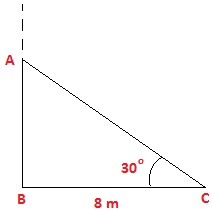
From figure: Total height of the tree is the sum of AB and AC i.e. AB+AC
In right ΔABC,
Using Cosine and tangent angles,
cos 30° = BC/AC
We know that, cos 30° = √3/2
√3/2 = 8/AC
AC = 16/√3 …(1)
Also,
tan 30° = AB/BC
1/√3 = AB/8
AB = 8/√3 ….(2)
Therefore, total height of the tree = AB + AC = 16/√3 + 8/√3 = 24/√3 = 8√3 m.
Posted by Yashaswi Kuril 5 years, 3 months ago (5421616)
- 3 answers
Posted by Anushka Chauhan 5 years, 1 month ago (9857995)
- 3 answers
Yogita Ingle 5 years, 3 months ago (2577571)
he two laws of reflection are:
(i) the incident ray, the reflected ray and the normal (at the point of incidence), all lie in the same plane.
(ii) the angle of reflection (<i>r</i>) is always equal to the angle of incidence (<i>i</i>)
∠<i>r</i> = ∠<i>i</i>
Gaurav Seth 5 years, 3 months ago (2898529)
Laws of Reflection of light:
- The angle of incidence and angle of reflection is equal.
- The incident ray, reflected ray and normal to the point of reflection lie in the same plane.
The angle of incidence is denoted by 'i' and angle of reflection is denoted by 'r'. The law of reflection is applicable to all types of reflecting surface.
Posted by Suresh Gupta 5 years, 3 months ago (5222476)
- 1 answers
Gaurav Seth 5 years, 3 months ago (2898529)
Steps which can be taken to prevent environmental degradation area are as follows:
- a) Proper planning should be done while deciding the location of industries, better design and efficient use of the equipment.
- b) Various equipment such as filters, precipitators, and scrubbers should be used in industries to control pollution.
- c) Water pollution can be controlled by treating polluted water before discharge from the industries.
myCBSEguide
Trusted by 1 Crore+ Students

Test Generator
Create papers online. It's FREE.

CUET Mock Tests
75,000+ questions to practice only on myCBSEguide app

~@Kanchi Jawla 5 years, 3 months ago (9746879)
1 Thank You