
Ask questions, doubts, problems and we will help you..
Ask questions which are clear, concise and easy to understand.
Ask Question
CBSE, JEE, NEET, CUET
Question Bank, Mock Tests, Exam Papers
NCERT Solutions, Sample Papers, Notes, Videos
Posted by Anuj Kumar 5 years ago (9607230)
- 1 answers
Posted by Neshok Ls 5 years ago (10299150)
- 2 answers
Deepender Sheoran 4 years, 11 months ago (9322082)
Gaurav Seth 5 years ago (2898529)
The momentum is zero.
Explanation:
momentum is the product of mass and velocity of a particular material . And when ball is thrown vertically upwards its velocity at highest point is zero . Therefore momentum P = m× v = m × 0 =0.
Posted by Naresh Singh 5 years ago (10256088)
- 2 answers
Gaurav Seth 5 years ago (2898529)
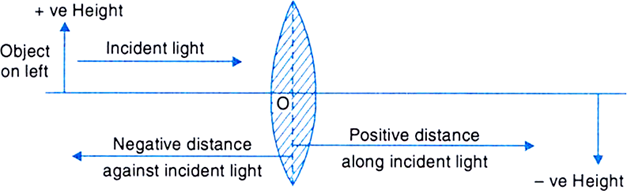
New cartesian sign convention for refraction of light through spherical lenses. According to this sign convention:
(i) All distances are measured from the optical centre of the lens.
(ii) The distances measured in the same direction as the incident light are taken positive.
(iii) The distances measured in the direction opposite to the direction of incident light are taken negative.
(iv) Heights measured upwards and perpendicular to the principal axis are taken positive.
(v) Heights measured downwards and perpendicular to the principal axis are taken negative.
Assumptions used in the derivation of lens formula:
(i) The lens used is thin.
(ii) The aperture of the lens is small.
(iii) The incident and refracted rays make small angles with the principal axis.
(iv) The object is a small object placed on the principal axis.
Derivation of lens formula for a convex lens. As shown in Fig, consider an object AB placed perpendicular to the principal axis of a thin convex lens between its F1 and 2F1. A real, inverted and magnified image AB' is formed beyond 2F2 on the other side of the lens.
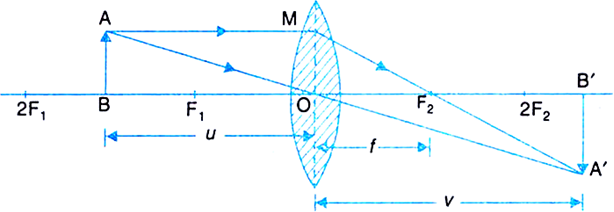
Fig. Real image formed by a convex lens.


 ...(1)
Also,  are similar,


But MO = AB,

 ...(2)
From (1) and (2), we get 
Using new Cartesian sign convention, we get
Object distance, BO = -u
Image distance, OB' = +v
Focal length, OF2 = + f


Derivation of lens formula is not included in CBSE syllabus.
or 
or 
Dividing both sides by uvf, we get

This proves the lens formula for a convex lens.
Posted by Mehul Kedia 5 years ago (10233896)
- 2 answers
Posted by Rishu Yadav 5 years ago (10309865)
- 2 answers
Inderjot ~~ 4 years, 11 months ago (10246258)
Gaurav Seth 5 years ago (2898529)
Considering the loss of classroom teaching time due to the Covid-19 pandemic and lockdown, CBSE reduced the syllabus of classes 9 to 12 with the help of suggestions from NCERT.
The CBSE syllabus has been rationalized keeping intact the learning outcomes so that the core concepts of students can be retained.
Click on the given link for <font color="#FF6600"><font style="box-sizing: border-box;">Revised Curriculum for the Academic Year 2020-21</font></font>
<div class="panel-group" id="accordion" style="margin-bottom:5px; text-align:start; -webkit-text-stroke-width:0px"> <div class="panel panel-default" style="border:1px solid #dddddd; margin-bottom:0px; border-radius:4px"> <div class="panel-heading" style="border-bottom:0px #dddddd; padding:10px 15px; border-top-left-radius:3px; border-top-right-radius:3px; border-top-color:#dddddd; border-right-color:#dddddd; border-left-color:#dddddd"><a data-toggle="collapse" href="http://cbseacademic.nic.in/Revisedcurriculum_2021.html#collapse2" style="box-sizing:border-box; color:inherit; text-decoration:none; outline:0px; display:block; font-weight:bold">Revised Secondary Curriculum (IX-X)</a>
</div> </div> </div>
Posted by Gowri Chandran 5 years ago (10254337)
- 4 answers
Gowri Chandran 5 years ago (10254337)

Posted by Tiya. Nerd 🤓 5 years ago (9866654)
- 0 answers
Posted by Shrishti Rawat 5 years ago (1225290)
- 1 answers
Yogita Ingle 5 years ago (2577571)
(l+m)2-4lm
= l2 + 2lm + m2 - 4lm
= l2 + m2 + 2lm - 4lm
= l2 + m2 - 2lm
Posted by Mohit Kala 5 years ago (9281797)
- 0 answers
Posted by Dibyaranjan Rout 5 years ago (8714292)
- 2 answers
Gaurav Seth 5 years ago (2898529)
The contribution of democracy towards economic growth and development is a debatable topic. However, sometimes democracy has proven helpful.
- Democracy consists of various stable and predictable institutions and tends to implement those policies which are beneficial to private enterprise. Thus, it results in higher rates of economic growth over a long period of time.
- As democracy is accountable to the public rather than to privileged, they produce more public goods, invest more in human capital, maintain the rule of law and protect private property rights.
- Democracy engages more in large-scale redistribution than autocracies. However, the various negative effects of redistribution are offset by the fact that democracies have lower barriers to entry, promoting competition and innovation.
Posted by Namrata Yadav 5 years ago (10154393)
- 2 answers
Mukul Raj Mahalkay 4 years, 11 months ago (10239806)
Posted by It'S Piyush 5 years ago (10167823)
- 4 answers
Sakshi Carpenter 5 years ago (10310517)
Gaurav Seth 5 years ago (2898529)
ANSWER
Let the cost of a notebook be Rs. x and that of a pen be Rs. y.
Given the cost of a notebook is twice the cost of a pen.
Then x = 2y
or, x − 2y = 0.
This is the required linear equation in two variable.
Posted by Khushboo Taravar 5 years ago (10235852)
- 0 answers
Posted by It'S Piyush 5 years ago (10167823)
- 3 answers
Paarvi Parashar 4 years, 6 months ago (11281060)
Posted by Mir Mirzan 5 years ago (10235060)
- 0 answers
Posted by Shubham Jaiswal 5 years ago (10314895)
- 1 answers
Gaurav Seth 5 years ago (2898529)
The country of Nepal has witnessed several people’s struggles for democracy. There was a people’s struggle in 1990 that established democracy that lasted for 12 years until 2002. In October 2002, King Gyanendra, citing the Maoist uprising in the countryside as his reason, began taking over different aspects of the government with the army’s assistance. The King then finally took over as the head of government in February 2005. In November 2005, the Maoists joined other political parties to sign a 12-point agreement. This agreement signalled to the larger public an imminent return to democracy and peace. In 2006, this people’s movement for democracy began gaining immense force. It repeatedly refused the small concessions that the King made and finally in April 2006 the King restored the Third Parliament and asked the political parties to form a government. In 2007, Nepal adopted an interim Constitution. The above photos show scenes from the people’s movement for democracy in 2006.
Nepal, a country that borders India on the north. Until quite recently, Nepal was a monarchy. The previous Constitution of Nepal, which had been adopted in 1990, reflected the fact that the final authority rested with the King. A people’s movement in Nepal fought for several decades to establish democracy and in 2006 they finally succeeded in putting an end to the powers of the King. Now the people have to write a new Constitution to establish Nepal as a democracy. The reason that they do not want to continue with the previous Constitution is because it does not reflect the ideals of the country that they want Nepal to be, and that they have fought for.
Posted by Vikas Kashyap 5 years ago (7357210)
- 1 answers
Gaurav Seth 5 years ago (2898529)
साक्षरता दर:
यह सात और उससे अधिक आयु वर्ग में साक्षर आबादी के अनुपात को मापता है I साक्षरता दर उन लोगों का कुल प्रतिशत है जो साक्षर हैं, वे लोग हैं जो पढ़ और लिख सकते हैं I
Literacy Rate:
It measures the proportion of literate population in the seven and above age group. Literacy rate is the total percentage of people who are literate that is people who can read and write
Posted by Raju Pokhrel 5 years ago (6970739)
- 1 answers
Gaurav Seth 5 years ago (2898529)
Origin of the United Nations Organisation (UNO):
It was the Atlantic Charter of 1941 which guaranteed the principle of equality of states and their freedom to choose any form of government that can be considered the origin of the UNO.
In 1942 the representatives of twenty-six countries put their signatures to the United Nations Declaration drawn on the lines of Atlantic Charter.
Click on the given link:
<a data-ved="2ahUKEwixzvHjoeTtAhWDe30KHQzuAHIQFjABegQIAxAC" href="https://www.yourarticlelibrary.com/project-reports/project-report-on-the-united-nations-organization-uno/85533#:~:text=Project%20Report%20%23%201.,the%20origin%20of%20the%20UNO.&text=The%20UNO%20was%20formally%20brought%20into%20existence%20on%2024%20October%201945." ping="/url?sa=t&source=web&rct=j&url=https://www.yourarticlelibrary.com/project-reports/project-report-on-the-united-nations-organization-uno/85533%23:~:text%3DProject%2520Report%2520%2523%25201.,the%2520origin%2520of%2520the%2520UNO.%26text%3DThe%2520UNO%2520was%2520formally%2520brought%2520into%2520existence%2520on%252024%2520October%25201945.&ved=2ahUKEwixzvHjoeTtAhWDe30KHQzuAHIQFjABegQIAxAC" rel="noopener" target="_blank">Project Report on the United Nations Organization (UNO)</a>
Posted by Devansh Prakash Sharma 5 years ago (9887981)
- 0 answers
Posted by Raju Pokhrel 5 years ago (6970739)
- 1 answers
Gaurav Seth 5 years ago (2898529)
Introduction
An international organization is an organization with an international membership, scope, or presence. International Organisation is a specialisation within the Political Science master programme. It covers various aspects of global governance from multiple social and political science perspectives. To study international organisation (IO) is to study the norms, rules, and institutions that shape relations between states and contacts across state borders, and how they affect people’s lives, the destiny of nations, and the fate of the planet.
Click on the given link for project:
<a data-ved="2ahUKEwiz5LH8n-TtAhUZlEsFHZoDAy4QFjABegQIBRAC" href="https://www.slideshare.net/sourabharay/international-organization-55132044" ping="/url?sa=t&source=web&rct=j&url=https://www.slideshare.net/sourabharay/international-organization-55132044&ved=2ahUKEwiz5LH8n-TtAhUZlEsFHZoDAy4QFjABegQIBRAC" rel="noopener" target="_blank">International organization - SlideShare</a>
Posted by Raju Pokhrel 5 years ago (6970739)
- 1 answers
Gaurav Seth 5 years ago (2898529)
An international organization is an organization with an international membership, scope, or presence. International Organisation is a specialisation within the Political Science master programme. It covers various aspects of global governance from multiple social and political science perspectives. To study international organisation (IO) is to study the norms, rules, and institutions that shape relations between states and contacts across state borders, and how they affect people’s lives, the destiny of nations, and the fate of the planet.
Posted by Ankit Chand 5 years ago (10306515)
- 3 answers
Posted by Dakshita Gulia 5 years ago (7911313)
- 2 answers
Gaurav Seth 5 years ago (2898529)
Answer:
When, Amenhotep IV became the pharaoh, he promoted the worship of Aten, and changed his name to Akhetan. He moved the religious capital from Thebes to a new city of Akhetaten. Besides these, he also attacked Amun, the major God, smashing his images and closing his temples.
Posted by Sazid Ahmed 5 years ago (8953779)
- 1 answers
Gaurav Seth 5 years ago (2898529)
- Some powerful tribes controlled large territories.
- In Punjab, the Khokhar tribe was very influential during the thirteenth and fourteenth centuries.
- Afterwards the Gakkhars became more important.
- Their chief, Kamal Khan Gakkhar, was made a noble (mansabdar) by Emperor Akbar.
- In Multan and Sind, the Langahs and Arghuns dominated vast regions.
- Afterwards they were defeated by the Mughals.
- The Balochis were another large and powerful tribe in the north-west.
- They were divided into many smaller clans under different chiefs.
- In the western Himalaya there lived the shepherd tribe of Gaddis.
- In the distant north-eastern part of the subcontinent the Nagas, Ahoms and many others lived.
Posted by Ranvijay Kumar 5 years ago (10396945)
- 3 answers
Posted by Khushboo Taravar 5 years ago (10235852)
- 1 answers
Yogita Ingle 5 years ago (2577571)
Indifference Set : It is a set of those combination of two goods which offer the consumer the same level of satisfaction, so that, the consumer is indifferent across any number of combination in his indifference set.
Monotonic Preferences : onotonic preferences refers to a situation where the consumer will prefer more quantity of commodities than lesser quantity.
Posted by Samiksha Jain 5 years ago (10314787)
- 1 answers
Aniket Singh 4 years, 11 months ago (10331349)
Posted by Ranvijay Kumar 5 years ago (10396945)
- 2 answers
Gaurav Seth 5 years ago (2898529)
Covalent bonds are of 3 types:
1)Single covalent bond:It is formed by sharing of one pair of electron between two atoms.
For Ex:Formation of chlorine ,Hydrogen,Hydrogen chloride,Methane molecule etc.
2)Double covalent bond:It is formed by sharing of two pair of electron between two atoms.
For Ex:Oxygen,Carbondioxide,Ethene molecule etc.
3)Triple Covalent bond:It is formed by sharing of three pair of electron between two atoms.
For Ex:Nitrogen,Ethyne molecule etc.
myCBSEguide
Trusted by 1 Crore+ Students

Test Generator
Create papers online. It's FREE.

CUET Mock Tests
75,000+ questions to practice only on myCBSEguide app

Gaurav Malik 4 years, 11 months ago (10306170)
0 Thank You