A Square and A Cube – NCERT Solutions Class 8 Maths (Ganita Prakash) includes all the questions with solutions given in the NCERT Class 8 Maths (Ganita Prakash).
NCERT Solutions Class 8
English Poorvi Hindi Malhar Maths Ganita Prakash Science Curiosity Social Exploring SocietyA Square and A Cube – NCERT Solutions
Q.1: Find the squares of the first 30 natural numbers and fill in the table below.
| {tex}1^2=1{/tex} | {tex}11^2=121{/tex} | {tex}21^2=441{/tex} |
| {tex}2^2=4{/tex} | {tex}12^2={/tex} | {tex}22^2={/tex} |
| {tex}3^2=9{/tex} | {tex}13^2={/tex} | |
| {tex}4^2=16{/tex} | {tex}14^2={/tex} | |
| {tex}5^2=25{/tex} | {tex}15^2={/tex} | |
| {tex}6^2={/tex} | {tex}16^2={/tex} | |
| {tex}7^2={/tex} | {tex}17^2={/tex} | |
| {tex}8^2={/tex} | {tex}18^2={/tex} | |
| {tex}9^2={/tex} | {tex}19^2={/tex} | |
| {tex}10^2={/tex} | {tex}20^2={/tex} |
Solution:
| {tex}1^2=1{/tex} | {tex}11^2=121{/tex} | {tex}21^2=441{/tex} |
| {tex}2^2=4{/tex} | {tex}12^2=144{/tex} | {tex}22^2=484{/tex} |
| {tex}3^2=9{/tex} | {tex}13^2=169{/tex} | {tex}23^2=529{/tex} |
| {tex}4^2=16{/tex} | {tex}14^2=196{/tex} | {tex}24^2=576{/tex} |
| {tex}5^2=25{/tex} | {tex}15^2=225{/tex} | {tex}25^2=625{/tex} |
| {tex}6^2=36{/tex} | {tex}16^2=256{/tex} | {tex}26^2=676{/tex} |
| {tex}7^2=49{/tex} | {tex}17^2=289{/tex} | {tex}27^2=729{/tex} |
| {tex}8^2=64{/tex} | {tex}18^2=324{/tex} | {tex}28^2=784{/tex} |
| {tex}9^2=81{/tex} | {tex}19^2=361{/tex} | {tex}29^2=841{/tex} |
| {tex}10^2=100{/tex} | {tex}20^2=400{/tex} | {tex}30^2=900{/tex} |
Q.2: What patterns do you notice? Share your observations and make conjectures.
| {tex}1^2=1{/tex} | {tex}11^2=121{/tex} | {tex}21^2=441{/tex} |
| {tex}2^2=4{/tex} | {tex}12^2={/tex} | {tex}22^2={/tex} |
| {tex}3^2=9{/tex} | {tex}13^2={/tex} | |
| {tex}4^2=16{/tex} | {tex}14^2={/tex} | |
| {tex}5^2=25{/tex} | {tex}15^2={/tex} | |
| {tex}6^2={/tex} | {tex}16^2={/tex} | |
| {tex}7^2={/tex} | {tex}17^2={/tex} | |
| {tex}8^2={/tex} | {tex}18^2={/tex} | |
| {tex}9^2={/tex} | {tex}19^2={/tex} | |
| {tex}10^2={/tex} | {tex}20^2={/tex} |
Solution: The squares of the first 30 natural numbers are:
- {tex}1^2=1,2^2=4,3^2=9,4^2=16,5^2=25,6^2=36,7^2=49,8^2=64,9^2=81,10^2=100{/tex}
- {tex}11^2=121,12^2=144,13^2=169,14^2=196,15^2=225,16^2=256,17^2=289,18^2=324{/tex}, {tex}19^2=361,20^2=400{/tex}
- {tex}21^2=441,22^2=484,23^2=529,24^2=576,25^2=625,26^2=676,27^2=729,28^2=784{/tex}, {tex}29^2=841,30^2=900{/tex}
- Observation: The units digits of these square numbers are only {tex}0,1,4,5,6{/tex}, or 9.
None of them end in {tex}2,3,7{/tex}, or 8.
Q.3: If a number ends in 0, 1, 4, 5, 6 or 9, is it always a square?
Solution: No. For example, the number 26 ends in 6, but it is not a perfect square. Just looking at the units digit is not enough to confirm if a number is a square, but it can tell us if a number is not a square.
Q.4: Write 5 numbers such that you can determine by looking at their units digit that they are not squares.
Solution: Any number ending in 2, 3, 7, or 8 is not a perfect square. Five examples are: 12, 33, 47, 58, and 102.
Q.5: Which of the following numbers have the digit 6 in the units place?
- 382
- 342
- 462
- 562
- 742
- 822
Solution: To find the units digit (that is, the last digit) of the square of a number, we only need to look at the units digit of the original number, because squaring affects the last digit in a predictable way.
Here is a table showing what happens when we square numbers ending in each digit from 0 to 9:
| Units digit of a number | Units digit of its square |
| 0 | 0 |
| 1 | 1 |
| 2 | 4 |
| 3 | 9 |
| 4 | 6 |
| 5 | 5 |
| 6 | 6 |
| 7 | 9 |
| 8 | 4 |
| 9 | 1 |
From this table, we observe that:
A number’s square ends in 6 if the number itself ends in 4 or 6.
Checking Each Option:
- 382: The number ends in {tex}8 \rightarrow 8^2{/tex} ends in {tex}4 \rightarrow{/tex} does not end in 6
- 342: The number ends in {tex}4 \rightarrow 4^2{/tex} ends in {tex}6 \rightarrow{/tex} ends in 6
- 462: The number ends in {tex}6 \rightarrow 6^2{/tex} ends in {tex}6 \rightarrow{/tex} ends in 6
- 562: The number ends in {tex}6 \rightarrow 6^2{/tex} ends in {tex}6 \rightarrow{/tex} ends in 6
- 742: The number ends in {tex}4 \rightarrow 4^2{/tex} ends in {tex}6 \rightarrow{/tex} ends in 6
- 822: The number ends in {tex}^2 \rightarrow 2^2{/tex} ends in {tex}4 \rightarrow{/tex} does not end in 6
Q.6: If a number contains 3 zeros at the end, how many zeros will its square have at the end?
Solution: Its square will have 6 zeros at the end. The number of zeros at the end of a square is always double the number of zeros at the end of the original number.
Q.7: What do you notice about the number of zeros at the end of a number and the number of zeros at the end of its square? Will this always happen? Can we say that squares can only have an even number of zeros at the end?
Solution: The number of zeros at the end of a square is always double the number of zeros in the original number. This will always happen. Yes, we can say that perfect squares can only have an even number of zeros at the end.
Q.8: What can you say about the parity of a number and its square?
Solution: The square of an even number is always even. The square of an odd number is always odd.
Q.9: Find how many numbers lie between two consecutive perfect squares. Do you notice a pattern?
Solution: Between {tex}{n}^2{/tex} and {tex}({n}+1)^2{/tex}, there are 2 n non-perfect square numbers. For example, between {tex}2^2(4){/tex} and {tex}3^2(9){/tex}, there are {tex}2^2=4{/tex} numbers ( {tex}5,6,7,8{/tex} ). Between {tex}3^2{/tex} (9) and {tex}4^2(16){/tex}, there are {tex}2^3=6{/tex} numbers {tex}(10,11,12,13,14,15){/tex}.
Q.10: How many square numbers are there between 1 and 100? How many are between 101 and 200? Using the table of squares you filled earlier, enter the values below, tabulating the number of squares in each block of 100. What is the largest square less than 1000?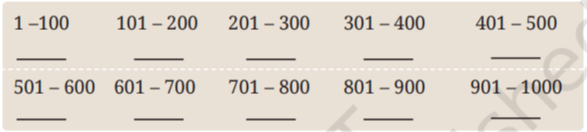
Solution:
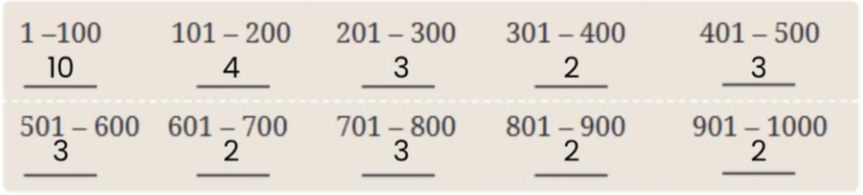
The largest square less than 1000 is {tex}31^2=961{/tex}.
Q.11: Can you see any relation between triangular numbers and square numbers? Extend the pattern shown and draw the next term.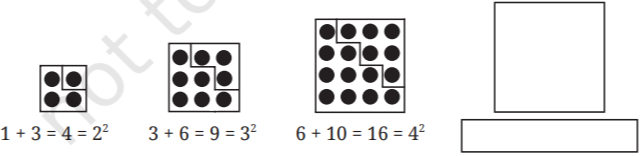
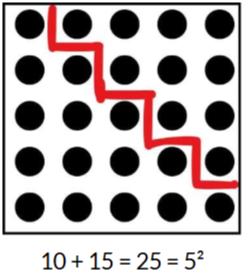
Solution: The sum of two consecutive triangular numbers is a perfect square.
- 1 + 3 = 4 = 22
- 3 + 6 = 9 = 32
- 6 + 10 = 16 = 42
- The next term would be
Q.12: Using the pattern above, find {tex}36^2{/tex}, given that {tex}35^2=1225{/tex}.
Solution: From the question we know that 1225 is the sum of the first 35 odd numbers. To find {tex}36^2{/tex}, we need to add the 36th odd number to 1225.
Q.13: How do we find the 36th odd number?
Solution: The 1st odd number is 1,2nd odd number is 3,3rd number is {tex}5, \ldots, 6{/tex}th odd number is 11 and so on.
Q.14: What is the {tex}n^{\text {th }}{/tex} odd number?
Solution: The {tex}n^{\text {th }}{/tex} odd number is {tex}2 n-1{/tex}.
Therefore, the 36th odd number is 71.
By adding 71 to 1225 , we get 1296 , which is {tex}36^2{/tex}.
Q.15: The area of a square is {tex}49 {sq} . {cm}{/tex}. What is the length of its side? We know that {tex}7 \times 7=49{/tex}, or {tex}7^2=49{/tex}.
Solution: So, the length of the side of a square with an area of {tex}49 {sq} . {cm}{/tex} is 7 cm .
We call 7 the square root of 49.
In general, if {tex}y=x^2{/tex} then {tex}x{/tex} is the square root of {tex}y{/tex}.
Q.16: What is the square root of {tex}64 ?{/tex}
Solution: We know that {tex}8 \times 8{/tex} is 64 . So, 8 is the square root of 64 . What about {tex}-8 \times-8{/tex}? That is 64 too!
{tex} 8^2=64, \text { and }(-8)^2=64 . {/tex}
So, the square roots of 64 are +8 and -8. Every perfect square has two integer square roots. One is positive and the other is negative. The square root of a number is denoted by square root.
Thus, {tex}\sqrt{64}= \pm 8{/tex} and {tex}\sqrt{100}= \pm 10{/tex}.
Note that {tex}\sqrt{8^2}= \pm 8{/tex} and {tex}\sqrt{10^2}= \pm 10{/tex}. In general, {tex}\sqrt{n^2}= \pm n{/tex}.
In this chapter, we shall only consider the positive square root.
Q.17: Given a number, such as 576 or 327, how do we find out if it is a perfect square? If it is a perfect square, how can we find its square root?
Solution: We know that perfect squares end in {tex}1,4,9,6,5{/tex}, or an even number of zeros. But, it is not certain that a number that satisfies this condition is a square.
We can clearly say that 327 is not a perfect square. However, we cannot be sure that 576 is a perfect square.
Q.18: Which of the following numbers are not perfect squares?
- 2032
- 2048
- 1027
- 1089
Solution:
- (i) 2032 ends in 2. Not a perfect square.
- (ii) 2048 ends in 8. Not a perfect square.
- (iii) 1027 ends in 7. Not a perfect square.
- (iv) 1089 might be. lets find out:
We know, 302=900, so, 1089 is very close to 900, lets list the squares of the next numbers.
312 = 961
322 = 1024
332 = 1089. So, 1089 is a perfect square. - So, (i), (ii), and (iii) are not perfect squares.
Q.19: Which one among 642, 1082, 2922, 362 has last digit 4?
Solution: A square has the last digit 4 if the original number’s last digit is 2 or 8.
Therefore, 1082 and 2922 will have the last digit 4.
Q.20: Given 1252 = 15625, what is the value of 1262?
- 15625 + 126
- 15625 + 262
- 15625 + 253
- 15625 + 251
- 15625 + 512
Solution: We know that, {tex}125^2=15625{/tex}. That means 15625 is the sum of 125 consecutive natural numbers. To find {tex}126^2{/tex}, we need to find the {tex}126^{\text {th }}{/tex} odd number and add it with {tex}125^{\text {th }}{/tex} odd number that is 15625.
{tex}126{ }^{\text {th }}{/tex} odd number {tex}=(2 \times 126)-1=251{/tex}.
Therefore, {tex}126^2=15625+251=15876{/tex}.
Q.21: Find the length of the side of a square whose area is 441 m2.
Solution: The length is {tex}\sqrt {441}{/tex}. We know {tex}20^2=400{/tex} and the number ends in 1, so the root must end in 1 or 9. Trying 21, we get {tex}21^2=441{/tex}. The length is 21 m.
Q.22: Find the smallest square number that is divisible by each of the following numbers: 4, 9, and 10.
Solution: First, find the LCM of 4, 9, and 10.
- {tex}4=2^2, 9=3^2, 10=2 \times 5{/tex}.
- {tex}{LCM}=2^2 \times 3^2 \times 5=4 \times 9 \times 5=180{/tex}.
- The prime factorization of 180 is {tex}2 \times 2 \times 3 \times 3 \times 5{/tex}. To make it a perfect square, all prime factors must be in pairs. The factor 5 is not paired.
- We must multiply by {tex}5: 180 \times 5=900{/tex}.
- The smallest square number is 900.
Q.23: Find the smallest number by which 9408 must be multiplied so that the product is a perfect square. Find the square root of the product.
Solution: Prime factorization of 9408:
{tex} 9408=2 \times 4704 {/tex}
{tex} =2 \times 2 \times 2352 {/tex}
{tex} =2 \times 2 \times 2 \times 2 \times 2 \times 2 \times 3 \times 7 \times 7 . {/tex}
{tex} \text { In pairs: }(2 \times 2) \times(2 \times 2) \times(2 \times 2) \times(7 \times 7) \times 3 . {/tex}
The factor 3 is unpaired.
The smallest number to multiply by is 3.
The new number is {tex}9408 \times 3=28224{/tex}.
The square root is {tex}2 \times 2 \times 2 \times 7 \times 3=168{/tex}.
Q.24: How many numbers lie between the squares of the following numbers?
- 16 and 17
- 99 and 100
Solution: There are 2n numbers between n2 and (n+1)2.
- Between {tex}16^2{/tex} and {tex}17^2: 2 \times 16=32{/tex} numbers.
- Between {tex}99^2{/tex} and {tex}100^2: 2 \times 99=198{/tex} numbers.
Q.25: In the following pattern, fill in the missing numbers:
{tex} 1^2+2^2+2^2=3^2 {/tex}
{tex} 2^2+3^2+6^2=7^2 {/tex}
{tex} 3^2+4^2+12^2=13^2 {/tex}
{tex} 4^2+5^2+20^2={/tex} (________)2
{tex} 9^2+10^2+{/tex}(________)2 = (________)2
Solution: The pattern is {tex}a^2+b^2+(a b)^2=(a b+1)^2{/tex}.
{tex} 1^2+2^2+2^2=3^2 {/tex}
{tex} 2^2+3^2+6^2=7^2 {/tex}
{tex} 3^2+4^2+12^2=13^2 {/tex}
{tex} 4^2+5^2+20^2=(21)^2 {/tex}
{tex} 9^2+10^2+(90)^2=(91)^2 {/tex}
Q.26: How many tiny squares are there in the following picture? Write the prime factorisation of the number of tiny squares.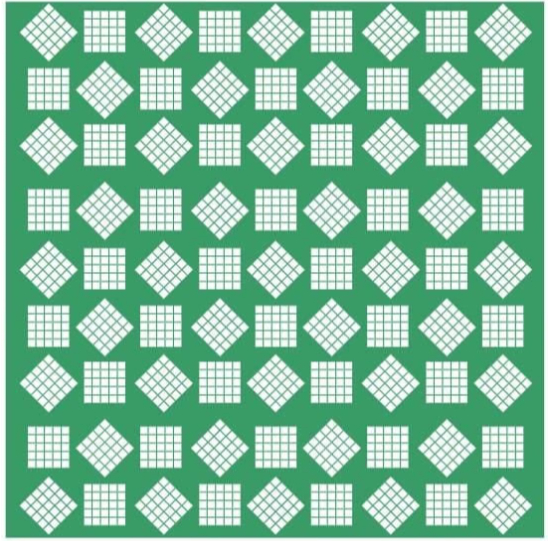
Solution: There are 1025 tiny squares
{tex}1025=5 \times 5 \times 41{/tex}
Q.27: Complete the table below.
| {tex}1^3=1{/tex} | {tex}11^3=1331{/tex} |
| {tex}2^3=8{/tex} | {tex}12^3={/tex} |
| {tex}3^3=27{/tex} | {tex}13^3=2197{/tex} |
| {tex}4^3=64{/tex} | {tex}14^3=2744{/tex} |
| {tex}5^3=125{/tex} | {tex}15^3={/tex} |
| {tex}6^3={/tex} | {tex}16^3={/tex} |
| {tex}7^3={/tex} | {tex}17^3=4913{/tex} |
| {tex}8^3={/tex} | {tex}18^3=5832{/tex} |
| {tex}9^3={/tex} | {tex}19^3=6859{/tex} |
| {tex}10^3={/tex} | {tex}20^3={/tex} |
Solution:
| {tex}1^3=1{/tex} | {tex}11^3=1331{/tex} |
| {tex}2^3=8{/tex} | {tex}12^3=1728{/tex} |
| {tex}3^3=27{/tex} | {tex}13^3=2197{/tex} |
| {tex}4^3=64{/tex} | {tex}14^3=2744{/tex} |
| {tex}5^3=125{/tex} | {tex}15^3=3375{/tex} |
| {tex}6^3=216{/tex} | {tex}16^3=4096{/tex} |
| {tex}7^3=343{/tex} | {tex}17^3=4913{/tex} |
| {tex}8^3=512{/tex} | {tex}18^3=5832{/tex} |
| {tex}9^3=729{/tex} | {tex}19^3=6859{/tex} |
| {tex}10^3=1000{/tex} | {tex}20^3=8000{/tex} |
Q.28:
| {tex}1^3=1{/tex} | {tex}11^3=1331{/tex} |
| {tex}2^3=8{/tex} | {tex}12^3={/tex} |
| {tex}3^3=27{/tex} | {tex}13^3=2197{/tex} |
| {tex}4^3=64{/tex} | {tex}14^3=2744{/tex} |
| {tex}5^3=125{/tex} | {tex}15^3={/tex} |
| {tex}6^3={/tex} | {tex}16^3={/tex} |
| {tex}7^3={/tex} | {tex}17^3=4913{/tex} |
| {tex}8^3={/tex} | {tex}18^3=5832{/tex} |
| {tex}9^3={/tex} | {tex}19^3=6859{/tex} |
| {tex}10^3={/tex} | {tex}20^3={/tex} |
What patterns do you notice in the table above?
Solution: The last digit of a cube can be any digit from 0 to 9.
- Cube of a number ending in 1 ends in 1.
- Cube of a number ending in 2 ends in 8.
- Cube of a number ending in 3 ends in 7.
- Cube of a number ending in 4 ends in 4.
- Cube of a number ending in 5 ends in 5.
- Cube of a number ending in 6 ends in 6.
- Cube of a number ending in 7 ends in 3.
- Cube of a number ending in 8 ends in 2.
- Cube of a number ending in 9 ends in 9.
- Cube of a number ending in 0 ends in 0.
Q.29: We know that 0, 1, 4, 5, 6, 9 are the only last digits possible for squares. What are the possible last digits of cubes?
Solution: All digits from 0 to 9 are possible last digits for cubes.
Q.30: Similar to squares, can you find the number of cubes with 1 digit, 2 digits, and 3 digits? What do you observe?
Solution:
- 1-digit cubes: {tex}1^3, 2^3(1,8){/tex}-> 2 cubes.
- 2-digit cubes: {tex}3^3, 4^3(27,64){/tex}-> 2 cubes.
- 3-digit cubes: {tex}5^3, 6^3, 7^3, 8^3, 9^3(125,216,343,512,729){/tex}-> 5 cubes.
- Observation: The number of cubes in a given range of digits is not as regular as squares.
Q.31: Can a cube end with exactly two zeroes (00)? Explain.
Solution: No. For a number to end in zero, it must be a multiple of 10. The cube of a multiple of 10 (like 10, 20, 30) will have a number of zeros that is a multiple of 3. For example, 103 = 1000 (3 zeros), 203 = 8000 (3 zeros). It is impossible for a perfect cube to end in exactly two zeros.
Q.32: The next two taxicab numbers after 1729 are 4104 and 13832. Find the two ways in which each of these can be expressed as the sum of two positive cubes.
Solution:
- {tex} \text { 4104: } 4104=2^3+16^3=8+4096 . {/tex} {tex}\text { Also, } 4104=9^3+15^3=729+3375 . {/tex}
- {tex} \text { 13832: } 13832=2^3+24^3=8+13824 . {/tex} {tex}\text { Also, } 13832=18^3+20^3=5832+8000 . {/tex}
Q.33: Can you tell what this sum is without doing the calculation?
91+93 +95 + 97 + 99 + 101 + 103 + 105 + 107 + 109.
Solution: This is a series of 10 consecutive odd numbers. The sum of n consecutive odd numbers starting from the correct term gives n3. The sum shown is 103 that is, 1000.
Q.34: Find the cube root of {tex}\sqrt[3]{ 64} {/tex}
Solution: Step 1: Prime factorisation
{tex} 64=2 \times 2 \times 2 \times 2 \times 2 \times 2 {/tex}
Step 2: Group the factors into triplets
{tex} (2 \times 2 \times 2) \times(2 \times 2 \times 2) {/tex}
{tex} \text { cube root }=2 \times 2=4 {/tex}
Q.35: Find the cube root of {tex}\sqrt[3]{ 512} {/tex}
Solution: Step 1: Prime factorisation
{tex} 512=2 \times 2 \times 2 \times 2 \times 2 \times 2 \times 2 \times 2 \times 2 {/tex}
Step 2: Group the factors into triplets
{tex} (2 \times 2 \times 2) \times(2 \times 2 \times 2) \times(2 \times 2 \times 2) {/tex}
{tex} \text { cube root }=2 \times 2 \times 2=8 {/tex}
Q.36: Find the cube root of {tex}\sqrt[3]{729} {/tex}
Solution: Step 1: Prime factorisation
{tex} 729=3 \times 3 \times 3 \times 3 \times 3 \times 3 {/tex}
Step 2: Group the factors into triplets
{tex} (3 \times 3 \times 3) \times(3 \times 3 \times 3) {/tex}
{tex} \text { cube root }=3 \times 3=9 {/tex}
Q.37: Find the cube roots of 27000 and 10648.
Solution:
- {tex}\sqrt[3]{27000 } {/tex}
Step 1: Prime factorisation
{tex} 27000=27 \times 1000 {/tex}
{tex} =(3 \times 3 \times 3) \times(2 \times 2 \times 2 \times 5 \times 5 \times 5) {/tex}
Step 2: Group the prime factors into triplets
{tex} (3 \times 3 \times 3) \times(2 \times 2 \times 2) \times(5 \times 5 \times 5){/tex} {tex}=\left(3^3\right) \times\left(2^3\right) \times\left(5^3\right) {/tex}
{tex} \text { cube root }=3 \times 2 \times 5=30 {/tex} - {tex}\sqrt[3]{10648} {/tex}
Step 1: Prime factorisation
{tex} 10648=2 \times 2 \times 2 \times 11 \times 11 \times 11=2^3 \times 11^3 {/tex}
Step 2: Group the prime factors into triplets
{tex} (2 \times 2 \times 2) \times(11 \times 11 \times 11) {/tex}
{tex} \text { cube root }=2 \times 11=22 {/tex}
Q.38: What number will you multiply by 1323 to make it a cube number?
Solution: Prime factorization of {tex}1323=3 \times 441=3 \times 21^2=3 \times(3 \times 7)^2=3 \times 3^2 \times 7^2=3^3 \times 7^2{/tex}.
- The factor 3 is a triplet, but 7 is only a pair. We need one more 7 to make it a triplet.
- You must multiply by 7.
Q.39: The cube of any odd number is even.
Options:
(1) True
(2) False ✅
Q.40: There is no perfect cube that ends with 8.
Options:
(1) True
(2) False ✅
Explanation: {tex}2^3=8{/tex}, and any number ending in 2 will have a cube ending in {tex}8\left(\right.{/tex} e.g., {tex}\left.12^3=1728\right){/tex}.
Q.41: The cube of a 2-digit number may be a 3-digit number.
Options:
(1) True
(2) False ✅
Explanation: The smallest 2-digit number is 10, and 103 = 1000 (a 4-digit number).
All other 2-digit cubes will be larger.
Q.42: The cube of a 2-digit number may have seven or more digits.
Options:
(1) True
(2) False ✅
Explanation: The largest 2-digit number is 99. 993 = 970299 (a 6-digit number). So a 2-digit number cannot have 7 or more digits
Q.43: Cube numbers have an odd number of factors.
Options:
(1) True
(2) False ✅
Explanation: This is true for square numbers. For a number to have an odd number of factors, it must be a perfect square. Some cube numbers are also perfect squares (e.g., 64 = 82 = 43), and these will have an odd number of factors. But most cubes (like 8, 27) are not perfect squares and have an even number of factors.
Q.44: You are told that 1331 is a perfect cube. Can you guess without factorisation what its cube root is? Similarly, guess the cube roots of 4913, 12167, and 32768.
Solution:
- 1331: Ends in 1, so root ends in 1. We know 103 = 1000 and 203 = 8000. 1331 lies between 1000 and 8000, and between 10 and 20 only 11 is a number that ends with 1. So, the root is 11.
- 4913: Ends in 3, so root ends in 7. We know 103 = 1000 and 203 = 8000. 4913 lies between 1000 and 8000, and between 10 and 20 only 17 is a number that ends with 1. So, the root is 17.
- 12167: Ends in 7, so root ends in 3. We know, 203 = 8000 and 303 = 27000. 12167 lies between 8000 and 27000. So, cube root of 12167 lies between 20 and 30. Only 23 is a number that ends with 3. So, the root is 23.
- 32768: Ends in 8, so root ends in 2. We know, 303 = 27000 and 403 = 64000. 32768 lies between these numbers, so cube root of 32768 lies between 30 and 40. 32 is the only number that ends with 2. So, the root is 32.
Q.45: Which of the following is the greatest? Explain your reasoning.
- 673 – 663
- 433 – 423
- 672 – 662
- 432 – 422
Solution: We know {tex}{n}^2-({n}-1)^2=2 {n}-1{/tex}.
We know {tex}{n}^3-({n}-1)^3=3 {n}^2-3 {n}+1{/tex}.
(iii) {tex}67^2-66^2=2(67)-1=133{/tex}.
(iv) {tex}43^2-42^2=2(43)-1=85{/tex}.
(i) {tex}67^3-66^3=3(67)^2-3(67)+1=3(4489)-201+1=13467-200=13267{/tex}.
(ii) {tex}43^3-42^3=3(43)^2-3(43)+1=3(1849)-129+1=5547-128=5419{/tex}.
Comparing the results, (i) {tex}{6 7}^{{3}}-{6 6}^{{3}}{/tex} is the greatest.
Q.46: Look at the following numbers: 3 6 10 15 1
They are arranged such that each pair of adjacent numbers adds up to a square.
Try arranging the numbers 1 to 17 (without repetition) in a row in a similar way — the sum of every adjacent pair of numbers should be a square. Can you arrange them in more than one way? If not, can you explain why?
Solution: Step 1: What sums are allowed?
Perfect squares less than or equal to 34 (because 17 + 16 = 33) are:
4,9,16,254, 9, 16, 25
So, any two neighbours in the arrangement must add up to 4, 9, 16, or 25.
Step 2: Try to find which numbers go together
List pairs of numbers from 1 to 17 whose sum is one of those perfect squares:
Sum = 4:
- 1 + 3
Sum = 9:
- {tex} 1+8 {/tex}
- {tex} 2+7 {/tex}
- {tex} 3+6 {/tex}
- {tex} 4+5 {/tex}
Sum = 16:
- {tex} 1+15 {/tex}
- {tex} 2+14 {/tex}
- {tex} 3+13 {/tex}
- {tex} 4+12 {/tex}
- {tex} 5+11 {/tex}
- {tex} 6+10 {/tex}
- {tex} 7+9 {/tex}
- {tex} 8+8 \rightarrow \text { not allowed (same number twice) } {/tex}
Sum = 25:
- {tex} 8+17 {/tex}
- {tex} 9+16 {/tex}
- {tex} 10+15 {/tex}
- {tex} 11+14 {/tex}
- {tex} 12+13 {/tex}
This tells us which numbers can be next to each other.
Step 3: Use logic and trial to arrange
Now, we try to connect these numbers step by step. After careful trial and checking, this arrangement works:
16,9,7,2,14,11,5,4,12,13,3,6,10,15,1,8,17
Let’s check that each pair adds up to a perfect square:
- {tex} 16+9=25 {/tex}
- {tex} 9+7=16 {/tex}
- {tex} 7+2=9 {/tex}
- {tex} 2+14=16 {/tex}
- {tex} 14+11=25 {/tex}
- {tex} 11+5=16 {/tex}
- {tex} 5+4=9 {/tex}
- {tex} 4+12=16 {/tex}
- {tex} 12+13=25 {/tex}
- {tex} 13+3=16 {/tex}
- {tex} 3+6=9 {/tex}
- {tex} 6+10=16 {/tex}
- {tex} 10+15=25 {/tex}
- {tex} 15+1=16 {/tex}
- {tex} 1+8=9 {/tex}
- {tex} 8+17=25 {/tex}
All pairs are correct, and every number from 1 to 17 is used exactly once.
Final Answer:
Yes, it is possible to arrange the numbers from 1 to 17 in this way. One such arrangement is:
16,9,7,2,14,11,5,4,12,13,3,6,10,15,1,8,17
No, we cannot arrange them in more than one way.
Class 8 Maths Ganita Prakash Solutions
- A Square and A Cube
- Power Play
- A Story of Numbers
- Quadrilaterals
- Number Play
- We Distribute Yet Things Multiply
- Proportional Reasoning-1
- Fractions In Disguise
- The Baudhayana-Pythagoras Theorem
- Proportional Reasoning-2
- Exploring Some Geometric Themes
- Tales by dots and lines
- Algebra Play

Test Generator
Create question paper PDF and online tests with your own name & logo in minutes.
Create Now
Learn8 App
Practice unlimited questions for Entrance tests & government job exams at ₹99 only
Install Now