We Distribute Yet Things Multiply – NCERT Solutions Class 8 Maths (Ganita Prakash) includes all the questions with solutions given in the NCERT Class 8 Maths (Ganita Prakash).
NCERT Solutions Class 8
English Poorvi Hindi Malhar Maths Ganita Prakash Science Curiosity Social Exploring SocietyWe Distribute Yet Things Multiply – NCERT Solutions
Q.1: Consider the multiplication of two numbers, say, 23 × 27.
By how much does the product increase if the first number (23) is increased by 1?
Solution: If the first number (23) is increased by 1:
New product = 24 × 27 = 648
Original product = 23 × 27 = 621
Increase in product = 648 – 621 = 27
Q.2: Consider the multiplication of two numbers, say, 23 × 27.
What if the second number (27) is increased by 1?
Solution: If the second number (27) is increased by 1:
New product = 23 × 28 = 644
Original product = 23 × 27 = 621
Increase in product = 644 – 621 = 23
Q.3: Consider the multiplication of two numbers, say, 23 × 27.
How about when both numbers are increased by 1?
Solution: If both numbers are increased by 1:
New product = 24 × 28 = 672
Original product = 23 × 27 = 621
Increase in product = 672 – 621 = 51
Q.4: What would we get if we had expanded (a + 1) (b + 1) by first taking (b + 1) as a single term? Try it?
Solution: If we treat {tex}(b+1){/tex} as a single term and expand {tex}(a+1)(b+1){/tex}, we do it step by step by distributing {tex}(a+1){/tex} over {tex}(b+1){/tex} :
{tex} (a+1)(b+1)=(a+1) \times(b+1) {/tex}
First, take ( {tex}b+1{/tex} ) as a single entity and multiply {tex}a{/tex} by ( {tex}b+1{/tex} ), then multiply 1 by ( {tex}b+1{/tex} ):
{tex} =a \times(b+1)+1 \times(b+1) {/tex}
Now distribute inside the terms:
{tex} =a b+a+b+1 {/tex}
So, the expanded form of {tex}(a+1)(b+1){/tex} is:
{tex} a b+a+b+1 {/tex}
Q.5: Will the product always increase? Find 3 examples where the product decreases.
Solution: The product of two numbers will not always increase when either or both numbers are increased by 1. It depends on whether the numbers are positive or negative and their values.
Here are 3 examples where the product decreases when numbers are increased by 1:
Example 1:
{tex} a=-5, b=2 {/tex}
Original product {tex}=-5 \times 2=-10{/tex}
Increase {tex}a{/tex} by 1: {tex}-4 \times 2=-8 \rightarrow{/tex} product increases
Increase {tex}b{/tex} by 1: {tex}-5 \times 3=-15 \rightarrow{/tex} product decreases
Example 2:
{tex} a=-2, b=-3 {/tex}
Original product {tex}=(-2) \times(-3)=6{/tex}
Increase {tex}a{/tex} by 1: {tex}-1 \times-3=3 \rightarrow{/tex} product decreases
Increase {tex}b{/tex} by 1: {tex}-2 \times-2=4 \rightarrow{/tex} product decreases
3. Example 3:
{tex} a=0, b=-7 {/tex}
Original product {tex}=0 \times-7=0{/tex}
Increase {tex}a{/tex} by 1: {tex}1 \times-7=-7 \rightarrow{/tex} product decreases
Increase {tex}b{/tex} by 1: {tex}0 \times-6=0 \rightarrow{/tex} no change
So, when dealing with negative numbers or zero, increasing either number may decrease the product. When both numbers are positive, increasing them by 1 usually increases the product.
Q.6: Use Identity 1 to find how the product changes when
- one number is decreased by 2 and the other increased by 3;
- both numbers are decreased, one by 3 and the other by 4.
Solution: Let’s use the algebraic identity for the product of two binomials:
{tex} (a+x)(b+y)=a b+a y+b x+x y {/tex}
where {tex}a{/tex} and {tex}b{/tex} are the original numbers, and {tex}x, y{/tex} are the changes applied to them.
- One number is decreased by 2 and the other increased by 3:
{tex} (a-2)(b+3)=a b+3 a-2 b-6 {/tex}
Change in product:
{tex} =(a-2)(b+3)-a b=3 a-2 b-6 {/tex} - Both numbers are decreased, one by 3 and the other by 4:
{tex} (a-3)(b-4)=a b-4 a-3 b+12 {/tex}
Change in product:
{tex} =(a-3)(b-4)-a b=-4 a-3 b+12 {/tex}
So, the change in product depends on the values of {tex}a{/tex} and {tex}b{/tex} according to the above expressions.
Q.7: Observe the multiplication grid below. Each number inside the grid is formed by multiplying two numbers. If the middle number of a 3 × 3 frame is given by the expression pq, as shown in the figure, write the expressions for the other numbers in the grid.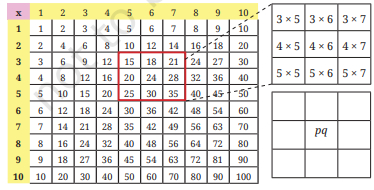
Solution: Let’s find the expressions for each number in the 3 × 3 frame centered at pq.
Assume the center of the 3 × 3 grid corresponds to multiplying p {tex}\times{/tex} q
The neighboring entries are formed by shifting either p or q by {tex}\pm{/tex}1.
Here’s the filled expressions for the 3 × 3 frame:
| q−1 | q | q+1 | |
| p−1 | (p−1)(q−1) | (p−1)q | (p−1)(q+1) |
| p | p(q−1) | pq | p(q+1) |
| p+1 | (p+1)(q−1) | (p+1)q | (p+1)(q+1) |
So, the expressions for the nine positions in the grid are:
- Top-left : (p−1)(q−1)
- Top-center : (p−1)q
- Top-right : (p−1)(q+1)
- Middle-left : p(q−1)
- Middle : pq
- Middle-right : p(q+1)
- Bottom-left : (p+1)(q−1)
- Bottom-center : (p+1)q(p+1)q
- Bottom-right : (p+1)(q+1)
This structure follows the multiplication pattern in the main grid and matches the framework given in your question.
Q.8: Expand the following products.
- {tex}(3+u)(v-3){/tex}
- {tex}\frac{2}{3}(15+6 a){/tex}
- {tex}(10 a+b)(10 c+d){/tex}
- {tex}(3-x)(x-6){/tex}
- {tex}(-5 a+b)(c+d){/tex}
- {tex}(5+z)(y+9){/tex}
Solution: Let’s expand each product step by step:
- (3 + u) (v – 3)
= (3 + u)v – (3 + u)3
= 3 + uv – (9 + 3u)
= 3 + uv – 9 + 3u
= uv + 3u + 3 – 9
= uv + 3u – 6. - {tex} \frac{2}{3}(15+6 a) {/tex}
{tex} = \frac{2}{3} \times 15+\frac{2}{3} \times 6 a {/tex}
{tex} = 2 \times 5+2 \times 2 a {/tex}
{tex} = 10+4 a . {/tex} - (10a+ b) (10c + d)
= (10a + b)10c + (10 a + b)d
= 100ac + 10bc + 10ad + bd. - {tex} \text { }(3-x)(x-6) {/tex}
{tex} =(3-x) x-(3-x) 6 {/tex}
{tex} =3 x-x^2-(18-6 x) {/tex}
{tex} =3 x-x^2-18+6 x {/tex}
{tex} =-x^2+6 x+3 x-18 {/tex}
{tex} =-x^2+9 x-18 {/tex} - (-5a + b) (c+ d)
= (-5a + b)c + (-5a + b)d
= -5ac + bc – 5ad + bd
= -5ac – 5ad + bc + bd. - (5 + z) (y+ 9)
= (5 + z)y + (5 + z)9
= 5y + zy + 45 + 9z
= 5y + 9z + zy + 45.
Q.9: Examples where the product remains unchanged when one number is increased by 2 and the other is decreased by 4
Solution: Let the original numbers be {tex}a{/tex} and {tex}b{/tex}. We seek {tex}a \times b=(a+2) \times(b-4){/tex}.
Set:
{tex} a b=(a+2)(b-4) {/tex}
{tex} a b=a b-4 a+2 b-8 {/tex}
{tex} 0=-4 a+2 b-8 {/tex}
{tex} 4 a-2 b=-8 {/tex}
{tex} 2 a-b=-4 {/tex}
So, for any pair {tex}(a, b){/tex} where {tex}b=2 a+4{/tex}.
Examples:
– {tex}a=0, b=4 \rightarrow 0 \times 4=(0+2) \times(4-4)=2 \times 0=0{/tex}
– {tex}a=1, b=6 \rightarrow 1 \times 6=(1+2) \times(6-4)=3 \times 2=6{/tex}
– {tex}a=3, b=10 \rightarrow 3 \times 10=(3+2) \times(10-4)=5 \times 6=30{/tex}
Q.10: Expand
- (a + ab – 3b2) (4 + b), and
- (4y + 7) (y + 11z – 3).
Solution:
- {tex} \text { }\left(a+a b-3 b^2\right)(4+b) {/tex}
{tex} =\left(a+a b-3 b^2\right) 4+\left(a+a b-3 b^2\right) b {/tex}
{tex} =4 a+4 a b-12 b^2+a b+a b^2-3 b^3 {/tex}
{tex} =-3 b^3-12 b^2+a b^2+4 a b+a b+4 a {/tex}
{tex} =-3 b^3-12 b^2+a b^2+5 a b+4 a . {/tex} - {tex} \text { }(4 y+7)(y+11 z-3) {/tex}
{tex} =(4 y+7) y+(4 y+7) 11 z-(4 y+7) 3 {/tex}
{tex} =4 y^2+7 y+44 y z+77 z-(12 y+21) {/tex}
{tex} =4 y^2+7 y+44 y z+77 z-12 y-21 {/tex}
{tex} =4 y^2+7 y-12 y+44 y z+77 z-21 {/tex}
{tex} =4 y^2-5 y+44 y z+77 z-21 . {/tex}
Q.11: Expand (i) (a – b) (a + b), (ii) (a – b) (a2 + ab + b2 ) and (iii) (a – b)(a3 + a2 b + ab2 + b3 ), Do you see a pattern? What would be the next identity in the pattern that you see? Can you check it by expanding?
Solution: Pattern:
{tex}(a-b){/tex} times the sum of powers of {tex}a{/tex} descending and {tex}b{/tex} ascending always gives the difference of corresponding powers:
– {tex}(a-b)(a+b)=a^2-b^2{/tex}
– {tex}(a-b)\left(a^2+a b+b^2\right)=a^3-b^3{/tex}
– {tex}(a-b)\left(a^3+a^2 b+a b^2+b^3\right)=a^4-b^4{/tex}
Next identity:
{tex} (a-b)\left(a^4+a^3 b+a^2 b^2+a b^3+b^4\right)=a^5-b^5 {/tex}
Let’s check by expansion:
{tex} (a-b)\left(a^4+a^3 b+a^2 b^2+a b^3+b^4\right){/tex} {tex}=a\left(a^4+a^3 b+a^2 b^2+a b^3+b^4\right)-b\left(a^4+a^3 b+a^2 b^2\right. {/tex}
{tex} =a^5+a^4 b+a^3 b^2+a^2 b^3+a b^4{/tex}{tex}-\left(a^4 b+a^3 b^2+a^2 b^3+a b^4+b^5\right) {/tex}
{tex} =a^5-b^5 {/tex}
Q.12: Which is greater: {tex}(a-b)^2{/tex} or {tex}(b-a)^2{/tex}? Justify.
Solution: Here, (a – b)2 = a2 + b2 – 2ab …(1)
and (b – a)2 = b2 + a2 – 2ba
b2 + a2 = a2 + b2 and ba = ab
(b – a)2 = a2 + b2 – 2ab …(2)
Comparing (1) and (2), we get (a – b)2 = (b – a)2
Q.13: Express 100 as the difference of two squares.
Solution: a2 – b2 = 100
(a + b) (a – b) = 100
[100 = 1 {tex}\times{/tex} 100, 2 {tex}\times{/tex} 50, 4 {tex}\times{/tex} 25, 5 {tex}\times{/tex} 20, 10 {tex}\times{/tex} 10]
We can take anyone
Let us take 50 {tex}\times{/tex} 2 = 100
Hence, (a + b) (a – b) = 50 {tex}\times{/tex} 2
a + b = 50 …(1)
a – b = 2 …(2)
Adding (1) and (2)
2a = 52
⇒ a = 26
Substituting a = 26 in (1)
26 + b = 50
⇒ b = 50 – 26 = 24
Let us check 262 – 242 = 676 – 576 = 100
Hence 262 – 242 = 100
Q.14: Find 4062, 722, 1452, 10972, and 1242 using the identities you have learnt so far.
Solution: It’s easiest to use {tex}(a \pm b)^2=a^2 \pm 2 a b+b^2{/tex} with convenient decompositions.
{tex}406^2=(400+6)^2{/tex}{tex}=400^2+2 \cdot 400 \cdot 6+6^2{/tex} = 160000 + 4800 + 36 = 164836.
722 = (50 + 22)2 = 502 + 2 × 50 × 22 + 222 = 2500 + 2200 + 484 = 5184.
{tex}145^2=(100+45)^2{/tex} {tex}=100^2+2 \cdot 100 \cdot 45+45^2{/tex} = 10000 + 9000 + 2025 = 21025.
{tex}1097^2=(1100-3)^2{/tex} {tex}=1100^2-2 \cdot 1100 \cdot 3+3^2{/tex} {tex}=1210000-6600+ 9=1203409{/tex}.
(Or use {tex}1097=(1000+97){/tex}, either way gives same result.)
{tex}124^2=(100+24)^2{/tex} {tex}=100^2+2 \cdot 100 \cdot 24+24^2{/tex} = 10000 + 4800 + 576 = 15376.
Q.15: Do Patterns 1 and 2 hold only for counting numbers? Do they hold for negative integers and fractions? Justify your answer..
Solution: Pattern 1
{tex} 2\left(a^2+b^2\right)=(a+b)^2+(a-b)^2 {/tex}
{tex} \text { Case-I } {/tex}
{tex} \text { Let } a=4, b=2 {/tex}
{tex} \text { LHS }=2\left(4^2+2^2\right)=2 \times(16+4)=40 {/tex}
{tex} \text { RHS }=(4+2)^2+(4-2)^2=36+4=40 {/tex}
{tex}\therefore{/tex} Pattern 1 holds for counting numbers.
{tex} \text { Case-II } {/tex}
{tex} \text { Let } a=-4, b=-2 {/tex}
{tex} \text { LHS }=2\left((-4)^2+(-2)^2\right) {/tex}
{tex} =2 \times(16+4) {/tex}
{tex} =2 \times 20 {/tex}
{tex} =40 {/tex}
{tex} \text { RHS }=(-4+(-2))^2+(-4-(-2))^2 {/tex}
{tex} =(-4-2)^2+(-4+2)^2 {/tex}
{tex} =(-6)^2+(-2)^2 {/tex}
{tex} =36+4 {/tex}
{tex} =40 {/tex}
{tex} \text { LHS = RHS } {/tex}
{tex}\therefore{/tex} Pattern 1 holds for negative integers also.
Case-III
Let {tex}a=\frac{1}{2}, b=\frac{1}{3}{/tex}
{tex} \text { LHS } =2\left(\left(\frac{1}{2}\right)^2+\left(\frac{1}{3}\right)^2\right) {/tex}
{tex} =2\left[\frac{1}{4}+\frac{1}{9}\right]=2 \times \frac{13}{36}=\frac{13}{18} {/tex}
{tex} \text { RHS } =\left(\frac{1}{2}+\frac{1}{3}\right)^2+\left(\frac{1}{2}-\frac{1}{3}\right)^2 {/tex}
{tex} =\left(\frac{5}{6}\right)^2+\left(\frac{1}{6}\right)^2=\frac{25}{36}+\frac{1}{36} {/tex}
{tex} =\frac{26}{36}=\frac{13}{18} {/tex}
The pattern holds for fractions also.
Pattern 2
{tex} a^2-b^2=(a+b)(a-b) {/tex}
{tex} \text { Case-I } {/tex}
{tex} \text { Let } a=5, b=3 {/tex}
{tex} \text { LHS }=5^2-3^2=25-9=16 {/tex}
{tex} \text { RHS }=(5+3)(5-3)=8 \times 2=16 {/tex}
{tex} \therefore \text { LHS }=\text { RHS } {/tex}
{tex}\therefore{/tex} Pattern 2 holds for counting numbers.
Case-II
Let {tex}a=-5, b=-3{/tex}
{tex} \text { Now, LHS }=(-5)^2-(-3)^2=25-9=16 {/tex}
{tex} \text { and RHS }=[(-5)+(-3)][(-5)-(-3)] {/tex}
{tex} =(-5-3)(-5+3) {/tex}
{tex} =(-8)(-2) {/tex}
{tex} =16 {/tex}
{tex} \therefore \text { LHS }=\text { RHS } {/tex}
{tex}\therefore{/tex} Pattern 2 holds for negative integers also.
{tex} \text { Case-III } {/tex}
{tex} \text { Let } {a}=\frac{1}{2}, {~b}=\frac{1}{3} {/tex}
{tex} \text { LHS }=\left(\frac{1}{2}\right)^2-\left(\frac{1}{3}\right)^2 {/tex}
{tex} =\frac{1}{4}-\frac{1}{9} {/tex}
{tex} =\frac{9-4}{36} {/tex}
{tex} =\frac{5}{36} {/tex}
{tex} \text { and RHS }=\left(\frac{1}{2}+\frac{1}{3}\right)\left(\frac{1}{2}-\frac{1}{3}\right)=\left(\frac{3+2}{6}\right)\left(\frac{3-2}{6}\right)=\frac{5}{6} \times \frac{1}{6}=\frac{5}{36} {/tex}
{tex} \therefore \text { LHS }=\text { RHS } {/tex}
{tex} \therefore \text { Pattern } 2 \text { holds for fractions also. } {/tex}
Q.16: Compute these products using the suggested identity.
- {tex}46^2{/tex} using Identity 1A for {tex}(a+b)^2{/tex}
- {tex}397 \times 403{/tex} using Identity 1 C for {tex}(a+b)(a-b){/tex}
- {tex}91^2{/tex} using Identity 1B for {tex}(a-b)^2{/tex}
- {tex}43 \times 45{/tex} using Identity 1C for {tex}(a+b)(a-b){/tex}
Solution:
- {tex}46^2{/tex} using {tex}(a+b)^2{/tex}, with {tex}a=40, b=6{/tex} :
{tex} (40+6)^2=40^2+2(40)(6)+6^2{/tex} = 1600 + 480 + 36 = 2116 - {tex}397 \times 403{/tex} using {tex}(a+b)(a-b)=a^2-b^2{/tex}, with {tex}a=400, b=3{/tex} :
{tex} (400-3)(400+3)=400^2-3^2{/tex} = 160000 – 9 = 159991 - {tex}91^2{/tex} using {tex}(a-b)^2{/tex}, with {tex}a=100, b=9{/tex} :
{tex} (100-9)^2=100^2+9^2-2(100)(9){/tex} = 10000 + 81 – 1800 = 8281 - {tex}43 \times 45{/tex} using {tex}(a+b)(a-b)=a^2-b^2{/tex}, with {tex}a=44, b=1{/tex}:
{tex} (44-1)(44+1)=44^2-1^2{/tex} = 1936 – 1 = 1935
Q.17: Use either a suitable identity or the distributive property to find each of the following products.
- {tex}(p-1)(p+11){/tex}
- {tex}(3 a-9 b)(3 a+9 b){/tex}
- {tex}-(2 y+5)(3 y+4){/tex}
- {tex}(6 x+5 y)^2{/tex}
- {tex}\left(2 x-\frac{1}{2}\right)^2{/tex}
- {tex}(7 p) \times(3 r) \times(p+2){/tex}
Solution:
- {tex}(p-1)(p+11){/tex} : {tex} =p^2+11 p-p-11=p^2+10 p-11 {/tex}
- {tex}(3 a-9 b)(3 a+9 b){/tex} : {tex} =(3 a)^2-(9 b)^2=9 a^2-81 b^2 {/tex}
- -(2y + 5)(3y + 4) = (-2y – 5) (3y + 4) = -2y(3y + 4) – 5(3y + 4) = -6y2 – 8y – 15y – 20 = -6y2 – 23y – 20
- {tex}(6 x+5 y)^2{/tex}: {tex} =(6 x)^2+(5 y)^2+2(6 x)(5 y)=36 x^2+25 y^2+60 x y {/tex}
- {tex}(2 x-1 / 2 y)^2{/tex}: {tex} =(2 x)^2+\left(\frac{1}{2} y\right)^2-2(2 x)\left(\frac{1}{2} y\right)=4 x^2+\frac{1}{4} y^2-2 x y {/tex}
- {tex}(7 p) \times (3 r)\times (p+2){/tex}: {tex} =7 {p} \times 3 {r} \times({p}+2) {/tex} {tex} =21 {pr}({p}+2) {/tex} {tex} =21 {pr} \times {p}+21 {pr} \times 2 {/tex}
{tex} =21 {p}^2 {r}+42 {pr} {/tex}
Q.18: For each statement identify the appropriate algebraic expression(s).
- Two more than a square number.
{tex} 2+s \ \ \ \ (s+2)^2 \ \ \ \ s^2+2 \ \ \ \ s^2+4 \ \ \ \ 2 s^2 \ \ \ \ 2^2 s {/tex} - The sum of the squares of two consecutive numbers
{tex} m^2+n^2\ \ \ \ (m+n)^2\ \ \ \ m^2+1 \ \ \ \ \ m^2+(m+1)^2 {/tex}
{tex} m^2+(m-1)^2 \ \ \ \ \ (m+(m+1))^2 \ \ \ \ \ (2 m)^2+(2 m+1)^2 {/tex}
Solution:
- Two more than a square number
If the square is {tex}s^2{/tex}, then expression {tex}=s^2+2{/tex}. - Sum of the squares of two consecutive numbers is m2 + (m + 1)2
Q.19: Consider any 2 by 2 square of numbers in a calendar, as shown in the figure.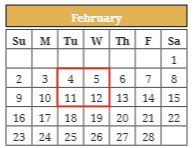
Find products of numbers lying along each diagonal- 4 {tex}\times{/tex} 12 = 48, 5 {tex}\times{/tex} 11 = 55. Do this for the other 2 by 2 squares. What do you observe about the diagonal products? Explain why this happens.
Solution: Let the top-left number be {tex}a{/tex}. Then the {tex}2 \times 2{/tex} square is:
| a | a + 1 |
| a + 7 | a + 8 |
- Product along one diagonal {tex}=a(a+8){/tex}.
- Product along other diagonal {tex}=(a+1)(a+7){/tex}.
Expand:
{tex} a^2+8 a \text { and } a^2+8 a+7 {/tex}
They differ by 7, so in every {tex}2 \times 2{/tex} calendar square the diagonal products differ by 7.
Q.20: Verify which of the following statements are true.
- {tex}(k+1)(k+2)-(k+3){/tex} is always 2.
- {tex}(2 q+1)(2 q-3){/tex} is a multiple of 4.
- Squares of even numbers are multiples of 4, and squares of odd numbers are 1 more than multiples of 8.
- {tex}(6 n+2)^2-(4 n+3)^2{/tex} is 5 less than a square number.
Solution:
- {tex}(k+1)(k+2)-(k+3){/tex}
Expand: {tex}=k^2+3 k+2-(k+3)=k^2+2 k-1{/tex}.
This is not always 2 (depends on {tex}k{/tex} ).
False. - {tex}(2 q+1)(2 q-3){/tex}
Expand: {tex}=4 q^2-4 q-3=4\left(q^2-q\right)-3{/tex}.
Always leaves remainder 1 when divided by 4, not multiple of 4.
False. - Squares of even numbers are multiples of 4, and squares of odd numbers are 1 more than multiples of 8.
– Even: {tex}(2 m)^2=4 m^2{/tex}, divisible by 4 .
– Odd: {tex}(2 n+1)^2=4 n(n+1)+1=8 k+1{/tex}.
True. - {tex}(6 n+2)-(4 n+3)=2 n-1{/tex}.
Not always 5 less than a square number.
False.
Q.21: A number leaves a remainder of 3 when divided by 7, and another number leaves a remainder of 5 when divided by 7. What is the remainder when their sum, difference, and product are divided by 7?
Solution: Let the numbers be x and y.
x = 7a + 3, y = 7b + 5
Sum = x + y
= 7a + 3 + 7b + 5
= 7(a + b) + 8
= 7(a + b) + 7 + 1
= 7(a + b + 1) + 1
{tex}\therefore{/tex} The remainder on division by 7 is 1.
Difference = x – y
= (7a + 3) – (7b + 5)
= 7a + 3 – 7b – 5
= 7(a – b) – 2
= 7(a – b) – 1 + 5 ({tex}\because{/tex} -2 = -7 + 5)
= 7(a – b – 1) + 5
{tex}\therefore{/tex} The remainder on division by 7 is 5.
Product = xy
= (7a + 3) (7b + 5)
= 49ab + 35a + 21b + 15
= (49ab + 35a + 21b + 14) + 1
= 7(7ab + 5a + 3b + 2) + 1
{tex}\therefore{/tex} The remainder on division by 7 is 1.
Q.22: Choose three consecutive numbers, square the middle one, and subtract the product of the other two. Repeat the same with other sets of numbers. What pattern do you notice? How do we write this as an algebraic equation? Expand both sides of the equation to check that it is a true identity.
Solution: Let us take the numbers 7, 8, 9
Now, 82 – 7 {tex}\times{/tex} 9 = 64 – 63 = 1
Let us take the numbers 10, 11, 12
Then 112 – 10 {tex}\times{/tex} 12 = 121 – 120 = 1
Generalizing:
Let the numbers be a – 1, a, a + 1
Then a2 – (a + 1) (a – 1) = 1
LHS = a2 – (a + 1)(a – 1)
= a2 – (a2 – 1)
= a2 – a2 + 1
= 1
{tex}\therefore{/tex} LHS = RHS
Hence, the identity is correct.
Q.23: What is the algebraic expression describing the following steps- add any two numbers. Multiply this by half of the sum of the two numbers? Prove that this result will be half of the square of the sum of the two numbers.
Solution: Let the two numbers be a and b .
Step 1: {tex}{a}+{b}{/tex}
Step 2: {tex}({a}+{b}) \times \frac{1}{2}({a}+{b}){/tex}
{tex} \therefore(a+b) \times \frac{1}{2}(a+b)=\frac{1}{2}(a+b)^2 {/tex}
Q.24: Which is larger? Find out without fully computing the product.
- {tex}14 \times 26{/tex} or {tex}16 \times 24{/tex}
- {tex}25 \times 75{/tex} or {tex}26 \times 74{/tex}
Solution:
- {tex} Let \ p=14 \times 26 {/tex}
{tex} p^{\prime}=16 \times 24 {/tex}
{tex} =(14+2)(26-2) {/tex}
{tex} =14 \times 26+2 \times 26-14 \times 2-2 \times 2 {/tex}
{tex} =14 \times 26+2(26-14-2) {/tex}
{tex} =14 \times 26+2 \times 10 {/tex}
{tex} p^{\prime}=p+2 \times 10 {/tex}
{tex} \therefore p^{\prime}>p \text { or } 16 \times 24>14 \times 26 {/tex} - {tex} Let \ p=25 \times 75 {/tex}
{tex} p^{\prime}=26 \times 74 {/tex}
{tex} =(25+1)(75-1) {/tex}
{tex} =25 \times 75+75 \times 1-25 \times 1-1 \times 1 {/tex}
{tex} =p+(75-25-1) {/tex}
{tex} =p+49 {/tex}
{tex} \therefore p^{\prime}>p \text { or } 26 \times 74>25 \times 75 {/tex}
Q.25: A tiny park is coming up in Dhauli. The plan is shown in the figure. The two square plots, each of area g2 sq. ft., will have a green cover. All the remaining area is a walking path w ft. wide that needs to be tiled. Write an expression for the area that needs to be tiled.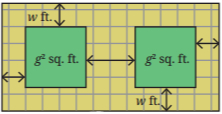
Solution: Length = w + g + 2w + g + w = 4w + 2g
Breadth = w + g + w = 2w + g
Area of park = (4w + 2g) (2w + g)
= 8w2 + 4wg + 4wg + 2g2
= 8w2 + 8wg + 2g2
Area of path = Area of park – Area of green cover
= 8w2 + 8wg + 2g2 – 2g2
= 8w2 + 8wg
{tex}\therefore{/tex} (8w2 + 8wg) sq. feet area needs to be tiled.
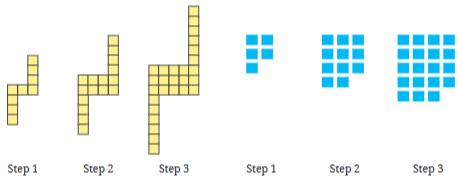
Q.26: For each pattern shown below,
- Draw the next figure in the sequence.
- How many basic units are there in Step 10?
- Write an expression to describe the number of basic units in Step y.
Solution:
- First pattern (L-shaped growth)
Topic: Some Properties of Multiplication- Step {tex}1=3{/tex} units
- Step {tex}2=5{/tex} units
- Step {tex}3=7{/tex} units
- Step {tex}4=9{/tex} units …
We see the pattern is odd numbers.
Expression for Step {tex}n{/tex}:
{tex} \text { Units }=2 n+1 {/tex}
At Step 10:
{tex} 2(10)+1=21 {/tex}
Answer: Step 10 has 21 units.
- Second pattern (square growth)
Topic: This Way or That Way, All Ways Lead to the Bay- Step {tex}1=2 \times 2=4{/tex} units
- Step {tex}2=3 \times 3=9{/tex} units
- Step {tex}3=4 \times 4=16{/tex} units
So, Step {tex}n=(n+1)^2{/tex}.
At Step 10:
{tex} (10+1)^2=121 {/tex}
Q.27: Describe a general rule to multiply a number (of any number of digits) by 11 and write the product in one line.
Evaluate
- 94 × 11
- 495 × 11
- 3279 × 11
- 4791256 × 11
Solution: Think “add neighbors,” carrying as needed.
- Write the rightmost digit.
- For each position moving left, write the sum of its two neighboring digits (the digit itself and the one just to its right), adding any carry from the previous sum.
- Finally, write the leftmost digit plus any remaining carry.
Example pattern for digits {tex}a_k a_{k-1} \ldots a_2 a_1 a_0{/tex} : the result’s interior digits are {tex}\left(a_i+a_{i-1}\right){/tex} with carries propagated left.
- {tex}94 \times 11{/tex} ={tex} 94 \cdot(10+1)=940+94=1034 {/tex}
- {tex}495 \times 11{/tex} = {tex} 4950+495=5445 {/tex}
- {tex}3279 \times 11{/tex} = {tex} 32790+3279=36069 {/tex}
- {tex}4,791,256 \times 11{/tex} = {tex} 47,912,560+4,791,256=52,703,816 {/tex}
Q.28: Use this to multiply 3874 × 101 in one line.
Solution: {tex}3874 \times 101=387400+3874=391274 .{/tex}
Q.29: What could be a general rule to multiply a number by 101 and write the product in one line? Extend this rule for multiplication by 1001, 10001, …
Solution: Here’s the clean “one-line” rule and the answers.
General rule
For any integer {tex}n{/tex} and any {tex}k \geq 1{/tex} :
– {tex}n \times\left(10^k+1\right){/tex} : append {tex}k{/tex} zeros to {tex}n{/tex} and add {tex}n{/tex} once.
– e.g., {tex}n \times 101(k=2) \rightarrow{/tex} write {tex}n 00{/tex} and add {tex}n{/tex}.
– {tex}n \times\left(10^k-1\right){/tex} : append {tex}k{/tex} zeros to {tex}n{/tex} and subtract {tex}n{/tex} once.
– e.g., {tex}n \times 99(k=2) \rightarrow{/tex} write {tex}n 00{/tex} and subtract {tex}n{/tex}.
– This extends directly to {tex}1001\left(=10^3+1\right), 10001\left(=10^4+1\right), \ldots{/tex}
Q.30: Use this to find
- 89 × 101
- 949 × 101
- 265831 × 1001
- 1111 × 1001
- 9734 × 99
- 23478 × 999.
Solution:
- {tex}89 \times 101=8900+89=8989{/tex}
- {tex}949 \times 101=94900+949=95849{/tex}
- {tex}265831 \times 1001=265,831,000+265,831=266,096,831{/tex}
- {tex}1111 \times 1001=1,111,000+1,111=1,112,111{/tex}
- {tex}9734 \times 99=973,400-9,734=963,666{/tex}
- {tex}23478 \times 999=23,478,000-23,478=23,454,522{/tex}
Q.31: If {tex}a{/tex} and {tex}b{/tex} are any two integers, is {tex}(a+b)^2{/tex} always greater than {tex}a^2+b^2{/tex}? If not, when is it greater?
Solution:
- We use the identity: {tex}(a+b)^2=a^2+b^2+2 a b{/tex}.
- Compare with {tex}a^2+b^2{/tex}.
- Difference {tex}=2 a b{/tex}.
- Hence:
- Greater if {tex}a b>0{/tex} (same sign integers).
- Equal if {tex}a b=0{/tex}.
- Smaller if {tex}a b<0{/tex} (opposite signs).
Q.32: Use Identity 1A to find the values of 1042,372
Solution:
– {tex}104^2=(100+4)^2=100^2+2 \cdot 100 \cdot 4+4^2=10816{/tex}.
– {tex}37^2=(30+7)^2=30^2+2 \cdot 30 \cdot 7+7^2=1369{/tex}.
Q.33: Expand (3j + 2k)2 using both the identity and by applying the distributive property.
Solution: Method 1: Using the Identity {tex}(a+b)^2=a^2+2 a b+b^2{/tex}
Here, {tex}a=3 j, b=2 k{/tex}.
{tex} (3 j+2 k)^2 =(3 j)^2+2(3 j)(2 k)+(2 k)^2 {/tex}
{tex} =9 j^2+12 j k+4 k^2 {/tex}
Method 2: By Distributive Property
{tex} (3 j+2 k)(3 j+2 k) {/tex}
Multiply term by term:
{tex} =(3 j)(3 j)+(3 j)(2 k)+(2 k)(3 j)+(2 k)(2 k) {/tex}
{tex} =9 j^2+6 j k+6 j k+4 k^2 {/tex}
{tex} =9 j^2+12 j k+4 k^2 {/tex}
Final Answer (both ways):
{tex} (3 j+2 k)^2=9 j^2+12 j k+4 k^2 {/tex}
Q.34: Use the identity (a – b)2 to find the values of (a) 992 and (b) 582.
Solution:
- {tex} 99^2=(100-1)^2 {/tex} {tex} =100^2+1^2-2(100)(1)=10000+1-200=9801 {/tex}
- {tex} 58^2=(60-2)^2 {/tex} {tex} =60^2+2^2-2(60)(2)=3600+4-240=3364 {/tex}
Q.35: Expand the following using both Identity 1B and by applying the distributive property
- {tex}(b-6)^2{/tex}
- {tex}(-2 a+3)^2{/tex}
- {tex}\left(7 y-\frac{3}{4 z}\right)^2{/tex}
Solution:
- Using identity: {tex} b^2+6^2-2(b)(6)=b^2+36-12 b {/tex}
By distributive: {tex}(b-6)(b-6)=b^2-6 b-6 b+36{/tex} {tex}=b^2-12 b+36{/tex}. Same. - Using identity:{tex} =(3)^2+(2 a)^2-2(3)(2 a){/tex} {tex}=9+4 a^2-12 a=4 a^2-12 a+9 {/tex}
By distributive: {tex}(-2 a+3)(-2 a+3){/tex} {tex}=4 a^2-6 a-6 a+9=4 a^2-12 a+9{/tex}. Same. - Using identity: {tex} =(7 y)^2+\left(\frac{3}{4} z\right)^2-2(7 y)\left(\frac{3}{4} z\right) {/tex}
{tex} =49 y^2+\frac{9}{16} z^2-\frac{42}{4} y z {/tex}
{tex} =49 y^2+\frac{9}{16} z^2-\frac{21}{2} y z {/tex}
By distributive: {tex}\left(7 y-\frac{3}{4} z\right)\left(7 y-\frac{3}{4} z\right){/tex} gives the same.
Q.36: Write an algebraic expression for the number of tiles in Step n. Share your methods with the class. Can you find more than one method to arrive at the answer?
Solution: So, the exact algebraic expression depends on what the Step figures look like.
- If it’s a growing line of tiles, the rule is linear.
- If it’s a square shape, the rule is often square numbers.
- If it’s something like a triangle, the rule might be triangular numbers: {tex}T_n = \frac{n(n+1)}{2}{/tex}
Q.37: By expanding both expressions, check that {tex}(m+n)^2-4 m n=(n-m)^2{/tex}.
Solution: Left-hand side (LHS):{tex} (m+n)^2-4 m n {/tex}
First expand {tex}(m+n)^2{/tex} :{tex} (m+n)^2=m^2+2 m n+n^2 {/tex}
So,
{tex} (m+n)^2-4 m n=m^2+2 m n+n^2-4 m n {/tex}
Combine like terms:
{tex} =m^2-2 m n+n^2 {/tex}
Right-hand side (RHS):{tex} (n-m)^2 {/tex}
Expand:{tex} (n-m)^2=n^2-2 m n+m^2 {/tex}
Rearrange:{tex} =m^2-2 m n+n^2 {/tex}
We see that:
{tex} (m+n)^2-4 m n=(n-m)^2 {/tex}
Q.38: By expanding the expressions, “Verify that all three expressions are equivalent. If {tex}x={/tex} 8 and {tex}y=3{/tex}, find the area of the shaded region.”
Solution: A common trio of equivalent expressions used in these problems is
{tex} (x+y)^2, x^2+y^2+2 x y, (x-y)^2+4 x y . {/tex}
Expand / simplify each to show they are the same.
- {tex}(x+y)^2=x^2+2 x y+y^2{/tex}.
- {tex}x^2+y^2+2 x y{/tex} is already written in expanded form.
- {tex}(x-y)^2+4 x y=\left(x^2-2 x y+y^2\right)+4 x y=x^2+2 x y+y^2{/tex}.
- All three simplify to {tex}x^2+2 x y+y^2{/tex}, so they are equivalent.
Now substitute {tex}x=8, y=3{/tex}. The common value is
{tex} x^2+2 x y+y^2=8^2+2 \cdot 8 \cdot 3+3^2{/tex} = 64 + 48 + 9 = 121.
So the area of the shaded region (the quantity those expressions represent) is 121 (square units).
Q.39: Write an expression for the area of the dashed region in the figure below. Use more than one method to arrive at the answer. Substitute p = 6, r = 3.5, and s = 9, and calculate the area.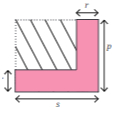
Solution: Look at the L shape: it can be seen as the union of
- a vertical rectangle of width {tex}r{/tex} and height {tex}p{/tex} (the right vertical strip), and
- a horizontal rectangle of length {tex}s{/tex} and height {tex}r{/tex} (the bottom horizontal strip).
These two rectangles overlap in the bottom-right square of side {tex}r{/tex}, so we must subtract that once.
So area {tex}A{/tex} = (area of vertical strip) + (area of horizontal strip) – (overlap square):
{tex} A=r \cdot p+s \cdot r-r^2 {/tex}
Factor {tex}r{/tex}:
{tex} A=r(p+s-r) {/tex}
(Alternate method: consider a big rectangle of width {tex}s{/tex} and height {tex}p+r{/tex} then subtract the top-left rectangle of width {tex}s-r{/tex} and height {tex}p{/tex}; you get the same algebraic form after simplification.)
Now substitute {tex}p=6, r=3.5, s=9{/tex}:
{tex} A=3.5(6+9-3.5)=3.5 \cdot 11.5=40.25 {/tex}
So the dashed region’s area is 40.25 square units.
Class 8 Maths Ganita Prakash Solutions
- A Square and A Cube
- Power Play
- A Story of Numbers
- Quadrilaterals
- Number Play
- We Distribute Yet Things Multiply
- Proportional Reasoning-1
- Fractions In Disguise
- The Baudhayana-Pythagoras Theorem
- Proportional Reasoning-2
- Exploring Some Geometric Themes
- Tales by dots and lines
- Algebra Play

Test Generator
Create question paper PDF and online tests with your own name & logo in minutes.
Create Now
Learn8 App
Practice unlimited questions for Entrance tests & government job exams at ₹99 only
Install Now