The Baudhayana-Pythagoras Theorem – NCERT Solutions Class 8 Maths (Ganita Prakash) includes all the questions with solutions given in the NCERT Class 8 Maths (Ganita Prakash).
NCERT Solutions Class 8
English Poorvi Hindi Malhar Maths Ganita Prakash Science Curiosity Social Exploring SocietyThe Baudhayana-Pythagoras Theorem – NCERT Solutions
Q.1: How can one construct a square having double the area of a given square?
A first guess might be to simply double the length of each side of the square. Will this new square have double the area of the original square?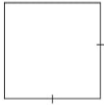
Solution:
No, the new square will not have double the area of the original square.
If the original square has side length 1 unit, its area {tex}=1 \times 1=1{/tex} sq. unit.
If we double the side length to 2 units, the new area {tex}=2 \times 2=4{/tex} sq. units.
Therefore, doubling the side length gives us a square with {tex}{4}{/tex} times the area, not double the area.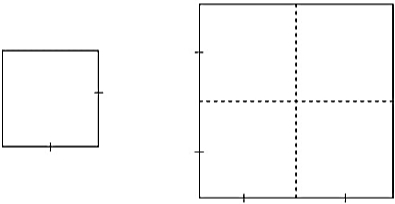
Q.2: Why does the new dotted square have double the area of the original square?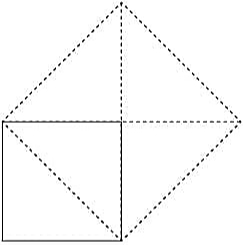
Solution:
The new dotted square has double the area because:
When we construct a square on the diagonal of the original square, we can see by drawing horizontal and vertical lines that:
- The original square is made up of {tex}{2}{/tex} small congruent triangles (divided by the diagonal)
- The new dotted square is made up of {tex}{4}{/tex} small congruent triangles (of the same size)
Since the new square contains exactly twice as many triangles of the same size, its area is exactly double that of the original square.
Area of new square {tex}=4{/tex} triangles {tex}=2 \times(2{/tex} triangles{tex})=2 \times{/tex} Area of original square.
Q.3: Now suppose we are given a square, and we want to construct a square whose area is half that of the original square. How would you do it?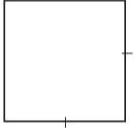
Solution:
To construct a square with half the area of the original square:
Method: Draw a tilted smaller square inside the larger square by connecting the midpoints of the sides of the original square.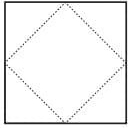
Explanation:
- Draw horizontal and vertical lines through the construction
- The larger square can be divided into 4 small congruent triangles
- The smaller tilted square is made up of 2 of these small triangles
- Therefore, the smaller square has exactly half the area of the larger square
Area of smaller square {tex}=2{/tex} triangles {tex}=\frac 1 2 \times(4{/tex} triangles{tex})=\frac 1 2 \times{/tex} Area of larger square
Q.4: Find the hypotenuse of this isosceles right triangle.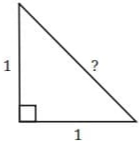
Solution:
Given: An isosceles right triangle with equal sides {tex}=1{/tex} unit each
To find: Length of hypotenuse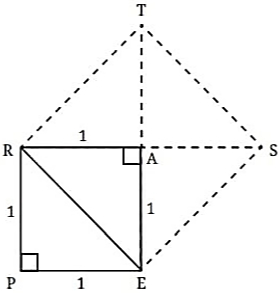
We know that a square of side 1 unit is made up of two such isosceles right triangles (divided by the diagonal).
When we construct a square on the hypotenuse (diagonal) of the original square:
- Area of original square PEAR {tex}=1 \times 1=1{/tex} sq. unit
- Area of square REST (on the hypotenuse) {tex}=2 \times{/tex} Area of PEAR {tex}=2 \times 1=2{/tex} sq. units
Let c be the length of the hypotenuse.
Since REST is a square with side c:
- Area of REST {tex}={c} \times {c}={c}^2{/tex}
We know Area of REST = 2 sq. units
Therefore: {tex}c^2=2{/tex}
Taking square root: {tex}{c}=\sqrt{2}{/tex}
The hypotenuse is of length {tex}\sqrt{2}{/tex} units (approximately 1.414 units).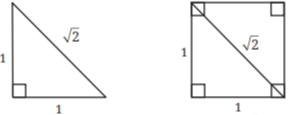
Q.5: What is the value of {tex}\sqrt{2}{/tex}?
Solution:
The value of {tex}\sqrt{2}{/tex} is approximately {tex}{1 . 4 1 4}{/tex}.
{tex} 1.411^2=1.990921 {/tex}
{tex} 1.412^2=1.993744 {/tex}
{tex} 1.413^2=1.996569 {/tex}
{tex} 1.414^2=1.999396 {/tex}
{tex} 1.415^2=2.002225 {/tex}
So, {tex}1.414<\sqrt{2}<1.415{/tex}
Q.6: Is {tex}\sqrt{2}{/tex} less than or greater than 1?
Solution:
A square of sidelength 1 unit has an area of 1 sq. unit. A square of sidelength {tex}\sqrt{2}{/tex} has an area of 2 sq. units. So, 1 is less than {tex}\sqrt{2}{/tex}.
In other words, {tex}1^2=1{/tex}, and {tex}\sqrt{2}^2=2{/tex}.
Therefore, {tex}1<\sqrt{2}{/tex}.
Q.7: Is {tex}\sqrt{2}{/tex} less than or greater than 2?
Solution:
A square of sidelength 2 units has an area of 4 sq. units. A square of sidelength {tex}\sqrt{2}{/tex} has an area of 2 sq. units. So, 2 is greater than {tex}\sqrt{2}{/tex}.
In other words, {tex}\sqrt{2}^2=2{/tex}, and {tex}2^2=4{/tex}.
Therefore, {tex}\sqrt{2}<2{/tex}.
Thus, {tex}1<\sqrt{2}<2{/tex}.
Q.8: Can {tex}\sqrt{2}{/tex} be expressed as a fraction {tex}m / n{/tex}, where {tex}m{/tex} and {tex}n{/tex} are counting numbers?
Solution:
No, {tex}\sqrt{2}{/tex} cannot be expressed as a fraction {tex}m / n{/tex} where {tex}m{/tex} and {tex}n{/tex} are counting numbers.
Let’s assume {tex}\sqrt{2}{/tex} can be written as {tex}{m} / {n}{/tex} (a fraction)
Then: {tex}\sqrt{2}=m / n{/tex}
Squaring both sides: {tex}2={m}^2 / {n}^2{/tex}
Cross-multiplying: {tex}2 n^2=m^2{/tex}
Key observation:
- In the prime factorization of any square number (like {tex}{m}^2{/tex} or {tex}{n}^2{/tex}), each prime factor appears an even number of times
- On the left side {tex}\left(2 n^2\right){/tex}: The prime factor 2 appears an odd number of times (one 2, plus an even number from {tex}{n}^2{/tex})
- On the right side {tex}\left({m}^2\right){/tex}: The prime factor 2 must appear an even number of times
This creates a contradiction! A number cannot have both odd and even occurrences of the same prime factor.
Therefore, our assumption must be wrong. {tex}\sqrt{2}{/tex} cannot be expressed as a fraction {tex}{m} \boldsymbol{/} {n}{/tex}.
Conclusion: {tex}\sqrt{2}{/tex} is an irrational number with a non-terminating, non-repeating decimal expansion.
Q.9: List down all the Baudhāyana triples with numbers less than or equal to 20.
Solution:
Baudhāyana triples with numbers {tex}\boldsymbol{\leq} {2 0}{/tex}:
To find these, we check which triples {tex}({a}, {b}, {c}){/tex} satisfy {tex}{a}^2+{b}^2={c}^2{/tex} where {tex}{a}, {b}, {c} \leq 20{/tex}.
The complete list:
- {tex}(3,4,5){/tex}-Primitive
- {tex}3^2+4^2=9+16=25=5^2{/tex}
- {tex}({6 , 8 , 1 0}){/tex} – Scaled version of {tex}(3,4,5){/tex} [multiply by 2]
- {tex}6^2+8^2=36+64=100=10^2{/tex}
- (5, 12, 13)-Primitive
- {tex}5^2+12^2=25+144=169=13^2{/tex}
- (9, 12, 15)- Scaled version of {tex}(3,4,5){/tex} [multiply by 3]
- {tex}9^2+12^2=81+144=225=15^2{/tex}
- (8, 15, 17)-Primitive
- {tex}8^2+15^2=64+225=289=17^2{/tex}
- (12, 16, 20)-Scaled version of {tex}(3,4,5){/tex} [multiply by 4]
- {tex}12^2+16^2=144+256=400=20^2{/tex}
Total: 6 Baudhāyana triples with numbers {tex}\boldsymbol{\leq} {2 0}{/tex}
Primitive triples: {tex}(3,4,5),(5,12,13),(8,15,17){/tex}
Non-primitive triples: {tex}(6,8,10),(9{/tex}, {tex}12,15),(12,16,20){/tex}
Q.10: Is there an unending sequence of Baudhāyana triples?
Solution:
Yes, there is an unending (infinite) sequence of Baudhāyana triples.
Proof:
We know that {tex}(3,4,5){/tex} is a Baudhāyana triple.
We can generate infinite triples by multiplying each term by any positive integer k:
- {tex}(3 \times 1,4 \times 1,5 \times 1)=(3,4,5) \checkmark{/tex}
- {tex}(3 \times 2,4 \times 2,5 \times 2)=(6,8,10) \checkmark{/tex}
- {tex}(3 \times 3,4 \times 3,5 \times 3)=(9,12,15) \checkmark{/tex}
- {tex}(3 \times 4,4 \times 4,5 \times 4)=(12,16,20) \checkmark{/tex}
- And so on…
Since k can be any positive integer {tex}(1,2,3,4,5, \ldots, \infty){/tex}, and each gives us a valid
Baudhāyana triple, there are infinitely many Baudhāyana triples.
Q.11: Is (5, 12, 13) a primitive Baudhāyana triple? What are the other primitive Baudhāyana triples with numbers less than or equal to 20?
Solution:
Yes, {tex}(5,12,13){/tex} is a primitive Baudhāyana triple.
Reason:
- First, verify it’s a Baudhāyana triple: {tex}5^2+12^2=25+144=169=13^2{/tex}
- Check for common factors: The numbers 5, 12, and 13 have no common factor greater than 1
- {tex}\operatorname{GCD}(5,12,13)=1{/tex}
Therefore, {tex}(5,12,13){/tex} is primitive.
Q.12: Generate 5 scaled versions of each of these primitive triples. Are these scaled versions primitive?
Solution:
Scaled versions of (3, 4, 5):
- {tex}{k}=2:(6,8,10){/tex}
- {tex}{k}=3:(9,12,15){/tex}
- {tex}{k}=4:(12,16,20){/tex}
- {tex}{k}=5:(15,20,25){/tex}
- {tex}{k}=6:(18,24,30){/tex}
Are these primitive? No, each has common factor {tex}{k}>1{/tex}.
Scaled versions of (5, 12, 13):
- {tex}{k}=2:(10,24,26){/tex}
- {tex}{k}=3:(15,36,39){/tex}
- {tex}{k}=4:(20,48,52){/tex}
- {tex}{k}=5:(25,60,65){/tex}
- {tex}{k}=6:(30,72,78){/tex}
Are these primitive? No, each has common factor {tex}{k}>1{/tex}.
Scaled versions of (8, 15, 17):
- {tex}{k}=2:(16,30,34){/tex}
- {tex}{k}=3{/tex} : {tex}(24,45,51){/tex}
- {tex}{k}=4:(32,60,68){/tex}
- {tex}{k}=5:(40,75,85){/tex}
- {tex}{k}=6:(48,90,102){/tex}
Are these primitive? No, each has common factor {tex}{k}>1{/tex}.
Conclusion: No, scaled versions are never primitive because they all have a common factor {tex}{k}>1{/tex}.
General rule: Only the original triple is primitive; all scaled versions are nonprimitive.
Q.13: Earlier, we saw a method to create a square with double the area of a given square paper. There is another method to do this in which two identical square papers are cut in the following way.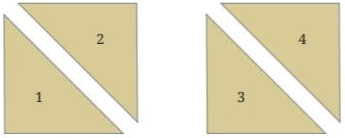
Can you arrange these pieces to create a square with double the area of either square?
Solution:
Yes, we can arrange these pieces to create a square with double the area.
Arrangement method:
- Take the two identical squares, each cut into pieces {tex}1,2,3,4{/tex}
- From each square, you get 2 triangular pieces (if cut along one diagonal) or 4 pieces (if cut differently)
- Arrange the {tex}{8}{/tex} pieces (4 from each square) to form a larger square:
- Place the pieces so that the triangular pieces fit together
- The straight edges should align to form the sides of the new square
- Use the diagonal of the original square as the side of the new square
- The resulting square will have:
- Side length {tex}={/tex} diagonal of original square {tex}=\sqrt{2 } \times{/tex} (side of original)
- Area {tex}=(\sqrt{ 2} \times \text { side })^2=2 \times(\text { side })^2=2 \times{/tex} Area of original square
Verification:
- Original square area {tex}={a}^2{/tex} (where a is the side)
- Each square contributes 4 pieces
- New square is formed by 8 pieces total
- New square area {tex}=2 a^2={/tex} double the original area
Therefore, this arrangement creates a square with exactly double the area of either original square.
Q.14: The length of the two equal sides of an isosceles right triangle is given. Find the length of the hypotenuse. Find bounds on the length of the hypotenuse such that they have at least one digit after the decimal point.
- 3
- 4
- 6
- 8
- 9
Solution:
For an isosceles right triangle with equal sides of length a, the hypotenuse c is given by:
Formula: {tex}{c}^2=2 {a}^2{/tex} or {tex}{c}={a} \sqrt{ 2} {/tex}
- When {tex}{a}=3{/tex}:
{tex} c=3 \sqrt{ 2} {/tex}
To find bounds, we calculate:- {tex}4^2=16{/tex} and {tex}5^2=25{/tex}
- {tex}(3 \sqrt{ 2} )^2=9 \times 2=18{/tex}
- Since {tex}16<18<25{/tex}, we have {tex}4<3 \sqrt{ 2}<5{/tex}
- {tex}4.2^2=17.64{/tex}
- {tex}4.3^2=18.49{/tex}
- Since 17.64 < 18 < 18.49
Length of hypotenuse {tex}=3 \sqrt{ 2} {/tex} units {tex}\approx 4.24{/tex} units
Bounds: 4.2 < hypotenuse < 4.3
- When a = 4:
{tex} c=4 \sqrt{ 2}{/tex}
To find bounds:- {tex}(4 \sqrt{ } 2)^2=16 \times 2=32{/tex}
- {tex}5^2=25{/tex} and {tex}6^2=36{/tex}
- Since {tex}25<32<36{/tex}, we have {tex}5<4 \sqrt{ 2} <6{/tex}
- {tex}5.6^2=31.36{/tex}
- {tex}5.7^2=32.49{/tex}
- Since 31.36 < 32 < 32.49
Length of hypotenuse {tex}=4 \sqrt{ 2} {/tex} units {tex}\approx 5.66{/tex} units
Bounds: 5.6 < hypotenuse < 5.7
- When {tex}{a}=6{/tex}:
{tex}c=6 \sqrt{ 2} {/tex}
To find bounds:- {tex}(6 \sqrt{2 })^2=36 \times 2=72{/tex}
- {tex}8^2=64{/tex} and {tex}9^2=81{/tex}
- Since {tex}64<72<81{/tex}, we have {tex}8<6 \sqrt{ 2} <9{/tex}
- {tex}8.4^2=70.56{/tex}
- {tex}8.5^2=72.25{/tex}
- Since {tex}70.56<72<72.25{/tex}
Length of hypotenuse {tex}=6 \sqrt{ 2} {/tex} units {tex}\approx 8.49{/tex} units
Bounds: 8.4 < hypotenuse < 8.5
- When {tex}a=8{/tex}:
{tex} c=8 \sqrt{ 2} {/tex}
To find bounds:- {tex}(8 \sqrt{2 })^2=64 \times 2=128{/tex}
- {tex}11^2=121{/tex} and {tex}12^2=144{/tex}
- Since {tex}121<128<144{/tex}, we have {tex}11<8 \sqrt{ 2} <12{/tex}
- {tex}11.3^2=127.69{/tex}
- {tex}11.4^2=129.96{/tex}
- Since 127.69 < 128 < 129.96
Length of hypotenuse {tex}=8 \sqrt{ 2} {/tex} units {tex}\approx 11.31{/tex} units
Bounds: 11.3 < hypotenuse < 11.4
- When a = 9:
{tex} c=9 \sqrt{ 2} {/tex}
To find bounds:- {tex}(9 \sqrt{ 2} )^2=81 \times 2=162{/tex}
- {tex}12^2=144{/tex} and {tex}13^2=169{/tex}
- Since 144 < 162 < 169, we have {tex}12<9 \sqrt{2 }<13{/tex}
- {tex}12.7^2=161.29{/tex}
- {tex}12.8^2=163.84{/tex}
- Since 161.29 < 162 < 163.84
Length of hypotenuse {tex}=9 \sqrt{ 2} {/tex} units {tex}\approx 12.73{/tex} units
Bounds: 12.7 < hypotenuse < 12.8
Q.15: The hypotenuse of an isosceles right triangle is 10. What are its other two sidelengths?
Solution:
Given: Hypotenuse of isosceles right triangle {tex}=10{/tex} units
To find: Length of the two equal sides
Let a be the length of each equal side.
Using the formula for isosceles right triangle: {tex}c^2=2 a^2{/tex}
Given {tex}{c}=10{/tex}
Substituting: {tex}(10)^2=2 {a}^2{/tex}
{tex} 100=2 a^2 {/tex}
Dividing by 2: {tex}a^2=100 / 2=50{/tex}
Taking square root: {tex}{a}=\sqrt{ 50} {/tex}
Simplifying {tex}\sqrt{ 50} {/tex}:
{tex} \sqrt{50 } =\sqrt{(25 \times 2) }=\sqrt{ 25} \times \sqrt{2 } =5 \sqrt{ 2} {/tex}
Finding bounds:
- {tex}(5 \sqrt{2 } )^2=25 \times 2=50{/tex}
- {tex}7^2=49{/tex} and {tex}8^2=64{/tex}
- Since {tex}49<50<64{/tex}, we have {tex}7<5 \sqrt{2}<8{/tex}
More precisely:
- {tex}7.0^2=49{/tex}
- {tex}7.1^2=50.41{/tex}
- So {tex}7.0<5 \sqrt{ 2} <7.1{/tex}
Each of the two equal sides has length {tex}{5} \sqrt{ 2}{/tex} units {tex}\boldsymbol{\approx} {7 . 0 7}{/tex} units.
Q.16: Find the hypotenuse of an isosceles right triangle whose equal sides have length 12.
Solution:
We have {tex}a=12{/tex}. Using the formula, we get
{tex} c=\sqrt{2 \times 12^2}=\sqrt{288} . {/tex}
We have {tex}16^2=256{/tex}, and {tex}17^2=289{/tex}.
So, {tex}\sqrt{288}{/tex} lies between 16 and 17.
The length of the hypotenuse of an isosceles right triangle, whose length of the equal sides is 12 units, is between 16 and 17 units.
Q.17: If the hypotenuse of an isosceles right triangle is {tex}\sqrt{72}{/tex}, find its other two sides.
Solution:
We have {tex}c=\sqrt{72}{/tex}. Using the formula, we get
{tex} c^2=2 a^2 {/tex}
{tex} \text { So, }(\sqrt{72})^2 =2 a^2 {/tex}
{tex} 72 =2 a^2 {/tex}
{tex} \text { Thus, } a^2 =\frac{72}{2}=36 {/tex}
{tex} \text { So, } a =\sqrt{36}=6 {/tex}
Therefore, each of the other two sides has length 6.
Q.18: If a right-angled triangle has shorter sides of lengths 5 cm and 12 cm, then what is the length of its hypotenuse? First draw the right-angled triangle with these sidelengths and measure the hypotenuse, then check your answer using Baudhāyana’s Theorem.
Solution:
Step 1: Drawing and Measuring
Draw a right-angled triangle with:
- Base {tex}=5 {~cm}{/tex}
- Height {tex}=12 {~cm}{/tex}
- Measure hypotenuse {tex}\approx 13 {~cm}{/tex}
Step 2: Using Baudhāyana’s Theorem
Given:
- {tex}{a}=5 {~cm}{/tex}
- {tex}{b}=12 {~cm}{/tex}
Formula: {tex}a^2+b^2=c^2{/tex}
Calculation:
- {tex}5^2+12^2={c}^2{/tex}
- {tex}25+144={c}^2{/tex}
- {tex}169={c}^2{/tex}
- {tex}{c}=\sqrt{ } 169=13{/tex}
The length of the hypotenuse is 13 cm.
Verification: The measured value matches our calculated value!
Q.19: If a right-angled triangle has a short side of length 8 cm and hypotenuse of length 17 cm, what is the length of the third side? Again, try drawing the triangle and measuring, and then check your answer using Baudhāyana’s Theorem.
Solution:
Step 1: Drawing and Measuring
This is trickier to draw since we know the hypotenuse length.
- Draw one side {tex}=8 {~cm}{/tex}
- Using a compass with radius 17 cm, find where it intersects the perpendicular
- Measure the third side {tex}\approx 15 {~cm}{/tex}
Step 2: Using Baudhāyana’s Theorem
Given:
- {tex}{a}=8 {~cm}{/tex} (one short side)
- {tex}{c}=17 {~cm}{/tex} (hypotenuse)
- {tex}{b}={/tex} ? (third side)
Formula: {tex}a^2+b^2=c^2{/tex}
Rearranging: {tex}{b}^2={c}^2-{a}^2{/tex}
Calculation:
- {tex}b^2=17^2-8^2{/tex}
- {tex}{b}^2=289-64{/tex}
- {tex}{b}^2=225{/tex}
- {tex}b=\sqrt{225 } =15{/tex}
The length of the third side is 15 cm.
Verification: Our calculation matches the measurement!
Q.20: Using the constructions you have now seen, how would you construct a square whose area is triple the area of a given square? Five times the area of a given square? (Baudhāyana’s Śulba-Sūtra, Verse 1.10)
Solution:
For a square with triple the area:
Method:
- Take a square with side ‘{tex}a{/tex}’ (Area {tex}=a^2{/tex})
- We want a new square with area {tex}=3 a^2{/tex}
- Using Baudhāyana’s theorem: We need to find sides {tex}p{/tex} and {tex}q{/tex} such that {tex}p^2+q^2=3 a^2{/tex}
Construction:
- One approach: {tex}p^2+q^2=3 a^2{/tex}
- {tex}\operatorname{Try} p=a{/tex} and {tex}q^2=2 a^2{/tex}, so {tex}q=a \sqrt{2 } {/tex}
- But we can also use: {tex}a^2+a^2+a^2=3 a^2{/tex}
- This means: {tex}a^2+(a \sqrt{ 2} )^2=3 a^2{/tex}
Practical method:
- Take the original square (side a)
- Construct a square on its diagonal (side {tex}a \sqrt{ 2} {/tex}, area {tex}2 a^2{/tex})
- Now combine the original square ({tex}a^2{/tex}) with the diagonal square ({tex}2 a^2{/tex})
- Make a right triangle with sides {tex}a{/tex} and {tex}a \sqrt{ } 2{/tex}
- The hypotenuse will be {tex}\sqrt{ \left(a^2+2 a^2\right)}=\sqrt{ \left(3 a^2\right)}=a \sqrt{ 3} {/tex}
- Construct a square on this hypotenuse {tex}\rightarrow{/tex} Area {tex}=3 a^2{/tex}
Alternative simple method:
- Take three identical squares of side a
- Arrange them: two squares side by side, one on top
- This creates a shape with total area {tex}3 a^2{/tex}
- Use Baudhāyana’s method: Make a right triangle with sides a and a {tex}\sqrt{ 2} {/tex}
- Square on hypotenuse {tex}=3 a^2{/tex}
For a square with five times the area:
Method:
We need area {tex}=5 a^2{/tex}
Using {tex}p^2+q^2=5 a^2{/tex}
One solution:
- {tex}{p}={a}{/tex} and {tex}{q}=2 {a}{/tex}
- Check: {tex}a^2+(2 a)^2=a^2+4 a^2=5 a^2 {/tex}
Construction:
- Take the original square with side a
- Construct another square with side {tex}2 a\left(a r e a=4 a^2\right){/tex}
- Make a right triangle with sides a and 2a
- The hypotenuse {tex}=\sqrt{ \left(a^2+4 a^2\right)}=\sqrt{ \left(5 a^2\right)}=a \sqrt{ 5} {/tex}
- Construct a square on this hypotenuse {tex}\rightarrow{/tex} Area {tex}=5 a^2{/tex}
Verification:
- Original square area {tex}=a^2{/tex}
- New square area {tex}=(a \sqrt{5 } )^2=5 a^2{/tex}
Q.21: Let a, b and c denote the length of the sides of a right triangle, with c being the length of the hypotenuse. Find the missing sidelength in a = 5, b = 7.
Solution:
Given: {tex}{a}=5, {~b}=7, {c}={/tex} ?
Formula: {tex}a^2+b^2=c^2{/tex}
Calculation:
- {tex}5^2+7^2=c^2{/tex}
- {tex}25+49={c}^2{/tex}
- {tex}74={c}^2{/tex}
- {tex}{c}=\sqrt{ 74} {/tex}
Finding bounds:
- {tex}8^2=64{/tex} and {tex}9^2=81{/tex}
- Since {tex}64<74<81{/tex}, we have {tex}8<\sqrt{ 74} <9{/tex}
More precise:
- {tex}8.6^2=73.96{/tex}
- {tex}8.7^2=75.69{/tex}
- So {tex}8.6<\sqrt{ 74} <8.7{/tex}
{tex}c=\sqrt{ 74} \approx 8.60{/tex} units
Q.22: Let a, b and c denote the length of the sides of a right triangle, with c being the length of the hypotenuse. Find the missing sidelength in a = 8, b = 12.
Solution:
Given: {tex}a=8, b=12, c={/tex} ?
Formula: {tex}a^2+b^2=c^2{/tex}
Calculation:
- {tex}8^2+12^2={c}^2{/tex}
- {tex}64+144={c}^2{/tex}
- {tex}208={c}^2{/tex}
- {tex}c=\sqrt{ 208} {/tex}
Simplifying:
- {tex}\sqrt{208 } =\sqrt{(16 \times 13) }=4 \sqrt{ 13} {/tex}
Finding bounds:
- {tex}14^2=196{/tex} and {tex}15^2=225{/tex}
- Since {tex}196<208<225{/tex}, we have {tex}14<\sqrt{ 208}<15{/tex}
More precise:
- {tex}14.4^2=207.36{/tex}
- {tex}14.5^2=210.25{/tex}
- So {tex}14.4<\sqrt{ 208} <14.5{/tex}
{tex}c=\sqrt{208 }=4 \sqrt{ } 13 \approx 14.42{/tex} units.
Q.23: Let a, b and c denote the length of the sides of a right triangle, with c being the length of the hypotenuse. Find the missing sidelength in a = 9, c = 15.
Solution:
Given: {tex}a=9, c=15, b={/tex} ?
Formula: {tex}a^2+b^2=c^2{/tex}
Rearranging: {tex}{b}^2={c}^2-{a}^2{/tex}
Calculation:
- {tex}{b}^2=15^2-9^2{/tex}
- {tex}{b}^2=225-81{/tex}
- {tex}{b}^2=144{/tex}
- {tex}{b}=\sqrt{ 144} =12{/tex}
{tex}{b}=12{/tex} units
Verification: {tex}9^2+12^2=81+144=225=15^2 {/tex}
Q.24: Let a, b and c denote the length of the sides of a right triangle, with c being the length of the hypotenuse. Find the missing sidelength in a = 7, b = 12.
Solution:
Given: {tex}{a}=7, {~b}=12, {c}={/tex} ?
Formula: {tex}a^2+b^2=c^2{/tex}
Calculation:
- {tex}7^2+12^2={c}^2{/tex}
- {tex}49+144={c}^2{/tex}
- {tex}193={c}^2{/tex}
- {tex}{c}=\sqrt{ 193}{/tex}
Finding bounds:
- {tex}13^2=169{/tex} and {tex}14^2=196{/tex}
- Since 169 < 193 < 196, we have 13 < {tex}\sqrt{ 193} {/tex} < 14
More precise:
- {tex}13.8^2=190.44{/tex}
- {tex}13.9^2=193.21{/tex}
- So 13.8 < {tex}\sqrt{ 193} {/tex} < 13.9
{tex}c=\sqrt{ 193} \approx 13.89{/tex} units
Q.25: Let a, b and c denote the length of the sides of a right triangle, with c being the length of the hypotenuse. Find the missing sidelength in a = 1.5, b = 3.5.
Solution:
Given: {tex}{a}=1.5, {~b}=3.5, {c}={/tex} ?
Formula: {tex}a^2+b^2=c^2{/tex}
Calculation:
- {tex}(1.5)^2+(3.5)^2={c}^2{/tex}
- {tex}2.25+12.25={c}^2{/tex}
- {tex}14.5={c}^2{/tex}
- {tex}{c}=\sqrt{ 14.5} {/tex}
Finding bounds:
- {tex}3^2=9{/tex} and {tex}4^2=16{/tex}
- Since {tex}9<14.5<16{/tex}, we have {tex}3<\sqrt{ 14.5} <4{/tex}
More precise:
- {tex}3.8^2=14.44{/tex}
- {tex}3.9^2=15.21{/tex}
- So {tex}3.8<\sqrt{ 14.5} <3.9{/tex}
{tex}c=\sqrt{14.5 } \approx 3.81{/tex} units
Q.26: Find 5 more Baudhāyana triples using this idea.
Solution:
Method: Use the formula {tex}(n-1)^2+(2 n-1)=n^2{/tex}, where {tex}(2 n-1){/tex} is an odd perfect square.
The odd perfect squares are: 1, 9, 25, 49, 81, 121, 169, 225, …
We already used 9 and 25. Let’s use the next ones.
Triple 1: Using 49
{tex}49=2 n-1{/tex}
- {tex}2 {n}=50{/tex}
- {tex}{n}=25{/tex}
Formula: {tex}(25-1)^2+49=25^2{/tex}
- {tex}24^2+7^2=25^2{/tex}
- {tex}576+49=625{/tex}
Baudhāyana triple: {tex}(7,24,25){/tex}
Triple 2: Using 81
{tex} 81=2 n-1 {/tex}
- {tex}2 {n}=82{/tex}
- {tex}{n}=41{/tex}
Formula: {tex}(41-1)^2+81=41^2{/tex}
- {tex}40^2+9^2=41^2{/tex}
- {tex}1600+81=1681{/tex}
Baudhāyana triple: {tex}(9,40,41){/tex}
Triple 3: Using 121
{tex} 121=2 n-1 {/tex}
- {tex}2 {n}=122{/tex}
- {tex}{n}=61{/tex}
Formula: {tex}(61-1)^2+121=61^2{/tex}
- {tex}60^2+11^2=61^2{/tex}
- {tex}3600+121=3721{/tex}
Baudhāyana triple: {tex}(11,60,61){/tex}
Triple 4: Using 169
{tex} 169=2 n-1 {/tex}
- {tex}2 {n}=170{/tex}
- {tex}{n}=85{/tex}
Formula: {tex}(85-1)^2+169=85^2{/tex}
- {tex}84^2+13^2=85^2{/tex}
- {tex}7056+169=7225{/tex}
Baudhāyana triple: {tex}(13,84,85){/tex}
Triple 5: Using 225
{tex} 225=2 {/tex}
Q.27: Does this method yield non-primitive Baudhāyana triples?
Solution:
No, this method does NOT yield non-primitive Baudhāyana triples. It yields only primitive triples.
Reason:
Using the formula {tex}(n-1)^2+(2 n-1)=n^2{/tex}, we get triples of the form:
- {tex}((2 n-1),(n-1), n){/tex}
Rearranging: ( {tex}{n – 1 , 2 n – 1 , n}{/tex} ) where the hypotenuse differs from one side by just 1.
Observation from the hint:
- {tex}\ln (3,4,5): 5-4=1{/tex}
- {tex}\ln (5,12,13): 13-12=1{/tex}
- {tex}\ln (7,24,25): 25-24=1{/tex}
- {tex}\ln (9,40,41): 41-40=1{/tex}
Key insight: If one sidelength is one less than the hypotenuse ({tex}{c}-{b}=1{/tex}), then these two numbers are consecutive integers.
Consecutive integers always have GCD {tex}{= 1}{/tex} (no common factor >1).
Since two of the three numbers have no common factor, the entire triple cannot have a common factor >1.
Therefore, all triples generated by this method are primitive.
Q.28: Are there primitive triples that cannot be obtained through this method? If yes, give examples.
Solution:
Yes, there are primitive triples that cannot be obtained through this method.
Example: (3,4,5)
Using the method: One side should be one less than hypotenuse
- Check: {tex}5-4=1{/tex} (Right)
- Check: {tex}5-3=2 {/tex} (Wrong)
Actually, {tex}(3,4,5){/tex} can be obtained! Let’s verify:
- If {tex}n=5{/tex}, then {tex}(n-1)=4{/tex} and {tex}(2 n-1)=9=3^2{/tex}
- So {tex}4^2+3^2=16+9=25=5^2 {/tex} (Right)
Better Example: (8,15,17)
Check if one side is one less than hypotenuse:
- {tex}17-15=2{/tex} (Wrong)
- {tex}17-8=9{/tex} (Wrong)
This triple cannot have the form {tex}(n-1,2 n-1, n){/tex} because:
- If {tex}{n}=17{/tex}, then {tex}({n}-1)=16 \neq 8{/tex} or 15
- Neither 8 nor 15 is one less than 17
Verification: {tex}(8,15,17){/tex} is indeed primitive:
- {tex}8^2+15^2=64+225=289=17^2{/tex} (Right)
- {tex}{GCD}(8,15,17)=1{/tex}
Conclusion:
- Yes, there are primitive triples not obtained by this method
- Example: {tex}(8,15,17){/tex} and many others
- This method gives us some but not all primitive triples
- To get all primitive triples, we need other generation methods as well
Q.29: Find the diagonal of a square with sidelength 5 cm.
Solution:
Given: Square with side {tex}=5 {~cm}{/tex}
To find: Length of diagonal
Method:
A diagonal of a square divides it into two congruent right-angled triangles.
For each triangle:
- Both perpendicular sides {tex}=5 {~cm}{/tex} (sides of square)
- Hypotenuse = diagonal of square
Using Baudhāyana’s Theorem:
Let d = length of diagonal
- {tex}5^2+5^2={d}^2{/tex}
- {tex}25+25=d^2{/tex}
- {tex}50=d^2{/tex}
- {tex}{d}=\sqrt{ 50} {/tex}
Simplifying:
- {tex}\sqrt{ 50} =\sqrt{(25 \times 2) }{/tex} {tex}=\sqrt{25 } \times \sqrt{2 } =5 \sqrt{ 2} {/tex}
Finding approximate value:
- {tex}\sqrt{2 } \approx 1.414{/tex}
- {tex}5 \sqrt{2 } \approx 5 \times 1.414=7.07{/tex}
The diagonal of the square is {tex}{5} \sqrt{2 } {~ c m} \boldsymbol{\approx} {7 . 0 7} {~ c m}{/tex}.
Alternative formula: For a square with side {tex}a{/tex}, diagonal {tex}=a \sqrt{ 2} {/tex}
Q.30: Find the missing sidelengths in the right triangle: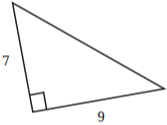
Solution:
If one perpendicular side {tex}=7{/tex} and other perpendicular side {tex}=9{/tex}:
Given: {tex}a=7, b=9, c={/tex} ?
Using Baudhāyana’s Theorem:
- {tex}7^2+9^2=c^2{/tex}
- {tex}49+81={c}^2{/tex}
- {tex}130={c}^2{/tex}
- {tex}{c}=\sqrt{130 }{/tex}
Finding bounds:
- {tex}11^2=121,12^2=144{/tex}
- So {tex}11<\sqrt{ 130} <12{/tex}
- More precisely: {tex}11.4^2=129.96,11.5^2=132.25{/tex}
- So {tex}11.4<\sqrt{ 130} <11.5{/tex}
{tex}c=\sqrt{130 } \approx 11.40{/tex} units
Q.31: Find the missing sidelengths in the right triangle: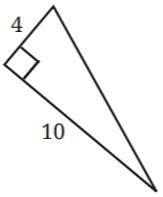
Solution:
Given: {tex}a=4, b=10, c={/tex} ?
Using Baudhāyana’s Theorem:
- {tex}4^2+10^2={c}^2{/tex}
- {tex}16+100={c}^2{/tex}
- {tex}116={c}^2{/tex}
- {tex}c=\sqrt{116 }{/tex}
Simplifying:
- {tex}\sqrt{116 } =\sqrt{(4 \times 29) }=2 \sqrt{ 29} {/tex}
Finding bounds:
- {tex}10^2=100,11^2=121{/tex}
- So {tex}10<\sqrt{ 116} <11{/tex}
- More precisely: {tex}10.7^2=114.49,10.8^2=116.64{/tex}
- So {tex}10.7<\sqrt{ 116} <10.8{/tex}
{tex}c=\sqrt{116 } =2 \sqrt{29 } \approx 10.77{/tex} units
Q.32: Find the missing sidelengths in the right triangle: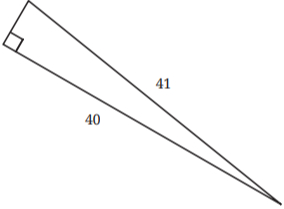
Solution:
Given: {tex}a=40, c=41, b={/tex} ?
Using Baudhāyana’s Theorem:
{tex} b^2=c^2-a^2 {/tex}
- {tex}{b}^2=41^2-40^2{/tex}
- {tex}{b}^2=1681-1600{/tex}
- {tex}{b}^2=81{/tex}
- {tex}{b}=\sqrt{ 81} =9{/tex}
{tex}b=9{/tex} units
Q.33: Find the missing sidelengths in the right triangle: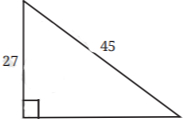
Solution:
Given: {tex}{a}=27, {c}=45, {~b}={/tex} ?
Using Baudhāyana’s Theorem:
{tex} b^2=c^2-a^2 {/tex}
- {tex}{b}^2=45^2-27^2{/tex}
- {tex}{b}^2=2025-729{/tex}
- {tex}{b}^2=1296{/tex}
- {tex}{b}=\sqrt{1296 }=36{/tex}
{tex}{b}=36{/tex} units
Verification: {tex}27^2+36^2=729+1296=2025=45^2{/tex}
Q.34: Find the missing sidelengths in the right triangle: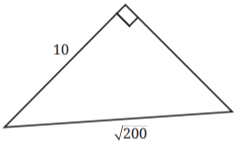
Solution:
Given: {tex}a=\sqrt{200}, b=10, c={/tex} ?
Using Baudhāyana’s Theorem:
- {tex}200^2+10^2={c}^2{/tex}
- {tex}40000+100={c}^2{/tex}
- {tex}40100={c}^2{/tex}
- {tex}{c}=\sqrt{ 40100} {/tex}
Simplifying:
- {tex}\sqrt{ 40100} =\sqrt{(100 \times 401) }=10 \sqrt{ 401} {/tex}
Finding approximate value:
- {tex}20^2=400,21^2=441{/tex}
- So {tex}20<\sqrt{401 }<21{/tex}
- More precisely: {tex}20.02^2 \approx 400.8,20.03^2 \approx 401.2{/tex}
- So {tex}\sqrt{401 } 1 \approx 20.02{/tex}
- Therefore, {tex}{c} \approx 10 \times 20.02=200.2{/tex}
{tex}c=10 \sqrt{401 }\approx 200.2{/tex} units
Q.35: Find the missing sidelengths in the right triangle: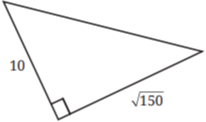
Solution:
Given: {tex}a=10, b=150, c={/tex} ?
Using Baudhāyana’s Theorem:
- {tex}10^2+150^2={c}^2{/tex}
- {tex}100+22500={c}^2{/tex}
- {tex}22600={c}^2{/tex}
- {tex}c=\sqrt{ 22600} {/tex}
Simplifying:
- {tex}\sqrt{22600 } =\sqrt{ (100 \times 226)}=10 \sqrt{ 226} {/tex}
Finding approximate value:
- {tex}15^2=225,16^2=256{/tex}
- So {tex}15<\sqrt{226 }<16{/tex}
- More precisely: {tex}15.03^2 \approx 225.9,15.04^2 \approx 226.2{/tex}
- So {tex}\sqrt{226 } \approx 15.03{/tex}
- Therefore, {tex}{c} \approx 10 \times 15.03=150.3{/tex}
{tex}c=10 \sqrt{ 226} \approx 150.3{/tex} units
Q.36: Find the sidelength of a rhombus whose diagonals are of length 24 units and 70 units.
Solution:
Given:
- Diagonal {tex}1\left({~d}_1\right)=24{/tex} units
- Diagonal {tex}2\left({~d}_2\right)=70{/tex} units
To find: Side length of the rhombus
Key properties of a rhombus:
- Diagonals bisect each other at right angles {tex}\left(90^{\circ}\right){/tex}
- All four sides are equal
When diagonals intersect, they form 4 right-angled triangles.
Each right triangle has:
- One side {tex}={d}_1 / 2=24 / 2=12{/tex} units
- Other side {tex}={d}_2 / 2=70 / 2=35{/tex} units
- Hypotenuse = side of rhombus (s)
Using Baudhāyana’s Theorem:
{tex} s^2=12^2+35^2 {/tex}
- {tex}{s}^2=144+1225{/tex}
- {tex}{s}^2=1369{/tex}
- {tex}{s}=\sqrt{1369 } =37{/tex}
The side length of the rhombus is 37 units.
Verification: {tex}12^2+35^2=144+1225=1369=37^2{/tex}
Q.37: Is the hypotenuse the longest side of a right triangle? Justify your answer.
Solution:
Yes, the hypotenuse is always the longest side of a right triangle.
Justification:
Method 1: Using Baudhāyana’s Theorem
In a right triangle with sides {tex}{a}, {b}{/tex} and hypotenuse c:
- {tex}a^2+b^2=c^2{/tex}
Since {tex}{a}^2{/tex} and {tex}{b}^2{/tex} are both positive:
- {tex}c^2=a^2+b^2{/tex}
- {tex}c^2>a^2\left(\right.{/tex}because {tex}\left.b^2>0\right){/tex}
- {tex}{c}^2>{b}^2\left(\right.{/tex}because {tex}\left.{a}^2>0\right){/tex}
Taking square roots:
- {tex}c>a{/tex}
- {tex}c>b{/tex}
Therefore, hypotenuse {tex}{c}{/tex} is greater than both other sides.
Method 2: Logical reasoning
- Let’s assume one of the other sides is longer than the hypotenuse
- Say b {tex}>{/tex} c
Then:
- {tex}{b}^2>{c}^2{/tex}
- But from Baudhāyana’s theorem: {tex}a^2+b^2=c^2{/tex}
- This means: {tex}{b}^2={c}^2-{a}^2{/tex}
- Since {tex}a^2>0{/tex}, we get {tex}b^2<c^2{/tex}
- This contradicts our assumption that {tex}{b}^2>{c}^2{/tex}
Therefore, the hypotenuse must be the longest side.
Method 3: Geometric understanding
The hypotenuse is the side opposite to the largest angle {tex}\left(90^{\circ}\right){/tex} in the triangle. In any triangle, the longest side is always opposite to the largest angle.
Conclusion: Yes, in every right triangle, the hypotenuse is always the longest side.
Q.38: Every Baudhāyana triple is either a primitive triple or a scaled version of a primitive triple.
Options:
(1) True ✅
(2) False
Explanation: True
Q.39: Give 5 examples of rectangles whose sidelengths and diagonals are all integers.
Solution:
For a rectangle with sides {tex}a{/tex} and {tex}b{/tex}, the diagonal {tex}d{/tex} is given by:
- {tex}d^2=a^2+b^2{/tex}
We need {tex}{a}, {b}{/tex}, and d to all be integers. This means we need Baudhāyana triples!
The sides of the rectangle are the two smaller numbers, and the diagonal is the largest number from a Baudhāyana triple.
Example 1: Using {tex}\boldsymbol{(} {3 , 4 , 5} \boldsymbol{)}{/tex}
- Length {tex}=4{/tex} units
- Width {tex}=3{/tex} units
- Diagonal {tex}=5{/tex} units
- Verification: {tex}3^2+4^2=9+16=25=5^2{/tex}
Example 2: Using {tex}\boldsymbol{(} {5 , 1 2 , 1 3} \boldsymbol{)}{/tex}
- Length {tex}=12{/tex} units
- Width {tex}=5{/tex} units
- Diagonal {tex}=13{/tex} units
- Verification: {tex}5^2+12^2=25+144=169=13^2{/tex}
Example 3: Using {tex}({8 ,} {1 5 ,} {1 7}){/tex}
- Length = 15 units
- Width {tex}=8{/tex} units
- Diagonal {tex}=17{/tex} units
- Verification: {tex}8^2+15^2=64+225=289=17^2{/tex}
Example 4: Using {tex}\boldsymbol{(} {7} \boldsymbol{,} {2 4} \boldsymbol{,} {2 5} \boldsymbol{)}{/tex}
- Length = 24 units
- Width {tex}=7{/tex} units
- Diagonal {tex}=25{/tex} units
- Verification: {tex}7^2+24^2=49+576=625=25^2{/tex}
Example 5: Using {tex}(6,8,10){/tex}
- Length {tex}=8{/tex} units
- Width {tex}=6{/tex} units
- Diagonal {tex}=10{/tex} units
- Verification: {tex}6^2+8^2=36+64=100=10^2 {/tex}
Q.40: Construct a square whose area is equal to the difference of the areas of squares of sidelengths 5 units and 7 units.
Solution:
Given:
- First square: side {tex}=7{/tex} units, {tex}\operatorname{Area}=7^2=49{/tex} sq. units
- Second square: side {tex}=5{/tex} units, Area {tex}=5^2=25{/tex} sq. units
Required: Square with area {tex}=49-25=24{/tex} sq. units
To find: Side of the new square
If the side of new square = s, then:
- {tex}{s}^2=24{/tex}
- {tex}s=\sqrt{ 24} =\sqrt{(4 \times 6) }=2 \sqrt{6 } {/tex}
Construction Method:
Step 1: Understanding the relationship
We need to find a right triangle where:
- Hypotenuse {tex}=7{/tex}
- One side {tex}=5{/tex}
- Other side = s
Using Baudhāyana’s theorem:
- {tex}5^2+s^2=7^2{/tex}
- {tex}25+{s}^2=49{/tex}
- {tex}s^2=24{/tex}
- {tex}s=\sqrt{ 24} =2 \sqrt{6 } {/tex}
Step 2: Practical Construction
- Draw a square {tex}A B C D{/tex} with side 7 units
- Draw a square PQRS with side 5 units
- Place the smaller square inside the larger square, aligning one corner
- Draw a right triangle with:
- Hypotenuse {tex}=7{/tex} units (diagonal or side of larger square)
- One side {tex}=5{/tex} units (side of smaller square)
- The third side will be {tex}\sqrt{ 24} {/tex} units
- Construct a square on this third side.
Q.41: Using the dots of a grid as the vertices, can you create a square that has an area of (a) 2 sq. units, (b) 3 sq. units, (c) 4 sq.units, and (d) 5 sq. unit?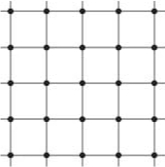
Solution:
Understanding: The distance between adjacent dots (horizontally or vertically) = 1 unit.
- Area {tex}=2{/tex} sq. units
Yes, this is possible!
Method:- We need a square with side {tex}=\sqrt{2}{/tex}
- This is the diagonal of a {tex}1 \times 1{/tex} square
- Connect dots that are 1 unit apart horizontally and 1 unit apart vertically
- Take a point A
- Move 1 unit right to point B
- Move 1 unit up to point C
- Move 1 unit left to point D
- Complete the square by connecting diagonally
- Side {tex}=\sqrt{\left(1^2+1^2\right) }=\sqrt{2}{/tex}
- Area {tex}=(\sqrt{2 })^2=2{/tex} sq. units
- Area {tex}=3{/tex} sq. units
Yes, this is possible!
Method:- We need a square with side {tex}=\sqrt{ 3}{/tex}
- Use a right triangle with sides 1 and {tex}\sqrt{ 2}{/tex}
Better construction: The diagonal of a rectangle with sides 1 and {tex}\sqrt{ 2}{/tex} gives {tex}\sqrt{ 3}{/tex}.
Actually, on a grid:- Take a segment connecting points that are 1 unit right and 1 unit up: length {tex}=\sqrt{2}{/tex}
- We need side {tex}=\sqrt{ 3}{/tex}
Yes, a square with area 3 can be constructed. - Area {tex}=4{/tex} sq. units
Yes, this is very easy!
Method:- We need a square with side {tex}=2{/tex} units
- Simply take a {tex}2 \times 2{/tex} square on the grid
- This uses dots that are 2 units apart
- Area {tex}=5{/tex} sq. units
Yes, this is possible!
Method:- We need a square with side {tex}=\sqrt{5}{/tex}
- From Baudhāyana triple {tex}(1,2, \sqrt{5}): 1^2+2^2=5{/tex}
- Connect dots that form a right triangle with legs 1 and 2
- From point A, move 2 units right to B
- Move 1 unit up to get the hypotenuse length {tex}\sqrt{5}{/tex}
- This {tex}\sqrt{5}{/tex} becomes the side of our square
Q.42: Suppose the grid extends indefinitely. What are the possible integer-valued areas of squares you can create in this manner?
Solution:
Analysis:
The side of any square we can create on the grid has the form:
- {tex}\sqrt{ \left(a^2+b^2\right)}{/tex}
where {tex}a{/tex} and {tex}b{/tex} are non-negative integers (representing horizontal and vertical movements between grid points).
The area of such a square:
- {tex}\operatorname{Area}=\left(\sqrt{\left(a^2+b^2\right)}\right)^2=a^2+b^2{/tex}
Q.43: Find the area of an equilateral triangle with sidelength 6 units.
Solution:
Given: Equilateral triangle with side {tex}=6{/tex} units
To find: Area of the triangle
Step 1: Understanding the hint
In an equilateral triangle:
- All sides are equal
- All angles are {tex}60^{\circ}{/tex}
- An altitude (height) from any vertex bisects the opposite side and is perpendicular to it
Step 2: Drawing and analyzing
Let triangle ABC be equilateral with side 6 units.
Draw altitude AD from A to side BC.
Properties:
- {tex}{AD} \perp {BC}{/tex} (altitude is perpendicular)
- {tex}{BD}={DC}=3{/tex} units (altitude bisects the base)
Step 3: Finding the height using Baudhāyana’s Theorem
Triangle ABD is a right-angled triangle with:
- {tex}{AB}=6{/tex} units (side of equilateral triangle)
- {tex}{BD}=3{/tex} units (half the base)
- {tex}{AD}={h}{/tex} (height, to be found)
Using Baudhāyana’s theorem in triangle ABD:
{tex} {BD}^2+{AD}^2={AB}^2 {/tex}
- {tex}3^2+h^2=6^2{/tex}
- {tex}9+h^2=36{/tex}
- {tex}{h}^2=27{/tex}
- {tex}h=\sqrt{27} =\sqrt{(9 \times 3)}=3 \sqrt{3}{/tex}
Height {tex}=3 \sqrt{3}{/tex} units
Step 4: Calculating the area
Area of triangle {tex}=\frac 12 \times{/tex} base × height
- {tex}=\frac 1 2 \times 6 \times 3 \sqrt{3}{/tex}
- {tex}=3 \times 3 \sqrt{3}{/tex}
- {tex}=9 \sqrt{3}{/tex} sq. units
Finding approximate value:
- {tex}\sqrt{3} \approx 1.732{/tex}
- Area {tex}\approx 9 \times 1.732=15.588{/tex} sq. units
The area of the equilateral triangle is {tex}{9} \sqrt{3}{/tex} sq. units {tex}\boldsymbol{\approx} {1 5 . 5 9}{/tex} sq. units.
General formula: For an equilateral triangle with side a:
- Height {tex}=\frac {({a} \sqrt{3 } ) }{ 2}{/tex}
- Area {tex}=\frac {\left(a^2 \sqrt{3}\right) }{ 4}{/tex}
Verification for {tex}{a = 6 :}{/tex}
- Area {tex}=\frac {\left(6^2 \times \sqrt{3}\right) }{ 4}=\frac {(36 \sqrt{ 3}) }{4}=9 \sqrt{3}{/tex}
Class 8 Maths Ganita Prakash Solutions
- A Square and A Cube
- Power Play
- A Story of Numbers
- Quadrilaterals
- Number Play
- We Distribute Yet Things Multiply
- Proportional Reasoning-1
- Fractions In Disguise
- The Baudhayana-Pythagoras Theorem
- Proportional Reasoning-2
- Exploring Some Geometric Themes
- Tales by dots and lines
- Algebra Play

Test Generator
Create question paper PDF and online tests with your own name & logo in minutes.
Create Now
Learn8 App
Practice unlimited questions for Entrance tests & government job exams at ₹99 only
Install Now