Dynamics of Population – NCERT Solutions Class 8 Social Science (New) Understanding Society includes all the questions with solutions given in the NCERT Class 8 Social Science Book Understanding Society textbook.
NCERT Solutions Class 8
English Poorvi Hindi Malhar Maths Ganita Prakash Science Curiosity Social Exploring SocietyDynamics of Population – NCERT Solutions
Q.1: What is demography?
Solution:
Demography is the systematic study of human populations, including their size, composition, distribution, and changes over time through births, deaths, and migration.
Q.2: What are some important concepts of demography?
Solution:
Important concepts include population size, population density, birth rate, death rate, fertility rate, life expectancy, migration, age structure, sex ratio, and population growth.
Q.3: How has the population of India and the world changed over time?
Solution:
The population of India and the world has increased greatly over time. Improvements in healthcare, sanitation, food supply, and living conditions reduced death rates and increased life expectancy, leading to rapid population growth.
Q.4: How do population trends shape societies and economies?
Solution:
Population trends influence employment, education, healthcare, housing, resources, and economic growth. Changes in population size and age structure affect the workforce, government planning, consumption patterns, and the overall development of society.
Q.5: Why is it important for a country to study its population through demography?
Solution:
Demography helps a country understand population size, age structure, birth and death rates, migration, and population trends. This information helps governments plan healthcare, education, employment, housing, and other public services.
Q.6: How can a low fertility rate affect a country’s future economy and workforce?
Solution:
A low fertility rate can lead to a smaller working-age population in the future. This may create labour shortages, increase the burden on workers supporting older people, and reduce economic growth and productivity.
Q.7: Do you think a high birth rate is always good for a country? Why or why not?
Solution:
A high birth rate is not always good for a country, depending on economic growth, resource availability, and infrastructure. While it can expand the future workforce, it can also strain public services and slow down development if the economy cannot keep up.
Q.8: Do you think it’s better to have more people or fewer people in a country? What are the challenges countries face in the case of a fast-growing or shrinking population?
Solution:
A country’s ideal population size depends on its resources, with both growth and decline bringing distinct economic and social hurdles. Fast growth strains infrastructure and jobs, while population shrinkage reduces the workforce and burdens elder care systems.
Fast-Growing Population Challenges
- Resource strain: High demand for water, food, energy, and housing.
- Job scarcity: Difficulty creating enough jobs for a young, expanding workforce.
- Service overload: Crowded schools, hospitals, and public transport systems.
Shrinking Population Challenges
- Labor shortage: Fewer workers to fill essential jobs and run the economy.
- Aging society: A large retired population relying on a smaller group of workers.
- Financial pressure: Higher costs for pensions and healthcare with less tax money coming in.
Q.9: Why do you think families are generally getting smaller? Does having fewer children ensure better education and health for them? How does it affect families and society?
Solution:
Families are getting smaller due to rising living costs, career priorities, and better birth control. While fewer children generally allow for higher investment in health and education, smaller sizes reshape household dynamics and pose broader workforce challenges for society.
Why Families Are Getting Smaller
- High Costs: Raising and educating a child demands significant financial resources in modern economies.
- Career Focus: More people, especially women, focus on higher education and long-term career goals.
- Urban Living: City life offers less living space and shifts cultural norms toward smaller households.
Impact on Education and Health
- More Resources: Parents divide finite income and time among fewer children, making private tutoring or quality healthcare more affordable.
- Better Attention: Adults can actively monitor a child’s school progress and emotional well-being.
- Not a Absolute Guarantee: Low numbers help, but poverty, local school quality, and baseline access to doctors still play major roles.
Effects on Family and Society
- For Families: Households enjoy less financial stress and higher living standards, though children miss out on large sibling networks.
- For Society: Lower birth rates reduce pressure on natural resources, but lead to aging populations and smaller future workforces.
Q.10: Observe the graph below showing changes in life expectancy across gender in India and answer the questions given below: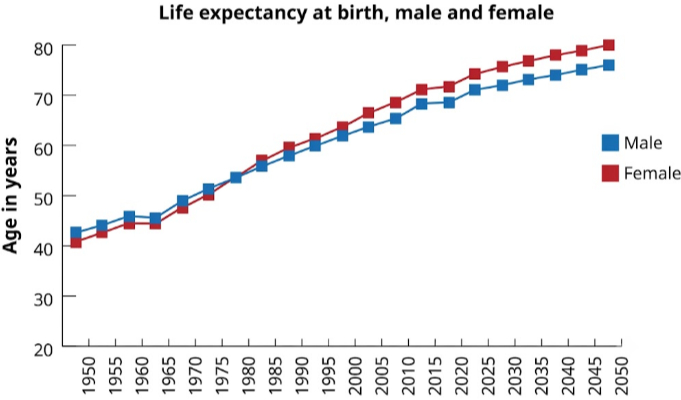
- Has the life expectancy in India increased? If yes, what could be the reasons?
- What was the life expectancy of males and females in 2010?
Solution:
- Yes, life expectancy in India has increased significantly. This may be due to better healthcare, improved sanitation, nutritious food, vaccination, medical advancements, and improved living standards.
- In 2010:
- Male life expectancy: approximately 68 years
- Female life expectancy: approximately 70 years
Q.11: What is a demographic dividend, and how does it benefit a country? What do you think India needs to do today to make the most of its demographic dividend before 2050?
Solution:
A demographic dividend is the economic benefit a country can gain when a large share of its population is in the working-age group. It can increase productivity, economic growth, and national development if people are educated, healthy, skilled, and employed.
To make the most of its demographic dividend before 2050, India should improve education and healthcare, provide skill development, create more employment opportunities, encourage entrepreneurship, and ensure equal opportunities for all young people. This will help the country use its workforce effectively for development.
Q.12: Choose two countries (for example: India and Japan, or Nigeria and Italy). Find out their:
- Population size
- Fertility rate
- Life expectancy
- Age distribution
How are they different? What might be the reasons behind these differences? For instance, find out how countries with ageing populations are managing this.
Solution:
For comparison, let us take India and Japan. The latest comparable UN data available for 2025 show a clear contrast between a relatively young India and a much older Japan.
| Indicator | India | Japan |
| Population size | About 1.464 billion | About 123.1 million |
| Fertility rate | 1.9 births per woman | 1.2 births per woman |
| Life expectancy | Female: 74.1 years; Male: 71.0 years | Female: 88.0 years; Male: 82.0 years |
| Age distribution | 0–14 years: 24.2%; 60+ years: 11.1% | 0–14 years: 11.2%; 60+ years: 36.3% |
- India has a much larger and younger population, with nearly one-fourth below 15 years.
- Japan has a much older population, with more than one-third aged 60 or above.
- Japan has a much lower fertility rate and considerably higher life expectancy than India.
- India therefore needs to focus strongly on education, skills, employment, and healthcare for a large young population.
- Japan faces greater challenges related to pensions, healthcare, long-term care, and maintaining its workforce.
Japan’s low fertility and high life expectancy have contributed to rapid population ageing. India has also experienced falling fertility and rising life expectancy, but its population remains considerably younger.
Japan has been responding by:
- encouraging older people to remain in employment;
- reforming its pension system;
- improving health and long-term care;
- promoting lifelong learning and skills development;
- using technology and healthcare reforms to improve productivity and care.
Conclusion: India currently has the advantage of a large working-age and young population, while Japan has to manage the economic and social pressures of an ageing and shrinking population.
Q.13: Imagine you are a researcher who intends to study migration patterns in your locality. Make a questionnaire to collect data on the following questions.
- Name of the person
- Age of the person
- Occupation of the person
- Place of residence
- Number of years lived in the place
- List the factors contributing to migration, such as lack of facilities, poor infrastructure, limited job opportunities and so on.
Solution:
1. Name of the person: ________
2. Age of the person: ________
3. Occupation of the person: ________
4. Place of residence: ________
5. Number of years lived in this place: ________
6. Have you migrated from another place?
☐ Yes ☐ No
7. If yes, what was your previous place of residence?
8. What were the main reasons for migration? (Tick all that apply)
☐ Lack of basic facilities
☐ Poor infrastructure
☐ Limited job opportunities
☐ Better education
☐ Better healthcare
☐ Higher income opportunities
☐ Family reasons
☐ Safety and security
☐ Other: ________
9. Was the migration permanent or temporary?
☐ Permanent ☐ Temporary
10. What improvements have you experienced after migration?
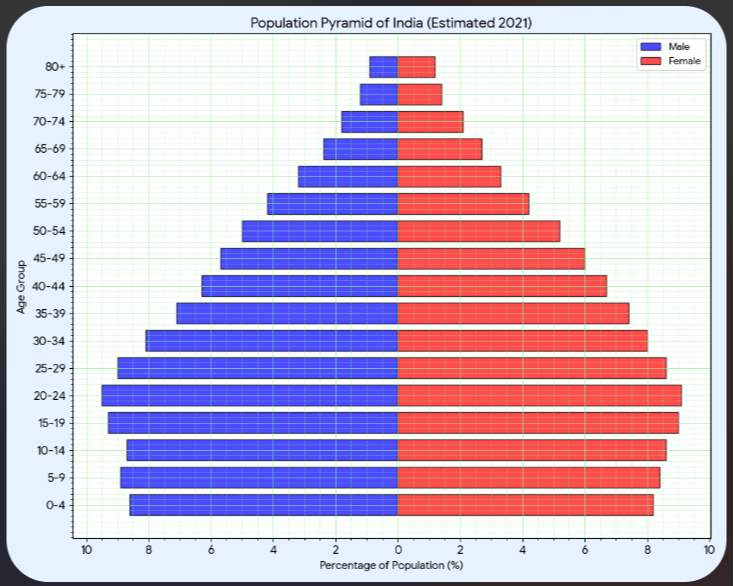
Q.14: Draw a population pyramid on graph paper for India using the data given in the following table.
Age-group-wise percentage distribution
of population (estimated for 2021)
| Age Group | Male | Female |
| 0-4 | 8.6 | 8.2 |
| 5-9 | 8.9 | 8.4 |
| 10-14 | 8.7 | 8.6 |
| 15-19 | 9.3 | 9 |
| 20-24 | 9.5 | 9.1 |
| 25-29 | 9 | 8.6 |
| 30-34 | 8.1 | 8 |
| 35-39 | 7.1 | 7.4 |
| 40-44 | 6.3 | 6.7 |
| 45-49 | 5.7 | 6 |
| 50-54 | 5 | 5.2 |
| 55-59 | 4.2 | 4.2 |
| 60-64 | 3.2 | 3.3 |
| 65-69 | 2.4 | 2.7 |
| 70-74 | 1.8 | 2.1 |
| 75-79 | 1.2 | 1.4 |
| 80+ | 0.9 | 1.2 |
Solution:
Q.15:
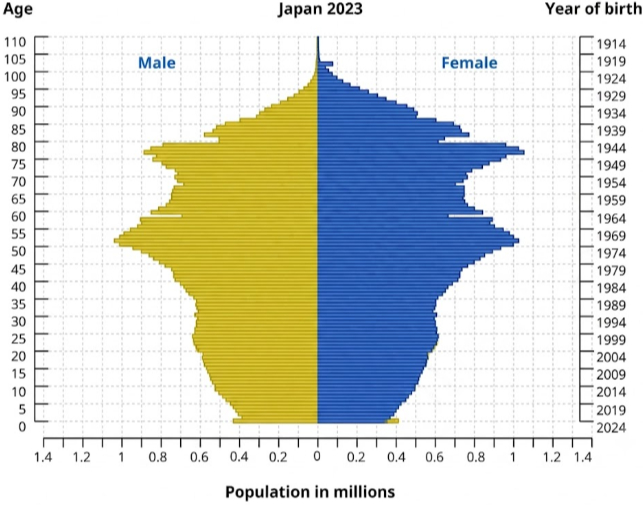
Observe the population pyramid for Japan in 2023 below. What can you infer from this? Write your observations and share in the class.
Solution:
The population pyramid of Japan in 2023 shows the following:
- Japan has a low birth rate, as the younger age groups form a relatively narrow base.
- A large proportion of the population is middle-aged and elderly.
- The country has an ageing population, with many people above 60 years of age.
- Female life expectancy is higher, as females outnumber males in the older age groups.
- The working-age population is significant but is expected to decline as more people enter old age.
- Japan may face challenges such as shortage of workers, higher healthcare costs, and greater demand for elderly care and pensions.
- The pyramid indicates that Japan has a slow-growing or declining population.
NCERT Solutions – Class 8 Social Science (New)
- Natural Resources and Their Use
- Reshaping India’s Political Map
- The Rise of the Marathas
- The Colonial Era in India
- Universal Franchise and India’s Electoral System
- The Parliamentary System: Legislature and Executive
- Factors of Production
- World Geography Some Glimpses
- India’s Long Road to Independence
- A Journey Through Indian Architecture
- The Role of the Judiciary in Our Society
- Citizenship Rights and Duties
- Dynamics of Population
- India’s Urban Landscape
- Cultural Currents 13th to 17th Centuries

Test Generator
Create question paper PDF and online tests with your own name & logo in minutes.
Create Now
Learn8 App
Practice unlimited questions for Entrance tests & government job exams at ₹99 only
Install Now