Working With Fractions – NCERT Solutions Class 7 Maths (Ganita Prakash) includes all the questions with solutions given in the NCERT Class 7 Maths (Ganita Prakash).
NCERT Solutions Class 7
English Poorvi Hindi Malhar Maths Ganita Prakash Science Curiosity Social Exploring SocietyWorking With Fractions – NCERT Solutions
Q.1: Tenzin drinks {tex}\frac{1}{2}{/tex} glass of milk every day. How many glasses of milk does he drink in a week? How many glasses of milk did he drink in the month of January?
Solution:
Glass of milk drank every day {tex}=\frac{1}{2}{/tex}
Glasses of milk drank in a week {tex}=\frac{1}{2} \times 7=\frac{7}{2}{/tex}
Days in month of January = 31
Glasses of milk drank in month of January {tex}=31 \times \frac{1}{2}=\frac{31}{2}=15 \frac{1}{2}{/tex}.
Q.2: A team of workers can make 1 km of a water canal in 8 days. So, in one day, the team can make ________ km of the water canal. If they work 5 days a week, they can make ________ km of the water canal in a week.
Solution:
The length of canal made by workers in 8 days {tex}=1 {~km}{/tex}
The length of canal made by workers in 1 day {tex}=\frac{1}{8} {~km}{/tex}
By working 5 days in a week, the length of canal made by workers {tex}=5 \times \frac{1}{8}=\frac{5}{8} {~km}{/tex}.
Q.3: Manju and two of her neighbours buy 5 litres of oil every week and share it equally among the 3 families. How much oil does each family get in a week? How much oil will one family get in 4 weeks?
Solution:
Amount of oil shared by 3 families in a week = 5 litres
Amount of oil one family got in a week {tex}=\frac{5}{3}{/tex} litres
Amount of oil one family got in 4 weeks {tex}=4 \times \frac{5}{3}=\frac{20}{3}=6 \frac{2}{3}{/tex} litres.
Q.4: Safia saw the Moon setting on Monday at 10 pm. Her mother, who is a scientist, told her that every day the Moon sets {tex}\frac{5}{6}{/tex} hour later than the previous day. How many hours after 10 pm will the moon set on Thursday?
Solution:
No. of days from Monday to Thursday = 3
Delay in moon setting time per day {tex}=\frac{5}{6}{/tex} hour
Delay in moon setting time over 3 days {tex}=3 \times \frac{5}{6}{/tex} hour {tex}=\frac{5}{2}=2.5{/tex} hours
Thus, the Moon will set 2.5 hours or 2 hours 30 minutes after 10 PM on Thursday.
Q.5: Multiply and then convert it into a mixed fraction:
- {tex} 7 \times \frac{3}{5} {/tex}
- {tex} 4 \times \frac{1}{3} {/tex}
- {tex} \frac{9}{7} \times 6 {/tex}
- {tex} \frac{13}{11} \times 6 {/tex}
Solution:
- {tex}7 \times \frac{3}{5}=\frac{21}{5}=4 \frac{1}{5}{/tex}.
- {tex}4 \times \frac{1}{3}=\frac{4}{3}{/tex}.
- {tex}\frac{9}{7} \times 6=\frac{54}{7}{/tex}.
- {tex}\frac{13}{11} \times 6=\frac{78}{11}{/tex}.
Q.6: Find the following products. Use a unit square as a whole for representing the fractions:
- {tex} \frac{1}{3} \times \frac{1}{5} {/tex}
- {tex} \frac{1}{4} \times \frac{1}{3} {/tex}
- {tex} \frac{1}{5} \times \frac{1}{2} {/tex}
- {tex} \frac{1}{6} \times \frac{1}{5} {/tex}
Solution:
- {tex} \frac{1}{3} \times \frac{1}{5} {/tex}
{tex}\frac{1}{3}{/tex} (multiplier) {tex}\times \frac{1}{5}{/tex} (multiplicand)
Number of rows {tex}={/tex} Denominator of the multiplicand {tex}=5{/tex}
Number of columns {tex}={/tex} Denominator of the multiplier {tex}=3{/tex}
Thus, the whole is divided into {tex}(5 \times 3)=15{/tex} equal parts
So, {tex}\frac{1}{3} \times \frac{1}{5}=\frac{1}{3 \times 5}=\frac{1}{15}{/tex}.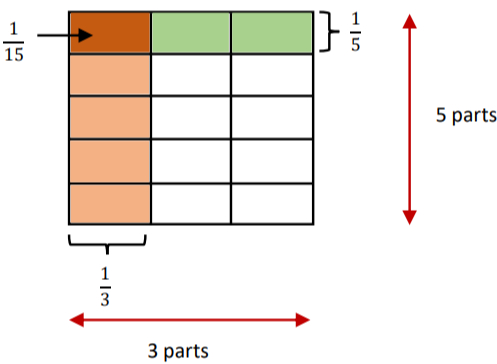
- {tex}\frac{1}{4} \times \frac{1}{3}{/tex}
{tex}\frac{1}{4}{/tex} (multiplier) {tex}\times \frac{1}{3}{/tex} (multiplicand)
Number of rows {tex}={/tex} Denominator of the multiplicand {tex}=3{/tex}
Number of columns {tex}={/tex} Denominator of the multiplier {tex}=4{/tex}
Thus, the whole is divided into {tex}(3 \times 4)=12{/tex} equal parts
So, {tex}\frac{1}{4} \times \frac{1}{3}=\frac{1}{4 \times 3}=\frac{1}{12}{/tex}.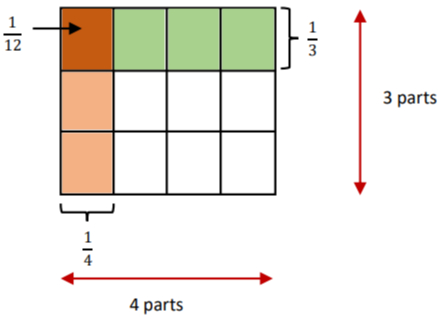
- {tex}\frac{1}{5} \times \frac{1}{2}{/tex}
{tex}\frac{1}{5}({/tex}multiplier{tex}) \times \frac{1}{2}({/tex}multiplicand{tex}){/tex}
Number of rows {tex}={/tex} Denominator of the multiplicand {tex}=2{/tex}
Number of columns {tex}={/tex} Denominator of the multiplier {tex}=5{/tex}
Thus, the whole is divided into {tex}(2 \times 5)=10{/tex} equal parts
So, {tex}\frac{1}{5} \times \frac{1}{2}=\frac{1}{5 \times 2}=\frac{1}{10}{/tex}.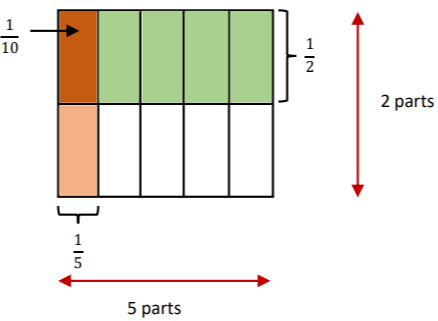
- {tex}\frac{1}{6} \times \frac{1}{5}{/tex}
{tex}\frac{1}{6}{/tex} (multiplier) {tex}\times \frac{1}{5}{/tex} (multiplicand)
Number of rows {tex}={/tex} Denominator of the multiplicand {tex}=5{/tex}
Number of columns = Denominator of the multiplier = 6
Thus, the whole is divided into {tex}(5 \times 6)=30{/tex} equal parts
So, {tex}\frac{1}{6} \times \frac{1}{5}=\frac{1}{6 \times 5}=\frac{1}{30}{/tex}.
Q.7: Find the product. Use a unit square as a whole for representing the fractions and carrying out the operations.
{tex}\frac{2}{3} \times \frac{4}{5}{/tex}
Solution:
{tex}\frac{2}{3} \times \frac{4}{5}{/tex}
First, the whole is divided into 5 rows and 3 columns creating {tex}15(5 \times 3){/tex} equal parts.
The value we get by dividing {tex}\frac{4}{5}{/tex} into 3 equal parts is {tex}\frac{4}{3 \times 5}{/tex}.
Thus, we multiply this result by 2 to get the product. This is {tex}\frac{2 \times 4}{3 \times 5}{/tex}.
So, {tex}\frac{2}{3} \times \frac{4}{5}=\frac{2 \times 4}{3 \times 5}=\frac{8}{15}{/tex}.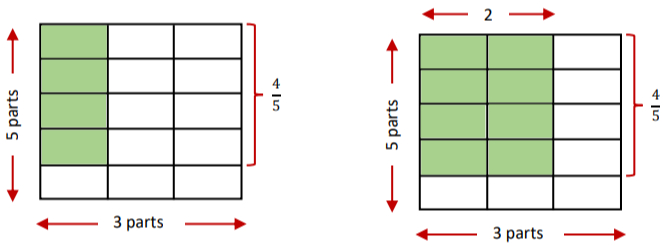
Q.8: Find the product. Use a unit square as a whole for representing the fractions and carrying out the operations.
{tex}\frac{1}{4} \times \frac{2}{3}{/tex}
Solution:
{tex}\frac{1}{4} \times \frac{2}{3}{/tex}
First, the whole is divided into 3 rows and 4 columns creating {tex}12(3 \times 4){/tex} equal parts.
The value we get by dividing {tex}\frac{2}{3}{/tex} into 4 equal parts is {tex}\frac{2}{4 \times 3}{/tex}.
So, {tex}\frac{1}{4} \times \frac{2}{3}=\frac{1 \times 2}{4 \times 3}=\frac{2}{12}{/tex}.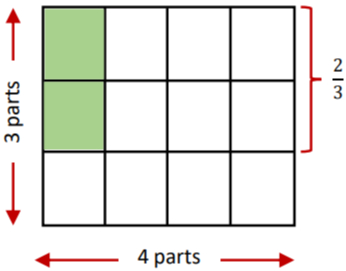
Q.9: Find the product. Use a unit square as a whole for representing the fractions and carrying out the operations.
{tex}\frac{3}{5} \times \frac{1}{2}{/tex}
Solution:
{tex}\frac{3}{5} \times \frac{1}{2}{/tex}
First, the whole is divided into 2 rows and 5 columns creating {tex}10(2 \times 5){/tex} equal parts.
The value we get by dividing {tex}\frac{1}{2}{/tex} into 5 equal parts is {tex}\frac{1}{5 \times 2}{/tex}.
Thus, we multiply this result by 3 to get the product. This is {tex}\frac{3 \times 1}{5 \times 2}{/tex}.
So, {tex}\frac{3}{5} \times \frac{1}{2}=\frac{3 \times 1}{5 \times 2}=\frac{3}{10}{/tex}.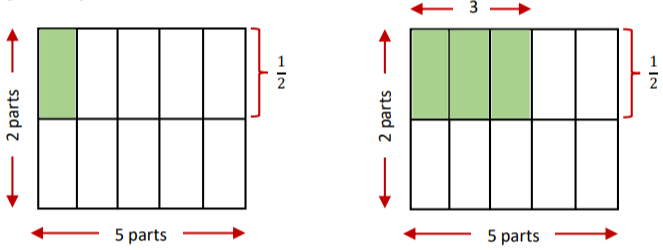
Q.10: Find the product. Use a unit square as a whole for representing the fractions and carrying out the operations.
{tex}\frac{4}{6} \times \frac{3}{5}{/tex}
Solution:
{tex}\frac{4}{6} \times \frac{3}{5}{/tex}
First, the whole is divided into 5 rows and 6 columns creating {tex}30(5 \times 6){/tex} equal parts.
The value we get by dividing {tex}\frac{3}{5}{/tex} into 6 equal parts is {tex}\frac{3}{6 \times 5}{/tex}.
Thus, we multiply this result by 4 to get the product. This is {tex}\frac{4 \times 3}{6 \times 5}{/tex}.
So, {tex}\frac{4}{6} \times \frac{3}{5}=\frac{4 \times 3}{6 \times 5}=\frac{12}{30}{/tex}.
Q.11: A water tank is filled from a tap. If the tap is open for 1 hour, {tex}\frac{7}{10}{/tex} of the tank gets filled. How much of the tank is filled if the tap is open for
- {tex}\frac{1}{3}{/tex} hour ________
- {tex}\frac{2}{3}{/tex} hour ________
- {tex}\frac{3}{4}{/tex} hour ________
- {tex}\frac{7}{10}{/tex} hour ________
- For the tank to be full, how long should the tap be running?
Solution:
Part of the tank filled in 1 hour {tex}=\frac{7}{10}{/tex}
- Part of the tank filled in {tex}\frac{1}{3}{/tex} hour {tex}=\frac{1}{3} \times \frac{7}{10}=\frac{7}{30}{/tex}.
- Part of the tank filled in {tex}\frac{2}{3}{/tex} hour {tex}=\frac{2}{3} \times \frac{7}{10}=\frac{14}{30}=\frac{7}{15}{/tex}.
- Part of the tank filled in {tex}\frac{3}{4}{/tex} hour {tex}=\frac{3}{4} \times \frac{7}{10}=\frac{21}{40}{/tex}.
- Part of the tank filled in {tex}\frac{7}{10}{/tex} hour {tex}=\frac{7}{10} \times \frac{7}{10}=\frac{49}{100}{/tex}.
- Part of the tank filled in 1 hour {tex}=\frac{7}{10}{/tex}.
or Time required to fill {tex}\frac{7}{10}{/tex} of a tank {tex}=1{/tex} hour.
Time required to fill 1 tank {tex}=1 \div \frac{7}{10}=1 \times \frac{10}{7}=\frac{10}{7}{/tex} hours {tex}=1 \frac{3}{7}{/tex} hours.
Q.12: The government has taken {tex}\frac{1}{6}{/tex} of Somu’s land to build a road. What part of the land remains with Somu now? She gives half of the remaining part of the land to her daughter, Krishna, and {tex}\frac{1}{3}{/tex} it to her son Bora. After giving them their shares, she kept the remaining land for herself.
- What part of the original land did Krishna get?
- What part of the original land did Bora get?
- What part of the original land did Somu keep for herself?
Solution:
Part of Somu’s land acquired by the government {tex}=\frac{1}{6}{/tex}
Somu’s original land {tex}=1-\frac{1}{6}=\frac{6-1}{6}=\frac{5}{6}{/tex}
- Part of the land given to Krishna {tex}=\frac{1}{2}{/tex} of original land {tex}=\frac{1}{2} \times \frac{5}{6}=\frac{5}{12}{/tex}.
- Part of the land given to Bora {tex}=\frac{1}{3}{/tex} of original land {tex}=\frac{1}{3} \times \frac{5}{6}=\frac{5}{18}{/tex}.
- Part of the land Somu kept for herself {tex}=\frac{5}{6}-\left(\frac{5}{12}+\frac{5}{18}\right){/tex}
{tex} =\frac{5}{6}-\left(\frac{3 \times 5+5 \times 2}{36}\right) {/tex}
{tex} =\frac{5}{6}-\left(\frac{15+10}{36}\right) {/tex}
{tex} =\frac{5}{6}-\left(\frac{25}{36}\right) {/tex}
{tex} =\frac{6 \times 5-25}{36} {/tex}
{tex} =\frac{30-25}{36}=\frac{5}{36} . {/tex}
Q.13: Find the area of a rectangle of sides {tex}3 \frac{3}{4} {ft}{/tex} and {tex}9 \frac{3}{5} {ft}{/tex}.
Solution:
{tex} \text { Area of rectangle }=3 \frac{3}{4} {ft} \times 9 \frac{3}{5} {ft} =\frac{15}{4} {ft} \times \frac{48}{5} {ft} {/tex}
{tex}= \frac {15}{4} \times \frac {48}{5}{/tex} = 3 {tex}=3\times 12{/tex} = 36 sq. ft
Q.14: Tsewang plants four saplings in a row in his garden. The distance between two saplings is {tex}\frac{3}{4}{/tex}m. Find the distance between the first and last sapling.
Solution:
No. of saplings in a row in garden {tex}=4{/tex}
Distance between two saplings {tex}=\frac{3}{4}{/tex}
Distance between first and last sapling {tex}=\frac{3}{4}+\frac{3}{4}+\frac{3}{4}=\frac{3+3+3}{4}=\frac{9}{4} {~m}=2 \frac{1}{4} {~m}{/tex}.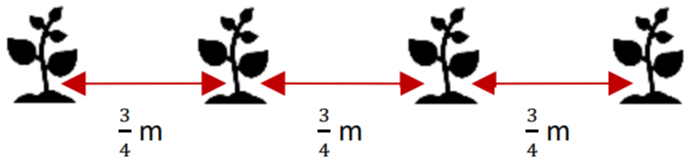
Q.15: Which is heavier: {tex}\frac{12}{15}{/tex} of 500 grams or {tex}\frac{3}{20}{/tex} of {tex}4 {~kg} ?{/tex}
Solution:
{tex}\frac{12}{15}{/tex} of 500 grams {tex}=\frac{12}{15} \times 500 {~g}{/tex}
{tex}=\frac {12}{15}\times 500 = 4 \times 100 = 400 g{/tex}
{tex}\frac{3}{20}{/tex} of {tex}4 {~kg}=\frac{3}{20} \times 4000 {~g}{/tex}
{tex}= \frac {3}{20} \times 4000 = 3 \times 200 = 600 g{/tex}
Hence, {tex}\frac{3}{20}{/tex} of 4 kg is heavier than {tex}\frac{12}{15}{/tex} of 500 grams.
Q.16: Is the Product Always Greater than the Numbers Multiplied?
What can you conclude about the relationship between the numbers multiplied and the product? Fill in the blanks:
- When one of the numbers being multiplied is between 0 and 1, the product is
________ (greater/less) than the other number. - When one of the numbers being multiplied is greater than 1, the product is
________ (greater/less) than the other number.
Solution:
- When one of the numbers being multiplied is between 0 and 1, the product is less than the other number.
Example:
Let one number be {tex}\frac{1}{4}{/tex} and other number be 100.
Product {tex}=\frac{1}{4} \times 100=25{/tex}.
Hence, the product (25) is less than the other number (100). - When one of the numbers being multiplied is greater than 1 , the product is greater than the other number.
Example:
Let one number be 10 and other number 50 .
Product = {tex}10 \times 50=500{/tex}.
Hence, the product (500) is greater than the other number (50).
Q.17: In each of the figures given below, find the fraction of the big square that the shaded region occupies.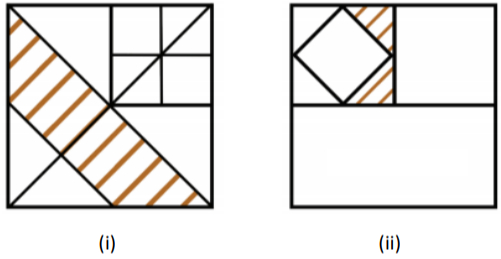
Solution:
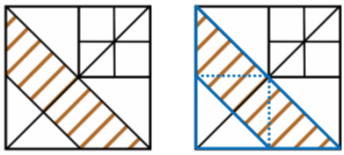
There are 4 triangles in half of the area of the whole square.
So, there are total 8 triangles in the whole square.
Area of each triangle {tex}=\frac{1}{8}{/tex}.
Area of the shaded region {tex}=3{/tex} triangles {tex}=3 \times \frac{1}{8}=\frac{3}{8}{/tex}.
Hence, the shaded region occupies {tex}\frac{3}{8}{/tex} area of the whole square.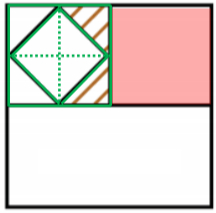
There are total number of 4 red small squares in the area of the whole square.
Total number of triangles in one small square {tex}=8{/tex}
So, total number of triangles in the area of the whole square {tex}=4 \times 8=32{/tex}.
Area of each triangle {tex}=\frac{1}{32}{/tex}
Area of the shaded region {tex}=2{/tex} triangles {tex}=2 \times \frac{1}{32}=\frac{2}{32}=\frac{1}{16}{/tex}.
Hence, the shaded region occupies {tex}\frac{1}{16}{/tex} area of the whole square.
Q.18: If we assume 1 gold dinar = 12 silver drammas, 1 silver dramma = 4 copper panas, 1 copper pana {tex}=6{/tex} mashakas, and 1 pana = 30 cowrie shells,
1 copper pana {tex}=\frac{1}{48}{/tex} gold dinar {tex}\left(\frac{1}{12} \times \frac{1}{4}\right){/tex}
1 cowrie shell = ________ copper panas
1 cowrie shell = ________ gold dinar.
Solution:
1 copper pana {tex}=\frac{1}{48}{/tex} gold dinar
1 copper pana = 30 cowrie shells
or 30 cowrie shells = 1 copper pana
or 1 cowrie shell {tex}=\frac{1}{30}{/tex} copper panas.
or 1 cowrie shell {tex}=\frac{1}{30} \times \frac{1}{48}{/tex} gold dinar {tex}=\frac{1}{1440}{/tex} gold dinar.
Q.19: Evaluate: {tex}3 \div \frac{7}{9}{/tex}
Solution:
{tex}3 \div \frac{7}{9}=3 \times \frac{9}{7}=\frac{27}{7}=3 \frac{6}{7}{/tex}.
Q.20: Evaluate: {tex}\frac{4}{3} \div \frac{3}{4}{/tex}
Solution:
{tex}\frac{4}{3} \div \frac{3}{4}=\frac{4}{3} \times \frac{4}{3}=\frac{16}{9}=1 \frac{7}{9}{/tex}
Q.21: Evaluate: {tex}\frac{1}{5} \div \frac{1}{9}{/tex}
Solution:
{tex}\frac{1}{5} \div \frac{1}{9}=\frac{1}{5} \times \frac{9}{1}=\frac{9}{5}=1 \frac{4}{5}{/tex}
Q.22: Evaluate: {tex}\frac{14}{4} \div 2{/tex}
Solution:
{tex}\frac {14}{4} \div 2 = \frac {14}{4} \times \frac 12 =1 \frac 34{/tex}
Q.23: Evaluate: {tex}\frac{7}{4} \div \frac{1}{7}{/tex}
Solution:
{tex}\frac{7}{4} \div \frac{1}{7}=\frac{7}{4} \times \frac{7}{1}=\frac{49}{4}=12 \frac{1}{4}{/tex}
Q.24: Evaluate: {tex}\frac{1}{6} \div \frac{11}{12}{/tex}
Solution:
{tex}\frac 16 \div \frac {11}{12} = \frac 16 \times \frac {12}{11} = \frac {2}{11}{/tex}
Q.25: Evaluate: {tex}\frac{2}{3} \div \frac{2}{3}{/tex}
Solution:
{tex}\frac{2}{3} \div \frac{2}{3} = \frac 23 \times \frac 37=1{/tex}
Q.26: Evaluate: {tex}\frac{8}{2} \div \frac{4}{15}{/tex}
Solution:
{tex}\frac{8}{2} \div \frac{4}{15} = \frac 82 \times \frac {15}{4}=15{/tex}
Q.27: Evaluate: {tex}3 \frac{2}{3} \div 1 \frac{3}{8}{/tex}
Solution:
{tex}3 \frac{2}{3} \div 1 \frac{3}{8}=\frac{11}{3} \div \frac{11}{8}=\frac{11}{3} \times \frac{8}{11}=\frac{8}{3}=2 \frac{2}{3}{/tex}.
Q.28: Evaluate: {tex}\frac{14}{6} \div \frac{7}{3}{/tex}
Solution:
{tex}\frac{14}{6} \div \frac{7}{3} = \frac {14}{6} \times \frac 37 = 1{/tex}
Q.29: Maria bought 8 m of lace to decorate the bags she made for school. She used {tex}\frac{1}{4} {~m}{/tex} for each bag and finished the lace. How many bags did she decorate?
Options:
(1) {tex}8 \times \frac{1}{4}{/tex}
(2) {tex}\frac{1}{8} \times \frac{1}{4}{/tex}
(3) {tex}8 \div \frac{1}{4}{/tex} ✅
(4) {tex}\frac{1}{4} \div 8{/tex}
Explanation:
Lace bought {tex}=8 {~m}{/tex}
Lace used to decorate one bag {tex}=\frac{1}{4} {~m}{/tex}
No. of bags decorated {tex}=8 \div \frac{1}{4}{/tex}.
Q.30: {tex}\frac{1}{2}{/tex} metre of ribbon is used to make 8 badges. What is the length of the ribbon used for each badge?
Options:
(1) {tex}8 \times \frac{1}{2}{/tex}
(2) {tex}\frac{1}{2} \div \frac{1}{8}{/tex}
(3) {tex}8 \div \frac{1}{2}{/tex}
(4) {tex}\frac{1}{2} \div 8{/tex} ✅
Explanation:
Length of ribbon used to make 8 badges {tex}=\frac{1}{2}{/tex} metres.
Length of ribbon used to make each badge {tex}=\frac{1}{2} \div 8{/tex}.
Q.31: A baker needs {tex}\frac{1}{6} {~kg}{/tex} of flour to make one loaf of bread. He has 5 kg of flour. How many loaves of bread can he make?
Options:
(1) {tex}5 \times \frac{1}{6}{/tex}
(2) {tex}\frac{1}{6} \div 5{/tex}
(3) {tex}5 \div \frac{1}{6}{/tex} ✅
(4) {tex}5 \times 6{/tex}
Explanation:
Quantity of flour needed to make 1 loaf of bread {tex}=\frac{1}{6} {~kg}{/tex}
Total quantity of flour {tex}=5 {~kg}{/tex}
No. of loafs of bread made {tex}=5 \div \frac{1}{6}{/tex}.
Q.32: If {tex}\frac{1}{4} {~kg}{/tex} of flour is used to make 12 rotis, how much flour is used to make 6 rotis?
Solution:
If {tex}1 / 4 {~kg}{/tex} is used for 12 rotis, then amount of flour per roti {tex}=\frac{1}{4} \div 12=\frac{1}{4} \times \frac{1}{12}=\frac{1}{48} {~kg}{/tex}.
For 6 rotis: {tex}6 \times \frac{1}{48}=\frac{6}{48}=\frac{1}{8} {~kg}{/tex}.
{tex}\frac{1}{8} {~kg}{/tex} of flour is used to make 6 rotis.
Q.33: Pāțīgaṇita, a book written by Sridharacharya in the 9th century CE, mentions this problem: “Friend, after thinking, what sum will be obtained by adding together {tex}1 \div \frac{1}{6}, 1 \div \frac{1}{10}, 1 \div \frac{1}{13}, 1 \div{/tex} {tex}\frac{1}{9}{/tex}, and {tex}1 \div \frac{1}{2}{/tex}”. What should the friend say?
Solution:
{tex} \text { The sum obtained } {/tex}{tex}=\left(1 \div \frac{1}{6}\right)+\left(1 \div \frac{1}{10}\right)+{/tex}{tex}\left(1 \div \frac{1}{13}\right)+\left(1 \div \frac{1}{9}\right)+\left(1 \div \frac{1}{2}\right) {/tex}
{tex} =\left(1 \times \frac{6}{1}\right)+\left(1 \times \frac{10}{1}\right)+{/tex}{tex}\left(1 \times \frac{13}{1}\right)+\left(1 \times \frac{9}{1}\right)+\left(1 \times \frac{2}{1}\right) {/tex}
{tex} =6+10+13+9+2=40 {/tex}
Therefore, the friend should say that the sum is 40.
Q.34: Mira is reading a novel that has 400 pages. She read {tex}\frac{1}{5}{/tex} of the pages yesterday and {tex}\frac{3}{10}{/tex} of the pages today. How many more pages does she need to read to finish the novel?
Solution:
The total number of pages in the novel {tex}=400{/tex}.
The number of pages read by Mira yesterday {tex}=\frac{1}{5}{/tex} of {tex}400=\frac{1}{5} \times 400=\frac{400}{5}=80{/tex} pages.
The number of pages read by Mira today {tex}=\frac{3}{10}{/tex} of {tex}400=\frac{3}{10} \times 400=\frac{1200}{10}=120{/tex} pages.
Total pages read by Mira {tex}=80+120=200{/tex} pages.
Therefore, the number of pages she needs to finish the novel {tex}=400-200=200{/tex} pages.
Q.35: A car runs 16 km using 1 litre of petrol. How far will it go using {tex}2 \frac{3}{4}{/tex} litres of petrol?
Solution:
Distance travelled by car in 1 litre of petrol {tex}=16 {~km}{/tex}.
Distance travelled by car in {tex}2 \frac{3}{4}{/tex} litres of petrol {tex}=16 \times 2 \frac{3}{4}=16 \times \frac{11}{4}{/tex} {tex}=4 \times 11=44 {~km}{/tex}.
Q.36: Amritpal decides on a destination for his vacation. If he takes a train, it will take him {tex}5 \frac{1}{6}{/tex} hours to get there. If he takes a plane, it will take him {tex}\frac{1}{2}{/tex} hour. How many hours does the plane save?
Solution:
The time taken by the train to reach the destination {tex}=5 \frac{1}{6}{/tex} hours.
The time taken by the plane to reach the destination {tex}=\frac{1}{2}{/tex} hour.
The time saved by travelling by plane {tex}=5 \frac{1}{6}-\frac{1}{2}{/tex}
{tex} =\frac{31}{6}-\frac{1}{2}=\frac{31-3}{6}{/tex}{tex}=\frac{28}{6}=\frac{14}{3}=4 \frac{2}{3} \text { hours. } {/tex}
Q.37: Mariam’s grandmother baked a cake. Mariam and her cousins finished {tex}\frac{4}{5}{/tex} of the cake. The remaining cake was shared equally by Mariam’s three friends. How much of the cake did each friend get?
Solution:
Part of cake finished by Mariam and her cousins {tex}=\frac{4}{5}{/tex}
Part of cake left {tex}=1-\frac{4}{5}=\frac{5-4}{5}=\frac{1}{5}{/tex}
This {tex}\frac{1}{5}{/tex} part of the cake is shared equally among 3 friends.
Part each friend got {tex}=\frac{1}{5} \div 3=\frac{1}{5} \times \frac{1}{3}=\frac{1}{15}{/tex}.
Thus, each of Mariam’s three friends got {tex}\frac{1}{15}{/tex} of the cake.
Q.38: Choose the option(s) describing the product of {tex}\left(\frac{565}{465} \times \frac{707}{676}\right){/tex}:
- {tex} >\frac{565}{465} {/tex}
- {tex} <\frac{565}{465} {/tex}
- {tex} >\frac{707}{676} {/tex}
- {tex} <\frac{707}{676} {/tex}
- {tex} >1 {/tex}
- < 1
Solution:
{tex} \frac{565}{465}>1 \text { and } \frac{707}{676}>1 {/tex}
Since, both numbers are greater than 1 , their product is greater than both the numbers.
Therefore, (a), (c) and (e) are correct options.
Q.39: What fraction of the whole square is shaded?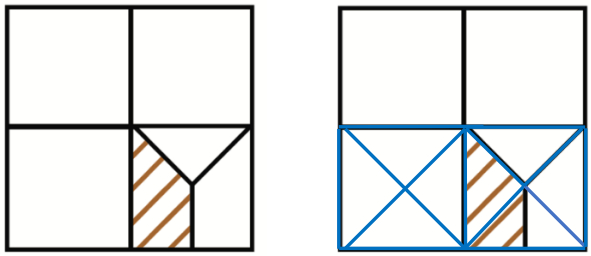
Solution:
The area of the bigger square is divided into four equal smaller squares.
The number of triangles in a smaller square {tex}=4{/tex}
Therefore, the total number of triangles in the bigger square {tex}=4 \times 4=16{/tex}
Area of each triangle {tex}=\frac{1}{16}{/tex}
Area of the shaded region = area of {tex}1 \frac{1}{2}{/tex} triangle {tex}=1 \frac{1}{2} \times \frac{1}{16}=\frac{3}{2} \times \frac{1}{16}=\frac{3}{32}{/tex}.
Therefore, {tex}\frac{3}{32}{/tex} fraction of the whole square is shaded.
Q.40: A colony of ants set out in search of food. As they search, they keep splitting equally at each point and reach two food sources, one near a mango tree and another near a sugarcane field. What fraction of the original group reached each food source?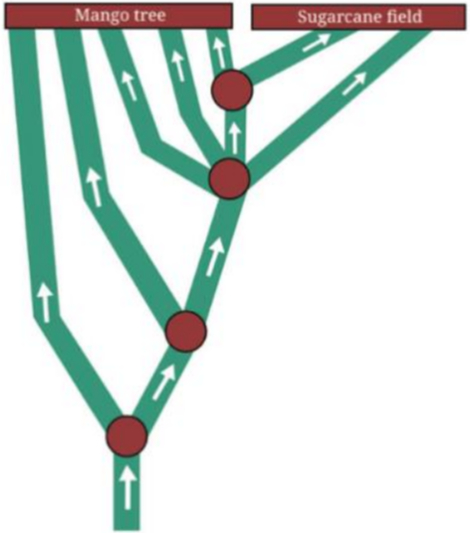
Solution:
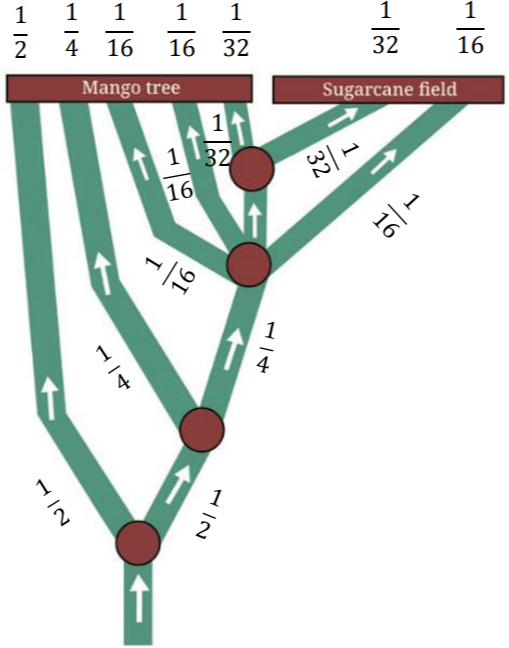
At first point ants split into two ways. So, fraction of ants at each way {tex}=1 \div 2=\frac{1}{2}{/tex}.
At second point ants split further into two ways. So, fraction of ants at each way {tex}=\frac{1}{2} \div 2=\frac{1}{2} \times{/tex} {tex}\frac{1}{2}=\frac{1}{4}{/tex}
At third point ants split further into four ways. So, fraction of ants at each way {tex}=\frac{1}{4} \div 4=\frac{1}{4} \times \frac{1}{4}{/tex} {tex}=\frac{1}{16}{/tex}.
At fourth point ants split further into two ways. So, fraction of ants at each way {tex}=\frac{1}{16} \div 2=\frac{1}{16}{/tex} {tex}\times \frac{1}{2}=\frac{1}{32}{/tex}.
Fraction of ants reaching mango tree {tex}=\frac{1}{2}+\frac{1}{4}+\frac{1}{16}+\frac{1}{16}+\frac{1}{32}{/tex}{tex}=\frac{16+8+2+2+1}{32}=\frac{29}{32}{/tex}.
Fraction of ants reaching sugarcane field {tex}=\frac{1}{16}+\frac{1}{32}=\frac{2+1}{32}=\frac{3}{32}{/tex}.
Q.41: What is {tex}\left(1-\frac{1}{2}\right){/tex}?
{tex} \left(1-\frac{1}{2}\right) \times\left(1-\frac{1}{3}\right) ? {/tex}
{tex} \left(1-\frac{1}{2}\right) \times\left(1-\frac{1}{3}\right) \times\left(1-\frac{1}{4}\right) \times\left(1-\frac{1}{5}\right) ? {/tex}
{tex} \left(1-\frac{1}{2}\right) \times\left(1-\frac{1}{3}\right) \times\left(1-\frac{1}{4}\right) \times{/tex}{tex}\left(1-\frac{1}{5}\right) \times\left(1-\frac{1}{6}\right) \times\left(1-\frac{1}{7}\right) {/tex}{tex}\times\left(1-\frac{1}{8}\right) \times\left(1-\frac{1}{9}\right) \times \left(1-\frac{1}{10}\right) ? {/tex}
Solution:
- {tex}\left(1-\frac{1}{2}\right)=\frac{2-1}{2}=\frac{1}{2}{/tex}.
- {tex}\left(1-\frac{1}{2}\right) \times\left(1-\frac{1}{3}\right)=\left(\frac{2-1}{2}\right) \times\left(\frac{3-1}{3}\right)=\frac{1}{2} \times \frac{2}{3}=\frac{1}{3}{/tex}.
- {tex} \left(1-\frac{1}{2}\right) \times\left(1-\frac{1}{3}\right) \times\left(1-\frac{1}{4}\right) \times(1 \left.-\frac{1}{5}\right){/tex}{tex}=\left(\frac{2-1}{2}\right) \times\left(\frac{3-1}{3}\right) \times\left(\frac{4-1}{4}\right) \times\left(\frac{5-1}{5}\right) {/tex}
{tex} =\frac{1}{2} \times \frac{2}{3} \times \frac{3}{4} \times \frac{4}{5}=\frac{1}{5} {/tex} - {tex}\left(1-\frac{1}{2}\right) \times\left(1-\frac{1}{3}\right) \times\left(1-\frac{1}{4}\right){/tex}{tex} \times\left(1-\frac{1}{5}\right) \times\left(1-\frac{1}{6}\right) \times\left(1-\frac{1}{7}\right) \times\left(1-\frac{1}{8}\right) \times\left(1-\frac{1}{9}\right) \times{/tex} {tex}\left(1-\frac{1}{10}\right){/tex}
{tex} =\left(\frac{2-1}{2}\right) \times\left(\frac{3-1}{3}\right) \times\left(\frac{4-1}{4}\right) {/tex}{tex}\times\left(\frac{5-1}{5}\right) \times\left(\frac{6-1}{6}\right) \times\left(\frac{7-1}{7}\right) \times\left(\frac{8-1}{8}\right) \times\left(\frac{9-1}{9}\right) \times\left(\frac{10-1}{10}\right) {/tex}
{tex} =\frac{1}{2} \times \frac{2}{3} \times \frac{3}{4} \times \frac{4}{5} \times \frac{5}{6} \times \frac{6}{7} \times \frac{7}{8} \times \frac{8}{9} \times \frac{9}{10}=\frac{1}{10} {/tex}
General statement:
{tex} \left(1-\frac{1}{2}\right) \times\left(1-\frac{1}{3}\right) \times\left(1-\frac{1}{4}\right) {/tex}{tex}\times\left(1-\frac{1}{5}\right) \ldots\left(1-\frac{1}{n}\right)=\frac{1}{n}. {/tex}
Q.42: A farmer had 5 grandchildren. She distributed {tex}\frac{2}{3}{/tex} acre of land to each of her grandchildren.
How much land in all did she give to her grandchildren.
Solution:
{tex} 5 \times \frac{2}{3}=\frac{2}{3}+\frac{2}{3}+\frac{2}{3}+\frac{2}{3}+\frac{2}{3}=\frac{10}{3} . {/tex}
Q.43: 1 hour of internet time costs ₹ 8. How much will {tex}1 \frac{1}{4}{/tex} hours of internet time cost?
Solution:
{tex}1 \frac{1}{4}{/tex} hours is {tex}\frac{5}{4}{/tex} hours (converting from a mixed fraction).
Cost of {tex}\frac{5}{4}{/tex} hour of internet time {tex}=\frac{5}{4} \times 8{/tex}
{tex} =5 \times \frac{8}{4} {/tex}
{tex} =5 \times 2 {/tex}
{tex} =10 . {/tex}
It costs ₹ 10 for {tex}1 \frac{1}{4}{/tex} hours of internet time.
Q.44: Leena made 5 cups of tea. She used {tex}\frac{1}{4}{/tex} litre of milk for this. How much milk is there in each cup of tea?
Solution:
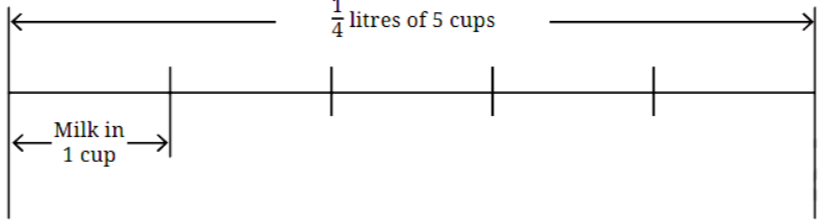
Leena used {tex}\frac{1}{4}{/tex} litres of milk in 5 cups of tea. So, in 1 cup of tea the volume of milk should be:
{tex} \frac{1}{4} \div 5 {/tex}
Writing this as multiplication, we have:
{tex} 5 \times(\text { milk per cup })=\frac{1}{4} {/tex}
We perform the division as follows as per Brahmagupta’s method:
The reciprocal of 5 (the divisor) is {tex}\frac{1}{5}{/tex}.
Multiplying this reciprocal by the dividend ({tex}\frac{1}{4}{/tex}), we get
{tex} \frac{1}{5} \times \frac{1}{4}=\frac{1}{20} {/tex}
So, each cup of tea has {tex}\frac{1}{20}{/tex} litre of milk.
Q.45: Some of the oldest examples of working with non-unit fractions occur in humanity’s oldest geometry texts, the Śhulbasūtra. Here is an example from Baudhāyana’s Śhulbasūtra (c. 800 BCE).
Cover an area of {tex}7 \frac{1}{2}{/tex} square units with square bricks each of whose sides is {tex}\frac{1}{5}{/tex} units.
How many such square bricks are needed?
Solution:
Each square brick has an area of {tex}\frac{1}{5} \times \frac{1}{5}=\frac{1}{25}{/tex} square units.
The total area to be covered is {tex}7 \frac{1}{2}{/tex} sq. units {tex}=\frac{15}{2}{/tex} sq. units.
As {tex}({/tex}Number of bricks{tex}) \times({/tex}Area of a brick{tex})={/tex} Total Area,
{tex} \text { Number of bricks }=\frac{15}{2} \div \frac{1}{25} {/tex}
The reciprocal of the divisor is 25 .
Multiplying the reciprocal by the dividend, we get
{tex} 25 \times \frac{15}{2}=\frac{25 \times 15}{2}=\frac{375}{2} . {/tex}
Q.46: This problem was posed by Chaturveda Prithūdakasvāmī (c. 860 CE) in his commentary on Brahmagupta’s book Brāhmasphuṭasiddhānta.
Four fountains fill a cistern. The first fountain can fill the cistern in a day. The second can fill it in half a day. The third can fill it in a quarter of a day. The fourth can fill the cistern in one fifth of a day. If they all flow together, in how much time will they fill the cistern?
Solution:
Let us solve this problem step by step.
In a day, the number of times –
- the first fountain will fill the cistern is {tex}1 \div 1=1{/tex}
- the second fountain will fill the cistern is {tex}1 \div \frac{1}{2}={/tex} ________
- the third fountain will fill the cistern is {tex}1 \div \frac{1}{4}={/tex} ________
- the fourth fountain will fill the cistern is {tex}1 \div \frac{1}{5}={/tex} ________
The number of times the four fountains together will fill the cistern in a day is ________ {tex}+{/tex} ________ {tex}+{/tex} ________ {tex}+{/tex} ________ {tex}=12{/tex}.
Thus, the total time needed by the four fountains to fill the cistern together is {tex}\frac{1}{12}{/tex} days.
NCERT Solutions Class 7 Maths (Ganita Prakash)
- Large Numbers Around Us
- Arithmetic Expressions
- A Peek Beyond the Point
- Expressions Using Letter-Numbers
- Parallel And Intersection Lines
- Number Play
- A Tale of Three Intersecting Lines
- Working With Fractions
- Geometric Twins
- Operations with Integers
- Finding Common Ground
- Another Peek Beyond the Point
- Connecting the Dots
- Constructions and Tilings
- Finding the Unknown

Test Generator
Create question paper PDF and online tests with your own name & logo in minutes.
Create Now
Learn8 App
Practice unlimited questions for Entrance tests & government job exams at ₹99 only
Install Now