Parallel and Intersection Lines – NCERT Solutions Class 7 Maths (Ganita Prakash) includes all the questions with solutions given in the NCERT Class 7 Maths (Ganita Prakash).
NCERT Solutions Class 7
English Poorvi Hindi Malhar Maths Ganita Prakash Science Curiosity Social Exploring SocietyParallel and Intersection Lines – NCERT Solutions
Q.1: How many angles do they form?
Solution:
In Figure, where line l intersects line m, we can see that four angles are formed.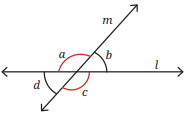
Q.2: Can two straight lines intersect at more than one point?
Solution:
No, two straight lines cannot intersect at more than one point. If two lines intersect at more than one point, then they are coincident lines.
Q.3: What patterns do you observe among these angles?
Solution:
It is observed that the sum of adjacent angles formed by the intersection of two lines is 180o, and the vertically opposite angles are equal in measure.
Q.4: In figure, if {tex}\angle {a}{/tex} is {tex}120^{\circ}{/tex}, can you figure out the measurements of {tex}\angle b, \angle c{/tex} and {tex}\angle d{/tex}, without drawing and measuring them?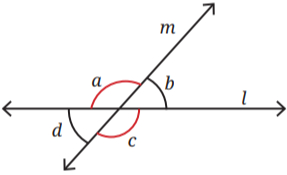
Solution:
We know that {tex}\angle a{/tex} and {tex}\angle b{/tex} together measure {tex}180^{\circ}{/tex}, because when they are combined, they form a straight angle which measures {tex}180^{\circ}{/tex}. So, if {tex}\angle a{/tex} is {tex}120^{\circ}{/tex}, then {tex}\angle b{/tex} must be {tex}60^{\circ}{/tex}.
Similarly, {tex}\angle b{/tex} and {tex}\angle c{/tex} together measure {tex}180^{\circ}{/tex}. So, if {tex}\angle b{/tex} is {tex}60^{\circ}{/tex}, then {tex}\angle c{/tex} must be {tex}120^{\circ}{/tex}. And {tex}\angle c{/tex} and {tex}\angle d{/tex} together measure {tex}180^{\circ}{/tex}. So, if {tex}\angle c{/tex} is {tex}120^{\circ}{/tex}, then {tex}\angle d{/tex} must be {tex}60^{\circ}{/tex}.
Therefore, in Fig. 5.2, {tex}\angle a{/tex} and {tex}\angle c{/tex} measure {tex}120^{\circ}{/tex}, and {tex}\angle b{/tex} and {tex}\angle d{/tex} measure {tex}60^{\circ}{/tex}.
When two lines intersect each other and form four angles, labelled {tex}{a}, {b}, {c}{/tex} and d , as in Fig. 5.2, then {tex}\angle a{/tex} and {tex}\angle c{/tex} are equal, and {tex}\angle b{/tex} and {tex}\angle d{/tex} are equal!
Q.5: Is this always true for any pair of intersecting lines?
Solution:
Yes, any pair of intersecting lines forms vertically opposite angles, which are equal in measure.
Q.6: Can you draw a pair of intersecting lines such that all four angles are equal? Can you figure out what will be the measure of each angle?
Solution:
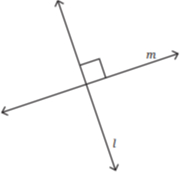
If two lines intersect and all four angles are equal, then each angle must be a right angle (90o). Perpendicular lines are a pair of lines which intersect each other at right angles (90o). In Figure, we can say that lines l and m are perpendicular to each other.
Q.7: Which pairs of lines appear to be parallel in figure below?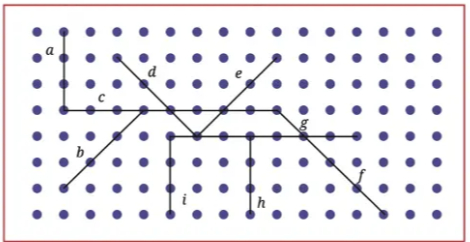
Solution:
Lines a, I, and h are parallel to each other.
Line b is parallel to line e.
Line c is parallel to line g.
Line d is parallel to line f.
Q.8: List all the linear pairs and vertically opposite angles you observe in figure.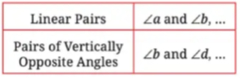
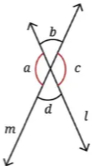
Solution:
Linear pair angles: {tex}\angle {a}{/tex} and {tex}\angle {b} ; \angle {b}{/tex} and {tex}\angle {c} ; \angle {c}{/tex} and {tex}\angle {d} ; \angle {a}{/tex} and {tex}\angle {d}{/tex}.
Vertically opposite angles: {tex}\angle {a}{/tex} and {tex}\angle {c} ; \angle {b}{/tex} and {tex}\angle {d}{/tex}.
Q.9: Draw some lines perpendicular to the lines given on the dot paper in the figure.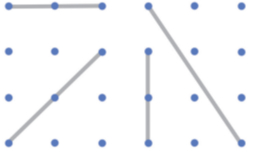
Solution:
Do it yourself.
Q.10: In Figure, mark the parallel lines using the notation given above (single arrow, double arrow etc.). Mark the angle between perpendicular lines with a square symbol.
- How did you spot the perpendicular lines?
- How did you spot the parallel lines?
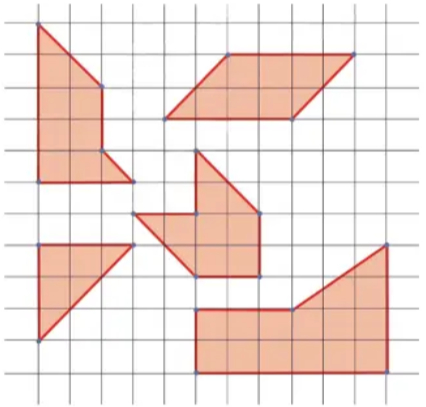
Solution:
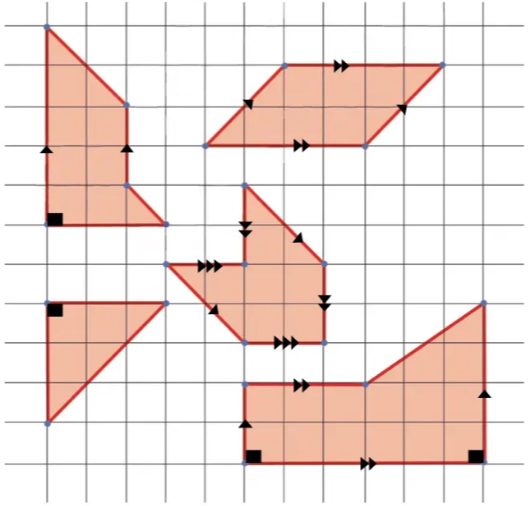
- Lines that intersect at a 90o angle are perpendicular.
- Lines that do not meet, no matter how far they are extended, are parallel.
Q.11: In the dot paper following, draw different sets of parallel lines. The line segments can be of different lengths but should have dots as endpoints.
Solution:
Do it yourself.
Q.12:
Using your sense of how parallel lines look, try to draw lines parallel to the line segments on this dot paper.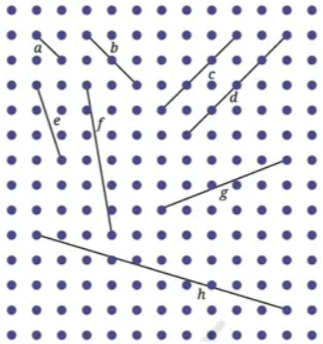
- Did you find it challenging to draw some of them?
- Which ones?
- How did you do it?
Solution:
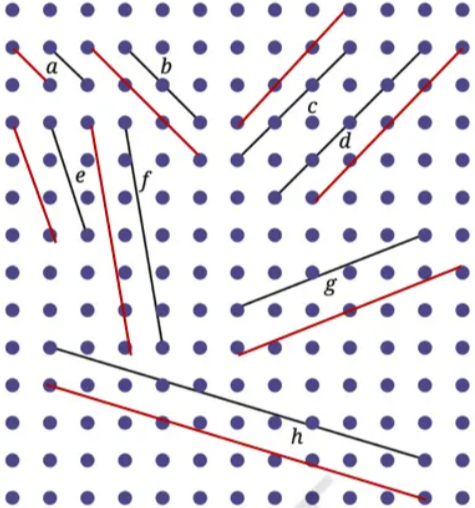
- Yes, some line segments are a little more difficult to draw than others.
- Line segments e, f, h, and g.
- Parallel lines are drawn by keeping them equidistant from the given lines.
Q.13: In Figure, which line is parallel to line a-line b or line c? How do you decide this?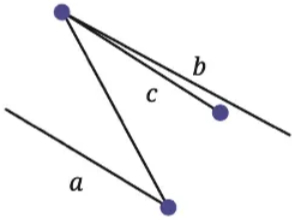
Solution:
Line a is parallel to line c because both lines remain equidistant from each other and do not intersect, no matter how far they are extended.
Q.14: Can you draw a line parallel to l, that goes through point A? How will you do it with the tools from your geometry box? Describe your method.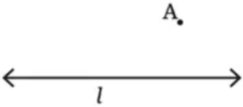
Solution:
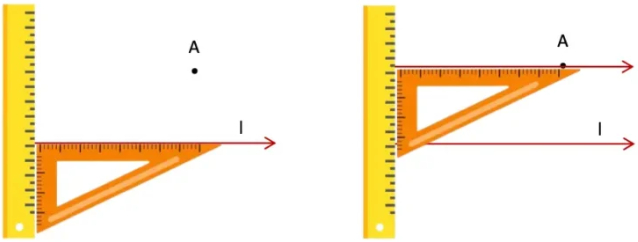
Steps of construction:
- Align one edge of the set square with line l.
- Place a ruler along the other perpendicular edge.
- Slide the set square along the ruler until it reaches point A.
- Draw a line through A along the set square’s edge.
- This is the required line parallel to l.
Q.15: In Figure, parallel lines l and m are intersected by the transversal t. If {tex}\angle 6{/tex} is {tex}135^{\circ}{/tex}, what are the measures of the other angles?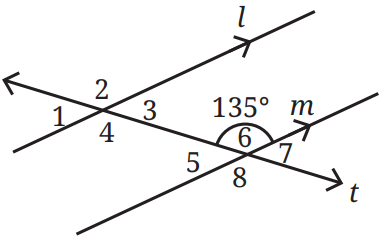
Solution:
{tex}\angle 6{/tex} is {tex}135^{\circ}{/tex}, so {tex}\angle 2{/tex} is also {tex}135^{\circ}{/tex}, because it is the corresponding angle of {tex}\angle 6{/tex} and the lines {tex}l{/tex} and m are parallel.
{tex}\angle 8{/tex} is {tex}135^{\circ}{/tex}, because it is the vertically opposite angle of {tex}\angle 6 . {/tex} {tex}\angle 4{/tex} is {tex}135^{\circ}{/tex} because it is the corresponding angle of {tex}\angle 8{/tex}.
{tex}\angle 2{/tex} is {tex}135^{\circ}{/tex} because is the vertically opposite angle of {tex}\angle 4{/tex}. So, {tex}\angle 2, \angle 4{/tex}, {tex}\angle 6{/tex}, and {tex}\angle 8{/tex} are all {tex}135^{\circ}{/tex}.
{tex}\angle 5{/tex} and {tex}\angle 6{/tex} are a linear pair, together they measure {tex}180^{\circ}{/tex}. If {tex}\angle 6{/tex} is {tex}135^{\circ}{/tex}, then
{tex} \angle 5=180-135=45^{\circ} {/tex}
We can similarly find out that {tex}\angle 1, \angle 3{/tex}, and {tex}\angle 7{/tex} measure {tex}45^{\circ}{/tex}.
Q.16: In Figure, lines {tex}l{/tex} and {tex}m{/tex} are intersected by the transversal {tex}t{/tex}. If {tex}\angle a{/tex} is {tex}120^{\circ}{/tex} and {tex}\angle f{/tex} is {tex}70^{\circ}{/tex}, are lines {tex}l{/tex} and m parallel to each other?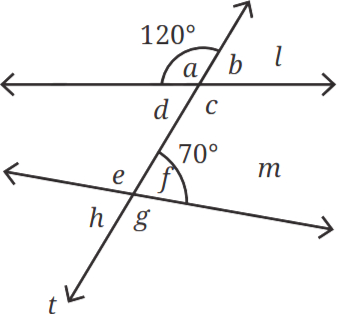
Solution:
{tex}\angle a{/tex} is {tex}120^{\circ}{/tex}, so {tex}\angle b{/tex} is {tex}60^{\circ}{/tex} because {tex}\angle a{/tex} and {tex}\angle b{/tex} form a linear pair. {tex}\angle b{/tex} is a corresponding angle of {tex}\angle f{/tex}. If {tex}l{/tex} and {tex}m{/tex} are parallel, {tex}\angle b{/tex} should be equal to {tex}\angle f{/tex}, however, they are not equal.
Therefore, lines land {tex}m{/tex} are not parallel to each other as the corresponding angles formed by the transversal {tex}t{/tex} are not equal to each other.
Q.17: In Figure, parallel lines {tex}l{/tex} and {tex}m{/tex} are intersected by the transversal {tex}t{/tex}. If {tex}\angle 3{/tex} is {tex}50^{\circ}{/tex}, what is the measure of {tex}\angle 6{/tex}?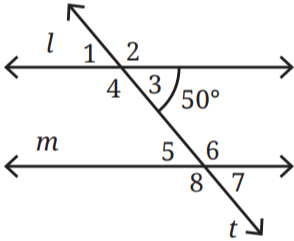
Solution:
{tex}\angle 3{/tex} is {tex}50^{\circ}{/tex}; therefore, {tex}\angle 2{/tex} is {tex}130^{\circ}{/tex}, because {tex}\angle 2{/tex} and {tex}\angle 3{/tex} form a linear pair, and linear pairs always add up to {tex}180^{\circ}{/tex}.
{tex}\angle 2{/tex} and {tex}\angle 6{/tex} are corresponding angles, and they need to be equal since lines {tex}l{/tex} and {tex}m{/tex} are parallel.
So, {tex}\angle 6{/tex} is {tex}130^{\circ}{/tex}.
Angles {tex}\angle 3{/tex} and {tex}\angle 6{/tex} are called interior angles.
Q.18: In Figure, line segment {tex}A B{/tex} is parallel to {tex}C D{/tex} and {tex}A D{/tex} is parallel to {tex}{BC} . \angle {DAC}{/tex} is {tex}65^{\circ}{/tex} and {tex}\angle {ADC}{/tex} is {tex}60^{\circ}{/tex}. What are the measure of angles {tex}\angle {CAB}, \angle {ABC}{/tex}, and {tex}\angle {BCD}{/tex}?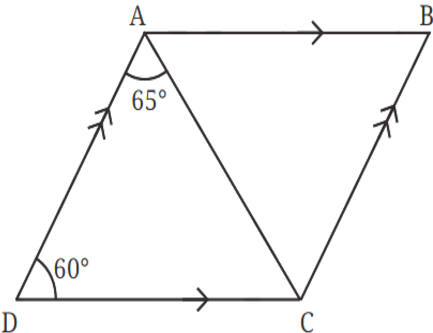
Solution:
Let us observe the parallel lines AB and {tex}{CD} {/tex}. AD is a transversal of these two lines.
We know that the sum of the interior angles formed by a transversal on a pair of parallel lines adds up to {tex}180^{\circ}{/tex}. So
{tex} \angle {ADC}+\angle {DAB}=180^{\circ} {/tex}
{tex} 60^{\circ}+\angle {DAB}=180^{\circ} . {/tex}
So {tex}\angle {DAB}=120^{\circ}{/tex}.
Can we find {tex}\angle {CAB}{/tex} from this?
{tex} \angle {DAB}=\angle {DAC}+\angle {CAB} {/tex}
So {tex}120^{\circ}=65^{\circ}+\angle {CAB}{/tex}.
So {tex}\angle {CAB}=55^{\circ}{/tex}.
Let us observe the parallel line segments {tex}A D{/tex} and {tex}B C{/tex}. They are intersected by a transversal CD. So, {tex}\angle {ADC}+\angle {BCD}=180^{\circ}{/tex}, because they are interior angles on the same side of the transversal. Since {tex}\angle {ADC}{/tex} is given as {tex}60^{\circ}, \angle {BCD}=120^{\circ}{/tex}
Similarly, we find {tex}\angle A B C=60^{\circ}{/tex}.
Therefore, in Fig. 5.29, {tex}\angle {CAB}=55^{\circ}, \angle {ABC}=60^{\circ}{/tex}, and {tex}\angle {BCD}=120^{\circ}{/tex}.
Q.19:
Find the angle marked below.
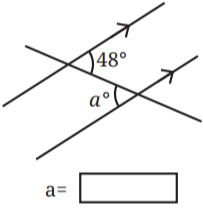
Solution:
Since alternate interior angles formed by a transversal intersecting a pair of parallel lines are equal, angle a is 48o.
Q.20: Find the angle marked below.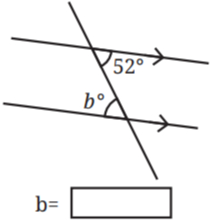
Solution:
Since alternate interior angles formed by a transversal intersecting a pair of parallel lines are equal, angle b is 52o.
Q.21: Find the angles marked below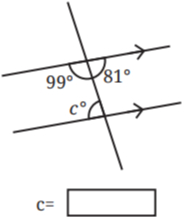
Solution:
Since alternate interior angles formed by a transversal intersecting a pair of parallel lines are equal, angle c is 81o.
Q.22: Find the angle marked below.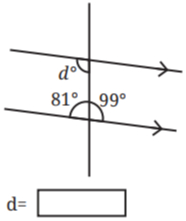
Solution:
Since alternate interior angles formed by a transversal intersecting a pair of parallel lines are equal, angle d is 99o.
Q.23: Find the angle marked below.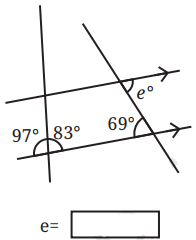
Solution:
Since alternate interior angles formed by a transversal intersecting a pair of parallel lines are equal, angle e is 69o.
Q.24: Find the angle marked below.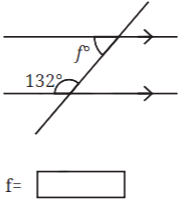
Solution:
Since the sum of interior angles on the same side of a transversal is always equal to {tex}180^{\circ}{/tex}. Therefore,
{tex}f{/tex} {tex} +132^{\circ}=180^{\circ} {/tex}
{tex} f=180^{\circ}-132^{\circ} {/tex}
{tex} f=48^{\circ} {/tex}
Q.25: Find the angle marked below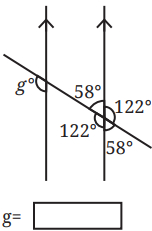
Solution:
Since corresponding angles formed by a transversal intersecting a pair of parallel sides are equal, angle g is 122o.
Q.26: Find the angle marked below.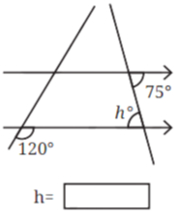
Solution:
Since alternate interior angles formed by a transversal intersecting a pair of parallel lines are equal, angle h is 75o.
Q.27: Find the angle marked below.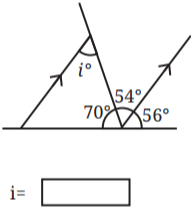
Solution:
Since alternate interior angles formed by a transversal intersecting a pair of parallel lines are equal, angle i is 54o.
Q.28: Find the angle marked below.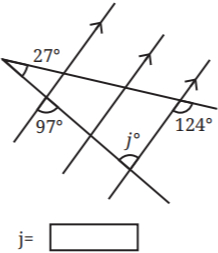
Solution:
Since alternate interior angles formed by a transversal intersecting a pair of parallel lines are equal, angle j is 97o.
Q.29: Find the angle represented by a.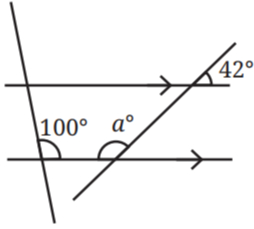
Solution:
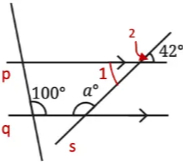
{tex}\angle 1=\angle 2=42^{\circ}{/tex} …(Vertically opposite angles)
Line p is parallel to q, and s is a transversal, then
{tex}{a}+\angle 1=180^{\circ}{/tex} …(Sum of interior angles on the same side of the transversal)
{tex}{a}+42^{\circ}=180^{\circ}{/tex}
{tex}{a}=180^{\circ}-42^{\circ}{/tex}
{tex}a=138^{\circ}{/tex}
Q.30: Find the angle represented by a.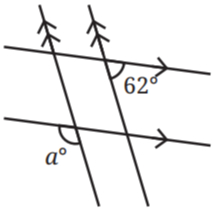
Solution:
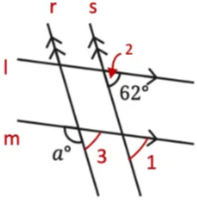
Line I is parallel to line {tex}m{/tex}, and {tex}s{/tex} is a transversal, then
{tex}\angle 1=\angle 2=62^{\circ}{/tex} …(Corresponding angles)
Line {tex}r{/tex} is parallel to line {tex}s{/tex}, and {tex}m{/tex} is a transversal, then
{tex}\angle 1=\angle 3=62^{\circ}{/tex} …(Corresponding angles)
{tex}a+\angle 3=180^{\circ}{/tex} …(Linear pair angles)
{tex}{a}+62^{\circ}=180^{\circ}{/tex}
{tex}a=180^{\circ}-62^{\circ}{/tex}
{tex}a=118^{\circ}{/tex}
Q.31: Find the angle represented by a.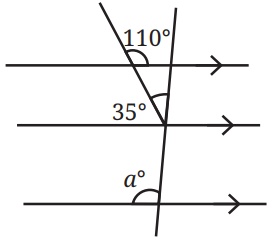
Solution:
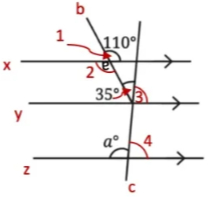
{tex}\angle 1=\angle 2=110^{\circ} \ldots{/tex}. (Vertically opposite angles)
Line x is parallel to line y and b is a transversal, then
{tex}\angle 2=35^{\circ}+\angle 3{/tex} … (Alternate interior angles)
or {tex}110^{\circ}=35^{\circ}+\angle 3{/tex}
{tex} 110^{\circ}-35^{\circ}=\angle 3 {/tex}
or {tex}\angle 3=75^{\circ}{/tex}.
Line y is parallel to line z and c is transversal, then
{tex}\angle 3=\angle 4=75^{\circ}{/tex} …(Corresponding angles)
{tex}{a}+\angle 4=180^{\circ}{/tex} …(Linear pair angles)
a {tex}+75^{\circ}=180^{\circ}{/tex}
{tex}{a}=180^{\circ}-75^{\circ}{/tex}
{tex}{a}=105^{\circ}{/tex}.
Q.32: Find the angle represented by a.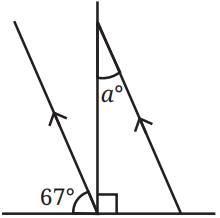
Solution:
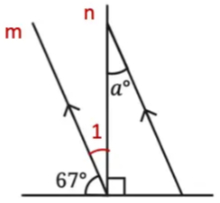
{tex} \angle 1+67^{\circ}+\angle 2=180^{\circ} \ldots {/tex}(Sum of angles on a straight line)
{tex} \angle 1+67^{\circ}+90^{\circ}=180^{\circ} {/tex}
{tex} \angle 1+157^{\circ}=180^{\circ} {/tex}
{tex} \angle 1=180^{\circ}-157^{\circ} {/tex}
{tex} \angle 1=23^{\circ} . {/tex}
{tex} \angle 1=\angle {a}=23^{\circ} \ldots {/tex}(Alternate interior angles)
Q.33: In the figure below, what angles do x and y stand for?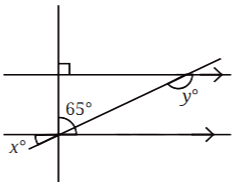
Solution:
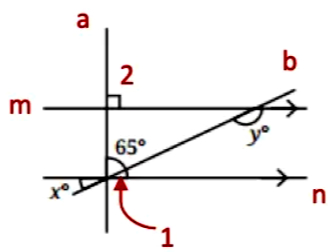
Line m is parallel to line n and a is a transversal, then
{tex} \angle 2=65^{\circ}+\angle 1 {/tex} …(Corresponding angles)
{tex} 90^{\circ}=65^{\circ}+\angle 1 {/tex}
{tex} \angle 1=90^{\circ}-65^{\circ} {/tex}
{tex} \angle 1=25^{\circ} {/tex}
{tex}\angle 1={x}=25^{\circ}{/tex} …(Vertically opposite angles)
Line {tex}m{/tex} is parallel to line {tex}n{/tex} and {tex}b{/tex} is a transversal, then
{tex}\angle 1+\angle y=180^{\circ}{/tex} …(Sum of interior angles on the same side of the transversal)
{tex} 25^{\circ}+\angle y=180^{\circ} {/tex}
{tex} \angle y=180^{\circ}-25^{\circ} {/tex}
{tex} \angle y=155^{\circ} {/tex}
Q.34: In the figure below, what angles do x and y stand for?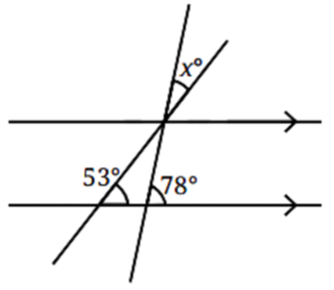
Solution:
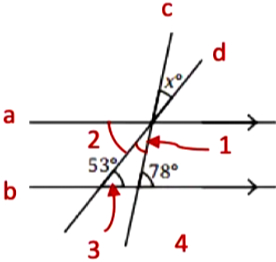
Line {tex}a{/tex} is parallel to line {tex}b{/tex} and {tex}d{/tex} is a transversal, then
{tex}\angle 2=\angle 3=53^{\circ}{/tex} …(Alternate interior angles)
Also, line a is parallel to line b and c is a transversal, then
{tex}\angle 1+\angle 2=\angle 4{/tex} …(Alternate interior angles)
or {tex}\angle 1+53^{\circ}=78^{\circ}{/tex}
{tex} \angle 1=78^{\circ}-53^{\circ} {/tex}
{tex} \angle 1=25^{\circ} {/tex}
Therefore, {tex}\angle 1={x}=25^{\circ}{/tex} …(Vertically opposite angles).
Q.35: In Figure, {tex}\angle {ABC}=45^{\circ}{/tex} and {tex}\angle {IKJ}=78^{\circ}{/tex}. Find angles {tex}\angle {GEH}, \angle {HEF}{/tex}, {tex}\angle {FED}{/tex}.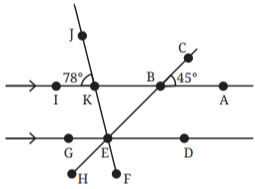
Solution:
{tex} \angle {ABC}=\angle {KBE}=45^{\circ} \ldots \text { } {/tex}(Vertically opposite angles)
{tex} \angle {IKJ}=\angle {BKE}=78^{\circ} \text {… } {/tex}(Vertically opposite angles)
{tex} \angle {BKE}=\angle {FED}=78^{\circ} \ldots \text { } {/tex}(Corresponding angles)
{tex} \angle {KBE}=\angle {BED}=45^{\circ} \text {… } {/tex}(Alternate interior angles)
{tex} \angle {BED}=\angle {GEH}=45^{\circ} \text {… } {/tex}(Vertically opposite angles)
{tex} \angle {GEH}+\angle {HEF}+\angle {FED}=180^{\circ} \text {… } {/tex}(Sum of angles on a straight line)
{tex} 45^{\circ}+\angle {HEF}+78^{\circ}=180^{\circ} {/tex}
{tex} 123^{\circ}+\angle {HEF}=180^{\circ} {/tex}
{tex} \angle {HEF}=180^{\circ}-123^{\circ} {/tex}
{tex} \angle {HEF}=57^{\circ} {/tex}
Q.36: In Figure, {tex}A B{/tex} is parallel to CD and CD is parallel to EF. Also, EA is perpendicular to AB. If {tex}\angle {BEF}=55^{\circ}{/tex}, find the values of {tex}x{/tex} and {tex}y{/tex}.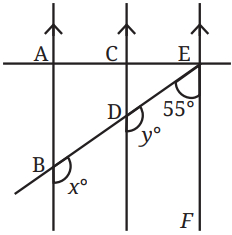
Solution:
Since EF is parallel to CD and BE is a transversal, then
{tex}\angle {BEF}+{y}=180^{\circ}{/tex} …(Sum of interior angles on the same side of the transversal)
{tex} 55^{\circ}+y=180^{\circ} {/tex}
{tex} y=180^{\circ}-55^{\circ} {/tex}
{tex} y=125^{\circ} {/tex}
Since {tex}A B{/tex} is parallel to {tex}C D{/tex} and {tex}B E{/tex} is a transversal, then
{tex}x=y=125^{\circ}{/tex} …(Corresponding angles).
Q.37: What is the measure of angle {tex}\angle {NOP}{/tex} in Figure?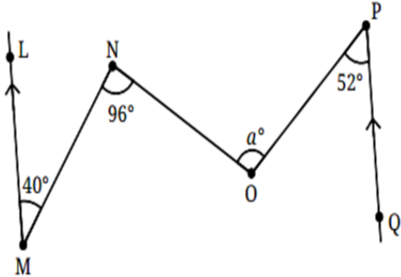
Solution:
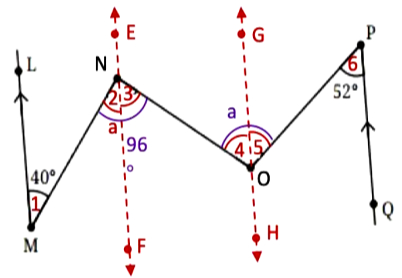
Construction: Draw lines EF and GH parallel to lines LM and PQ. LM is parallel to EF and MN is a transversal, then
{tex} \angle 1=\angle 2=40^{\circ} \ldots \text { } {/tex}(Alternate interior angles)
{tex} \angle 2+\angle 3=96^{\circ} {/tex}
{tex} 40^{\circ}+\angle 3=96^{\circ} {/tex}
{tex} \angle 3=96^{\circ}-40^{\circ} {/tex}
{tex} \angle 3=56^{\circ} {/tex}
EF is parallel to GH and NO is a transversal, then
{tex}\angle 3=\angle 4=56^{\circ} \ldots {/tex}(Alternate interior angles)
Also, GH is parallel to PQ and OP is a transversal, then
{tex} \angle 5=\angle 6=52^{\circ}{/tex}
{tex} a=\angle 4+\angle 5 {/tex}
{tex} a=56^{\circ}+52^{\circ} {/tex}
{tex} a=108^{\circ} {/tex}
NCERT Solutions Class 7 Maths (Ganita Prakash)
- Large Numbers Around Us
- Arithmetic Expressions
- A Peek Beyond the Point
- Expressions Using Letter-Numbers
- Parallel And Intersection Lines
- Number Play
- A Tale of Three Intersecting Lines
- Working With Fractions
- Geometric Twins
- Operations with Integers
- Finding Common Ground
- Another Peek Beyond the Point
- Connecting the Dots
- Constructions and Tilings
- Finding the Unknown

Test Generator
Create question paper PDF and online tests with your own name & logo in minutes.
Create Now
Learn8 App
Practice unlimited questions for Entrance tests & government job exams at ₹99 only
Install Now