Proportional Reasoning-2 – NCERT Solutions Class 8 Maths (Ganita Prakash) includes all the questions with solutions given in the NCERT Class 8 Maths (Ganita Prakash).
NCERT Solutions Class 8
English Poorvi Hindi Malhar Maths Ganita Prakash Science Curiosity Social Exploring SocietyProportional Reasoning-2 – NCERT Solutions
Q.1: Convert 60,00,000 cm to kilometres.
Solution:
60,00,000 cm = 60 km
We know that:
- 1 km = 1000 m
- 1 m = 100 cm
- Therefore, 1 km = 1000 × 100 = 1,00,000 cm
Now, to convert {tex}60,00,000 {~cm}{/tex} to {tex}{km}: 60,00,000 {~cm} \div 1,00,000=60 {~km}{/tex}
Verification: {tex}60,00,000 {~cm}=60,00,000 \div 100{/tex}{tex}=60,000 {~m} {/tex}
{tex}60,000 {~m}=60,000 \div 1000={/tex}60 km
Q.2: Using the map given, can you find the geographical distance between Bengaluru and Chennai? Also, find the geographical distance between Mangaluru and Chennai.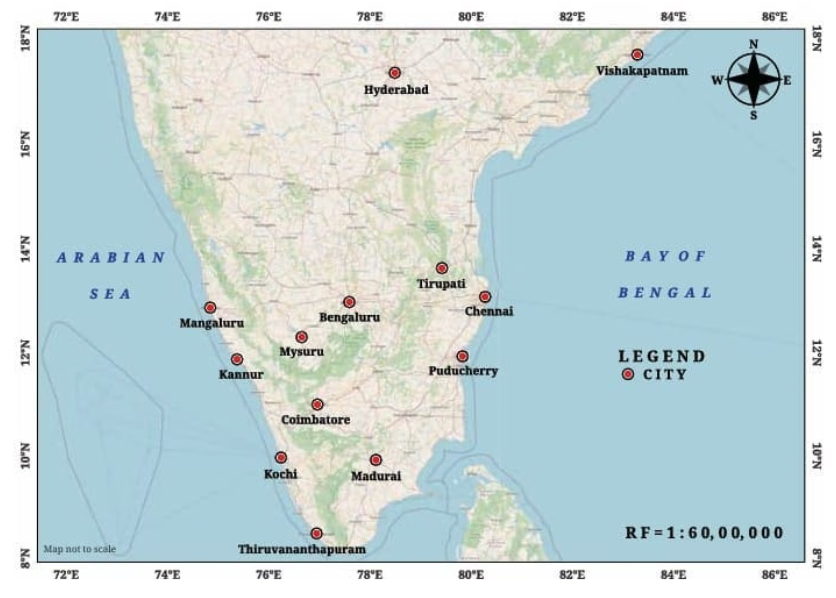
Solution:
To find the geographical distances, follow these steps:
Step 1: Measure the distance on the map using a ruler.
- Let’s say the distance between Bengaluru and Chennai on the map {tex}=7 {~cm}{/tex} (example)
- Distance between Mangaluru and Chennai on the map {tex}=5.5 {~cm}{/tex} (example)
Step 2: Use the map scale RF 1:60,00,000 This means 1 cm on map {tex}=60,00,000 {~cm}{/tex} in reality {tex}=60 {~km}{/tex}
Step 3: Calculate actual distances:
- Bengaluru to Chennai: If map distance {tex}=7 {~cm}{/tex}
Actual distance {tex}=7 \times 60 {~km}=420 {~km}{/tex} (approximately) - Mangaluru to Chennai: If map distance {tex}=5.5 {~cm}{/tex}
Actual distance {tex}=5.5 \times 60 {~km}=330{/tex} km (approximately)
Q.3: Try to find the distances between the same two pairs of cities with different maps that have different scales (ratios). Do they all give the same geographical distance, approximately?
Solution:
Yes, they should all give approximately the same geographical distance.
Explanation: Different maps may have different scales (like 1:50,00,000 or 1:1,00,00,000), but the actual geographical distance between two cities remains constant.
For example:
- Map 1 with scale 1:60,00,000 might show {tex}7 {~cm}=420 {~km}{/tex}
- Map 2 with scale {tex}1: 1,00,00,000{/tex} might show {tex}4.2 {~cm}=420 {~km}{/tex}
- Map 3 with scale {tex}1: 30,00,000{/tex} might show {tex}14 {~cm}=420 {~km}{/tex}
The map distances will be different, but after using the respective scales, the actual geographical distance will be approximately the same (minor variations may occur due to measurement errors or map accuracy).
Q.4: Puneet has only 2 red chillies in his kitchen. But he wants to make spice mix powder that tastes the same as Viswanath’s spice mix powder. How much of the other ingredients should Puneet use to make his spice mix powder?
Solution:
Puneet should use:
- 4 spoons of coriander seeds
- 2 red chillies
- 1 spoon of toor dal
- 0.5 spoon (or half spoon) of fenugreek seeds
Explanation:
Viswanath’s ratio {tex}={/tex} Coriander : Red chillies : Toor dal : Fenugreek {tex}=8: 4: 2: 1{/tex}
Puneet has only 2 red chillies, which is half of what Viswanath used (2 is half of 4).
So, Puneet should reduce all ingredients to half:
- Coriander seeds {tex}=8 \div 2=4{/tex} spoons
- Red chillies {tex}=4 \div 2=2{/tex}
- Toor dal {tex}=2 \div 2=1{/tex} spoon
- Fenugreek {tex}={1} \div 2=0.5{/tex} spoon
Puneet’s ratio {tex}=4: 2: 1: 0.5{/tex}
Both ratios are proportional: {tex}8: 4: 2: 1:: 4: 2: 1: 0.5{/tex}
This can be verified as: {tex}8 / 4=4 / 2=2 / 1=1 / 0.5=2{/tex}
Q.5: To make a special shade of purple, paint must be mixed in the ratio, Red : Blue : White :: 2 : 3 : 5. If Yasmin has 10 litres of white paint, how many litres of red and blue paint should she add to get the same shade of purple?
Solution:
In the ratio {tex}2: 3: 5{/tex}, the white paint corresponds to 5 parts. If 5 parts is 10 litres, 1 part is {tex}10 \div 5=2{/tex} litres.
Red {tex}=2{/tex} parts {tex}=2 \times 2=4{/tex} litres.
Blue {tex}=3{/tex} parts {tex}=3 \times 2=6{/tex} litres.
So, the purple paint will have 4 litres of red, 6 litres of blue, and 10 litres of white paint.
Q.6: What is the total volume of this purple paint?
Solution:
The total volume of purple paint is 20 litres.
Explanation:
- Red paint {tex}=4{/tex} litres
- Blue paint = 6 litres
- White paint = 10 litres
Total volume {tex}=4+6+10=20{/tex} litres
Q.7: A cricket coach schedules practice sessions that include different activitles in a specific ratio- time for warm-up/cool-down : time for batting : time for bowiling : time for fielding : {tex}3: 4: 3: 5{/tex}.
If each session is {tex}{1 5 0}{/tex} minutes long, how much time is spent on each activity?
Solution:
- Warm-up/cool-down = 30 minutes
- Batting {tex}=40{/tex} minutes
- Bowling {tex}=30{/tex} minutes
- Fielding {tex}=50{/tex} minutes
Explanation:
The ratio is {tex}3: 4: 3: 5{/tex}
Total session time {tex}=150{/tex} minutes
Step 1: Find the sum of ratio terms
Sum {tex}=3+4+3+5=15{/tex}
Step 2: Find the value of 1 part
1 part {tex}=150 \div 15=10{/tex} minutes
Step 3: Calculate time for each activity
- Warm-up/cool-down {tex}=3 \times 10=30{/tex} minutes
- Batting {tex}=4 \times 10=40{/tex} minutes
- Bowling {tex}=3 \times 10=30{/tex} minutes
- Fielding {tex}=5 \times 10=50{/tex} minutes
Verlfication: {tex}30+40+30+50={1 5 0}{/tex} minutes
Q.8: A school library has books in different languages in the following ratio no. of Odiya books: no. of Hindi books : no. of English books {tex}: 3: 2: 1{/tex}. If the library has 288 Odiya books, how many Hindi and English books does it have?
Solution:
- Hindi books {tex}=192{/tex}
- English books {tex}=96{/tex}
Explanation:
Given ratio {tex}={/tex} Odiya {tex}:{/tex} Hindi {tex}:{/tex} English {tex}=3: 2: 1{/tex}
Step 1: Find the value of 1 part Odiya books {tex}=3{/tex} parts {tex}=288{/tex} books
Therefore, 1 part {tex}=288 \div 3=96{/tex} books
Step 2: Calculate other books
- Hindi books {tex}=2{/tex} parts {tex}=2 \times 96=192{/tex} books
- English books {tex}={1}{/tex} part {tex}={1} \times 96=96{/tex} books
Verification: Check if ratio is maintained: {tex}288: 192: 96{/tex}
Divide by {tex}96: 3: 2: 1{/tex}
Q.9: I have 100 coins in the ratio- no. of ₹10 coins : no. of ₹5 coins : no. of ₹2 coins : no. of ₹1 coins {tex}:: 4: 3: 2: 1{/tex}. How much money do I have in coins?
Solution:
Total money = ₹590
Explanation:
Given ratio {tex}=4: 3: 2: 1{/tex} Total coins {tex}=100{/tex}
Step 1: Find the value of 1 part
Sum of ratio terms {tex}=4+3+2+1=10{/tex}
1 part {tex}={1 0 0} \div {1 0}={1 0}{/tex} coins
Step 2: Calculate number of each type of coin
- {tex}₹ 10{/tex} coins {tex}=4 \times 10=40{/tex} coins
- {tex}₹ 5{/tex} coins {tex}=3 \times 10=30{/tex} coins
- {tex}₹ 2{/tex} coins {tex}=2 \times 10=20{/tex} coins
- {tex}₹ 1{/tex} coins {tex}=1 \times 10=10{/tex} coins
Step 3: Calculate total value
- Value of ₹ 10 coins {tex}=40 \times 10=₹ 400{/tex}
- Value of ₹5 coins {tex}=30 \times 5=₹ 150{/tex}
- Value of ₹ 2 coins {tex}=20 \times 2={/tex} ₹ 40
- Value of ₹ 1 coins {tex}=10 \times 1=₹ 10{/tex}
Total money {tex}=400+150+40+10=₹ 590{/tex}
Q.10: Construct a triangle with side lengths in the ratio {tex}3: 4: 5{/tex}. Will all the triangles drawn with this ratio of sidelengths be congruent to each other? Why or why not?
Solution:
No, all triangles with sidelengths in the ratio {tex}3: 4: 5{/tex} will NOT be congruent to each other.
Explanation:
Construction: We can construct triangles with sides in ratio {tex}3: 4: 5{/tex} by choosing different values for the unit length.
Example 1: If we take 1 part = 1 cm
- Sides {tex}=3 {~cm}, 4 {~cm}, 5 {~cm}{/tex}
Example 2: If we take {tex}{1}{/tex} part = {tex}{2} {cm}{/tex}
- Sides {tex}=6 {~cm}, 8 {~cm}, 10 {~cm}{/tex}
Example 3: If we take 1 part {tex}=3 {~cm}{/tex}
- Sides {tex}=9 {~cm}, 12 {~cm}, 15 {~cm}{/tex}
Why they are not congruent:
- Though all these triangles have the same ratio {tex}(3: 4: 5){/tex}, their actual sizes are different
- Congruent triangles must have exactly the same size and shape
- These triangles have the same shape (they are similar) but different sizes
- Therefore, they are NOT congruent
Q.11: Can you construct a triangle with side lengths in the ratio 1 : 3 : 5? Why or why not?
Solution:
No, we cannot construct a triangle with side lengths in the ratio {tex}1: 3: 5{/tex}.
Explanation:
For a triangle to exist, it must satisfy the Triangle Inequality Theorem, which states: The sum of any two sides of a triangle must be greater than the third side.
Let’s take 1 part = 1 cm
- Side {tex}1=1 {~cm}{/tex}
- Side {tex}2=3 {~cm}{/tex}
- Side {tex}3=5 {~cm}{/tex}
Checking triangle inequality:
- Is {tex}{1}+{3}>{5}{/tex} ? {tex}\rightarrow 4>5{/tex} ? {tex}\rightarrow{/tex} {tex}{N O}{/tex}
- Is {tex}1+5>3 ? \rightarrow 6>3 ? \rightarrow{/tex} YES
- Is {tex}3+5>1 ? \rightarrow 8>1{/tex} ? {tex}\rightarrow{/tex} YES
Since the first condition fails ({tex}1+3=4{/tex}, which is less than 5), we cannot construct a triangle with these side lengths.
General rule: For sides in ratio {tex}1: 3: 5{/tex}, regardless of the unit we choose: {tex}1+3=4{/tex}, which is always less than 5
Therefore, it is impossible to construct such a triangle.
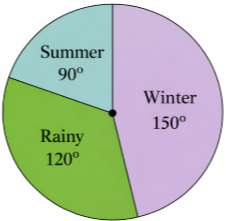
Q.12: A group of 360 people were asked to vote for their favourite season from the three seasons-rainy, winter and summer. 90 liked the summer season, 120 liked the rainy season, and the rest liked the winter. Draw a pie chart to show this information.
Solution:
Step 1: Find the number who liked winter
Total people {tex}=360{/tex}
Summer lovers {tex}=90{/tex}
Rainy lovers {tex}={/tex} 120
Winter lovers {tex}=360-90-120=150{/tex}
Step 2: Calculate angles for each season
Total angle in a circle {tex}=360^{\circ}{/tex}
- Summer angle {tex}=(90 / 360) \times 360^{\circ}{/tex} {tex}=(1 / 4) \times 360^{\circ}=90^{\circ}{/tex}
- Rainy angle {tex}=(120 / 360) \times 360^{\circ}{/tex} {tex}=(1 / 3) \times 360^{\circ}=120^{\circ}{/tex}
- Winter angle {tex}=(150 / 360) \times 360^{\circ}{/tex} {tex}=(5 / 12) \times 360^{\circ}=150^{\circ}{/tex}
Verlficaton: {tex}90^{\circ}+120^{\circ}+150^{\circ}=360^{\circ}{/tex}
Step 3: Draw the pie chart
- Draw a circle with center A
- Draw radius AB
- From AB, measure {tex}90^{\circ}{/tex} anti-clockwise and mark AC (Summer sector)
- From AC, measure {tex}120^{\circ}{/tex} anti-clockwise and mark AD (Rainy sector)
- From AD, measure {tex}150^{\circ}{/tex} anti-clockwise (this completes the circle) (Winter sector)
- Label and colour each sector.
Q.13: Draw a pie chart based on the following information about viewers’ favourite type of TV channel: Entertainment-50%, Sports-25%, News-15%, Information-10%.
Solution:
Step 1: Calculate angles for each channel type
Total angle {tex}=360^{\circ}{/tex}
- Entertainment {tex}=50 \%{/tex} of {tex}360^{\circ}=(50 / 100) \times 360^{\circ}{/tex}{tex}=0.5 \times 360^{\circ}=180^{\circ}{/tex}
- Sports {tex}=25 \%{/tex} of {tex}360^{\circ}=(25 / 100) \times 360^{\circ}{/tex} {tex}=0.25 \times 360^{\circ}=90^{\circ}{/tex}
- News {tex}=15 \%{/tex} of {tex}360^{\circ}=(15 / 100) \times 360^{\circ}{/tex} {tex}=0.15 \times 360^{\circ}=54^{\circ}{/tex}
- Information {tex}=10 \%{/tex} of {tex}360^{\circ}=(10 / 100) \times 360^{\circ}{/tex}{tex}=0.1 \times 360^{\circ}=36^{\circ}{/tex}
Verification: {tex}180^{\circ}+90^{\circ}+54^{\circ}+36^{\circ}=360^{\circ}{/tex}
Step 2: Draw the pie chart
- Draw a circle with center A
- Draw radius AB
- From AB, measure {tex}180^{\circ}{/tex} and mark AC (Entertainment exactly half circle)
- From AC, measure {tex}90^{\circ}{/tex} and mark AD (Sports quarter circle)
- From AD, measure {tex}54^{\circ}{/tex} and mark AE (News)
- From AE, measure {tex}36^{\circ}{/tex} to complete the circle (Information)
- Label and colour appropriately
Q.14: Prepare a pie chart that shows the favourite subjects of the students in your class. You can collect the data of the number of students for each subject shown in the table (each student should choose only one subject). Then write these numbers in the table and construct a pie chart:
| Subject | Language | Arts Education | Vocational Education | Social Science | Physical Education | Maths | Science |
| Number of Students |
Solution:
This is a practical activity. Here’s how to solve it:
Step 1: Collect data from your classmates Example data (you should use actual data from your class):
| Subject | Language Arts | Education | Vocational Education | Social Science | Physical Education | Math | Science |
| Students | 6 | 4 | 3 | 5 | 2 | 8 | 2 |
Total students {tex}=6+4+3+5+2+8+2=30{/tex}
Step 2: Calculate angles for each subject
Formula: Angle {tex}=({/tex}Number of students / Total students{tex}) \times 360^{\circ}{/tex}
- Language Arts {tex}=(6 / 30) \times 360^{\circ}=72^{\circ}{/tex}
- Education {tex}=(4 / 30) \times 360^{\circ}=48^{\circ}{/tex}
- Vocational Education {tex}=(3 / 30) \times 360^{\circ}=36^{\circ}{/tex}
- Social Science {tex}=(5 / 30) \times 360^{\circ}=60^{\circ}{/tex}
- Physical Education {tex}=(2 / 30) \times 360^{\circ}=24^{\circ}{/tex}
- Maths {tex}=(8 / 30) \times 360^{\circ}=96^{\circ}{/tex}
- Science {tex}=(2 / 30) \times 360^{\circ}=24^{\circ}{/tex}
Verification: {tex}72+48+36+60+{/tex}{tex}24+96+24=360^{\circ}{/tex}
Step 3: Draw the pie chart using these angles in sequence.
Q.15: Which of these are in inverse proportion?
- {tex}x{/tex} 40 80 25 16 {tex}y{/tex} 20 10 32 50
- {tex}x{/tex} 40 80 25 16 {tex}y{/tex} 20 10 32 50
- {tex}x{/tex} 30 90 150 10 {tex}y{/tex} 15 5 3 45
Solution:
- Yes, {tex}x{/tex} and {tex}y{/tex} are in inverse proportion.
Explanation: For inverse proportion, the product xy should be constant.
{tex}40 \times 20=800{/tex}
{tex}80 \times 10=800{/tex}
{tex}25 \times 32=800{/tex}
{tex}16 \times 50=800{/tex}
Since all products are equal (800), {tex}x{/tex} and {tex}y{/tex} are in Inverse proportion. - No, {tex}x{/tex} and {tex}y{/tex} are NOT in inverse proportion.
Explanation:Check if product xy is constant:
{tex}40 \times 20=800{/tex}
{tex}80 \times 10=800{/tex}
{tex}25 \times 12.5=312.5{/tex}
{tex}16 \times 8=128{/tex}
The products are NOT equal, sox and {tex}y{/tex} are NOT in inverse proportion. - Yes, x and y are in inverse proportion.
Explanation: Check if product xy is constant:
{tex}30 \times 15=450{/tex}
{tex}90 \times 5=450{/tex}
Since all products are equal (450), {tex}x{/tex} and {tex}y{/tex} are in Inverse proportion.
{tex}150 \times 3=450{/tex}
{tex}10 \times 45=450{/tex}
Q.16: Fill in the empty cells if x and y are in inverse proportion.
| {tex}x{/tex} | 16 | 12 | 36 | |
| {tex}y{/tex} | 9 | 48 |
Solution:
| {tex}x{/tex} | 16 | 12 | 3 | 36 |
| {tex}y{/tex} | 9 | 12 | 48 | 4 |
Explanation:
Since {tex}x{/tex} and {tex}y{/tex} are in inverse proportion, {tex}x y={/tex} constant ({tex}k{/tex})
Step 1: Find the constant k
From first column: k =16 ×9 =144
Step 2: Find missing values
For second column {tex}(x=12, y=?): 12 \times y{/tex}{tex}=144 y=144 \div 12=12{/tex}
For third column {tex}(x=?, y=48): x \times 48{/tex} {tex}=144 x=144 \div 48=3{/tex}
For fourth column {tex}(x=36, y=?): 36 \times y{/tex} {tex}=144 y=144 \div 36=4{/tex}
Verification:
- {tex}16 \times 9=144{/tex}
- {tex}12 \times 12=144{/tex}
- {tex}3 \times 48=144{/tex}
- {tex}36 \times 4=144{/tex}
Q.17: Which of the following pairs of quantities are in inverse proportion?
- The number of taps filling a water tank and the time taken to fill it.
- The number of painters hired and the days needed to paint a wall of fixed size.
- The distance a car can travel and the amount of petrol in the tank.
- The speed of a cyclist and the time taken to cover a fixed route.
- The length of cloth bought and the price paid at a fixed rate per metre.
- The number of pages in a book and the time required to read it at a fixed reading speed.
Solution:
- YES, they are in inverse proportion.
Explanation:- More taps {tex}\rightarrow{/tex} Less time to fill the tank
- Fewer taps {tex}\rightarrow{/tex} More time to fill the tank
- YES, they are in inverse proportion.
Explanation:- More painters {tex}\rightarrow{/tex} Fewer days needed
- Fewer painters {tex}\rightarrow{/tex} More days needed
- NO, they are NOT in inverse proportion. They are in direct proportion.
Explanation:- More petrol {tex}\rightarrow{/tex} More distance can be traveled
- Less petrol {tex}\rightarrow{/tex} Less distance can be traveled
- YES, they are in inverse proportion.
Explanation:- Higher speed {tex}\rightarrow{/tex} Less time taken
- Lower speed {tex}\rightarrow{/tex} More time taken
- NO, they are NOT in inverse proportion. They are in direct proportion.
Explanation:- More cloth {tex}\rightarrow{/tex} More price to pay
- Less cloth {tex}\rightarrow{/tex} Less price to pay
- NO, they are NOT in inverse proportion. They are in direct proportion.
Explanation:- More pages {tex}\rightarrow{/tex} More time to read
- Fewer pages {tex}\rightarrow{/tex} Less time to read
Q.18: If 24 pencils cost ₹120, how much will 20 such pencils cost?
Solution:
20 pencils will cost ₹100.
Explanation:
This is a case of direct proportion (more pencils → more cost).
Method 1: Unitary Method
Cost of 24 pencils {tex}=₹ 120{/tex}
Cost of 1 pencil {tex}=120 \div 24=₹ 5{/tex}
Cost of 20 pencils {tex}=5 \times 20=₹ 100{/tex}
Method 2: Using Proportion
{tex} 24: 20:: 120: \times 24 \times x={/tex}{tex}20 \times 120 x=(20 \times 120) \div 24 x{/tex} {tex}=2400 \div 24 x=100 {/tex}
Therefore, 20 pencils cost ₹100.
Q.19: A tank on a building has enough water to supply 20 families living there for 6 days. If 10 more families move in there, how long will the water last? What assumptions do you need to make to work out this problem?
Solution:
The water will last for 4 days.
This is a case of inverse proportion (more families {tex}\rightarrow{/tex} fewer days).
Assumptions needed:
- All families use the same amount of water
- Water usage per family per day is constant
- No additional water is added to the tank
Given:
- 20 families {tex}\rightarrow{/tex} Water lasts 6 days
- Total families after 10 more join {tex}=20+10=30{/tex} families
Using inverse proportion: {tex}{x}_1 {y}_1={x}_2 {y}_2{/tex}
{tex} 20 \times 6=30 \times x {/tex}
{tex} 120=30 \times x {/tex}
{tex} x=120 \div 30 {/tex}
{tex} x=4 \text { days } {/tex}
Therefore, the water will last for only 4 days.
Verification: 20 families increased to 30 families ({tex}{1 . 5}{/tex} times)
So days should decrease by factor of 1.5
{tex}6 \div 1.5=4{/tex} days
Q.20: Fill in the average number of hours each living being sleeps in a day by looking at the charts. Select the appropriate hours from this list : 15,2.5,20,8,3.5,13,10.5,18.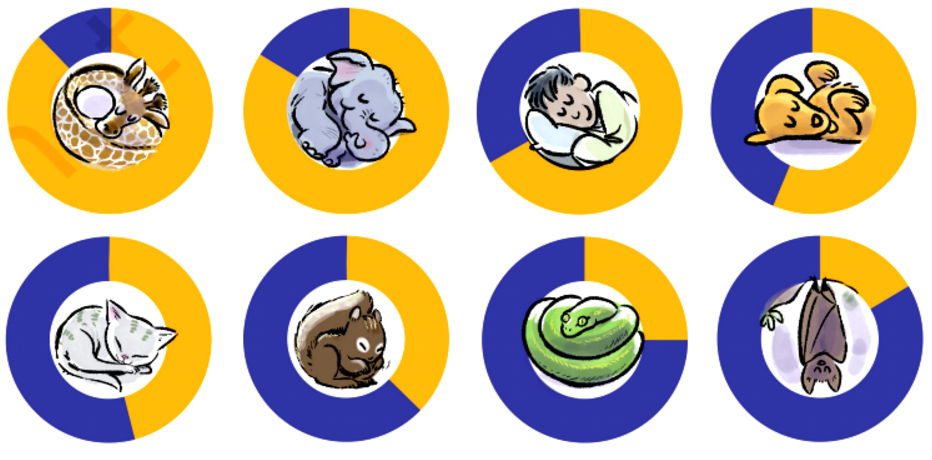
Solution:
This question requires looking at charts provided in the textbook. The typical sleep hours are:
Common sleep patterns:
- Cats: {tex}{1 3}{/tex} hours
- Dogs: 10.5 hours
- Elephants: 3.5 hours
- Giraffes: 2.5 hours
- Humans (adults): 8 hours
- Koalas: 20 hours
- Lions: 15 hours
- Sloths: 18 hours
Q.21: Three workers can paint a fence in 4 days. If one more worker joins the team, how many days will it take them to finish the work? What are the assumptions you need to make?
Solution:
It will take 3 days for 4 workers to finish the work.
Assumptions needed:
- All workers work at the same rate/speed
- All workers work for the same number of hours each day
- The work is uniformly distributed among all workers
Explanation:
This is inverse proportion (more workers → fewer days).
Given:
- 3 workers {tex}\rightarrow 4{/tex} days
- Total workers after one joins {tex}=3+1=4{/tex} workers
Using inverse proportion: {tex}x_1 y_1=x_2 y_2 {/tex},
{tex}3 \times 4=4 \times x {/tex}
{tex}12=4 x {/tex}
{tex}x=12 \div 4{/tex}
{tex} x=3{/tex} days
Therefore, 4 workers will complete the work in 3 days.
Q.22: It takes 6 hours to fill 2 tanks of the same size with a pump. How long will it take to fill 5 such tanks with the same pump?
Solution:
It will take 15 hours to fill 5 tanks.
Explanation:
This is direct proportion (more tanks {tex}\rightarrow{/tex} more time).
Given:
- 2 tanks {tex}\rightarrow 6{/tex} hours
- Need to find time for 5 tanks
Method 1: Unitary method Time to fill 2 tanks {tex}=6{/tex} hours
Time to fill 1 tank {tex}=6 \div 2=3{/tex} hours
Time to fill 5 tanks {tex}=3 \times 5=15{/tex} hours
Method 2: Using proportion 2 : 5 :: 6 : x
2 {tex}\times{/tex} x = 5 {tex}\times{/tex} 6
2x = 30
x = 30 {tex}\div 2 {/tex}
x = 15 hours
Therefore, it will take 15 hours to fill 5 tanks.
Q.23: A given set of chairs are arranged in 25 rows, with 12 chairs in each row. If the chairs are rearranged with 20 chairs in each row, how many rows does this new arrangement have?
Solution:
The new arrangement will have 15 rows.
This is inverse proportion (more chairs per row {tex}\rightarrow{/tex} fewer rows needed).
Given:
- Original: 25 rows with 12 chairs each
- New: 20 chairs in each row, find number of rows
Step 1: Find total number of chairs
Total chairs {tex}=25 \times 12=300{/tex} chairs
Step 2: Find number of rows with 20 chairs each
Number of rows {tex}=300 \div 20=15{/tex} rows
Therefore, the new arrangement will have 15 rows.
Q.24: A school has 8 periods a day, each of 45 minutes duration. How long is each period, if the school has 9 periods a day, assuming that the number of school hours per day stays the same?
Solution:
Each period will be 40 minutes long.
This is inverse proportion (more periods {tex}\rightarrow{/tex} shorter duration of each period).
Given:
- 8 periods of 45 minutes each
- Need to find duration when there are 9 periods
Step 1: Find total school hours
Total time {tex}=8 \times 45=360{/tex} minutes
Step 2: Find duration of each period for 9 periods
Duration of each period {tex}=360 \div 9=40{/tex} minutes
Alternative method using inverse proportion:
{tex} x_1 y_1=x_2 y_2 {/tex}
{tex} 8 \times 45=9 \times x {/tex}
{tex} 360=9 x {/tex}
{tex} x=360 \div 9 {/tex}
{tex} x=40 \text { minutes } {/tex}
Therefore, each period will be 40 minutes long.
Q.25: A small pump can fill a tank in 3 hours, while a large pump can fill the same tank in 2 hours. If both pumps are used together, how long will the tank take to fill?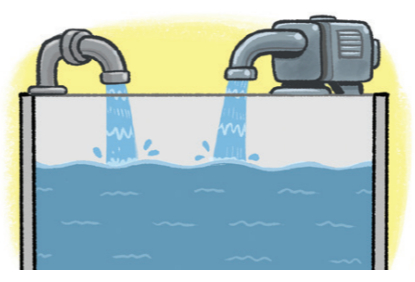
Solution:
The tank will fill in 1.2 hours (or 1 hour 12 minutes).
Step 1: Find work done by each pump in 1 hour
- Small pump fills the tank in 3 hours → {tex}\ln 1{/tex} hour, it fills {tex}1 / 3{/tex} of the tank
- Large pump fills the tank in 2 hours → {tex}\ln 1{/tex} hour, it fills {tex}1 / 2{/tex} of the tank
Step 2: Find work done by both pumps together in 1 hour
Work done in 1 hour {tex}=1 / 3+1 / 2{/tex}
To add, find LCM of 3 and {tex}2=6=2 / 6+3 / 6=5 / 6{/tex} of the tank
Step 3: Find time to fill the whole tank
If {tex}5 / 6{/tex} of tank is filled in 1 hour
Then full tank {tex}(1{/tex} whole) will be filled in:
Time {tex}=1 \div(5 / 6)=1 \times(6 / 5)=6 / 5{/tex} hours {tex}=1.2{/tex} hours
Converting to minutes: 1.2 hours {tex}=1{/tex} hour {tex}+0.2 \times 60{/tex} minutes {tex}=1{/tex} hour 12 minutes
Therefore, both pumps together will fill the tank in 1.2 hours or 1 hour 12 minutes.
Q.26: A factory requires 42 machines to produce a given number of toys in 63 days. How many machines are required to produce the same number of toys in 54 days?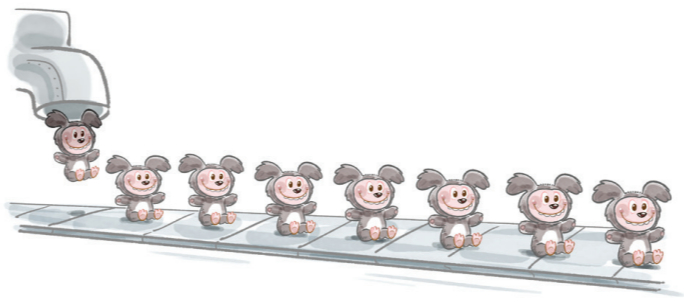
Solution:
49 machines are required.
This is inverse proportion (fewer days {tex}\rightarrow{/tex} more machines needed).
Given:
- 42 machines {tex}\rightarrow 63{/tex} days
- Need to find machines for 54 days
Using inverse proportion: {tex}{x}_1 {y}_1={x}_2 {y}_2 {/tex}
{tex}42 \times 63= x\times 54{/tex}
{tex}2646=54 x{/tex}
{tex}x=2646 \div 54 {/tex}
{tex}{x}=49{/tex} machines
Therefore, 49 machines are required to produce the same number of toys in 54 days.
Q.27: A car takes 2 hours to reach a destination, travelling at a speed of 60 km/h. How long will the car take if it travels at a speed of 80 km/h?
Solution:
The car will take 1.5 hours (or 1 hour 30 minutes).
This is inverse proportion (higher speed {tex}\rightarrow{/tex} less time).
Given:
- Speed {tex}=60 {~km} / {h} \rightarrow{/tex} Time {tex}=2{/tex} hours
- Speed {tex}=80 {~km} / {h} \rightarrow{/tex} Time {tex}={/tex} ?
Using inverse proportion: {tex}{x}_1 {y}_1={x}_2 {y}_2 {/tex}
{tex}60 \times 2=80 \times {x} {/tex}
{tex}120=80 x{/tex}
{tex}x=120 \div 80{/tex}
{tex} {x}=1.5{/tex} hours
Converting to hours and minutes: 1.5 hours {tex}=1{/tex} hour 30 minutes
Therefore, at {tex}80 {~km} / {h}{/tex}, the car will take 1.5 hours or 1 hour 30 minutes.
Class 8 Maths Ganita Prakash Solutions
- A Square and A Cube
- Power Play
- A Story of Numbers
- Quadrilaterals
- Number Play
- We Distribute Yet Things Multiply
- Proportional Reasoning-1
- Fractions In Disguise
- The Baudhayana-Pythagoras Theorem
- Proportional Reasoning-2
- Exploring Some Geometric Themes
- Tales by dots and lines
- Algebra Play

Test Generator
Create question paper PDF and online tests with your own name & logo in minutes.
Create Now
Learn8 App
Practice unlimited questions for Entrance tests & government job exams at ₹99 only
Install Now