Number Play – NCERT Solutions Class 8 Maths (Ganita Prakash) includes all the questions with solutions given in the NCERT Class 8 Maths (Ganita Prakash).
NCERT Solutions Class 8
English Poorvi Hindi Malhar Maths Ganita Prakash Science Curiosity Social Exploring SocietyNumber Play – NCERT Solutions
Q.1: Anshu is exploring sums of consecutive numbers. He has written the following-
7=3+47=3+4
10=1+2+3+410=1+2+3+4
12=3+4+512=3+4+5
15=7+815=7+8
=4+5+6=4+5+6
=1+2+3+4+5=1+2+3+4+5
Now, he is wondering-
- “Can I write every natural number as a sum of consecutive numbers?”
- “Which numbers can I write as the sum of consecutive numbers in more than one way?”
- “Ohh, I know all odd numbers can be written as a sum of two consecutive numbers. Can we write all even numbers as a sum of consecutive numbers?”
- “Can I write 0 as a sum of consecutive numbers? Maybe I should use negative numbers.”
Solution: Do it your self.
Q.2: Explore these questions and any others that may occur to you. Discuss them with the class.
Solution: Do it your self.
Q.3: The sum of four consecutive numbers is 34. What are these numbers?
Solution: Step 1: Represent the numbers
Let the four consecutive numbers be:
x,x+1,x+2,x+3x,x+1,x+2,x+3
Step 2: Write the sum
x+(x+1)+(x+2)+(x+3)=34x+(x+1)+(x+2)+(x+3)=34
x+x+1+x+2+x+3=34x+x+1+x+2+x+3=34
4x+6=344x+6=34
Step 3: Solve for xx
4x+6=344x+6=34
4x=34−64x=34−6
4x=284x=28
x=7x=7
Step 4: Find the consecutive numbers
x=7⇒x+1=8,x+2=9,x+3=10x=7⇒x+1=8,x+2=9,x+3=10
= 7,8,9,107,8,9,10
Q.4: Suppose p is the greatest of five consecutive numbers. Describe the other four numbers in terms of p.
Solution: Given p is the greatest of five consecutive numbers.
The other four numbers in terms of p are (p – 1), (p – 2), (p – 3), and (p – 4).
p – 1 is the second largest number
p – 2 is the third largest number
p – 3 is the second smallest number
p – 4 is the smallest number
∴∴ p > (p – 1) > (p – 2) > (p – 3) > (p – 4).
Q.5: For each statement below, determine whether it is always true, sometimes true, or never true. Explain your answer. Mention examples and non-examples as appropriate. Justify your claim using algebra.
- The sum of two even numbers is a multiple of 3.
- If a number is not divisible by 18, then it is also not divisible by 9.
- If two numbers are not divisible by 6 , then their sum is not divisible by 6.
- The sum of a multiple of 6 and a multiple of 9 is a multiple of 3.
- The sum of a multiple of 6 and a multiple of 3 is a multiple of 9.
Solution:
- The sum of two even numbers is a multiple of 3.
- Even numbers: numbers divisible by 2.
- Example: 2+4=62+4=6 divisible by 3
- Example: 2+8=102+8=10 not divisible by 3
Conclusion: Sometimes true some sums are multiples of 3, some are not.
- If a number is not divisible by 18, then it is also not divisible by 9.
- Example: 9→9→ divisible by 9, but not by 18
- Example: 10→10→ divisible by neither
Conclusion: Sometimes true not always.
- If two numbers are not divisible by 6, then their sum is not divisible by 6.
- Example: 4+8=124+8=12 divisible by 6
- Example: 4+5=94+5=9 not divisible by 6
Conclusion: Sometimes true can happen, can not happen.
- The sum of a multiple of 6 and a multiple of 9 is a multiple of 3.
- Example: 6+9=156+9=15 divisible by 3
- Example: 12+18=3012+18=30 divisible by 3
Conclusion: Always true works every time.
- The sum of a multiple of 6 and a multiple of 3 is a multiple of 9.
- Example: 6+3=96+3=9 divisible by 9
- Example: 6+6=126+6=12 not divisible by 9
Conclusion: Sometimes true works in some cases but not always.
Q.6:
Find a few numbers that leave a remainder of 2 when divided by 3 and a remainder of 2 when divided by 4. Write an algebraic expression to describe all such numbers.
Solution: Here, Remainder = 2, Dividend = 3
∴∴ Number = (Quotient × Dividend) + Remainder = (K ×× 3) + 2
where, K = 1, 2, 3,…..
Numbers = 1 ×× 3 + 2 = 3 + 2 = 5
Numbers = 2 ×× 3 + 2 = 6 + 2 = 8
Numbers = 3 ×× 3 + 2 = 9 + 2 = 11
Thus, 5, 8, and 11 are numbers that leave a remainder of 2 when divided by 3.
Algebraic expression = 3K + 2
Here, Remainder = 2, dividend = 4
Number = 4K + 2, where K = 1, 2, 3, 4, …
Numbers = 4 ×× 1 + 2 = 4 + 2 = 6
Numbers = 4 ×× 2 + 2 = 8 + 2 = 10
Numbers = 4 ×× 3 + 2 = 12 + 2 = 14
Algebraic expression = 4K + 2
Thus, 6, 10, and 14 are numbers that leave a remainder of 2 when divided by 4.
Q.7: “I hold some pebbles, not too many, When I group them in 3’s, one stays with me. Try pairing them up- it simply won’t do, A stubborn odd pebble remains in my view. Group them by 5, yet one’s still around, But grouping by seven, perfection is found. More than one hundred would be far too bold, Can you tell me the number of pebbles I hold?”
Solution: The number of pebbles you hold is 91.
It’s less than 100, odd (remainder 1 when divided by 2), leaves 1 pebble when grouped by 3 or 5, and divides perfectly into groups of 7.
Q.8: Tathagat has written several numbers that leave a remainder of 2 when divided by 6. He claims, “If you add any three such numbers, the sum will always be a multiple of 6.” Is Tathagat’s claim true?
Solution: The expression has been written by Tathagat = 6k + 2
where, k = 1, 2, 3, 4, 5, 6,…
6 ×× 1 + 2 = 8
6 ×× 2 + 2 = 14
6 ×× 3 + 2 = 20
6 ×× 4 + 2 = 26
The sum of three numbers
8 + 14 + 20 = 42, it is a multiple of 6.
14 + 20 + 26 = 60, it is a multiple of 6.
Yes, Tathagat’s claim is true.
Q.9: When divided by 7, the number 661 leaves a remainder of 3, and 4779 leaves a remainder of 5. Without calculating, can you say what remainders the following expressions will leave when divided by 7? Show the solution both algebraically and visually.
- 4779 + 661
- 4779 – 661
Solution: We are given:
661÷7 leaves remainder 3⇒661=7a+3661÷7 leaves remainder 3⇒661=7a+3
4779÷7 leaves remainder 5⇒4779=7b+54779÷7 leaves remainder 5⇒4779=7b+5
- 4779 + 661
4779+661=(7b+5)+(7a+3)=7(a+b)+84779+661=(7b+5)+(7a+3)=7(a+b)+8
Divide 8 by 7→7→ remainder 1 - 4779 – 661
4779−661=(7b+5)−(7a+3)=7(b−a)+24779−661=(7b+5)−(7a+3)=7(b−a)+2
Remainder is 2
Q.10: Find a number that leaves a remainder of 2 when divided by 3, a remainder of 3 when divided by 4, and a remainder of 4 when divided by 5. What is the smallest such number? Can you give a simple explanation of why it is the smallest?
Solution: A number that leaves a remainder of 2 when divided by 3 is = 3x + 2
A number that leaves a remainder of 3 when divided by 4 is = 4x + 3
A number that leaves a remainder of 4 when divided by 5 is = 5x + 4
L.C.M of 3, 4, and 5 = 60
All the numbers are the same, so 4x + 3 = 3x + 2
4x – 3x = 2 – 3
x = -1
Each remainder is 1 less than the divisor.
Hence, the number is 1 less than the L.C.M = (60 – 1) = 59.
So, 59 is the smallest number that satisfies all the given conditions.
Q.11: Find, without dividing, whether the 123 number is divisible by 9.
Solution: If the sum of the digits of a number is divisible by 9, then the number is divisible by 9.
Sum of the digits = 1 + 2 + 3 = 6, is not divisible by 9.
Thus, 123 is not divisible by 9.
Q.12: Find, without dividing, whether the 405 number are divisible by 9.
Solution: If the sum of the digits of a number is divisible by 9, then the number is divisible by 9.
Sum of the digits = 4 + 0 + 5 = 9, is divisible by 9.
Thus, 405 is divisible by 9.
Q.13: Find, without dividing, whether the 8888 number are divisible by 9.
Solution: If the sum of the digits of a number is divisible by 9, then the number is divisible by 9.
Sum of the digits = 8 + 8 + 8 + 8 = 32, is not divisible by 9.
Thus, 8888 is not divisible by 9.
Q.14: Find, without dividing, whether the 93547 number are divisible by 9.
Solution: If the sum of the digits of a number is divisible by 9, then the number is divisible by 9.
Sum of the digits = 9 + 3 + 5 + 4 + 7 = 28, is not divisible by 9.
Thu,s 93547 is not divisible by 9.
Q.15: Find, without dividing, whether the 358095 number are divisible by 9.
Solution: If the sum of the digits of a number is divisible by 9, then the number is divisible by 9.
Sum of the digits = 3 + 5 + 8 + 0 + 9 + 5 = 30, is not divisible by 9.
Hence, 358095 is not divisible by 9.
Q.16: Find the smallest multiple of 9 with no odd digits.
Solution: Multiples of 9 = 9, 18, 27, 36,…, 288,………
The smallest multiple of 9 with an odd digit is 9.
The smallest multiple of 9 that can be formed by summing even digits is 18 (since 9 is odd).
Thus, the smallest multiple of 9 with no odd digits is 288.
Q.17: Find the multiple of 9 that is closest to the number 6000.
Solution: Given, 6000
Sum of the digits = 6 + 0 + 0 + 0 = 6
We know that, if the number is divisible by 9, then the sum of the digits is divisible by 9.
If we add 3 to the number 6000.
6000 + 3 = 6003, it is divisible by 3.
Thus, the multiple of 9 that is closest to the number is 6003.
Q.18: How many multiples of 9 are there between the numbers 4300 and 4400?
Solution: The multiples of 9 are there between the numbers 4300 and 4400 are 4302, 4311, 4320,………, 4392
The number of multiples of 9 = Last term − First term Difference +1= Last term − First term Difference +1
=4392−43029+1=4392−43029+1
=909+1=909+1
=10+1=10+1
= 11
Thus, the multiples of 9 are 11.
Q.19: The digital root of an 8-digit number is 5. What will be the digital root of 10 more than that number?
Solution: Consider the 8-digit number 80000006.
The digital root of 80000006 = 8 + 0 + 0 + 0 + 0 + 0 + 0 + 6
= 14
= 1 + 4
= 5
10 more than 80000006 = 80000006 + 10 = 80000016
The digital root of 80000016 = 8 + 0 + 0 + 0 + 0 + 0 + 1 + 6
= 15
= 1 + 5
= 6
Thus, the digital root of 10 more than 80000006 is 6.
Q.20: Write any number. Generate a sequence of numbers by repeatedly adding 11. What would be the digital roots of this sequence of numbers? Share your observations.
Solution: Let’s take a number, say 7, and repeatedly add 11:
Sequence: 7, 18, 29, 40, 51, 62, …
Digital roots: 7, 9, 2, 4, 6, 8, 1, 3, 5, 7…
Observation:
The digital roots cycle through 1 to 9 in a repeating pattern.
Adding 11 repeatedly increases the digital root by 2 each time (mod 9).
Q.21: What will be the digital root of the number 9a + 36b + 13?
Solution: First Method:
The digital root of the number 9a + 36b + 13 = 9a + 36b + 9 + 4
= 9(a + 4b + 1) + 4
= 9 + 4
= 13 [∵∵ The digital root of multiples of 9 is always 9.]
= 1 + 3
= 4
Thus, the digital root of the number 9a + 36b + 13 will be 4.
Second Method:
We have 9a + 36b + 13
Here, a and b are integers
Put a = 1, b = 1,
9a + 36b + 13 = 9 ×× 1 + 36 ×× 1 + 13
= 9 + 36 + 13
= 58
The digital root of 58 = 5 + 8 = 13 = 1 + 3 = 4
Put a = 2, 6 = 3,
9a + 36b + 13 = 9 ×× 2 + 36 ×× 3 + 13
= 18 + 108 + 13
= 139
The digital root of 139 = 1 + 3 + 9 = 13 = 1 + 3 = 4
Thus, the expression 9a + 36b + 13 always has a digital root of 4.
Q.22: Make conjectures by examining if there are any patterns or relations between
- the parity of a number and its digital root.
- the digital root of a number and the remainder obtained when the number is divided by 3 or 9.
Solution:
- Parity of a number and its digital root:
Even numbers: Digital root can be 2, 4, 6, 8, or 9 (if sum of digits = 9)
Odd numbers: Digital root can be 1, 3, 5, 7, or 9
Observation: The digital root retains the odd/even nature of the number unless it is 9 (since 9 is divisible by both 3 and 9). - Digital root and remainder when divided by 3 or 9:
Divisible by 3: Digital root = 3, 6, or 9 →→ remainder 0 when divided by 3
Divisible by 9: Digital root = 9 →→ remainder 0 when divided by 9
Q.23: If 31z5 is a multiple of 9, where z is a digit, what is the value of z? Explain why there are two answers to this problem.
Solution: Here, 31z5
Sum of the digits = 3 + 1 + z + 5 = 9 + z
(9 + z) should be divisible by 9.
z = 0, 3105 is divisible by 9.
z = 9, 3195 is also divisible by 9.
∴ z = 0 or 9
There are two answers to this problem because, excluding z, the sum of the digits is divisible by 9.
Q.24: “I take a number that leaves a remainder of 8 when divided by 12. I take another number which is 4 short of a multiple of 12. Their sum will always be a multiple of 8”, claims Snehal. Examine his claim and justify your conclusion.
Solution: Do it yourself.
Q.25: When is the sum of two multiples of 3, a multiple of 6 and when is it not? Explain the different possible cases, and generalise the pattern.
Solution: Let the two multiples of 3 be 3a and 3b.
Sum = 3a + 3b = 3(a + b) →→ always divisible by 3
A number divisible by 6 must be divisible by both 2 and 3.
So, sum divisible by 6 if a+ba+b is even (makes 3(a+b)3(a+b) even →→ divisible by 6)
Sum not divisible by 6 if a+ba+b is odd (3(a+b)(3(a+b) odd multiple of 3→3→ not divisible by 6))
Sum of two multiples of 3 is always divisible by 3; divisible by 6 only when the sum of their factors (a+b)(a+b) is even.
Q.26: If 48a23b is a multiple of 18, list all possible pairs of values for a and b.
Solution: Given by the question,
48a23b is a multiple of 18.
As we know that,
If the number is a multiple of 18, then it is also a multiple of 2 and 9.
∴∴ 48a23b
Sum of the digits = 4 + 8 + a + 2 + 3 + b = 17 + a + b
Case 1: Put a = 1 and b = 0
481230, it is possible values of a and b.
Sum = 18, it is divisible by 9.
Case 2: Put a = 4 and b = 6
484236
Sum = 17 + 10 = 27, it is divisible by 9.
Thus, the possible values of a and 6 are a = 1 and b = 0, a = 4 and b = 6; there are two possible cases.
Q.27: If 3p7q8 is divisible by 44, list all possible pairs of values for p and q.
Solution: Given by question, 3p7q8 is divisible by 44.
As we know, if a number is divisible by 44, then it is also divisible by 4 and 11.
∴∴ 3p7q8
Case 1: Put p = 1 and q = 0
37708 is divisible by 4 and 11, then it is also divisible by 44.
Case 2: Put p = 5 and q = 2
35728 is divisible by 4 and 11, then it is also divisible by 44.
Case 3: Put p = 3 and q = 4
33748 is divisible by 4 and 11, then it is also divisible by 44.
Case 4: Put p = 1 and q = 6
31768 is divisible by 4 and 11, then it is also divisible by 11.
Thus, (p = 7, q = 0), (p = 5, q = 2), (p = 3, q = 4), and (p = 1 and q = 6) are the possible pairs of values for p and q.
Q.28: Find three consecutive numbers such that the first number is a multiple of 2, the second number is a multiple of 3, and the third number is a multiple of 4. Are there more such numbers? How often do they occur?
Solution: Let x,x+1x,x+1 and (x+2)(x+2) be the three numbers
Put x=2,⇒2,3,4x=2,⇒2,3,4
Put x=14,⇒14,15,6x=14,⇒14,15,6
Put x=26,⇒26,27,28x=26,⇒26,27,28
Put x=38,⇒38,39,40x=38,⇒38,39,40
Thus, the three consecutive numbers are (14,15,1614,15,16),
Put x=26⇒26,27,28x=26⇒26,27,28
(26,27,28)(26,27,28) and (38,39,40)(38,39,40)
There are infinite numbers, spaced apart by 12.
Q.29: Write five multiples of 36 between 45,000 and 47,000. Share your approach with the class.
Solution: 45036, 45072, 45108, 45144, 45180
Approach: Find the smallest multiple of 36 above 45000 and keep adding 36 repeatedly.
Q.30: The middle number in the sequence of 5 consecutive even numbers is 5p. Express the other four numbers in sequence in terms of p.
Solution: Given the middle number in the sequence of 5 consecutive even numbers 5p.
The other four numbers in the sequence in terms of p are 5p – 4, 5p – 2, 5p + 2, 5p + 4
Hence, the other four numbers in sequence are p, 3p, 7p, and 9p.
Q.31: Deepak claims, “There are some multiples of 11 which, when doubled, are still multiples of 11. But other multiples of 11 don’t remain multiples of 11 when doubled”. Examine if his conjecture is true; explain your conclusion.
Solution: Deepak’s claim is not correct.
- Any multiple of 11=11×n11=11×n
- Doubled =2×(11×n)=22×n→=2×(11×n)=22×n→ still divisible by 11
Conclusion: All multiples of 11 remain multiples of 11 when doubled. There are no exceptions.
Q.32: Determine whether the statements below are ‘Always True’, ‘Sometimes True’, or ‘Never True’. Explain your reasoning.
- The product of a multiple of 6 and a multiple of 3 is a multiple of 9.
- The sum of three consecutive even numbers will be divisible by 6.
- If abcdef is a multiple of 6, then badcef will be a multiple of 6.
- 8 (7b – 3) – 4 (11b + 1) is a multiple of 12.
Solution:
- Multiple of 6=6a6=6a, multiple of 3=3 b→3=3 b→ product =6a×3 b=18ab=6a×3 b=18ab
18ab divisible by 9 (Always True) - Let numbers =2n,2n+2,2n+4→=2n,2n+2,2n+4→ sum =6n+6=6(n+1)=6n+6=6(n+1) (Always True)
- Reordering digits may change last digit →→ may not be even →→ may not be divisible by 2 (Sometimes True)
- 8(7b−3)−4(11b+1)=56b−24−44b−4=12b−288(7b−3)−4(11b+1)=56b−24−44b−4=12b−28
12b−28=12(b−2)−4→ remainder 4→ not always divisible by 1212b−28=12(b−2)−4→ remainder 4→ not always divisible by 12 (Never True)
Q.33: Choose any 3 numbers. When is their sum divisible by 3? Explore all possible cases and generalise.
Solution: The sum of three numbers is divisible by 3 if the sum of their remainders when divided by 3 is 0,3, or 6.
For example, remainders 0+0+0,1+1+1,2+2+20+0+0,1+1+1,2+2+2, or 0+1+20+1+2.
Q.34: Is the product of two consecutive integers always multiple of 2? Why? What about the product of these consecutive integers? Is it always a multiple of 6? Why or why not? What can you say about the product of 4 consecutive integers? What about the product of five consecutive integers?
Solution:
- Product of 2 consecutive numbers →→ always divisible by 2
- Product of 2 consecutive numbers →→ not always divisible by 6
- Product of 4 consecutive numbers →→ always divisible by 24
- Product of 5 consecutive numbers →→ always divisible by 120
Q.35: Solve the cryptarithms-
- EF ×× E = GGG
- WOW ×× 5 = MEOW
Solution:
- This means a 2-digit number multiplied by 5 gives a 3-digit number.
2-digit number = 20, 21,…., 99
37 ×× 3 = 111, all conditions are satisfied. - This means a 3-digit number multiplied by 5 gives 4-digit numbers.
Pick 3-digit number = 200, 201,…., 999
525 ×× 5 = 2625
Q.36: Which of the following Venn diagrams captures the relationship between the multiples of 4, 8, and 32?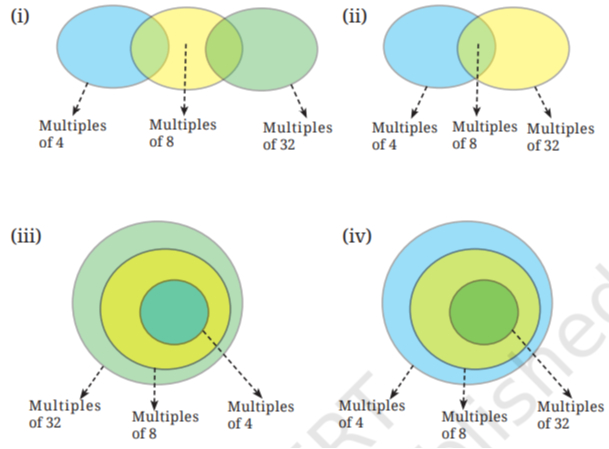
Solution: Do it yourself.
Q.37: Look at each of the following statements. Which are correct and why?
- If a number is divisible by 9, then the sum of its digits is divisible by 9.
- If the sum of the digits of a number is divisible by 9, then the number is divisible by 9.
- If a number is not divisible by 9, then the sum of its digits is not divisible by 9.
- If the sum of the digits of a number is not divisible by 9, then the number is not divisible by 9.
Solution:
- If a number is divisible by 9, then the sum of its digits is divisible by 9. Correct
This is a known rule for 9. Example: 729→7+2+9=18→729→7+2+9=18→ divisible by 9. - If the sum of the digits of a number is divisible by 9, then the number is divisible by 9. Correct
Works both ways. Example: 234→2+3+4=9→234→2+3+4=9→ divisible by 9, so 234÷9=26234÷9=26. - If a number is not divisible by 9, then the sum of its digits is not divisible by 9. Correct
Contrapositive of statement 1. Example: 125→125→ sum =1+2+5=8→=1+2+5=8→ not divisible by 9. - If the sum of the digits of a number is not divisible by 9, then the number is not divisible by 9. Correct
Contrapositive of statement 2. Example: 152→152→ sum =1+5+2=8→=1+5+2=8→ number not divisible by 9.
Q.38: Is 158 divisible by 11? If not, find the remainder.
Solution: (1 + 8) – (5) = 9 − 5 = 4 →→ Remainder = 4
Q.39: Is 841 divisible by 11? If not, find the remainder.
Solution: (8 + 1) − (4) = 9 – 4 = 5 →→ Remainder = 5
Q.40: Is 481 divisible by 11? If not, find the remainder.
Solution: (4 + 1) – (8) = 5 – 8 = -3 →→ remainder = 8 →→ Not divisible
Q.41: Is 5529 divisible by 11? If not, find the remainder.
Solution: (5 + 2) – (5 + 9) = 7 – 14 = -7 →→ remainder = 4 →→ Not divisible
Q.42: Is 90904 divisible by 11? If not, find the remainder.
Solution: (9 + 9 + 4) – (0 + 0) = 22 – 0 = 22 →→ 22 ÷÷ 11 = 2 →→ Divisible
Q.43: Is 857076 divisible by 11? If not, find the remainder.
Solution: (8 + 7 + 7) – (5 + 0 + 6) = 22 – 11 = 11 →→ divisible →→ Yes
Q.44: How can we find out if a number is divisible by 6?
Solution: A number is divisible by 6 if it is divisible by both 2 and 3
Q.45: Will checking its divisibility by its factors 2 and 3 work? Use the shortcuts for 2 and 3 on these numbers and divide each number by 6 to verify- 38, 225, 186, 64.
Solution:
- 38 is not divisible by 6
- 225 is not divisible by 6
- 186 is divisible by 6
- 64 is not divisible by 6
Q.46: How about checking divisibility by 24? Will checking the divisibility by its factors, 4 and 6, work? Why or why not?
Solution: Determining divisibility by 24 by checking divisibility by 4 and by 6 does not work. For example, the number 12 is divisible by both 4 and 6, but not by 24. To check for the divisibility by 24, we can instead check for the divisibility by 3 and divisibility by 8. Explain using prime factorisation why checking divisibility by 3 and 8 works for checking divisibility by 24, but checking divisibility by 4 and 6 is not sufficient for checking divisibility by 24. There are such shortcuts to check divisibility by every number until 100, and for some numbers beyond 100. You may try to understand how these work after learning certain concepts in higher grades.
Q.47: What property do you think this digital root will have? Recall that we did this while finding the divisibility shortcut for 9.
Solution: The digital root of a number is always the same as the remainder when the number is divided by 9.
Q.48: Between the numbers 600 and 700, which numbers have the digital root: (i) 5, (ii) 7, (iii) 3?
Solution: Numbers between 600 and 700 with given digital roots:
- Digital root 5:
608 = 6 + 0 + 8 = 14 = 1 + 4 = 5;
617 = 6 + 1 + 7 = 14 = 1 + 4 = 5;
662 = 6 + 6 + 2 = 14 = 1 + 4 = 5;
689 = 6 + 8 + 9 = 23 = 2 + 3 = 5, etc. - Digital root 7:
610 = 6 + 1 + 0 = 7;
619 = 6 + 1 + 9 = 16 = 1 + 6 = 7;
637 = 6 + 3 + 7 = 16 = 1 + 6 = 7;
673 = 6 + 7 + 3 = 16 = 1 + 6 = 7, etc. - Digital root 3:
606 = 6 + 0 + 6 = 12 = 1 + 2 = 3;
615 = 6 + 1 + 5 = 12 = 1 + 2 = 3;
633 = 6 + 3 + 3 = 12 = 1 + 2 = 3;
678 = 6 + 7 + 8 = 21 = 2 + 1 = 3, etc.
Q.49: Write the digital roots of any 12 consecutive numbers. What do you observe? We saw that the digital root of multiples of 9 is always 9.
Solution: Digital roots of 12 consecutive numbers:
1, 2, 3, 4, 5, 6, 7, 8, 9, 1, 2, 3
Observation:
The digital roots repeat in a cycle of 9.
Q.50: Now, find the digital roots of some consecutive multiples of (i) 3, (ii) 4, and (iii) 6.
Solution: Digital roots of consecutive multiples:
- Multiples of 3: 3, 6, 9, 3, 6, 9… (repeats 3, 6, 9)
- Multiples of 4: 4, 8, 3, 7, 2, 6, 1, 5, 9, 4…(repeats every 9 multiples)
- Multiples of 6: 6, 3, 9, 6, 3, 9…(repeats 6, 3, 9)
Q.51: What are the digital roots of numbers that are 1 more than a multiple of 6? What do you notice? Try to explain the patterns noticed.
Solution: Numbers 1 more than a multiple of 6: 1, 7, 13, 19, 25, 31,…
Digital roots: 1, 7, 4, 1, 7, 4,…
Observation:
- The digital roots repeat in a cycle of 3:1→7→4→1→…3:1→7→4→1→…
- Pattern: Each next number adds 6→6→ digital root increases by 6(mod9)6(mod9), so the cycle repeats.
Class 8 Maths Ganita Prakash Solutions
- A Square and A Cube
- Power Play
- A Story of Numbers
- Quadrilaterals
- Number Play
- We Distribute Yet Things Multiply
- Proportional Reasoning-1
- Fractions In Disguise
- The Baudhayana-Pythagoras Theorem
- Proportional Reasoning-2
- Exploring Some Geometric Themes
- Tales by dots and lines
- Algebra Play

Test Generator
Create question paper PDF and online tests with your own name & logo in minutes.
Create Now
Learn8 App
Practice unlimited questions for Entrance tests & government job exams at ₹99 only
Install Now