
Ask questions which are clear, concise and easy to understand.
Ask QuestionPosted by Amol Gùpta 6 years, 8 months ago
- 1 answers
Posted by Renu Aggarwal 6 years, 8 months ago
- 2 answers
Suman Sharma 6 years, 8 months ago
Rahul Sharma 6 years, 8 months ago
Posted by Latika Tahiliani 6 years, 8 months ago
- 1 answers
Cute_Girl_0003 ?? 6 years, 8 months ago
Posted by Sidharth Singh 6 years, 8 months ago
- 1 answers
Priya Dharshini 6 years, 8 months ago
Posted by Singh Gurjant 6 years, 8 months ago
- 7 answers
Abhilasha Abhi 6 years, 8 months ago
K@Łp@N@ $Øđh!?? 6 years, 8 months ago
Amrita Mohanty 6 years, 8 months ago
Ramakant Kushwaha 6 years, 8 months ago
Priya Upadhyay 6 years, 8 months ago
Yogita Ingle 6 years, 8 months ago
Vigorous contraction of the uterus atthe end of pregnancy causes expulsion/delivery of the fetuscalled as parturition. The signals for parturition originate from the fully developed fetus and the placenta which induces mild uterine contraction is called fetal ejection reflex.
Posted by Sohan .G 6 years, 8 months ago
- 2 answers
Sohan .G 6 years, 8 months ago
Gamer Zone 6 years, 8 months ago
Posted by Ɽøⱨł₮ ₲Ʉ₱₮₳ 6 years, 8 months ago
- 3 answers
Posted by Sejal Bhardwaj 6 years, 8 months ago
- 7 answers
Krishna Yadav 6 years, 8 months ago
Srishti Choudhary ✍⏳ 6 years, 8 months ago
Posted by Drishti Chhabra 6 years, 8 months ago
- 0 answers
Posted by Umesh Parihar 6 years, 8 months ago
- 0 answers
Posted by Kajal Kumar 6 years, 8 months ago
- 2 answers
Navjot Kaur 6 years, 8 months ago
Posted by Munish Mittal 6 years, 8 months ago
- 0 answers
Posted by Soumya Kumari 6 years, 8 months ago
- 1 answers
Rajat Barwar 6 years, 8 months ago
Posted by Athine 123456 6 years, 8 months ago
- 0 answers
Posted by Manish Saxena 6 years, 8 months ago
- 2 answers
Rajat Barwar 6 years, 8 months ago
Harsh Mishra 6 years, 8 months ago
Posted by Chumchum Ody 6 years, 8 months ago
- 7 answers
Krishna Yadav 6 years, 8 months ago
Rahul Sharma 6 years, 8 months ago
Srishti Choudhary ✍⏳ 6 years, 8 months ago
Řøhăň Řąjpůť ✌️✊ 6 years, 8 months ago
Srishti Choudhary ✍⏳ 6 years, 8 months ago
Posted by Alok Kumar Shah 6 years, 8 months ago
- 2 answers
Yogita Ingle 6 years, 8 months ago
Aromatic Hydrocarbons are circularly structured organic compounds that contain sigma bonds along with delocalized pi electrons. They are also referred to as arenes or aryl hydrocarbons.
A few examples of aromatic hydrocarbons are provided below. It can be observed that all these compounds contain a benzene ring.
Posted by Bosss Kumar 6 years, 8 months ago
- 3 answers
Posted by Milee Raj 6 years, 8 months ago
- 8 answers
K@Łp@N@ $Øđh!?? 6 years, 8 months ago
Vanshu Jais 6 years, 8 months ago
Dàñïyã Ãrshãd? 6 years, 8 months ago
Soumya Kumari 6 years, 8 months ago
Posted by Khushi Raikwar 6 years, 8 months ago
- 1 answers
Yogita Ingle 6 years, 8 months ago
Acyl chloride (acid chloride) is hydrogenated over catalyst, palladium on barium sulphate. This reaction is called Rosenmund reduction.

Posted by Janhavi Bover 6 years, 8 months ago
- 1 answers
Kalpana Jha 6 years, 8 months ago
Posted by Rajdev Parmar 6 years, 8 months ago
- 2 answers
Rajat Barwar 6 years, 8 months ago
Posted by Vivek Garg 6 years, 8 months ago
- 4 answers
Posted by Abhishek Dansena 2 years, 3 months ago
- 2 answers
Neha Sahu 2 years, 6 months ago
Few rules to keep homework help section safe, clean and informative.
- Don't post personal information, mobile numbers and other details.
- Don't use this platform for chatting, social networking and making friends. This platform is meant only for asking subject specific and study related questions.
- Be nice and polite and avoid rude and abusive language. Avoid inappropriate language and attention, vulgar terms and anything sexually suggestive. Avoid harassment and bullying.
- Ask specific question which are clear and concise.
Remember the goal of this website is to share knowledge and learn from each other. Ask questions and help others by answering questions.
Posted by Aisha Kumari 6 years, 8 months ago
- 2 answers
Rajat Barwar 6 years, 8 months ago
Sohan .G 6 years, 8 months ago
Posted by Kishan Joshi 6 years, 8 months ago
- 1 answers
Sia ? 6 years, 8 months ago
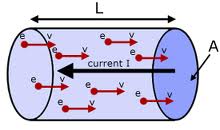
The drift velocity is the average velocity that a particle, such as an electron, attains in a material due to an electric field. It can also be referred to as axial drift velocity. In general, an electron will propagate randomly in a conductor at the Fermi velocity.
When a conductor is subjected to an electric field E, each electron experiences a force
F = - eE, and free electron acquires an
acceleration, a= F/m = - eE/m ... (i)
where, m = mass of electron, e = electronic charge and E = electric field.
Free electron starts accelerating and gains velocity and collide with atoms and molecules of the conductor. The average time difference between two consecutive collisions is known as relaxation time of electron and
{tex}\overline { \tau } = \frac { \tau _ { 1 } + \tau _ { 2 } + \ldots + \tau _ { n } } { n }{/tex} ...(ii)
where, {tex}\tau_{1}, \; \tau_{2}.... \; \tau_{n}{/tex} are the average time difference between 1st, 2nd, ...nth collisions.
{tex}\therefore{/tex} v1, v2, ... vn, are velocities gained by electron in 1st, 2nd, ..., nth collisions with initial thermal velocities u1, u2, ..., un, respectively.
{tex}\therefore \quad { v } _ { 1 } = { u } _ { 1 } + { a } \tau _ { 1 }{/tex}
Similarly,
{tex}\mathop {{v_2}}\limits_ \vdots = \mathop {{u_2}}\limits_ \vdots + \mathop {a{\tau _2}}\limits_ \vdots {/tex}
{tex}{v_n} = {u_n} + a{\tau _2}{/tex}
The drift speed vd may be defined as
{tex}v _ { d } = \frac { v _ { 1 } + v _ { 2 } + \ldots + v _ { n } } { n }{/tex}
{tex}v _ { d } = \frac { \left( u _ { 1 } + u _ { 2 } + \ldots + u _ { n } \right) + a \left( \tau _ { 1 } + \tau _ { 2 } + \ldots + \tau _ { n } \right) } { n }{/tex}
{tex} { v } _ { d } = \frac { \left( { u } _ { 1 } + { u } _ { 2 } + \ldots + { u } _ { n } \right) } { n } + \frac { { a } \left( \tau _ { 1 } + \tau _ { 2 } + \ldots + \tau _ { n } \right) } { n }{/tex}
{tex}v _ { d } = 0 + { a } \tau{/tex} [{tex}\because{/tex} Average thermal velocity in n collisions = 0]
{tex}{ v } _ { d } = - ( e { E } / m ) \tau{/tex} [from Eq. (i)]
This is the required expression of drift speed of free electrons in a conductor in a presence of voltage source.
Posted by Ratna Chaudhury 6 years, 8 months ago
- 3 answers
Aparna Mishra 6 years, 8 months ago
Posted by Ramandeep Singh 6 years, 8 months ago
- 0 answers

myCBSEguide
Trusted by 1 Crore+ Students

Test Generator
Create papers online. It's FREE.

CUET Mock Tests
75,000+ questions to practice only on myCBSEguide app

K@Łp@N@ $Øđh!?? 6 years, 8 months ago
1Thank You