
Ask questions which are clear, concise and easy to understand.
Ask QuestionPosted by A@Kash Kumar 5 years, 5 months ago
- 0 answers
Posted by Sai Chandu 5 years, 5 months ago
- 2 answers
Gaurav Seth 5 years, 5 months ago
मेघ आये बड़े बन ठन के संवर के
आगे-आगे नाचती गाती बयार चली
दरवाजे खिड़कियाँ खुलने लगीं गली गली
पाहुन ज्यो आये हों गाँव में शहर के
मेघ आये बड़े बन ठन के संवर के
जब प्रचंड गर्मी के बाद काले बादल आसमान पर छाने लगते हैं तो हर कोई बड़ी खुशी से उसका स्वागत करता है। इस कविता में मेघ के स्वागत की तुलना दामाद के स्वागत से की गई है। हमारे यहाँ हर जगह दामाद की बड़ी मान मर्यादा होती है। खासकर गांवों में तो जैसे पूरा गांव ही दामाद के स्वागत में जुट जाता है। मेघ किसी जमाई की तरह सज संवर कर आया है। उसके स्वागत में आगे-आगे नाचती गाती हुई हवा चल रही है, ठीक उसी तरह जैसे गांव की सालियाँ किसी जमाई के आने के समय करती हैं। लोग दरवाजे और खिड़कियाँ खोलकर उसकी एक झलक देखने को बेताब हैं।
Posted by Aman Kumar 5 years, 5 months ago
- 2 answers
Gaurav Seth 5 years, 5 months ago
Word-meanings
Page13
Set sail-started journey by sea. समुद्रीयात्रा प्रारम्भ क ी; duplicate-repeat, copy अनुसरण करन ा; voyage-a sea journey; In the wake of-afterwards. Just as Captain Cook had done; honing-improving, sharpening. सुधारना; seafaring–travelling by sea; hull–lower part of the ship; leg-stage, round,चरण; heading-sailing towards; crewmen-helpers, seamen; tackle–deal with, handle.निपटना; roughest–most stormy
Page 14
Encounter–meet, come across, face, सामना करना; gale–violent winds, आँधी – तूफ़ान; alarming–dangerous. Terrifying, व्याकुल कर देने वाल ी; main mast-central long pole, मस्तूल; despite–in spite of,के बावजूद; atrocious–rough, violent, क्रूर; reasoned–told ourselves; gigantic–huge, high,विशाल ऊँची; jib-a triangular staysail. तिकोना पाल; knots–a nautical mile; enormous–huge, विशाल; screaming–making sharp noise. चीख, पुकार; lashed–tied, fastened together; mooring-rope–a rope used for securing a boat on the coast, घाट पर बाँधने वाला रस्म; loop–noose, फंद ा; stern–back part of the ship. जहाज का पिछला भाग; life raft-a fleet made of logs, नदी पार करने के लिए तख्तों से बनाया गया बेड़ ा; spray–flying of small drops of water. फुहार; drill–exercise, practical training. अभ्यास; attached–joined,जोड़ दिय ा; donned–put on, पहन लिय ा; indication–sign, संकेत; impending–drawing near,आसन्न; disaster–ruin, mishap.तबाही ,विपद ा; dropped–stopped blowing; towered–mounted. ऊपर आ गय ा; aft–back, पीठ; horror–fear,भय; vertical–standing upright, लंब की भाँति; frightful–deadly. Dreadful.डरावन ी; crest–top; thunder–loud roar. गर्जन; tremendous–fearful; explosion–burst, विस्फोट; deck– the platform of a ship; torrent–a strong fast stream; smashed–hit, struck,टकराय ा; popped–rose, ऊthe पर उठ गय ा; capsizing–overturning.उलट रहा थ ा; horizontal–level. समानांतर; hurled–threw with force.वेग से उछाल दिय ा; jerked–moved; taut–tight; lifeline–a rope thrown to secure someone from drowning; Wavewalker– the name given to the boat; grabbed–caught firmly; guardrails–the horizontal pieces of iron or wood for security. Raithe ling; a boom–long pole. पाल दण्ड; subsequent–that came thereafter, बाद में आने वाल ी; tossed–threw, फैंक ा; rag doll–a doll made of a torn clothes, a toy,गुड़िय ा; ribs–chest bones, पसलियाँ; cracked–broke, चटक गई; hung on–trapped. लटका रह ा; abandon–leave.छोड़न ा; investigate–find out, पता लगाना I
Page 15
Screamed–cried; decks– platform, roof; smashed–broken; scrambled–tried to catch. झपट कर पकड़ ा; hatch–a small opening in a floor. ; timbers–wood used for building purpose,इमारती लकड़ ी; crazy –odd. बेढंगे तरीके स े; starboard–right-hand side of a ship,जलपोत का दाहिना भाग; bulged–swollen, फूल गया sloshed–moved around water, पानी चल रहे थ े; bunk–sleeping berth. शयन स्थान; a bit–a little bump–swelling.गुमड़ा ; hammer–a tool for driving nails, हथौड़ी; screws–a metal fastener. पेच ; canvas–water proof material, thick cloth of hemp or flax, किरमिच ; bashed open–struck open forcibly, आघात के कारण खुल गया ; stretch–spread out; hatch covers–the lids to cover the openings in the deck; gaping–open; deflected–turned to another direction, रास्ता मोड़ दिया; debris–scattered broken things, मलबा, कचरा ; threateningly–In an alarming manner. खतरनाक तरीके से; wrenched–pulled off, twisted. खराब हो गया थ ा; dinghies–small boats on a ship; anchor–piece of heavy metal, लंगर; chartroom–where maps used for navigation are kept; dragged on–passed with difficulty; steering–the mechanism or wheel to control the direction; Mayday calls–radio signals used by ships in distress calling for help. Remote–far off; swollen– सूज गया थ ा; alarmingly–dangerously; enormous–big; sufficiently–enough, adequate; In rotation–turn by turn. बारी –बारी से; tremendous–big, अधिक; leak–opening, छेद I
Page16
Rib–one of the ships curved timbers, घुमावदार लकड़ ी; smashed to the keel–completely broken; starboard hull–the lower part of the right side of the ship; calculated–estimated, अनुमान गलाय ा; pinpricks–very small dots or islands; abated–cooled down, grew less severe; hoist–flutter,फहराना ; slim–very little, thin, कम ; auxiliary–additional, अतिरिक्त; main mast–prime pole, प्रमुख मस्तूल ;pressure–pulls; rigging–ropes; pull apart–separate, अलग कर देना ; corned–saved from damage; respite–relief, interval of rest, विराम ; deteriorate–grow worse, worsen, बदतर होना ; dawn–daybreak; desperate–hopeless; respond–reply; heave-to–lift, raise with great effort, बलपूर्वक खींचन ा; improvise–to use whatever is available,काम चलाऊ; anchor–a heavy metal object which helps to keep a ship In one place लंगर; barrels–drums; paraffin–waxमोम; planks–long flat pieces of sawn timber, तख्ते; rode out–survived. बच निकल ा; easing–cooling down.
Pages 1 7-18
A sextant–an instrument for measuring,कोण की दूरी मापने का यंत्र; drift–slow currents. मंद बहाव ; slits–thin openings, झिरी ; caricature–funny representation of a person, व्यंग चित्र; compass–instrument with magnetised needle, क़ुतुबनुमा; variation–changes indicating direction; conviction–firm belief, दृढ़विश्वास; dozed off–slept; tousled–rough, disorderly, बिखरे बाल ; hug–embrace, आलिंगन; chorused–spoke jointly, एक साथ बोले ; stark–bare, stiff naked; bleak–cheerless; little vegetation–no greenery. Barren; anchored–dropped the heavy iron piece,जहाज का लंगर गिराये रख ा; off-shore–near the shore. तट के निकट; inhabitants–residents, निवास ी; optimistic–hopeful; direst–extreme, most horrible; stress–pressure, strain; crucial–critical; subsequently–coming after, बाद में; recurring–coming up again and again; clot–half solid lump, रक्त का थक्का l
Posted by Divyesh Selot 5 years, 5 months ago
- 0 answers
Posted by Aadya Singh 5 years, 5 months ago
- 3 answers
Posted by Aadya Singh 5 years, 5 months ago
- 3 answers
? S. S. ? 5 years, 5 months ago
Posted by Aadya Singh 5 years, 5 months ago
- 0 answers
Posted by Aadya Singh 5 years, 5 months ago
- 1 answers
Gaurav Seth 5 years, 5 months ago
Molarity = Number of moles of solute per litre of solution in molar concentration
M = no of moles / volume
Mole = mass/molar mass = 1000/18= 55.56 mol
1l of water = 1000mL = 1Kg
Density = 1000kg/m3
therefore Molarity = 55.56mol/1L = 55.56mol/L
Posted by Aadya Singh 5 years, 5 months ago
- 2 answers
Gaurav Seth 5 years, 5 months ago
Given,
Mass of solute, glucose = 36 g
Mass of solvent, water = 250 g
Molar mass of glucose = 180 g/mole
Molality : It is defined as the number of moles of solute present in the one kilogram of solvent.
Formula used :
where,
= mass of solute, glucose
= mass of solvent, water
= molar mass of solute, glucose
Now put all the given values in the above formula, we get
Therefore, the molality of solution is, 0.8 mole/Kg
Posted by Aadya Singh 5 years, 5 months ago
- 1 answers
Ruhi Rao 5 years, 5 months ago
Posted by Aadya Singh 4 years, 9 months ago
- 1 answers
Sia ? 4 years, 9 months ago
|
Molarity |
Molality |
|
Molarity of a given solution is defined as the total number of moles of solute per litre of solution. |
Molality is defined as the total moles of a solute contained in a kilogram of a solvent. |
|
Mathematical expression is M = number of moles of the solute /Volume of solution given in terms of litres. |
Mathematical expression is |
|
Depends on volume of the whole solution. |
Depends on the mass of the solvent. |
|
Unit sign expressed as (M). |
Unit sign expressed as (m). |
|
Molarity has a unit of moles/liter. |
Molality has units of moles/kg. |
Posted by Aadya Singh 5 years, 5 months ago
- 3 answers
Gaurav Seth 5 years, 5 months ago
Molarity
It is one of the most widely used unit of concentration and is denoted by M. It is defined as no. of moles of solute present in 1 liter of solution. Thus,
Molarity = No. of moles of solute / Volume of solution(in Litres)
Posted by Aadya Singh 5 years, 5 months ago
- 1 answers
Gaurav Seth 5 years, 5 months ago
Normality in chemistry is one of the expressions used to measure the concentration of a solution. It is abbreviated as ‘N’ and is sometimes referred to as the equivalent concentration of a solution. It is mainly used as a measure of reactive species in a solution and during titration reactions or particularly in situations involving acid-base chemistry.
As per the standard definition, normality is described as the number of gram or mole equivalents of solute present in one litre of a solution. When we say equivalent, it is the number of moles of reactive units in a compound.
Posted by Aadya Singh 5 years, 5 months ago
- 1 answers
Gaurav Seth 5 years, 5 months ago
- Parts per million can be defined as the ratio of number of parts of the component to the total number of parts of all components of the solution multiplied by 106.
- It is denoted by ppm.
Posted by Aadya Singh 5 years, 5 months ago
- 1 answers
Gaurav Seth 5 years, 5 months ago
Mass per cent is a way of expressing a concentration or describing the component in a particular mixture. The solution composition can be described in mass percentage which shows the mass of solute present in a given mass of solution. The quantity of solute is expressed in mass or by moles. For a solution, the mass per cent is described as the grams of solute per grams of solution, multiplied by 100 to get the percentage.
Mass per cent Formula
The Mass per cent formula is expressed as solving for the molar mass also for the mass of each element in 1 mole of the compound. You can determine the mass percentage of each element with these masses.
Posted by Aadya Singh 5 years, 5 months ago
- 1 answers
Gaurav Seth 5 years, 5 months ago
Mass by volume percentage
- Mass by volume percentage can be defined as the mass of solute dissolved in 100 mL of the solution.
- For instance, mass by volume percent of a solution with 1 g of solute dissolved in 100 mL of solution will be 1% or 1% (mass/volume).
- Mathematically, Mass by volume% =

Posted by Aadya Singh 5 years, 5 months ago
- 1 answers
Gaurav Seth 5 years, 5 months ago
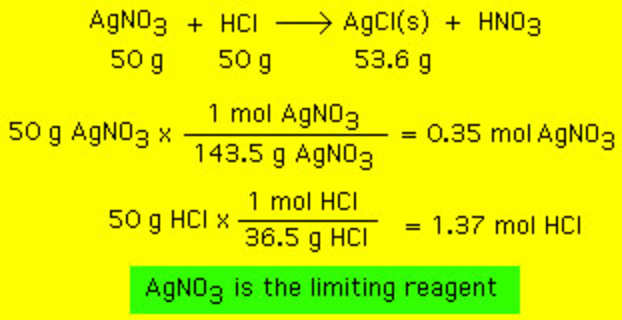
The reactant which reacts completely in the reaction is called limiting reactant or limiting reagent.
The reactant which is not consumed completely in the reaction is called excess reactant .
Posted by Aadya Singh 5 years, 5 months ago
- 1 answers
Gaurav Seth 5 years, 5 months ago
CH4 + 2O2 -> CO2 + 2H2O
GRAM MOLECULAR MASS OF CO2 = 12 +2(16) = 44g
From the reaction it is clear that 1 mole of methane on complete combustion produces 44g (1 mole) of carbon dioxide.
therefore moles of CH4 required to produce 22g of CO2 are:
(22) * (1/44) = 1/2 moles
Posted by Aadya Singh 5 years, 5 months ago
- 1 answers
Gaurav Seth 5 years, 5 months ago
- The word ‘stoichiometry’ is derived from two Greek words - stoicheion (meaning element) and metron (meaning measure).
- Stoichiometry deals with the calculation of masses (sometimes volumes also) of the reactants and the products involved in a chemical reaction.
- This is done using balance chemical equation.
Posted by Buli Bhoi 5 years, 5 months ago
- 1 answers
Posted by Aadya Singh 5 years, 5 months ago
- 1 answers
Gaurav Seth 5 years, 5 months ago
This method is also called trial and error method, or inspection method. In this method, coefficient before the formulae or symbols of the reactants and products are adjusted in such a way that the total number of atoms of each element only both the sides become equal. This is called material balance, or mass balance. In this method first of all, atoms of the element which appears least in the chemical equation should be balanced. Then, the next one, and so only.
Posted by Aadya Singh 5 years, 5 months ago
- 1 answers
Gaurav Seth 5 years, 5 months ago
A chemical equation has its own limitations. They do not provide information about:
- The physical state of reactants and products Hence, the symbols ‘s’ for solid, ‘l’ for liquid, ‘g’ for gas and ‘vap’ for vapour are added.
- Conditions such as temperature, pressure and catalyst affecting the reaction
- Concentration of reactants and products Hence, in some cases, for dilute ‘dil.’ and for concentrated ‘conc.’ are added.
- The nature of the chemical reaction; whether it is reversible or irreversible reaction.
- Speed of the reaction
- Heat changes accompanying the reaction; whether heat is given out or absorbed
- Time taken for completion of the reaction A reaction may or may not be complete, and the equation does not reveal it.
Posted by Aadya Singh 5 years, 5 months ago
- 1 answers
Gaurav Seth 5 years, 5 months ago
The atomic mass of metal M is 56. Calculate the empirical formula of its oxide containing 70% of M.
<hr />(i) To calculate the percentage of oxygen.

(ii) To calculate the empirical formula of oxide:

Posted by Aadya Singh 5 years, 5 months ago
- 1 answers
Gaurav Seth 5 years, 5 months ago
Molecular mass of {tex}KHSO_(4)=39+1=32+64=136.0u{/tex}
Percentage of potassium =(39u) / (136u)×100 = 28.68%
Percentage of hydrogen =(1u) / (136u)×100 = 0.735%
Percentage of sulphur =(32u) / (136u)×100 = 23.53%
Percentage of oxygen =(64u) / (136u)×100 = 47.06%
Posted by Aadya Singh 5 years, 5 months ago
- 1 answers
Gaurav Seth 5 years, 5 months ago
S o l u t i o n:
The chemical formula of FeSo4 . 7 H2O
= 55.8 + 32.1 + 16x4 + 7x18
= 277.9
The percentage of water of crystallization=
= (7 x 18) / 277.9 x 100 %
= 45.34 %
Posted by Aadya Singh 5 years, 5 months ago
- 1 answers
Amrit Preet Kaur 5 years, 5 months ago
Posted by Pranjana Das 5 years, 5 months ago
- 0 answers
Posted by Aadya Singh 5 years, 5 months ago
- 1 answers
Ojhal Sharma 5 years, 5 months ago

myCBSEguide
Trusted by 1 Crore+ Students

Test Generator
Create papers online. It's FREE.

CUET Mock Tests
75,000+ questions to practice only on myCBSEguide app
