
Ask questions which are clear, concise and easy to understand.
Ask Question
Posted by Shubham Sharma 5 years, 8 months ago
- 0 answers
Posted by Bharat Bhushan 6 years, 10 months ago
- 0 answers
Posted by Subhi ? 6 years, 10 months ago
- 1 answers
😜Arnav Arya🙃 6 years, 10 months ago
Posted by Sukhman Preet 6 years, 10 months ago
- 1 answers
Gaurav Seth 6 years, 10 months ago
Amendment to the Constitution requires two different kinds of special majorities; in the first place, those voting in favour
of the amendment bill should constitute at least half of the total strength of that House. Secondly, the supporters of the
amendment bill must also constitute two-third of those who actually take part in voting. Both the Houses of Parliament
must pass the amendment bill separately. This special majority is required for the reason that it would need at least
some opposition parties into confidence so that the amending procedure is based on the basic principle that it should be
based on broad support among the political parties and parliamentarians. In respect of the articles related to distribution
of powers between the Centre and States or articles related to representation, it is necessary that the States must be
consulted. The powers of the State must not be at the mercy of the Central government. The constitution has ensured
this by providing that legislatures of half of the States have to pass such an amendment bill. The articles related to
federal structure, provisions about Fundamental Rights, are also amended in this manner. Thus through wide consensus
and limited participation of the States, the Constitution of India can be amended. Only half of the States is required due
to the reason that the framers of the Constitution were most careful to keep this procedure somewhat flexible even in its
more rigid format; consent of only half the States and simple majority of the State legislature is sufficient.
Posted by Dhruv Shukla 5 years, 8 months ago
- 1 answers
Yaser Siddiquee 6 years, 10 months ago
Posted by Green Shadow 6 years, 10 months ago
- 1 answers
Posted by Raju Kumar 6 years, 10 months ago
- 1 answers
Gaurav Seth 6 years, 10 months ago
The formula of moment inertia in terms of the radius of gyration is given as follows:
I = mk2 (1)
where I is the moment of inertia and m is the mass of the body
Accordingly, the radius of gyration is given as follows
k=√I/m (2)
The unit of radius of gyration is mm. By knowing the radius of gyration, one can find the moment of inertia of any complex body equation (1) without any hassle.
Consider a body having n number of particles each having a mass of m. Let the perpendicular distance from the axis of rotation be given by r1, r2, r3,…,rn. We know that the moment of inertia in terms of radius of gyration is given by the equation (1). Substituting the values in the equation, we get the moment of inertia of the body as follows

………… (3)
If all the particles have the same mass then equation (3) becomes
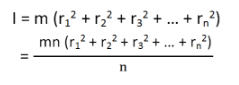
We can write mn as M which signifies the total mass of the body. Now the equation becomes
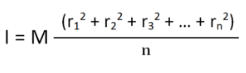
………… (4)
From equation (4), we get
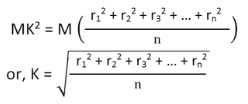
From the above equation, we can infer that the radius of gyration can also be defined as the root mean square distance of various particle of the body from the axis of rotation.
Posted by Mewan Tham 6 years, 10 months ago
- 1 answers
Gaurav Seth 6 years, 10 months ago
The Feudal system in Europe had a graded; organisation which is sometimes called “Feudal Pyramid”.
The main features of the social organisation of the Feudal system in Europe are described below:
(i) The King: The king was on the top of this organisation (Feudal system). All the feudal lords were under the king. He
used to take a part of the revenue collections which the feudal lords had from their areas or lands of agriculture.
(ii) Dukes and Earls: The second powerful class of the "Feudal system" consisted of the "Dukes" and "Earls". The king
bestowed the estates on a number of the Dukes and Earls who owned loyalty to the king.
(iii) Barons or lower lords: The Earls and Dukes distributed the parts of their estates to the lower lords called “Barons”. In
return for that, they provided military support to the Dukes or Earls whensoever required or needed.
(iv) The Knights: The knights formed the lowest category of Feudal lords. Mostly they were the vassals of the Barons and
provided them military service. The knights had no direct links either with the Dukes or the Earls.
(v) The Peasants: The peasants formed the lowest class in the feudal society. They cultivated and managed the land
which they received from their lords. The Peasants were divided into three classes: (i) The Independent peasant (ii) The
Slave Peasants (iii) The Bonded peasants (serfs).
Posted by Priya Samuya 6 years, 10 months ago
- 0 answers
Posted by Padma Jain 6 years, 10 months ago
- 0 answers
Posted by Karan Raikwar 6 years, 10 months ago
- 0 answers
Posted by Abhinav Bhardwaj 6 years, 10 months ago
- 0 answers
Posted by Aaditya Rathore??? 6 years, 10 months ago
- 2 answers
Ayushi Ayushi 6 years, 10 months ago
Posted by Punit Jangir 6 years, 10 months ago
- 1 answers
Posted by Famsi Isk 6 years, 10 months ago
- 0 answers
Posted by Punit Jangir 6 years, 10 months ago
- 1 answers
Ayushi Ayushi 6 years, 10 months ago
Posted by Sonu Mardi 6 years, 10 months ago
- 2 answers
Aditi Shourya 6 years, 10 months ago
Ayushi Ayushi 6 years, 10 months ago
Posted by Somya Mittal 6 years, 10 months ago
- 0 answers
Posted by Shivam Bansal 6 years, 10 months ago
- 2 answers
Yanshi Dhawan 6 years, 10 months ago
Posted by Lavi Dwivedi 6 years, 10 months ago
- 0 answers
Posted by Avinash Kumar 6 years, 10 months ago
- 1 answers
Aditi Shourya 6 years, 10 months ago
Posted by Amaan Ansari 6 years, 10 months ago
- 1 answers
Prachi Goyal 6 years, 10 months ago
Posted by Anjali Gupta 6 years, 10 months ago
- 0 answers
Posted by Manojit Bhagat 6 years, 10 months ago
- 4 answers
Posted by Nitu Saj 6 years, 10 months ago
- 0 answers
Posted by Aman Kadri 6 years, 10 months ago
- 0 answers
Posted by Dheet Singh 6 years, 10 months ago
- 3 answers

myCBSEguide
Trusted by 1 Crore+ Students

Test Generator
Create papers online. It's FREE.

CUET Mock Tests
75,000+ questions to practice only on myCBSEguide app

Vinay Gautam 6 years, 10 months ago
2Thank You