
Ask questions which are clear, concise and easy to understand.
Ask QuestionPosted by Deepanshu Deepanshu 6 years, 10 months ago
- 2 answers
Suhani Sharma 6 years, 10 months ago
Posted by Sundar Kumar 6 years, 10 months ago
- 1 answers
Gursharn Kaur 6 years, 10 months ago
Posted by Gourav Mishra 6 years, 10 months ago
- 2 answers
Kanishka Raturi 6 years, 10 months ago
Yaser Siddiquee 6 years, 10 months ago
Posted by Mohan Rawat 6 years, 10 months ago
- 1 answers
Posted by Manik Mallick 6 years, 10 months ago
- 1 answers
Mittali Khandelwal ????? 6 years, 10 months ago
Posted by Aditya Rialch 6 years, 10 months ago
- 1 answers
Posted by Shadow Kiruu 6 years, 10 months ago
- 1 answers
Posted by Rubu Tailyang7 6 years, 10 months ago
- 1 answers
Garhwalli???? Nona 6 years, 10 months ago
Posted by Sachin Barde 6 years, 10 months ago
- 0 answers
Posted by Shivam Bhand 6 years, 10 months ago
- 1 answers
Posted by Harshit Singh 6 years, 10 months ago
- 1 answers
Gaurav Seth 6 years, 10 months ago
Chemical Properties of Alkynes
Acidic nature
Coming to the chemical properties of alkynes, we begin with their slightly acidic nature. Now Alkynes are slightly electronegative in nature. The triply bonded carbon atoms in alkynes are sp hybridized, Whereas like in alkanes the single bond atoms are sp3 hybridized, causing the difference in the electronegativity. This makes it easier for them to attract the shared electron pair of the C-H bond.
So when we react a strong base like NaNH2 with ethyne, we will get sodium acetylide and liberated hydrogen (H2) gas. But such reactions will not happen in alkanes and alkenes. The conclusion being that the hydrogen atoms attached to the carbon-carbon triple bond in alkynes are slightly acidic in nature. It is to be noted the other hydrogen atoms baring these ones are not acidic.
HC ≡ CH + Na → HC ≡ C– Na+ + 1/2H2
Addition Reactions
Under suitable conditions (temperature and pressure) alkynes will undergo hydration reactions quite easily. Alkynes will react with halogens, hydrogen and other such elements to give a saturated compound as a product. Since they have a triple bond, two atoms of H2 or halides or halogens can be added to its structure.
1] Addition of Dihydrogen
The reaction occurs in presence of a catalyst such as Nickel or Platinum or Palladium. Here the addition of hydrogen to the alkyne gives us an alkene.
C3H4(g) + 2H2(g)  C3H8(g)
2] Addition of Halogens
When alkynes and halogens like Bromine react, halogen will add itself to the structure of the alkynes and result in halogen substituted alkenes. The resulting product will be tetrabromopropane.

(Source: chemistryassignment)
3] Addition of Water
Just like other hydrocarbons (alkanes and alkenes) alkynes also do not react with a water molecule. This is called immiscibility. But if alkynes is bubbled through dilute sulphuric acid (about 40%) in presence of the catalyst mercuric Sulphate, then a reaction occurs. The products will be carbonyl compounds, and such a reaction can be called a hydration reaction.

(Source: chemistryassignment)
4] Polymerization
Alkynes can undergo linear and cyclic polymerization under suitable conditions. They polymerize to give compounds that have a higher molecular weight than the original alkyne. Like for example, ethyne will polymerize to give polyacetylene or polyethene (of higher molecular weight), This is an example of linear polymerization.
For cyclic polymerization, high temperatures and the presence of a catalyst is required. Like passing ethyne through a red-hot iron tube at a minimum of 877K which gives benzene.
Chemical Properties of Alkynes
Acidic nature
Coming to the chemical properties of alkynes, we begin with their slightly acidic nature. Now Alkynes are slightly electronegative in nature. The triply bonded carbon atoms in alkynes are sp hybridized, Whereas like in alkanes the single bond atoms are sp3 hybridized, causing the difference in the electronegativity. This makes it easier for them to attract the shared electron pair of the C-H bond.
So when we react a strong base like NaNH2 with ethyne, we will get sodium acetylide and liberated hydrogen (H2) gas. But such reactions will not happen in alkanes and alkenes. The conclusion being that the hydrogen atoms attached to the carbon-carbon triple bond in alkynes are slightly acidic in nature. It is to be noted the other hydrogen atoms baring these ones are not acidic.
HC ≡ CH + Na → HC ≡ C– Na+ + 1/2H2
Addition Reactions
Under suitable conditions (temperature and pressure) alkynes will undergo hydration reactions quite easily. Alkynes will react with halogens, hydrogen and other such elements to give a saturated compound as a product. Since they have a triple bond, two atoms of H2 or halides or halogens can be added to its structure.
1] Addition of Dihydrogen
The reaction occurs in presence of a catalyst such as Nickel or Platinum or Palladium. Here the addition of hydrogen to the alkyne gives us an alkene.
C3H4(g) + 2H2(g) C3H8(g)
2] Addition of Halogens
When alkynes and halogens like Bromine react, halogen will add itself to the structure of the alkynes and result in halogen substituted alkenes. The resulting product will be tetrabromopropane.
(Source: chemistryassignment)
3] Addition of Water
Just like other hydrocarbons (alkanes and alkenes) alkynes also do not react with a water molecule. This is called immiscibility. But if alkynes is bubbled through dilute sulphuric acid (about 40%) in presence of the catalyst mercuric Sulphate, then a reaction occurs. The products will be carbonyl compounds, and such a reaction can be called a hydration reaction.
(Source: chemistryassignment)
4] Polymerization
Alkynes can undergo linear and cyclic polymerization under suitable conditions. They polymerize to give compounds that have a higher molecular weight than the original alkyne. Like for example, ethyne will polymerize to give polyacetylene or polyethene (of higher molecular weight), This is an example of linear polymerization.
For cyclic polymerization, high temperatures and the presence of a catalyst is required. Like passing ethyne through a red-hot iron tube at a minimum of 877K which gives benzene.
Posted by Jerang Annong 6 years, 10 months ago
- 0 answers
Posted by Mayank Bansal 6 years, 10 months ago
- 3 answers
Gaurav Seth 6 years, 10 months ago
Merchandise are the manufactured goods bought and sold in any business.
Posted by Prince Maurya 6 years, 10 months ago
- 2 answers
Avantika Tayal 6 years, 10 months ago
Barinderjit Singh 6 years, 10 months ago
Posted by Aditya Kumar 6 years, 10 months ago
- 0 answers
Posted by Rishika Jain 6 years, 10 months ago
- 0 answers
Posted by Sheik Farhan 6 years, 10 months ago
- 1 answers
Posted by Maryam Noor 6 years, 10 months ago
- 1 answers
Gaurav Seth 6 years, 10 months ago
Molecular orbital diagram of N2 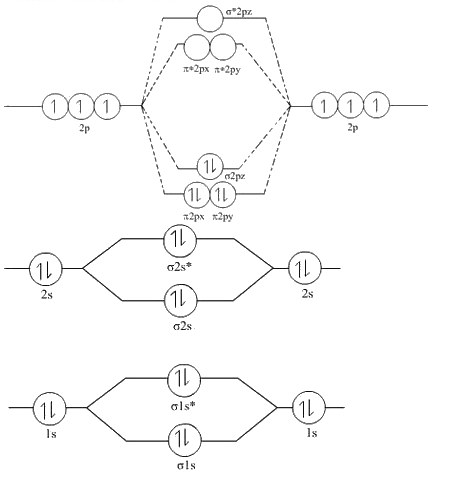 BO =  [Nb-Na] =[10-4] = 3 [Nb-Na] =[10-4] = 3Since all the electrons in nitrogen are paired, it is diamagnetic molecule. |
Posted by Aarif Ansari 6 years, 10 months ago
- 1 answers
Posted by Natik Malik 6 years, 10 months ago
- 0 answers
Posted by Manu Thakur 6 years, 10 months ago
- 0 answers
Posted by Manu Thakur 6 years, 10 months ago
- 0 answers
Posted by Manu Thakur 6 years, 10 months ago
- 1 answers
Posted by Aman Singh 6 years, 10 months ago
- 0 answers
Posted by Angel George 6 years, 10 months ago
- 2 answers
Ashish Mourya 6 years, 10 months ago
Anjali Gupta 6 years, 10 months ago
Posted by Known Un 6 years, 10 months ago
- 1 answers
Ashish Kumar Singh 6 years, 10 months ago
Posted by Amar Lal 6 years, 10 months ago
- 1 answers
Palak Bhinder 6 years, 10 months ago

myCBSEguide
Trusted by 1 Crore+ Students

Test Generator
Create papers online. It's FREE.

CUET Mock Tests
75,000+ questions to practice only on myCBSEguide app

Suhani Sharma 6 years, 10 months ago
0Thank You