
Ask questions which are clear, concise and easy to understand.
Ask QuestionPosted by Laxmi Laxmi 6 years, 10 months ago
- 1 answers
Posted by Sadhana Saroj 6 years, 10 months ago
- 2 answers
Posted by Miching Robinn 6 years, 10 months ago
- 0 answers
Posted by Shamsad Ali 6 years, 10 months ago
- 1 answers
Posted by Madhup Kumar 6 years, 10 months ago
- 1 answers
Gaurav Seth 6 years, 10 months ago
The radius of gyration of a body about a given axis is the perpendicular distance of a point P from the axis, where if whole mass of the body were concentrated, as the body shall have the same moment of inertia as it has with the actual distribution of mass.
Radius of gyration is represented by K.
Posted by Ankit Saini 6 years, 10 months ago
- 1 answers
Rizul Dulat 6 years, 10 months ago
Posted by Himanshu Kumar 6 years, 10 months ago
- 1 answers
Syed Nabeel Haider 6 years, 10 months ago
Posted by Madhup Kumar 6 years, 10 months ago
- 1 answers
Gaurav Seth 6 years, 10 months ago
Consider a liquid drop of radius R and surface tension T.
Due to surface tension the molecules on the surface film experience the net force in inward direction normal to the surface.
Therefore there is more pressure inside than outside.
Let pi be the pressure inside the liquid drop and po be the pressure outside the drop.
Therefore excess of pressure inside the liquid drop is,
p = p1– p0
Due to excess of pressure inside the liquid drop the free surface of the drop will experience the net force in outward direction due to which the drop will expand.
Let the free surface displace by dR under isothermal conditions.
Therefore excess of pressure does the work in displacing the surface and that work will be stored in the form of potential energy.
The work done by excess of pressure in displacing the surface is,
dW = Force x displacement
= (Excess of pressure x surface area) x displacement of surface

Increase in the potential energy is,
dU = surface tension x increase in area of the free surface

The above expression gives us the pressure inside a liquid drop.
Posted by Anshul Sharma 6 years, 10 months ago
- 0 answers
Posted by Madhup Kumar 6 years, 10 months ago
- 0 answers
Posted by Sabiha Shaikh 6 years, 10 months ago
- 2 answers
Himanshu Kumar 6 years, 10 months ago
Gaurav Seth 6 years, 10 months ago
| Meaning | Bill of Exchange is an instrument in writing showing the indebtedness of a buyer towards the seller of goods. | A promissory note is a written promise made by the debtor to pay a certain sum of money to the creditor at a future specified date. |
| Defined in | Section 5 of Negotiable Instrument Act, 1881. | Section 4 of Negotiable Instrument Act, 1881. |
| Parties | Three parties, i.e. drawer, drawee and payee. | Two parties, i.e. drawer and payee. |
| Drawn by | Creditor | Debtor |
| Liability of Maker | Secondary and conditional | Primary and absolute |
| Can maker and payee be the same person? | Yes | No |
| Copies | Bill can be drawn in copies. | Promissory Note cannot be drawn in copies. |
| Dishonor | Notice is necessary to be given to all the parties involved. | Notice is not necessary to be given to the maker. |
Posted by Madhup Kumar 6 years, 10 months ago
- 1 answers
Gaurav Seth 6 years, 10 months ago
Derive an expression for work done in isothermal process
<section data-topic-id="6324" id="topic"> <article data-post-id="7452" data-topic-id="6324" data-user-id="2" id="post_1">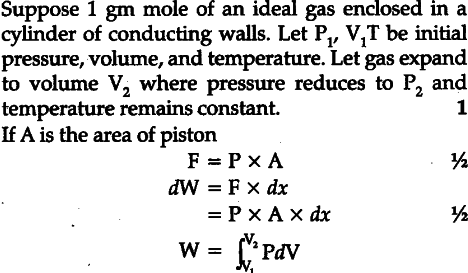
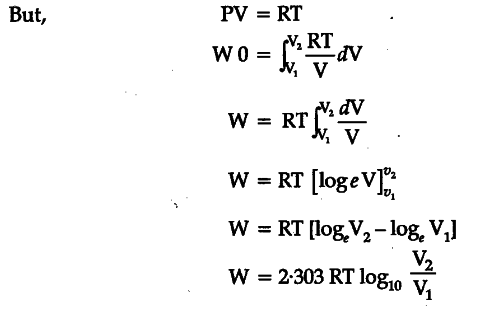
Posted by Sabiha Shaikh 6 years, 10 months ago
- 0 answers
Posted by Vaibhav Pandey 6 years, 10 months ago
- 1 answers
Manish Kumawat 6 years, 10 months ago
Posted by Madhup Kumar 6 years, 10 months ago
- 1 answers
Gaurav Seth 6 years, 10 months ago
Statement: For the streamline flow of non-viscous and incompressible liquid, the sum of potential energy, kinetic energy and pressure energy is constant.


Proof:
Let us consider the ideal liquid of density ρ flowing through the pipe LM of varying cross-section.
Let P1 and P2 be the pressures at ends L and M and A1 and A2 be the areas of cross-sections at ends L and M respectively.
Let the liquid enter with velocity V1 and leave with velocity v2.
Let A1 > A2.
Now, by equation of continuity,

Since, A1 > A2
Therefore,
v2 > v1 and P1 > P2
Let, m be the mass of liquid enetring at end L in time t.
The liquid will cover a distance = v1t
Therefore, the work done by pressure on the liquid at end L in time t is,
W1 = Force 
= P1A1v1t ... (1)
Since same mass m leaves the pipe at end M in same time t, in which liquid will cover the distance given by v2t.
Therefore, work done by liquid against the force due to pressure P1 is given by,
W2 = P2A2v2t ... (2)
Net ork done by pressure on the liquid in time t is,
W = W1 - W2
=P1A1v1t - P2A2v2t ... (3)
This work done on liquid by pressure increases it's kinetic energy and potential energy.
Increase in K.E of liquid is,

That is,

Posted by Sabiha Shaikh 6 years, 10 months ago
- 1 answers
Himanshu Kumar 6 years, 10 months ago
Posted by Deo Thakur 6 years, 10 months ago
- 1 answers
Manish Kumawat 6 years, 10 months ago
Posted by Mohan Kumar 6 years, 10 months ago
- 0 answers
Posted by Abhishek Kumar 6 years, 10 months ago
- 2 answers
Sakshi Sharma??️??️ 6 years, 10 months ago
Yaser Siddiquee 6 years, 10 months ago
Posted by Akhila K S English 6 years, 10 months ago
- 2 answers
Gursharn Kaur 6 years, 10 months ago
Posted by Grover Saab 6 years, 10 months ago
- 1 answers
Yaser Siddiquee 6 years, 10 months ago
Posted by Akshit Aggarwal 6 years, 10 months ago
- 0 answers

myCBSEguide
Trusted by 1 Crore+ Students

Test Generator
Create papers online. It's FREE.

CUET Mock Tests
75,000+ questions to practice only on myCBSEguide app

Rizul Dulat 6 years, 10 months ago
0Thank You