
Ask questions which are clear, concise and easy to understand.
Ask QuestionPosted by Tainya Kumari 6 years, 5 months ago
- 4 answers
Charu Sharma 6 years, 5 months ago
Ravi Yadav 6 years, 5 months ago
Posted by Hitesh Agarwal 6 years, 5 months ago
- 0 answers
Posted by Anjali Raja 6 years, 5 months ago
- 0 answers
Posted by Harsh Sharma 6 years, 5 months ago
- 3 answers
Posted by Amaira Shanz 6 years, 5 months ago
- 2 answers
Ritika Dongre 4 years, 10 months ago
Posted by Harsh Sharma 6 years, 5 months ago
- 0 answers
Posted by Pawan Kumar Chhetri 6 years, 5 months ago
- 1 answers
Pratiksha Pilane 6 years, 5 months ago
Posted by Diwakar Kumar 6 years, 5 months ago
- 1 answers
Posted by Kush Agrawal 6 years, 5 months ago
- 0 answers
Posted by Anangsha Dawn 6 years, 5 months ago
- 0 answers
Posted by Harsh Sharma 6 years, 5 months ago
- 1 answers
Sia ? 6 years, 5 months ago
A number of economics problems can easily be understood by the use of statistics. It helps in formulation of economic policies e.g., basic economic activities like production, consumption etc. use statistics. The importance of statistics in various parts of economics as follows:
- Statistics in consumption: To obtain the knowledge of how different groups of people spend their income on consumption. The data of consumption are useful and helpful in planning their budget and in improving their standards of living.
- Statistics in production: The comparative study of the production process is done with the help of statistics. The statistics in production is very useful and helpful in the adjustment of demand and supply and for determining the quantity of production of the commodity.
- Statistic in distribution: Statistical methods are used in solving the problem of distribution of national income among various factor of production i.e, land, labour, capital and entrepreneur.
Posted by Chander Shekhar 6 years, 5 months ago
- 1 answers
Sia ? 6 years, 5 months ago
The accounting equation is considered to be the foundation of the double-entry accounting system. The accounting equation shows on a company's balance sheet whereby the total of all the company's assets equals the sum of the company's liabilities and shareholders' equity. Based on this double-entry system, the accounting equation ensures that the balance sheet remains “balanced,” and each entry made on the debit side should have a corresponding entry (or coverage) on the credit side.The financial position of any business, large or small, is assessed based on two key components of the balance sheet, assets, and liabilities.
For example,
- Purchasing a Machine with Cash
Company XYZ wishes to purchase a Rs. 50,000 machine using only cash. This transaction would result in a debit to Equipment (Rs. 50,000) and a credit to Cash (Rs. 50,000). The net effect on the accounting equation would be as follows:
| Assets | = | Liabilities | + | Capital |
| 50,000 | ||||
| (50,000) | ||||
| 0 | 0 | 0 |
This transaction affects only the assets of the equation, therefore there is no corresponding effect in liabilities or shareholder’s equity in the right side of the equation.
- Purchasing a Machine with Cash and Credit
Company XYZ wishes to purchase a Rs. 50,000 machine but it only has Rs. 25,000 of cash in its holdings. The company is allowed to purchase this machine with an initial payment of Rs. 25,000 but it owes the manufacturer the remaining amount. This would result in a debit to Equipment (Rs. 50,000) and a credit to both Accounts Payable (Rs. 25,000) and Cash (Rs. 25,000). The net effect on the accounting equation would be as follows:
<th scope="col">Assets</th> <th scope="col">=</th> <th scope="col">Liabilities</th> <th scope="col">+</th> <th scope="col">Capital</th>| 50,000 | 25,000 | |||
| (25,000) | ||||
| 25,000 | = | 25,000 | + | 0 |
This transaction affects both sides of the accounting equation; both the left and right side of the equation increase by Rs. 25,000.
Posted by Neetu Samant 6 years, 5 months ago
- 0 answers
Posted by Devanshu Chatterjee 6 years, 5 months ago
- 0 answers
Posted by Aryan Modi 6 years, 5 months ago
- 8 answers
Binita Biswas 6 years, 5 months ago
Posted by Akshay Aakash 6 years, 5 months ago
- 0 answers
Posted by Anuj Yaduvanshi 6 years, 5 months ago
- 1 answers
Kaushik Suklabaidya 6 years, 5 months ago
Posted by Kumar Vaibhav 6 years, 5 months ago
- 0 answers
Posted by Kumar Vaibhav 6 years, 5 months ago
- 1 answers
Kush Lundia 6 years, 5 months ago
Posted by Rima Rokde 6 years, 5 months ago
- 0 answers
Posted by Akhilesh Agrahari 6 years, 5 months ago
- 1 answers
Sia ? 6 years, 5 months ago
Difference between Gulf and straits
(i) Meaning: A gulf is a large body of water almost encircled by land except for a small mouth that opens out to the sea. A strait is a strip of water that separates two lands or two large bodies of water.
(ii) Use: Straits are used for navigational purposes and have played an integral part when it comes to shipping routes. Gulfs are more useful for human settlements, as such areas provide easy access to the ocean while being well protected as well.
(iii) Association: Gulfs can be easily associated with inland bodies of water as well as the ocean. Straits are mostly discussed with regards to the ocean.
Posted by Gagan Singh 6 years, 5 months ago
- 2 answers
Navneet Singh 6 years, 5 months ago
Preeti Yadav 6 years, 5 months ago
Posted by Harsh Sharma 6 years, 5 months ago
- 0 answers
Posted by Harsh Sharma 6 years, 5 months ago
- 1 answers
Sia ? 6 years, 5 months ago
Check NCERT Solutions here : https://mycbseguide.com/ncert-solutions.html
Posted by Harsh Sharma 6 years, 5 months ago
- 1 answers
Posted by Akshay Aakash 6 years, 5 months ago
- 1 answers
Posted by Aryan Jaiswal 6 years, 5 months ago
- 1 answers
Kush Lundia 6 years, 5 months ago
Posted by Gaurav Kumar 6 years, 5 months ago
- 1 answers
Sia ? 6 years, 5 months ago
First Equation:
Acceleration is defined as the rate of change of velocity.
Let, V = final velocity; Vo = initial velocity, T= time, a =acceleration.
By definition of acceleration:
{tex}a = \frac{{V - {V_o}}}{T}{/tex}
{tex}at = V - {V_o}{/tex}
{tex}V = {V_o} + {\rm{ }}at{/tex}
Since, Vo =u = initial velocity
therefore V = u +at
Second Equation:
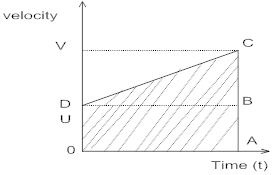
Let at time T=0, body moves with initial velocity u and at time ‘t’ body has final velocity ‘v’ and in time ‘t’ it covers a distance 'S'.
AC = v, AB = u, OA = t, DB = OA = t, BC = AC - AB = v - u
Area under a v-t curve gives displacement so,
S= Area of triangle DBC + Area of rectangle OABD .......(i)
Area of {tex}\Delta DBC = \frac{1}{2} \times Base \times Height{/tex}
= {tex}\frac{1}{2} \times DB \times BC{/tex}
= {tex}\frac{1}{2} \times t \times \left( {v - u} \right){/tex} ......... (ii)
Area of rectangle OABD {tex}= length \times breadth{/tex}
= {tex}OA \times BA{/tex}
= {tex}t \times u{/tex} ......... (iii)
From (i), (ii) and (iii)
S= ut+ {tex}\frac{1}{2} \times t \times \left( {v - u} \right){/tex}
S= ut + {tex}\frac{1}{2} \times t \times at{/tex}
S= ut + {tex}\frac{1}{2}a{t^2}{/tex}
Third Equation:
Let at time t=0, the body moves with an initial velocity u and time at ‘t’ has final velocity ‘v’ and in time ‘t’ covers a distance ‘s’
Area under v-t graph gives the displacement

S = Area of {tex}\Delta{/tex}DBC + Area of rectangle OABD
S = {tex}\frac{1}{2} \times base \times height + length \times breadth{/tex}
{tex}S = \frac{1}{2} \times DB \times BC + OA \times AB{/tex}
{tex}S = \frac{1}{2} \times t \times (v - u) + t \times u{/tex} ........(i)
Now, v - u = at
{tex}\frac{{v - u}}{a} = t{/tex}
put the value of 't' in equation (i)
{tex}S = \frac{1}{2} \times (v - u)\frac{{(v - u)}}{a} + u \times \left( {\frac{{(v - u)}}{a}} \right){/tex}
{tex}S = \frac{{{{(v - u)}^2}2u(v - u)}}{{2a}}{/tex}
{tex}S = \frac{{{v^2} + {u^2} - 2uv + 2uv - 2{u^2}}}{{2a}}{/tex}
{tex}S = \frac{{{v^2} - {u^2}}}{{2a}}{/tex}
{tex}2as = {v^2} - {u^2}{/tex}
Posted by Athira Ps 6 years, 5 months ago
- 1 answers
Kaushik Suklabaidya 6 years, 5 months ago

myCBSEguide
Trusted by 1 Crore+ Students

Test Generator
Create papers online. It's FREE.

CUET Mock Tests
75,000+ questions to practice only on myCBSEguide app

Tannu Sharma 6 years, 5 months ago
1Thank You