
Ask questions which are clear, concise and easy to understand.
Ask QuestionPosted by Lavish Vaid 3 years, 4 months ago
- 0 answers
Posted by Zubair Chaudhary 3 years, 4 months ago
- 1 answers
Posted by Najni Ansari 3 years, 4 months ago
- 1 answers
Preeti Dabral 3 years, 4 months ago
Intellectual disability is a term used when there are limits to a person's ability to learn at an expected level and function in daily life. Levels of intellectual disability vary greatly in children.
Posted by Diksha Rai 3 years, 4 months ago
- 2 answers
Posted by Laxman Das 3 years, 3 months ago
- 1 answers
Preeti Dabral 3 years, 3 months ago
Distance to market s=2.5km=2.5×103 =2500m
Speed with which he goes to market =5km/h={tex}5 \frac{10^3}{3600}=\frac{25}{18} \mathrm{~m} / \mathrm{s}{/tex}
Speed with which he comes back = {tex}7.5 \mathrm{~km} / \mathrm{h}=7.5 \times \frac{10^3}{3600}=\frac{75}{36} \mathrm{~m} / \mathrm{s}{/tex}
(a)Average velocity is zero since his displacement is zero.
(b) (i)Since the initial speed is 5km/s and the market is 2.5 km away,time taken to reach market: {tex}\frac{2.5}{5}=1 / 2 \mathrm{~h}=30 \text { minutes. }{/tex}
Average speed over this interval =5km/h
(ii)After 30 minutes,the man is travelling wuth 7.5 km/h speed for 50-30=20 minutes.The distance he covers in 20 minutes :{tex}7.5 \times \frac{1}{3}=2.5 \mathrm{~km}{/tex}
His average speed in 0 to 50 minutes: Vavg =distance traveled/time {tex}=\frac{2.5+2.5}{(50 / 60)}=6 \mathrm{~km} / \mathrm{h}{/tex}
(iii)In 40-30=10 minutes he travels a distance of : {tex}7.5 \times \frac{1}{6}=1.25 \mathrm{~km}{/tex}
{tex}\mathrm{V}_{\mathrm{avg}}=\frac{2.5+1.25}{(40 / 60)}=5.625 \mathrm{~km} / \mathrm{h}{/tex}
Posted by Lakshay S2 3 years, 4 months ago
- 0 answers
Posted by Priyanshi Maurya 3 years, 4 months ago
- 0 answers
Posted by Priyanshi Maurya 3 years, 4 months ago
- 0 answers
Posted by Danish Khan 3 years, 4 months ago
- 2 answers
Preeti Dabral 3 years, 4 months ago
As the depth increased the mass of the earth decreases. At the surface of earth this value will be maximum because radius will be maximum. When radius becomes less this value also decreases. Hence acceleration due to gravity decreases with increase in the depth.
Posted by Kanishka Parmar Kanishka 3 years, 4 months ago
- 1 answers
Preeti Dabral 3 years, 4 months ago
A solid cylinder rolling up an inclination is shown in the following figure.
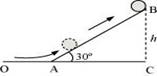
Initial velocity of the solid cylinder, v = 5 m/s
Angle of inclination, {tex}\theta = 30 ^ { \circ }{/tex}
Height reached by the cylinder = h
- Energy of the cylinder at point A will be purely kinetic due to the rotation and translational motion. Hence, total energy at A
= KErot + KEtrans
= {tex}\frac { 1 } { 2 } I \omega ^ { 2 } + \frac { 1 } { 2 } m v ^ { 2 }{/tex}The energy of the cylinder at point B will be purely in the form of gravitational potential energy = mgh
Using the law of conservation of energy, we can write:
{tex}\frac { 1 } { 2 } I \omega ^ { 2 } +\frac { 1 } { 2 } m v ^ { 2 } = m g h{/tex}
Moment of inertia of the solid cylinder, {tex}I = \frac { 1 } { 2 } m r ^ { 2 }{/tex}
{tex}\therefore \frac { 1 } { 2 } \left( \frac { 1 } { 2 } m r ^ { 2 } \right) \omega ^ { 2 } + \frac { 1 } { 2 } m v ^ { 2 } = m g h{/tex}
{tex}\frac { 1 } { 4 } I \omega ^ { 2 } + \frac { 1 } { 2 } m v ^ { 2 } = m g h{/tex}
But we have the relation, {tex}v = r \omega{/tex}
{tex}\therefore \frac { 1 } { 4 } v ^ { 2 } + \frac { 1 } { 2 } v ^ { 2 } = g h{/tex}
{tex}\frac { 3 } { 4 } v ^ { 2 } = g h{/tex}
{tex}\therefore h = \frac { 3 } { 4 } \frac { v ^ { 2 } } { g }{/tex}
{tex}= \frac { 3 } { 4 } \times \frac { 5 \times 5 } { 9.8 } = 1.91 \mathrm { m }{/tex}To find the distance covered along the inclined plane
In {tex}\Delta A B C{/tex}:
{tex}\sin \theta = \frac { B C } { A B }{/tex}
{tex}\sin 30 ^ { \circ } = \frac { h } { A B }{/tex}
{tex}A B = \frac { 1.91 } { 0.5 } = 3.82 \mathrm { m }{/tex}
Hence, the cylinder will travel 3.82 m up the inclined plane. -
{tex}v = \left( \frac { 2 g h } { 1 + \frac { K ^ { 2 } } { R ^ { 2 } } } \right) ^ { \frac { 1 } { 2 } }{/tex}
{tex}\therefore v = \left( \frac { 2 g A B \sin \theta } { 1 + \frac { K ^ { 2 } } { R ^ { 2 } } } \right) ^ { \frac { 1 } { 2 } }{/tex}
For the solid cylinder, {tex}K ^ { 2 } = \frac { R ^ { 2 } } { 2 }{/tex}
{tex}\therefore v = \left( \frac { 2 g A B \sin \theta } { 1 + \frac { 1 } { 2 } } \right) ^ { \frac { 1 } { 2 } }{/tex}
{tex}= \left( \frac { 4 } { 3 } g A B \sin \theta \right) ^ { \frac { 1 } { 2 } }{/tex}
The time taken to return to the bottom is:
{tex}t = \frac { A B } { v }{/tex}
{tex}= \frac { A B } { \left( \frac { 4 } { 3 } g A B \sin \theta \right) ^ { \frac { 1 } { 2 } } } = \left( \frac { 3 A B } { 4 g \sin \theta } \right) ^ { \frac { 1 } { 2 } }{/tex}
{tex}= \left( \frac { 11.46 } { 19.6 } \right) ^ { \frac { 1 } { 2 } } = 0.7645{/tex}
So the total time taken by the cylinder to return to the bottom is (2 {tex}\times{/tex} 0.764)= 1.53 s.as time of ascend is equal to time of descend for the following problem.
Posted by Ankit Thakur 3 years, 4 months ago
- 1 answers
Ram Avtar Kumar 2 years, 5 months ago
Posted by Bhumi Ahuja 3 years, 4 months ago
- 1 answers
Sakshi Mishra 3 years, 4 months ago
Posted by Anjita Chettri 3 years, 4 months ago
- 1 answers
Posted by Sujal Dahal 3 years, 4 months ago
- 1 answers
Preeti Dabral 3 years, 4 months ago
The central problem of “for whom to produce” refers to the selection of the category of the people who will ultimately consume the goods., i.e, whether to produce goods for poorer and less rich or richer and less poor. Since resources are scarce in every economy, no society can satisfy all the wants of its people. Thus, a problem of choice arises. Goods are produced for those people who have the paying capacity. The capacity of people to pay for goods depends upon their level of income. It means this problem is concerned with the distribution of income among the factors of production(land, labour, capital and enterprise) who contribute to the production process. Income is distributed in the form of wages,rent, interest and profit.
Posted by Sahil Arie 3 years, 4 months ago
- 0 answers
Posted by Sadiya Class 10Th 3 years, 4 months ago
- 1 answers
Posted by Saniya Yadav 3 years, 4 months ago
- 2 answers
Preeti Dabral 3 years, 4 months ago
Multimedia is a form of communication that combines different content forms such as text, audio, images, animations or video into a single presentation, in contrast to traditional mass media, such as printed material or audio recordings.
Posted by Emilin Sana 3 years, 4 months ago
- 1 answers
Posted by Yuvraj Ror 3 years, 4 months ago
- 0 answers
Posted by Ganesh Parki 3 years, 4 months ago
- 0 answers
Posted by Ganesh Parki 3 years, 4 months ago
- 1 answers
Preeti Dabral 3 years, 4 months ago
The members of the club used to call George Pearson, Pompy-ompy Pearson because they used to think that he was slow and pompous. They used to laugh at him behind his back.
Posted by Parul Chauhan 3 years, 4 months ago
- 2 answers
Posted by Tasbiya Pathan 3 years, 4 months ago
- 1 answers
Posted by Saheb Jani 3 years, 4 months ago
- 1 answers
Preeti Dabral 3 years, 4 months ago
We know that 180° = π radian.
40° 20' = 40 1/3 degree = π /180 × 121/3 radian = 121π /540radian
Therefore 40° 20′ = 121π/540 radian.
Posted by Harman Rooprai 3 years, 4 months ago
- 3 answers
Jasdeep Kaur 3 years, 4 months ago
Gayathri Ramanujam 3 years, 4 months ago

myCBSEguide
Trusted by 1 Crore+ Students

Test Generator
Create papers online. It's FREE.

CUET Mock Tests
75,000+ questions to practice only on myCBSEguide app

Preeti Dabral 3 years, 4 months ago
0Thank You