
Ask questions, doubts, problems and we will help you..
Ask questions which are clear, concise and easy to understand.
Ask Question
CBSE, JEE, NEET, CUET
Question Bank, Mock Tests, Exam Papers
NCERT Solutions, Sample Papers, Notes, Videos
Posted by Tamil Selvan 5 years, 1 month ago (10002940)
- 0 answers
Posted by Pratiksha Jha 5 years, 1 month ago (10002933)
- 1 answers
Posted by Sahil Parmar 5 years, 1 month ago (8933450)
- 3 answers
Shivam Singh 5 years, 1 month ago (9972644)
Aryan Kumar 5 years, 1 month ago (9990581)
Yogita Ingle 5 years, 1 month ago (2577571)
There are four types of movable joints in the body; which are as follows:
- Ball and socket joint: In this joint the rounded end of one bone fits into the cavity (hollow space) of another bone. It permits movement in all directions. The joints between shoulder and the upper arm is an example of ball and socket joint. Similarly, the joint between thigh and hip is an example of ball and socket joint.
- Pivot Joint: This type of joint allows movements in many planes, viz. up and down, side to side movements. The joint between the skull and the vertebral column is an example of pivot joint.
- Hinge joint: This joint is similar to the hinges in a door. This joint allows movement only in one plane and only up to 1800. The knee joint and elbow joint are examples of hinge joint.
- Gliding joints: The movement in this joint happens due to sliding of bones over one another. Joints between the rings of the backbone are examples of gliding joint. The wrist joint is also an example of gliding joint.
Posted by Sahil Parmar 5 years, 1 month ago (8933450)
- 2 answers
Shivam Singh 5 years, 1 month ago (9972644)
Yogita Ingle 5 years, 1 month ago (2577571)
There are four types of movable joints in the body; which are as follows:
- Ball and socket joint: In this joint the rounded end of one bone fits into the cavity (hollow space) of another bone. It permits movement in all directions. The joints between shoulder and the upper arm is an example of ball and socket joint. Similarly, the joint between thigh and hip is an example of ball and socket joint.
- Pivot Joint: This type of joint allows movements in many planes, viz. up and down, side to side movements. The joint between the skull and the vertebral column is an example of pivot joint.
- Hinge joint: This joint is similar to the hinges in a door. This joint allows movement only in one plane and only up to 1800. The knee joint and elbow joint are examples of hinge joint.
- Gliding joints: The movement in this joint happens due to sliding of bones over one another. Joints between the rings of the backbone are examples of gliding joint. The wrist joint is also an example of gliding joint.
Posted by Chanchal Sinha 5 years, 1 month ago (9950217)
- 1 answers
Abirami Kamalbabu 5 years, 1 month ago (10036453)
Posted by Ansh Tiwari 5 years, 1 month ago (9678007)
- 1 answers
Tec Om 5 years, 1 month ago (7036201)

Posted by Afifa Firdode 5 years, 1 month ago (9985109)
- 1 answers
Posted by Harshita Singh 5 years, 1 month ago (10002907)
- 1 answers
Posted by Natasha Mishra 5 years, 1 month ago (9227133)
- 1 answers
Yogita Ingle 5 years, 1 month ago (2577571)
Retailers provide important services to consumers and wholesalers as they act as middle-men between them.
Services to consumers:
- Ready or quick supply : The most important service of a retailer to consumers is to maintain regular availability of various products so that the buyers can buy the products whenever they need.
- Wide variety : Retailers generally keep stock of a variety of products and different manufacturers. This enables the consumers to make their choice out of a wide selection of goods.
- Guiding customers : By ananging the effective display of products and through their personal selling efforts retailers should provide the information of products to the customers.
- Demonstration and after sales services : It can be done in the form of home delivery, supply of spare parts and attending to customers.
- Home delivery : It is an important part of after sale services and for a buyers decision for repeat purchase of the products.
- Convenient location : They are suitated very near to the residential areas and remain open for long hours which makes great convenience to the customers.
Services to wholesalers and manufacturers : - Ready market: Retailers deal with individuals so the manufacturers and whole-salers will not make individual sales.
- Providing information : By undertaking personal selling efforts retailers relieve the producers of this activity of individual selling.
- Risk bearing : Retailers participates in the promotional activities of the product so that the product becomes popular and then it is less risk for the manufacturers.
- Distribution of goods to distant places : Retailers helps in distribution of goods to the final consumers and thus provide place utility.
Posted by Ayush Pathak 5 years, 1 month ago (9372101)
- 1 answers
Yogita Ingle 5 years, 1 month ago (2577571)
Human Digestive System
A human digestive system is a group of organs working together to convert food into energy and basic nutrients to feed the entire body. The food we take in is digested and utilized by our body and the unused parts of the food are defecated. Human digestive system is the sum of the gastrointestinal tract (GIT; also called alimentary canal) and accessory organs (tongue, liver, pancreas, etc). These two parts together help in digestion in humans.
The alimentary canal is the long tube through which the food that we eat is passed. It begins at the mouth (buccal or oral cavity), passes through the pharynx, esophagus or food pipe, stomach, small intestines, large intestines, rectum and finally ends at the ****. The food particles get digested gradually as they travel through various compartments of the alimentary canal. Accessory organs are organs which participate in the digestion process but are not actually a part of GIT. They stimulate the digestion by releasing certain enzymes.
Food begins its journey through the digestive system in the mouth, also known as the buccal cavity or the oral cavity. The mouth has many accessory organs such as the tongue, teeth, and salivary glands, which help in the digestion of food. Teeth grind the food into small pieces. Salivary glands secrete saliva which contains an enzyme called the salivary amylase. This enzyme breaks down starch content and moistens the food, before the tongue and other muscles push the food into the pharynx.
Pharynx: The pharynx passes the chewed food from the mouth to the esophagus. The flap of tissue known as the epiglottis present in pharynx prevents food from entering into the wide pipe
Esophagus or Food Pipe: The esophagus is a muscular tube connecting the pharynx to the stomach. It carries swallowed masses of chewed food along its length and pushes it down to the stomach.
Stomach: The stomach is a thick-walled muscular bag that is located on the left side of the abdominal cavity. It is the largest part of the human digestive system. Stomach acts as a storage tank for food so that the body has time to digest large meals properly. It receives food from the food pipe at one end and opens into the small intestine at the other end. The inner walls of the stomach consist of the gastric glands which secrete mucous, hydrochloric acid and digestive enzymes. These continue the digestion of food that began in the mouth.
Mucous protects the lining of the stomach while acid kills bacteria that enter the body along with the food. Hydrochloric acid also makes the medium in the stomach acidic, which helps the digestive enzymes like pepsin to act. The digestive enzymes break down proteins into simpler substances.
Small Intestine: The small intestine is the longest part of the human digestive system. It is a highly coiled long, thin tube which is about 7.5 metres in length. The length of the small intestine depends on the diet of the organism. A major proportion of digestion takes place in the small intestines. All types of nutrients are digested here with the help of secretions which it receives from the liver and the pancreas. The walls of the small intestine also secrete juices for digesting food.
The liver releases bile juice which alkalizes the acidic food received from the stomach and also emulsifies the fat content. The pancreatic juice digests the proteins and lipids. Finally, the intestinal secretions convert the carbohydrates into glucose, proteins to amino acids and fats into fatty acids and glycerol.
Once the food is broken down into the simple particles, it is ready to be absorbed by the body. The villi, finger-like projections present on the walls of the small intestine, absorb the digested food by increasing the surface area. The absorbed food is then transported to different parts of the body through the blood vessels for cell activities.
Large Intestine: The large intestine is a long, thick tube which is about 1.5 meters long. The large intestine absorbs water and small amounts of nutrients from the undigested food with the help of many symbiotic bacteria residing in it. The remaining waste passes into the rectum, where it remains as semi-solid feces. Feces exit the body through the **** via time-to-time excretion. This process is called Digestion.
Posted by Natasha Mishra 5 years, 1 month ago (9227133)
- 1 answers
Yogita Ingle 5 years, 1 month ago (2577571)
The functions of retailers are as follows :
- Financing : Retailers provide goods to the consumers on credit basis. This increases the level of consumption and hence the standard of living.
- Supplying market information : Since the retailer is in direct contact with the consumers, he provides information regarding their tastes, preferences and attitudes, etc. to the wholesaler. This information helps them in taking important marketing decisions.
- Convenience in buying : Retailers provide goods to the consumers according to their requirements. Usually, they are situated near the residential areas and remain open for long hours.
- Risk bearing : A retailer has to bear the risk if the change in style and fashion occurs when the goods are stored in large quantities in the warehouses.
Posted by Natasha Mishra 5 years, 1 month ago (9227133)
- 1 answers
Yogita Ingle 5 years, 1 month ago (2577571)
Services provided by wholesalers are as follows:
- Buying and assembling : The wholesaler buys the product from the manufacturer and collects the same at one place and supplies goods to the retailers according to their requirement.
- Storage function : The wholesaler also performs the storage function. The goods are purchased by the wholesalers from the manufacturers and stored at warehouses in order to meet the demand of retailers. The wholesalers act as bridge between the production and consumption of goods.
- Breaking the bulk : The wholesaler purchases goods from manufacturers in bulk and avails discounts. He sells goods in small quantities to the retailers which saves the retailers from maintaining large stocks.
- Advertisement : A wholesaler undertakes advertising and sales promotion of the product which automatically result in the increase in sales.
- Market information : Wholesalers inform the retailers about the introduction of new products in the market. He also gets feedback from the retailers about the needs and preferences of customers. He passes the information to the producer to make necessary changes in the products.
- Risk bearing : The wholesalers have to maintain optimum levels of stock in their godowns to meet the demands of the retailer. The retailer’s risk of maintaining godowns, price fluctuations, etc., are
reduced to a great level.
Posted by Avni ? 5 years, 1 month ago (7756027)
- 2 answers
Avni ? 5 years ago (7756027)
Posted by Natasha Mishra 5 years, 1 month ago (9227133)
- 1 answers
Yogita Ingle 5 years, 1 month ago (2577571)
Internal Trade also known as Domestic Trade is the buying and selling of goods and services within the confines of the international boundaries of a nation. So while import and export are important for the economy of a nation, most of its GDP contribution comes from internal trade.
Posted by Khush Nakrani 5 years, 1 month ago (9208740)
- 1 answers
Yogita Ingle 5 years, 1 month ago (2577571)
The importance of pipeline:
(i)Pipeline transport network is a new arrival on the transportation map of India. In the past, these were used to transport water to cities and industries.
(ii)Now, these are used for transporting crude oil, petroleum products and natural gas from oil and natural gas fields to refineries, fertilizer factories and big thermal power plants.
(iii)Solids can also be transported through a pipeline when converted into slurry.
(iv)The far inland locations of refineries like Barauni, Mathura, Panipat and gas based fertilizer plants could be thought of only because of pipelines.
(v)Initial cost of laying pipelines is high but subsequent running costs are minimal. It rules out trans-shipment losses or delays.
Posted by Natasha Mishra 5 years, 1 month ago (9227133)
- 1 answers
Yogita Ingle 5 years, 1 month ago (2577571)
Some of the common incentives provided by the government far industries in backward and hilly areas are as fallows
(i) Land Every state offers developed plots for setting up of industries. The terms and
conditions may vary. Some states don’t charge rent in the initial years, while some allow ’ '
payment in instalments.
(ii) Power Power is supplied at a concessional rate of 50 %, while some states exempt such units from payment in the initial years.
(iii) Water Water is supplied on no-profit, no-loss basis or with 50 % concession or exemption from water charges for a period of 5 years.
(iv) Sales Tax In all union territories, industries are exempted from sales tax, while some states extend exemption for 5 years period.
(v) Octroi Most states have abolished octroi.
(vi) Raw Materials Units located in backward areas get preferential treatment in the matter of allotment of scarce raw materials like cement, iron and steel, etc.
(vii) Finance Subsidy of 10-15 % is given for building capital assets. Loans are also offered at concessional rates.
(viii) Marketing Assistance Government tries to solve their marketing problem by improving information and in order to provide guarantee for sale of goods.
(ix) Tax Holiday Exemption from paying taxes for 5 or 10 years is given to industries established in backward, hilly and tribal areas.
Posted by Mayank Parashar 5 years, 1 month ago (9996893)
- 1 answers
Gaurav Seth 5 years, 1 month ago (2898529)
1. In Fig. 6.13, lines AB and CD intersect at O. If AOC +BOE = 70° and BOD = 40°, find BOE and reflex COE.
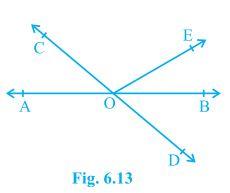
Solution:
From the diagram, we have
(AOC +BOE +COE) and (COE +BOD +BOE) forms a straight line.
So, AOC+BOE +COE = COE +BOD+BOE = 180°
Now, by putting the values of AOC+BOE = 70° and BOD = 40° we get
COE = 110° and
BOE = 30°
2. In Fig. 6.14, lines XY and MN intersect at O. If POY = 90° and a : b = 2 : 3, find c.
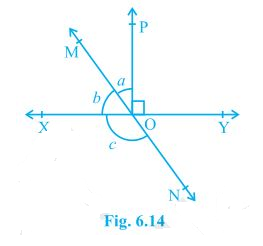
Solution:
We know that the sum of a linear pair is always equal to 180°
So,
POY +a +b = 180°
Putting the value of POY = 90° (as given in the question) we get,
a+b = 90°
Now, it is given that a : b = 2 : 3 so,
Let a be 2x and b be 3x
∴ 2x+3x = 90°
Solving this we get
5x = 90°
So, x = 18°
∴ a = 2×18° = 36°
Similarly, b can be calculated and the value will be
b = 3×18° = 54°
From the diagram, b+c also forms a straight angle so,
b+c = 180°
c+54° = 180°
∴ c = 126°
Posted by Vishal Yadav 5 years, 1 month ago (10002561)
- 1 answers
Yogita Ingle 5 years, 1 month ago (2577571)
Isomerism is the phenomenon in which more than one compounds have the same chemical formula but different chemical structures. Chemical compounds that have identical chemical formulae but differ in properties and the arrangement of atoms in the molecule are called isomers. Therefore, the compounds that exhibit isomerism are known as isomers.
The word “isomer” is derived from the Greek words “isos” and “meros”, which mean “equal parts”. This term was coined by the Swedish chemist Jacob Berzelius in the year 1830.
Posted by Supriya ✔️ 5 years, 1 month ago (8773308)
- 1 answers
Yogita Ingle 5 years, 1 month ago (2577571)
To copy, delete or move a file without using the Organize button, right click the file to display the _______ menu.
right
Posted by Supriya ✔️ 5 years, 1 month ago (8773308)
- 1 answers
Yogita Ingle 5 years, 1 month ago (2577571)
Click the _______ option at the Organize button drop down list to move a file.
paste
Explanation:
you can do ctrl + c and then at another ctrl + v
Posted by Ritu Sharma 5 years, 1 month ago (9228820)
- 1 answers
Gaurav Seth 5 years, 1 month ago (2898529)
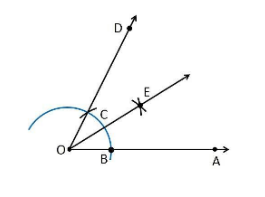
(i) 30°
Construction Procedure:
1. Draw a ray OA
2. Take O as a centre with any radius, draw an arc BC which cuts OA at B.
3. With B and C as centres, draw two arcs which intersect each other at the point E and the perpendicular bisector is drawn.
4. Thus, ∠EOA is the required angle making 30° with OA.

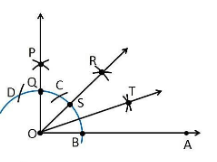
Construction Procedure:
1. Draw an angle ∠POA = 90°
2. Take O as a centre with any radius, draw an arc BC which cuts OA at B and OP at Q
3. Now, draw the bisector from the point B and Q where it intersects at the point R such that it makes an angle ∠ROA = 45°.
4. Again, ∠ROA is bisected such that ∠TOA is formed which makes an angle of 22.5° with OA
(iii) 15°
Construction Procedure:
1. An angle ∠DOA = 60° is drawn.
2. Take O as centre with any radius, draw an arc BC which cuts OA at B and OD at C
3. Now, draw the bisector from the point B and C where it intersects at the point E such that it makes an angle ∠EOA = 30°.
4. Again, ∠EOA is bisected such that ∠FOA is formed which makes an angle of 15° with OA.
5. Thus, ∠FOA is the required angle making 15° with OA.
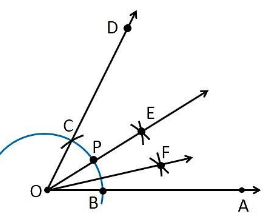
Posted by Supriya ✔️ 5 years, 1 month ago (8773308)
- 1 answers
Yogita Ingle 5 years, 1 month ago (2577571)
To delete a file the command to be clicked from Edit menu is __
press Ctrl + A
Posted by Diya Sheoran 5 years, 1 month ago (9948639)
- 4 answers
Yogita Ingle 5 years, 1 month ago (2577571)
protein, nutrient , fat
Depending upon size and cetromere position, the 46 chromosomes have been divided into a number of groups
Posted by Ankita Priyadarshini Jena Jena 5 years, 1 month ago (10002725)
- 5 answers
Posted by Anshika 16 5 years, 1 month ago (9563061)
- 2 answers
Muskan Maan 5 years, 1 month ago (9974792)
Posted by Arnesh Banerjee 5 years, 1 month ago (10002705)
- 0 answers
Posted by Sanket Arjun 5 years, 1 month ago (6698366)
- 0 answers
myCBSEguide
Trusted by 1 Crore+ Students

Test Generator
Create papers online. It's FREE.

CUET Mock Tests
75,000+ questions to practice only on myCBSEguide app
