The Case of the Fifth Word – NCERT Solutions Class 8 English (Poorvi) includes all the questions with solutions given in the NCERT Class 8 English (Poorvi).
NCERT Solutions Class 8
English Poorvi Hindi Malhar Maths Ganita Prakash Science Curiosity Social Exploring SocietyThe Case of the Fifth Word – NCERT Solutions
Q.1: Work in pairs. Solve the crossword puzzle given below with the clues in the form of anagrams.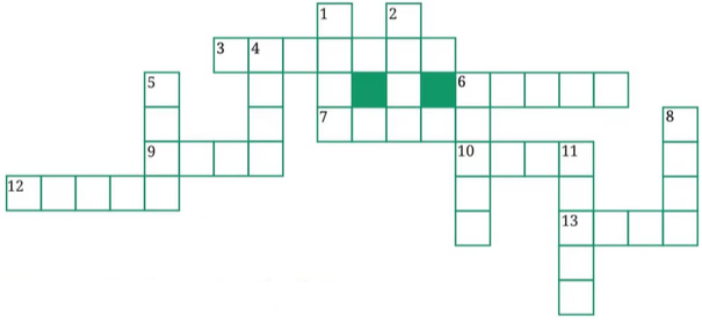
Across: 3. Declare 6. Tucks 7. Heart 9. Felt 10. Sown 12. Sword 13. Evil
Down: 1. Aces 2. Read 4. Tool 5. Alps 6. Hooks 8. Mane 11. Loves
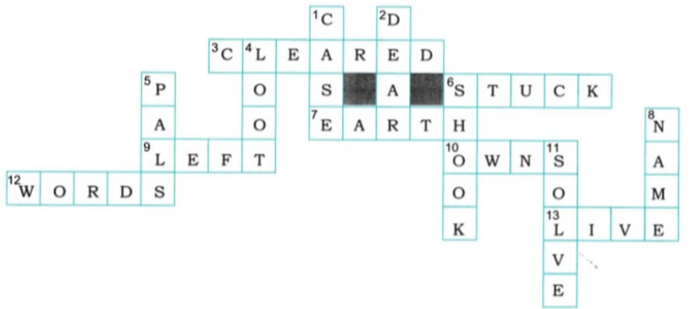
Solution:
Q.2: Work in pairs. Match the different meanings of ‘case’ in Column 2 with the correct usage in the sentences in Column 1. Share your answers with your classmates and teacher.
| Column 1 | Column 2 |
| 1. Lalit said that he could not sing but that was not the case as he sang melodiously later. | (i) writing format |
| 2. The lawyer was waiting for the case to be taken up in court. | (ii) container |
| 3. My pencil case is a gift from my grandmother. | (iii) situation |
| 4. The subject of a formal letter is written in title case. | (iv) matter |
Solution:
| Column 1 | Column 2 |
| 1. Lalit said that he could not sing but that was not the case as he sang melodiously later. | (iii) situation |
| 2. The lawyer was waiting for the case to be taken up in court. | (iv) matter |
| 3. My pencil case is a gift from my grandmother. | (ii) container |
| 4. The subject of a formal letter is written in title case. | (i) writing format |
Q.3: Complete the following statements with suitable reasons.
- Leroy’s nickname was Encyclopedia, and everyone called him by that name because ________.
- At the dinner table on Tuesday night, Chief Brown stared at his cream-of-mushroom soup as ________.
- Encyclopedia sat quietly at the dinner table because ________.
- Nolan put the will on the kitchen table because ________.
Solution:
- he read many books and never forgot a fact, knowing more than anyone in Idaville.
- he was thinking hard about the mysterious four-word code in the jewellery case.
- he knew his parents were discussing the case for him to hear and solve.
- he wanted to leave a clue about the hidden jewellery’s location for Davenport.
Q.4: Do you think Chief Brown would need Leroy’s help to solve this case? If yes, why? If no, why not?
Solution:
Yes, Chief Brown needed Leroy’s help because the four-word code (Nom, Utes, Sweden, Hurts) was confusing, and Leroy’s clever question about the fir tree solved the case quickly.
Q.5: A fact is something that can be proven true or false. A fact is not based on people’s beliefs. An opinion, on the other hand, is a belief, feeling, or judgment, and can vary from one person to another. An opinion cannot be proven. Identify which of the following statements from parts I and II of the story are facts or opinions. One example has been done for you. Share your answers with your classmates and teacher.
- Encyclopedia’s father was the Chief of Police.
- Everyone thought that Chief Brown must be the smartest police chief in the country.
- An encyclopedia is a book or set of books filled with facts from A to Z.
- Leroy’s friends said that he was like a library and a computer rolled into one, and more user-friendly.
- Two masked men held up the Diamond Mart on Sixth Avenue.
- Nolan and Davenport had met while both were in prison in South Carolina.
- Chief Brown’s hunch was that Davenport and Nolan decided to hide the loot until things cooled down.
- Nolan wrote a four-word code to tell Davenport where he had hidden the stolen jewellery.
Solution:
- Fact
- Opinion
based on people’s beliefs - Fact
definition of an encyclopedia - Opinion
friends’ subjective view - Fact
verifiable event - Fact
verifiable past event - Opinion
based on Chief Brown’s belief - Fact
verifiable action in the story
Q.6: Complete the table by choosing the character traits of Leroy given in the box below. There is an extra word that you do not need. One example has been done for you.
(cleverness, knowledgeable, keen, listener, gentle, humble)
| Textual Evidences | Traits |
| 1. He read more books than anyone in Idaville, and he never forgot a fact. | knowledgeable |
| 2. Encyclopedia never spoke of the help he gave his father. He didn’t want to seem different from other boys. | |
| 3. Encyclopedia sat quietly. He knew his mother and father were discussing the case for his benefit. | |
| 4. Usually, he needed to ask only one question to solve a case before dessert. |
Solution:
| Textual Evidences | Traits |
| 1. He read more books than anyone in Idaville, and he never forgot a fact. | knowledgeable |
| 2. Encyclopedia never spoke of the help he gave his father. He didn’t want to seem different from other boys. | humble |
| 3. Encyclopedia sat quietly. He knew his mother and father were discussing the case for his benefit. | listener |
| 4. Usually, he needed to ask only one question to solve a case before dessert. | cleverness |
Q.7: Read the given extract and answer the questions that follow.
Chief Brown would have liked to tell everyone about his only child. But who would believe him? Who would believe that the best detective alive was an eighth grader? So, he said nothing.
Encyclopedia never spoke of the help he gave his father. He didn’t want to seem different from other boys. But there was nothing he could do about his nickname. He was stuck with it.
Only his parents and teachers called him by his real name, Leroy. Everyone else called him Encyclopedia.
- Complete the following sentence with a suitable reason.
Chief Brown’s dilemma can be called unique because ________. - What can be inferred about why Encyclopedia never spoke of the help he gave his father?
- He is shy and lacks confidence in his abilities to share his insights.
- He wants to avoid the jealousy others might feel about his skills.
- He desires to blend with the other boys to prevent seeming different.
- He is embarrassed about being smarter than most adults around him.
- The parents choose not to call their son ‘Encyclopedia’. Select the reason that is false.
- For them, he is more than his unique abilities; he is their child, with a personal identity.
- Calling him by his real name reflects their affection and the desire to acknowledge him as an ordinary boy.
- They want him to be remembered as different from the others around.
- What does the writer mean by the fact that Leroy was ‘stuck with’ the name Encyclopedia?
Solution:
- Chief Brown’s dilemma can be called unique because he wanted to tell everyone his son was a brilliant detective, but no one would believe an eighth grader could be so talented.
- C. He desires to blend with the other boys to prevent seeming different (text states he didn’t want to seem different).
- C. They want him to be remembered as different from the others around (parents use his real name to treat him as
- It means everyone called him Encyclopedia because of his vast knowledge, and he couldn’t change this nickname.
Q.8: Read the given extract and answer the questions that follow.
Chief Brown studied the four words: Nom Utes Sweden Hurts. He shook his head and passed the notebook to Mrs. Brown again. “Can you figure it out?”
“Nom is a shortening of nominative, a grammatical term,” stated Mrs. Brown, who had taught English and other subjects in high school. “Utes is an American Indian tribe. Sweden is a country in northern Europe. Hurts is hurts.”
She lifted her gaze to Encyclopedia and shook her head.
“I can’t figure it out,” she confessed. “Davenport disappeared right after the hold-up,” Encyclopedia reminded her.
- What does Chief Brown’s reaction of shaking his head suggest about his understanding of the four words?
- He is confident that the words are a clue.
- He is confused, unable to make sense of the words.
- He believes the words are random and meaningless.
- He thinks the words are unrelated to the case.
- Identify whether the given statement is true or false. Mrs. Brown explained the actual meanings of the individual words rather than decoding the hidden message behind them.
- What does Mrs. Brown’s inability to decode the words suggest about the message?
- Complete the following sentence suitably.
The purpose of Encyclopedia’s reminder in the last line of the extract was to ________. (refocus the discussion on the context of the crime/suggest that the coded message was meant for Davenport/imply that the message was likely a clue about the location of the stolen jewellery)
Solution:
- He is confused, unable to make sense of the words (shaking his head indicates confusion).
- Mrs. Brown explained the actual meanings of the individual words rather than decoding the hidden message behind them- True (she defines each word literally, not as a code).
- It suggests the message is cleverly hidden and requires specific insight to understand.
- The purpose of Encyclopedia’s reminder in the last line of the extract was to suggest that the coded message was meant for Davenport.
Q.9: Nolan and Davenport were very close. Support this statement with evidence from the chapter ‘The Case of the Fifth Word’.
Solution:
They met in prison, became friendly due to shared interests, and Davenport lived with Nolan before the robbery.
Q.10: Why did Davenport disappear right after the jewellery hold-up? What might his plans have been if Nolan had not died?
Solution:
He disappeared to avoid suspicion after the robbery. If Nolan hadn’t died, they might have waited longer to retrieve and share the hidden jewellery.
Q.11: What does Mrs. Brown’s interest in the case tell us about her?
Solution:
She is curious and engaged, as she asks questions and tries to understand the code.
Q.12: Explain why Chief Brown was proud of his son.
Solution:
He was proud because Encyclopedia solved mysteries quickly, like finding the jewellery with one question.
Q.13: Why were Chief Brown’s suspicions regarding Nolan and Davenport justified, even when there was a lack of concrete proof?
Solution:
His suspicions were justified because Nolan and Davenport were friends from prison, lived together before the robbery, and a clerk thought she recognised Nolan.
Q.14: Analyse the role of the four-word coded message in the story.
Solution:
The code (Nom, Utes, Sweden, Hurts) represented days (Monday to Thursday), hiding the fifth word (Fir for Friday), which led to the jewellery’s location in a fir tree’s jug.
Q.15: Write a character sketch on Leroy with the help of the character trait stable given in ‘Let us discuss’ section. You may begin it like this:”Encyclopedia was a knowledgeable eighth grader who never forgot a fact that he read.”
Solution:
Encyclopedia was a knowledgeable eighth grader who never forgot a fact that he read. He was humble, not boasting about helping his father, and wanted to fit in with other boys. As a good listener, he quietly understood his parents’ discussions. His cleverness allowed him to solve cases with just one question.
Q.16: Match the phrasal verbs from the text given in Column 1 with their meanings in Column 2. You may refer to a dictionary.
| Column 1 | Column 2 |
| 1. put on | (i) appeared, been discovered |
| 2. cooled down | (ii) solve a problem |
| 3. turned up | (iii) became normal or calmed |
| 4. make of | (iv) wear (clothes, hat, etc.) |
| 5. figure out | (v) escaped without being punished |
| 6. got away with | (vi) have an idea or understanding of something |
Now, fill in the blanks with the phrasal verbs given in Column 1.
- Finally, some important evidence about the case has ________.
- After I ________, I understood that I had made a big mistake.
- I couldn’t ________ why he was angry with me.
- He ________ his special coat and went to his friend’s birthday party.
- Ravi forgets to do his homework but he ________ it as teacher didn’t ask for it that day.
- I do not know what to ________ his behaviour.
Solution:
| Column 1 | Column 2 |
| 1. put on | (iv) wear (clothes, hat, etc.) |
| 2. cooled down | (iii) became normal or calmed |
| 3. turned up | (i) appeared, been discovered |
| 4. make of | (vi) have an idea or understanding of something |
| 5. figure out | (ii) solve a problem |
| 6. got away with | (v) escaped without being punishedFinally, some important evidence about the case has turned up. |
- After I cooled down I understood that I had made a big mistake.
- I couldn’t figure out why he was angry with me.
- He put on his special coat and went to his friend’s birthday party.
- Ravi forgets to do his homework but he got away with it as teacher didn’t ask for it that day.
- I do not know what to make of his behaviour.
Q.17: Fill in the blanks in the following sentences by choosing the correct word pairs from the box given below.
(week/weak, dying/dyeing, fore/four, peace/piece, break/brake)
- After running for 50 kilometres last ________, I felt ________ for two days.
- When the committee met yesterday, they brought ________ local cases to the ________.
- While learning to drive, Rina used too much force on the ________, causing the car to ________ down.
- He has composed a beautiful ________ of music in order to bring ________ to thousands of people.
- She was busy ________ her hair not caring about the ________ flowers in her garden.
Solution:
- After running for 50 kilometres last week I felt weak for two days.
- When the committee met yesterday, they brought four local cases to the peace.
- While learning to drive, Rina used too much force on the brake, causing the car to break down.
- He has composed a beautiful piece of music in order to bring peace to thousands of people.
- She was busy braiding her hair not caring about the flowers in her garden.
Q.18: Leroy solved the mystery of the missing fifth word with his critical thinking abilities. Work in pairs to solve the puzzles given in the illustrations below and infer what they say. One example has been done for you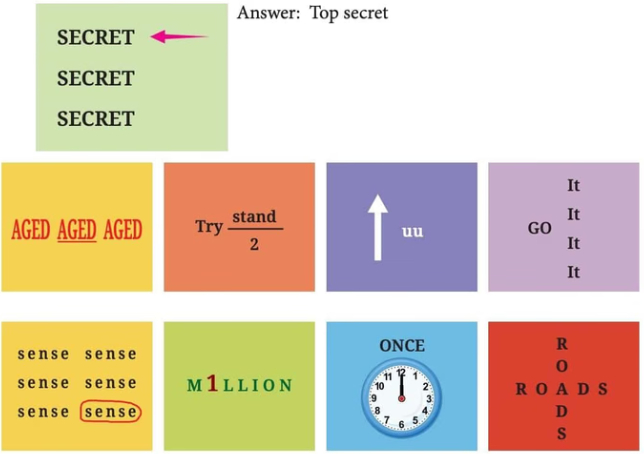
Solution:
Middle-aged, Try to understand, Up to you, Go for it, Sixth sense, One in a million, Once upon a time, Crossroads
Q.19: Spoonerism is a mistake made when speaking, where the first sounds of the words in a phrase or a sentence are exchanged with each other. This usually gives a funny meaning. Some examples of spoonerism are saying ‘wrong load’ instead of ‘long road’, ’round of mice’ instead of ‘mound of rice’.
Find the correct order for the following spoonerisms.
- knowing sits
- it’s roaring with pain.
- plaster man
- blarm wanket
- tars and crucks
- shake a tower
- bead a rook
- mardon me padamNumbered List Properties
Solution:
- knowing sits {tex}\rightarrow{/tex} sowing knits (or more sensibly: sewing knits)
- it’s roaring with pain {tex}\rightarrow{/tex} it’s pouring with rain
- plaster man {tex}\rightarrow{/tex} master plan
- blarm wanket {tex}\rightarrow{/tex} warm blanket
- tars and crucks {tex}\rightarrow{/tex} cars and trucks
- shake a tower {tex}\rightarrow{/tex} take a shower
- bead a rook {tex}\rightarrow{/tex} read a book
- mardon me padam {tex}\rightarrow{/tex} pardon me madam
Q.20: Read the following sentences from the text and study the highlighted words.
- Everyone thought that he must be the smartest police chief in the country.
- She read what he had copied.
- They tell where the jewellery is hidden.
- “Nom is a shortening of nominative, a grammatical term,” stated Mrs.Brown, who had taught English and other subjects in high school.
- “Nolan and Davenport had met,” Chief Brown said, “while both were in prison in South Carolina.”
- When he came up against a case he couldn’t solve, he acted at once.
- The code is simple, especially as it’s written on a sheet from a calendar.
- They became friendly because of shared interests.
- EncyclopeNumbered List Propertiesdia solved the case for him before dinner was over.
Now, fill in the blanks with the words in the box given below to complete the following sentences. There are two extra words that you do not need.
(where, why, who, though, which, when, because, whose, if, how)
Detective stories are exciting, keeping readers guessing (i) ________ the real culprit is. They take place in settings (ii) ________ clues are hidden carefully. (iii) ________ the mystery seems tricky, a clever detective always finds answers. Readers often wonder (iv) ________ criminals leave small but important clues. The challenge is to decide (v) ________ suspect is guilty. (vi) ________ the truth is revealed, everything makes sense. But one may wonder (vii) ________ they could have solved it themselves. These stories are fun (viii) ________ they make readers think till the very end.
Solution:
(i) who, (ii) where, (iii) Though, (iv) why, (v) which, (vi) When, (vii) if, (viii) because
Q.21: Combine the following pairs of sentences using the word given in brackets. One example has been done for you.
- We gave him the signal. He was waiting for the signal. (that)
- We went to a place. The incident occurred there. (where)
- Teacher said she would retire soon. She is now nearly sixty. (who)
- It was the day. Half the class was absent. (when)
Solution:
- We gave him the signal that he was waiting for.
- We went to the place where the incident occurred.
- The teacher, who is now nearly sixty, said she would retire soon.
- It was the day when half the class was absent.
Q.22: Read the following sentences from the text.
- “What’s suspicious about that?” Mrs. Brown asked.
- “What do you make of the four words, Leroy?”
- “Wasn’t he mixed up in a jewellery robbery a few years ago?”
- “Didn’t you search Nolan’s house, dear?”
- “Is there a young fir tree in Mr. Nolan’s palm-tree nursery?”
The given sentences are the direct words of the speaker, hence, they are in direct speech.
Solution:
- Mrs. Brown asked what was suspicious about that.
- Mrs. Brown questioned Leroy what he made of the four words.
- Mrs. Brown inquired whether Tim Nolan had been mixed up in a jewellery robbery a few years before.
- Mrs. Brown asked Chief Brown whether he had searched Nolan’s house.
- Mrs. Brown inquired whether there was a young fir tree in Mr. Nolan’s palm-tree nursery.
Q.23: Rewrite the following sentences in Reported Speech.
- “Why did you stop talking to me? ”asked Rohan.
Rohan questioned ________. - “Did you enjoy the family gathering yesterday? ”asked my aunt.
My aunt asked ________. - “When will you visit us again? ”asked my grandmother.
My grandmother inquired ________. - Madavi said to Ravi, “Will you come with me to meet our old teacher tomorrow? ”asked Madavi.
Madavi asked Ravi ________. - My friend said, “What gift are you planning to give your brother?”
My friend inquired ________. - “Shall I carry these notebooks to the staffroom, Ma’am? ”asked Veenu.
Veenu asked her teacher ________.
Solution:
- Rohan questioned why I had stopped talking to him.
- My aunt asked whether I had enjoyed the family gathering the day before.
- My grandmother inquired when I would visit them again.
- Madavi asked Ravi whether he would come with her to meet their old teacher the following day.
- My friend inquired what gift I was planning to give my brother.
- Veenu asked her teacher whether she should carry those notebooks to the staffroom.
Q.24: Read the conversation between Aditi and Rahul
ADITI: Did you see anyone leave a package near the lift?
RAHUL: I noticed a man wearing a blue jacket drop it off.
ADITI: What time did you see this happen? RAHUL: It was around 6:45 p.m. ADITI: Were you able to see his face?
RAHUL: He wore a hood and so I couldn’t see his face.
Complete the following paragraph by transforming the dialogue in indirect speech.
- Aditi asked Rahul 1. ________.
Rahul replied that he had noticed a man wearing a blue jacket drop it off. - Aditi asked Rahul 2. ________.
Rahul replied that it had been around 6.45 p.m. - Aditi further inquired 3. ________.
Rahul said that he had worn a hood, so he couldn’t see his face.
Solution:
- Aditi asked Rahul whether he had seen anyone leave a package near the lift.
Rahul replied that he had noticed a man wearing a blue jacket drop it off. - Aditi asked Rahul what time he had seen it happen.
Rahul replied that it had been around 6:45 p.m. - Aditi further inquired whether he had been able to see his face.
Rahul said that he had worn a hood, so he couldn’t see his face.
Q.25: You will listen to a podcast about ways of improving observation skills. As you listen, mark the statements 1-4 as true or false.
- Observation skills help improve your common sense.
- Rushing through tasks helps you focus better and observe more.
- Taking notes or making sketches helps with what you observe.
- Incorporating tips on observation skills will soon lead to success.
Solution:
- True
- False – rushing reduces focus
- True
- True
Q.26: You will once again listen to the podcast. As you listen, complete the given sentences by filling in the blanks with one to three exact words you hear.
- It is important to slow down and ________ to notice several aspects around you more clearly.
- The more senses like hearing and smelling you use, the more ________ you absorb.
- People who are ________ tend to be better observers because they seek to understand what they notice.
- When you make a note of things, it helps reinforce the ________ in your memory.
- Practising mindfulness helps a person stay ________ with their surroundings.
Solution:
- It is important to slow down and to notice several aspects around you more clearly.
- The more senses like hearing and smelling you use, the more you absorb.
- People who are curious tend to be better observers because they seek to understand what they notice.
- When you make a note of things, it helps reinforce the information in your memory.
- Practising mindfulness helps a person stay present with their surroundings.
Q.27: Work in groups of five or six. Conduct a group discussion on the topic, ‘The Interesting Aspects of a Mystery Story’.
Guidelines
- The moderator initiates the discussion inviting the speakers to share their views on the subject.
- The speakers take turns to put forth their viewpoint using polite expressions to agree or disagree.
- The speakers may interrupt by raising their hands to add or clarify a point.
- The moderator ensures equal participation of all the members in the group, consolidates views, and calls upon other speakers to respond.
- The moderator sums up the points of discussion, suggests guidelines for future action and thanks the members of the group.
Note: Choose a moderator. Decide upon the duration of the discussion.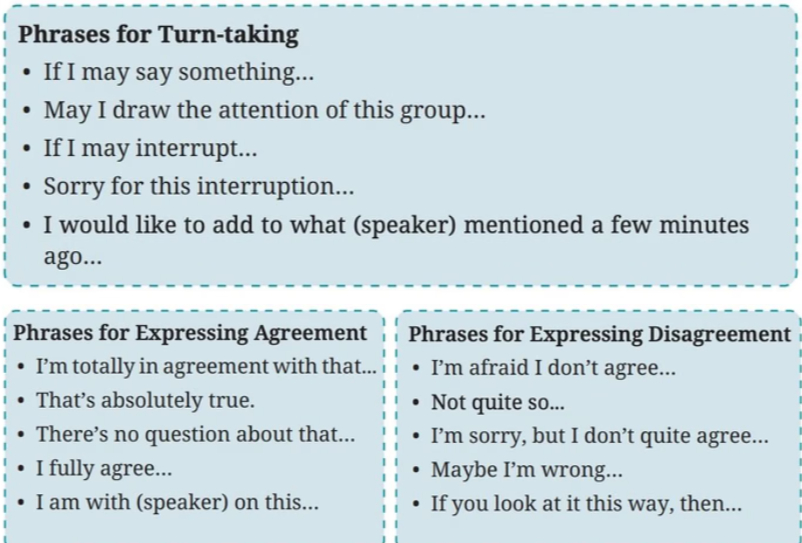
Solution:
This is a classroom activity. Follow these guidelines:
- The moderator starts by asking group members to share what makes mystery stories exciting.
- Speakers take turns, e.g., “I think mysteries are fun because they keep you guessing.”
- Use phrases like “If I may say something…” or “I agree with…” to agree/disagree politely.
- Example points: Mysteries have suspense, clever clues, and surprising endings.
- The moderator ensures everyone speaks and sums up, e.g., “We agree mysteries are exciting because of clues and twists.”
Q.28: A report is written for an event that has already occurred. The purpose of a report is to provide first-hand details of an incident or event. It presents the information in a proper sequence. Read the sample report written about the ‘Inter-school Football Tournament’ organised by your Vidyalaya. Note the format, content, and language used.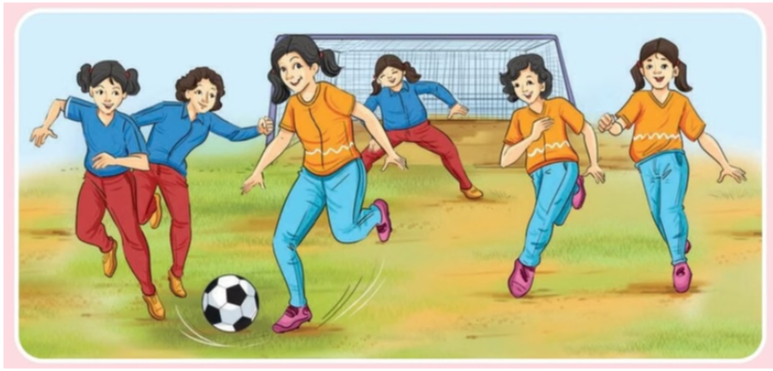
| Inter-school Football Tournament by | Title-Byline (Reporter’s Name and Class) |
| An Inter-school Football Tournament was organised by our Vidyalaya from 21 April 20XX to 24 April 20XX at Motinagar Football Ground. Ten teams participated in the tournament. | Paragraph 1: What Who When Where Note: use of past tense, for example, organised, participated, etc. |
| The tournament was declared open by the Chief Guest, Dr. Singh, Honorary Sports Secretary of the State, on Wednesday, 21 April 20XX in the presence of all the teams and spectators from the participating schools. The matches were held from 8:30 a.m. to 11:30 a.m. on all the days of the tournament. Following a tough competition, the teams from ABC Senior Secondary School and XYZ Senior Secondary School emerged as the finalists. For the final match, players from both these teams were cheered by students from their respective schools. After an exciting match, the score was tied at 3-3. Subsequently, a penalty shootout was used as tie breaker by the referee to decide the winner. Finally, the team from ABC Senior Secondary School won the penalty shootout and was declared the winner. | Paragraphs 2 and 3: Description of the event in detail Note: (i) use sequence markers: following, after, subsequently, finally (ii) use of passive form: was declared, were held, were cheered, etc. |
| The winning team was awarded with a trophy, medals, and certificates by the Chief Guest. Addressing the students, he said, “All of you must take up a sport to keep yourself healthy.” The inter-school football tournament was a great success, showcasing exceptional talent, teamwork, and sportsmanship among the participating teams. | Paragraph 4: Prize giving ceremony Remarks by the Chief Guest |
Now, as a member of the Art and Craft Club, write a report on an ‘Inter-school Art Exhibition’ organised by your school. Include the necessary details.
Solution:
Inter-school Art Exhibition Report
[Your School Name], [City]
1 August 2025
Our school hosted an Inter-school Art Exhibition on 25 July 2025 in the school auditorium. Five schools participated, showcasing paintings, sketches, and crafts by students. The theme was “Nature and Imagination.” Each school set up colourful stalls with artworks like drawings of forests and creative sculptures. Over 200 visitors, including parents and teachers, attended. The chief guest, a local artist, praised the students’ creativity. Our school won the “Best Display” award. The event encouraged young artists and was a great success.
Reported by: [Your Name], Art and Craft Club Member
Q.29: Work in pairs. Read the words and observe the images given below. Check if your answers match. Share your answers with your classmates and teacher.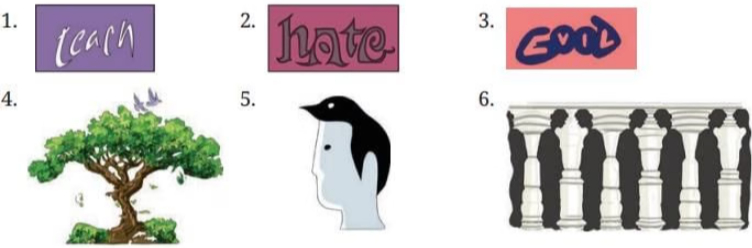
These are optical illusions which may trick the eye and make you think that you can see two different things.
Solution:
Do it yourself.
Q.30:
Read the steps to play a language game- Name the mystery object.
- Divide the class into teams.
- Each team chooses an object and prepares three hints to enable the other teams to name the object.
- Each team takes turns to name the object given by the other team.
- If a team names the object with the first hint, they get 20 points, with the second hint 10 points, and with the third hint 5 points.
One example with three hints:
- I display information for all to share, with a swipe I’m clean and bare.
- I am rectangular or a square, whom neither teacher nor student can spare.
- I am mostly black, sometimes green, now in white too I am seen.
Solution:
Do it yourself.
Q.31: Visit the library and look for an encyclopedia. What is it? Check how it is different from a dictionary. Share your answers with your classmates and teacher.
Solution:
An encyclopedia is a reference book (or a set of books) that provides detailed information on a wide range of subjects. The articles are usually arranged alphabetically and contain facts, explanations, and background knowledge written by experts. Encyclopedias can be general (like Encyclopedia Britannica) or subject-specific (like an Encyclopedia of Animals or Science).
Q.32: A thesaurus is a reference book or digital tool that provides a collection of words with similar meanings, allowing users to find alternative words or phrases to express the same idea. Choose any five words and find out their alternative words from the thesaurus.
Solution:
- Happy
Synonyms: joyful, cheerful, delighted, content, elated - Fast
Synonyms: quick, speedy, rapid, swift, brisk - Beautiful
Synonyms: attractive, lovely, stunning, charming, elegant - Smart
Synonyms: intelligent, clever, bright, sharp, brainy - Angry
Synonyms: mad, furious, annoyed, upset, irritated
NCERT Solutions Class 8 English Poorvi
- The Wit that Won Hearts
- A Concrete Example
- Wisdom Paves the Way
- A Tale of Valour: Major Somnath Sharma and the Battle of Badgam
- Somebody’s Mother
- Verghese Kurien – I Too Had A Dream
- The Case of the Fifth Word
- The Magic Brush of Dreams
- Spectacular Wonders
- The Cherry Tree
- Harvest Hymn
- Waiting for the Rain
- Feathered Friend
- Magnifying Glass
- Bibha Chowdhuri: Women in Indian Science

Test Generator
Create question paper PDF and online tests with your own name & logo in minutes.
Create Now
Learn8 App
Practice unlimited questions for Entrance tests & government job exams at ₹99 only
Install Now