A Tale of Valour: Major Somnath Sharma and the Battle of Badgam – NCERT Solutions Class 8 English (Poorvi) includes all the questions with solutions given in the NCERT Class 8 English (Poorvi).
NCERT Solutions Class 8
English Poorvi Hindi Malhar Maths Ganita Prakash Science Curiosity Social Exploring SocietyA Tale of Valour: Major Somnath Sharma and the Battle of Badgam – NCERT Solutions
Q.1: Work in pairs. Share your answers with your classmates and teacher.
- What do you think about the Republic Day Parade on 26 January?
- What are the highlights of this parade?
- What bravery awards are given on this day, and who receives them?
Solution:
- The Republic Day Parade is a grand event that shows India’s pride, strength, and unity. It makes me feel proud to be Indian.
- The parade includes marching soldiers, colourful floats, cultural dances, military vehicles, and air shows, displaying India’s diversity and power.
- Bravery awards, such as the Param Vir Chakra, Maha Vir Chakra, and Vir Chakra, are given to soldiers and occasionally civilians for their exceptional courage.
Q.2: Work in groups of four and discuss.
- What qualities do you think a soldier should have?
- If you had to share a message with a soldier, what would it be?
Solution:
- A soldier should be brave, disciplined, strong, loyal, and ready to protect the country even in danger.
- Thank you for your courage and sacrifice. You keep us safe, and we are proud of you!
Q.3: Arrange the following events in chronological order. The first and the last events have been marked for you. Share your answers with your classmates and teacher.
- Major Somnath Sharma was born in 1923 in Kangra, Himachal Pradesh. (i)
- Even after losing Major Somnath Sharma, the soldiers fought bravely to save Srinagar for India.
- The D Company, under the command of Major Somnath Sharma, was flown into Srinagar.
- Major Somnath Sharma underwent training at the Royal Military College, Sandhurst.
- Major Somnath Sharma requested air strikes to combat the enemy at Badgam.
- Major Somnath Sharma was commissioned into the 19th Hyderabad Regiment in 1942.
- Major Somnath Sharma was killed immediately after a mortar shell hit him.
- Major Somnath Sharma was the first recipient of the ParamVir Chakra. (viii)
Solution:
(i) Major Somnath Sharma was born in 1923 in Kangra, Himachal Pradesh.
(iv) Major Somnath Sharma underwent training at the Royal Military College, Sandhurst.
(vi) Major Somnath Sharma was commissioned into the 19th Hyderabad Regiment in 1942.
(iii) The D Company, under the command of Major Somnath Sharma, was flown into Srinagar.
(v) Major Somnath Sharma requested air strikes to combat the enemy at Badgam.
(vii) Major Somnath Sharma was killed immediately after a mortar shell hit him.
(ii) Even after losing Major Somnath Sharma, the soldiers fought bravely to save Srinagar for India.
(viii) Major Somnath Sharma was the first recipient of the Param Vir Chakra.
Q.4: Read the given extract and answer the questions that follow.
Vastly outnumbered and facing devastating fire, Major SomnathSharma and his men stood resolute. The air was thick with the sound of gunfire and the cries of battle, but Major Somnath Sharma’s voice cut through the chaos, urging his men to fight with tenacity and valour. Despite heavy casualties and his injuries, Major SomnathSharma displayed unparalleled bravery. He moved fearlessly through the battlefield, directing fire, filling magazines for his gunners, and encouraging his men to hold their ground.
- What can be inferred about the conditions from the line: ‘The air was thick with gunfire…’
- The gunshots had stopped for a while.
- There was intense fighting on the battlefield.
- The invaders were retreating from the fight.
- The Indian soldiers had achieved victory.
- Complete the sentence with a suitable reason.
Despite heavy casualties, Major Somnath Sharma continued to lead his men because ________ - Select the correct option for both Assertion (A) and Reason (R)given below:
(A): Major Somnath Sharma moved fearlessly through the battlefield, even though he was injured.
(R): He believed his courage was important to motivate the soldiers.- Both (A) and (R) are true, and (R) is the correct explanation of (A).
- Both (A) and (R) are true, but (R) is not the correct explanation of (A).
- (A) is true, but (R) is false.
Select the correct option for both Assertion (A) and Reason (R): - (A) is false, but (R) is true.(iii)
- Fill in the blank with the correct word from those given in the brackets: Major Somnath Sharma was filling magazines, and encouraging his men to hold their ground despite ________. (injuries/worry)
Solution:
- There was intense fighting on the battlefield.
Reason: The line means that there was a lot of shooting and noise from the battle, showing the fight was going on fiercely. - he was determined to protect Srinagar and inspire his soldiers to keep fighting.
Reason: Even though he was injured, he still gave orders, helped load guns, and motivated his men to be brave. - A. Both (A) and (R) are true, and (R) is the correct explanation of (A).
Reason:
(A) is true: He walked through the battlefield without fear, even when hurt.
(R) is true: He knew that if his soldiers saw his courage, they would also feel brave.
R explains A: He showed courage to inspire his soldiers to keep fighting. - Major Somnath Sharma was filling magazines and encouraging his men to hold their ground despite injuries.
Q.5: Read the given extract and answer the questions that follow.
Born on 31 January 1923, in the picturesque town of Dadh in Kangra, Himachal Pradesh, Somnath Sharma belonged to a family with a rich military legacy. His father, Major General Amar Nath Sharma, had served the nation with distinction, and young Somnath was deeply inspired by the valorous tales of the Mahabharata, imparted to him by his grandfather.
- What can be inferred about Somnath Sharma’s early influences on his career?
- He was primarily influenced by his father’s achievements in the military.
- His inspiration came solely from the tales of the Mahabharata.
- His family and heritage inspired his bravery and sense of duty.
- He decided to join the military out of necessity rather than passion.
- Identify whether the following statement is true or false:
Somnath Sharma belonged to a wealth - What does the phrase ‘served the nation with distinction’ tell us about Major General Amar Nath Sharma?
- Replace the underlined phrase with a word from the extract that has a similar meaning.
Solution:
- His family and heritage inspired his bravery and sense of duty.
Reason: Both his father’s military service and his grandfather’s stories from the Mahabharata motivated him to be brave and serve the country. - False
Reason: The text talks about his family’s military legacy, not wealth. - He performed his duties with exceptional dedication, honour, and excellence. He was highly respected for his contributions to the country.
- My family and I visited a popular hill station and stayed in an old but visually charming house surrounded by trees.
Ans: Picturesque
Reason: In the extract, picturesque means beautiful and visually pleasing, just like the old charming house described.
Q.6: ‘Major Somnath’s legacy of courage and devotion to the nation remains forever alive, forever alive…’ What is the significance of the repetition in this line?
Solution:
The repetition emphasises that Major Somnath’s courage and sacrifice will always be remembered and inspire people forever.
Q.7: Why do you think Major Somnath’s leadership was critical during the Battle of Badgam?
Solution:
His leadership was critical because he kept his men fighting despite being outnumbered, guided airstrikes, and held the position to save Srinagar.
Q.8: What were Major Somnath’s last words? What do they reflect about his sense of duty?
Solution:
His last words were, “The enemy is only 50 yards from us. We are heavily outnumbered. We are under devastating fire. I shall not withdraw an inch but will fight to the last man and the last round.” They show his strong duty to protect his country and never give up.
Q.9: What might have been the outcome of the Battle of Badgam if Major Somnath and his company had not held their ground?
Solution:
The enemy might have captured Srinagar airport and the Kashmir Valley, weakening India’s control over the region.
Q.10: Why do you think Major Somnath’s story continues to inspire soldiers and civilians today?
Solution:
His story inspires because it shows bravery, sacrifice, and love for the country, encouraging others to be courageous and patriotic.
Q.11: How can the values demonstrated by Major Somnath Sharma- courage, duty, and self-sacrifice-be applied in our daily lives?
Solution:
We can show courage by facing challenges, doing our duties honestly, and helping others selflessly, like studying hard or helping our community.
Q.12: Match the expressions from Column 1 with the situations in Column 2 and complete the sentences.
| Column 1 | Column 2 |
| (a) Fight to the last man | (i) A sports team scores a last-minute goal, giving them the lead and shaking the opponent’s confidence. |
| (b) Foil the plan | (ii) The soldiers fought valiantly until each one laid down his life for the nation. |
| (c) Deliver a blow | (iii) Soldiers stay in their position and fight back, even though the enemy is stronger. |
| (d) Hold their ground | (iv) A spy disrupts the enemy’s efforts to invade a country by intercepting their communications. |
Now, complete the following sentences using the expressions from Column 1.
- The detective managed to ________ by finding the hidden evidence before the culprit could get rid of it.
- The company’s new advertising campaign was meant to ________ to their competitors’ sales.
- The hikers chose to ________ despite the heavy rain, refusing to turn back on their journey.
- Despite being heavily outnumbered, the soldiers vowed to defend their homeland and ________, refusing to surrender to the enemy forces.
Solution:
| Column 1 | Column 2 |
| (a) Fight to the last man | (ii) The soldiers fought valiantly until each one laid down his life for the nation. |
| (b) Foil the plan | (iv) A spy disrupts the enemy’s efforts to invade a country by intercepting their communications. |
| (c) Deliver a blow | (i) A sports team scores a last-minute goal, giving them the lead and shaking the opponent’s confidence. |
| (d) Hold their ground | (iii) Soldiers stay in their position and fight back, even though the enemy is stronger. |
- The detective managed to foil the plan by finding the hidden evidence before the culprit could get rid of it.
- The company’s new advertising campaign was meant to deliver a blow to their competitors’ sales.
- The hikers chose to hold their ground despite the heavy rain, refusing to turn back on their journey.
- Despite being heavily outnumbered, the soldiers vowed to defend their homeland and fight to the last man, refusing to surrender to the enemy forces.
Q.13: Match the collective nouns in Column 1 to their meanings in Column 2.
You may refer to a dictionary
| Column 1 | Column 2 |
| 1. regiment | (i) a large body of troops ready for battle, especially an infantry unit |
| 2. squadron | (ii) a permanent unit of an army typically commanded by a lieutenant colonel/colonel and divided into several companies |
| 3. fleet | (iii) a small unit, typically comprising 12-24 aircrafts and their crews used in air force, naval, or army aviation services. |
| 4. battalion | (iv) a group of ships sailing together, engaged in the same activity, or under the same ownership |
Now, fill in the blanks suitably with words from Column 1 in the table.
- The commanding officer addressed the entire ________ of soldiers during the morning assembly.
- The admiral ordered the entire ________ to set sail for battle.
- The ________ of infantry advanced slowly through the dense forest.
- A ________ of fighter jets was sent to intercept the enemy planes.
Solution:
| Column 1 | Column 2 |
| 1. regiment | (ii) a permanent unit of an army typically commanded by a lieutenant colonel/colonel and divided into several companies |
| 2. squadron | (iii) a small unit, typically comprising 12-24 aircrafts and their crews used in air force, naval, or army aviation services. |
| 3. fleet | (iv) a group of ships sailing together, engaged in the same activity, or under the same ownership |
| 4. battalion | (i) a large body of troops ready for battle, especially an infantry unit |
- The commanding officer addressed the entire battalion of soldiers during the morning assembly.
- The admiral ordered the entire fleet to set sail for battle.
- The regiment of infantry advanced slowly through the dense forest.
- A squadron of fighter jets was sent to intercept the enemy planes.
Q.14: Read the following words from the text and fill in the blanks with the correct words by taking clues from the meanings given below in the box.
| overwhelm, overthrow, overrun |
Meanings
- To take and seize control: ________
- To invade or occupy an area in large numbers: ________
- To flood or overpower someone or something emotionally: ________
Now, create a list of at least five other verbs that begin with ‘over’ and frame sentences of your own.
Solution:
- To take and seize control: overthrow
- To invade or occupy an area in large numbers: overrun
- To flood or overpower someone or something emotionally: overwhelm
1. Overcome – She managed to overcome her fear of public speaking.
2. Overestimate – Don’t overestimate your ability to complete the project in one day.
3. Overreact – Please don’t overreact to a small mistake.
4. Overcook – He overcooked the pasta, so it turned out too soft.
5. Overlook – I overlooked the spelling error in the report.
Q.15: Now, fill in the blanks correctly with the words given in the brackets.
- The teacher’s (i) ____________ is always helpful, and she continues to (ii) ____________ students on their career choices. (advice/advise)
- The musician believes that daily (i) ________ helps a lot, so she isalways ready to (ii) ________ her harmonium lessons. (practice/practise)
- The scientist uses a strange (i) ________ for experiments and plansto (ii) ________ new methods for his analysis. (device/devise)
- The village (i) ________ met to discuss issues and decided to(ii) ________ the villagers on important matters. (council/counsel)
Solution:
- The teacher’s (i) advice is always helpful, and she continues to (ii) advise students on their career choices.
- The musician believes that daily (i) practice helps a lot, so she is always ready to (ii) practise her harmonium lessons.
- The scientist uses a strange (i) device for experiments and plans to (ii) devise new methods for his analysis.
- The village (i) council met to discuss issues and decided to (ii) counsel the villagers on important matters.
Q.16: Now, fill in the blanks for the following sentences by choosing the correct verb given within brackets.
- The bouquet of flowers ________ (is/are) beautiful.
- Neither the teacher nor the students ________ (was/were) aware of the change in the schedule.
- Each of the participants ________ (has/have) submitted their projects on time.
- The data collected by the researchers ________ (shows/show) significant trends.
- One of the players ________ (was/were) injured during the match.
- Either the children or their guardian ________ (has/have) to attend the meeting.
- A pair of shoes ________ (is/are) missing from the rack.
- Neither of the statements ________ (is/are) true.
- The members of the jury ________ (has deliver/have delivered) their verdict to the court.
- Mathematics ________ (is/are) an interesting subject for many students.
Solution:
- The bouquet of flowers is beautiful.
- Neither the teacher nor the students were aware of the change in the schedule.
- Each of the participants has submitted their projects on time.
- The data collected by the researchers show significant trends.
- One of the players was injured during the match.
- Either the children or their guardian has to attend the meeting.
- A pair of shoes is missing from the rack.
- Neither of the statements is true.
- The members of the jury have delivered their verdict to the court.
- Mathematics is an interesting subject for many students.
Q.17: Read the following passage and correct the incorrect usage of verbs. One example has been done for you.
A battalion of soldiers stand at attention as the National flag are raised.
A battalion of soldiers stands at attention as the National flag is raised.
Each soldier salute with pride while the commander and his assistants inspects the parade. The sound of marching feet echo through the air as a group of cadets prepare for their drill. Meanwhile, a convoy of military vehicles pass by, drawing cheers from the gathered crowd.
Solution:
Each soldier salutes with pride while the commander and his assistants inspect the parade. The sound of marching feet echoes through the air as a group of cadets prepares for their drill. Meanwhile, a convoy of military vehicles passes by, drawing cheers from the gathered crowd.
Q.18: You will listen to a talk about the Param Vir Chakra. As you listen, complete the sentences by filling in the blanks with one or two exact words or phrases you hear. (Transcript for teacher on page 98)
- The Param Vir Chakra signifies the ‘Wheel of the Ultimate ________’.
- The Param Vir Chakra is awarded to someone who shows exemplary bravery while fighting with the ________.
- The Param Vir Chakra was introduced as a Gallantry Medal in 1947 by the ________.
- The design of the Param Vir Chakra is inspired by Sage Dadhichi, who was a ________.
- The state emblem in the centre of the Param Vir Chakra is surrounded by the Vajra and ________.
Solution:
- The Param Vir Chakra signifies the ‘Wheel of the Ultimate Brave’.
- The Param Vir Chakra is awarded to someone who shows exemplary bravery while fighting with the enemy.
- The Param Vir Chakra was introduced as a Gallantry Medal in 1947 by the President of India.
- The design of the Param Vir Chakra is inspired by Sage Dadhichi, who was a Vedic rishi.
- The state emblem in the centre of the Param Vir Chakra is surrounded by the Vajra and lotus flowers.
Q.19: As the citizens of a nation, we all must fulfil our duty. In groups of 4–5, speak about how you propose to serve your nation.You can choose from the themes given below:
You may use the sentence prompts given below to organise what you speak about.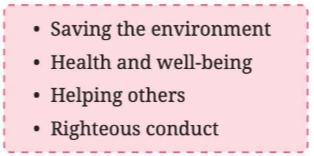
- I believe one of the best ways to serve the nation is by…
- A small change we can make is… and it will have a big impact because…
- If everyone contributes by… it can lead to…
- One of the biggest challenges we face is… and I propose we address it by…
- We can make a difference by working together as a team, if we…
- Serving the nation is not just about big actions; even small efforts like…matter.
Solution:
This is a classroom activity. In groups of 4-5, discuss how to serve the nation using these prompts:
Example: I believe one of the best ways to serve the nation is by saving the environment. A small change we can make is planting trees, and it will have a big impact because it keeps the air clean. If everyone contributes by recycling, it can lead to a healthier planet. One of the biggest challenges we face is pollution, and I propose we address it by using less plastic.
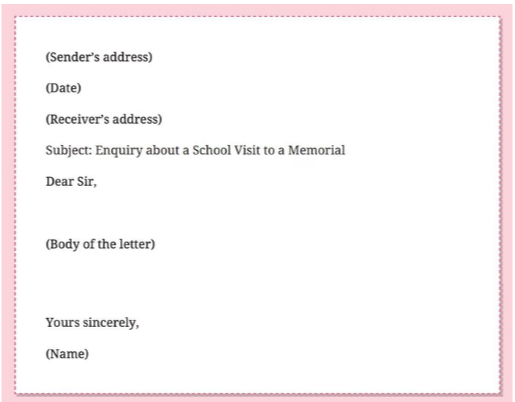
Q.20: A letter of enquiry is a formal letter written to seek detailed information about something the writer wants to know. For example, it can be used for joining a course, organising an event, knowing details about a trip, etc. The language used is formal and specific, with relevant queries. Now, write a letter of enquiry. Your school wishes to organise a visit to a Memorial in your state/region. Write the letter to the person in charge of that memorial, requesting information regarding available dates for visits, the duration of the tour, any entry fees, and guidelines for student groups.
- Follow the given layout.
- Use the cues given below to draft the letter.
| Body of the Letter | Prompts for Enquiry |
| Paragraph 1: State the purpose of writing | {tex}\checkmark{/tex} This is to enquire about… {tex}\checkmark{/tex} Could you please provide details about… ? |
| Paragraph 2: Ask for more details | {tex}\checkmark{/tex} Firstly, I request you to share… {tex}\checkmark{/tex} Secondly, I would appreciate it if you could explain… {tex}\checkmark{/tex} I would also be grateful to get further details on… {tex}\checkmark{/tex} Lastly, could you clarify if… ? |
| Paragraph 3: Request an early response | {tex}\checkmark{/tex} An early reply will be greatly appreciated, as it will help… {tex}\checkmark{/tex} Ilook forward to your guidance and support for making this trip meaningful. |
Solution:
Your Address
[City, State, ZIP Code]
31 July 2025
The In charge
National War Memorial
[City, State]
Subject: Enquiry about a School Visit to the National War Memorial
Dear Sir/Madam,
This is to enquire about organizing a school visit to the National War Memorial for our students. Could you please provide details about available dates for visits? Secondly, I would appreciate it if you could explain the duration of the tour and any entry fees. Lastly, could you clarify if there are specific guidelines for student groups? An early reply will be greatly appreciated, as it will help us plan a meaningful trip.
Yours sincerely,
[Your Name]
NCERT Solutions Class 8 English Poorvi
- The Wit that Won Hearts
- A Concrete Example
- Wisdom Paves the Way
- A Tale of Valour: Major Somnath Sharma and the Battle of Badgam
- Somebody’s Mother
- Verghese Kurien – I Too Had A Dream
- The Case of the Fifth Word
- The Magic Brush of Dreams
- Spectacular Wonders
- The Cherry Tree
- Harvest Hymn
- Waiting for the Rain
- Feathered Friend
- Magnifying Glass
- Bibha Chowdhuri: Women in Indian Science

Test Generator
Create question paper PDF and online tests with your own name & logo in minutes.
Create Now
Learn8 App
Practice unlimited questions for Entrance tests & government job exams at ₹99 only
Install Now