Atomic Foundations of Matter – NCERT Solutions Class 9 Science Exploration includes all the questions with solutions given in NCERT Class 9 Science Exploration textbook.
NCERT Solutions Class 9
English Kaveri Hindi Ganga Sanskrit Sharada Maths Ganita Manjari Science Exploration Social Understanding SocietyAtomic Foundations of Matter – NCERT Solutions
Q.1: Water can be obtained from various sources. Are all these samples of water chemically identical?
Solution: Yes, pure water is chemically identical everywhere, but real samples of water are often not chemically identical.
From the point of view of atomic foundation of matter:
- Water is a compound with fixed composition: H₂O (2 hydrogen atoms + 1 oxygen atom).
- So, pure water (like distilled water) is chemically the same in all places.
However:
- Water obtained from different sources (river, sea, rain, tap) is not pure water.
- It contains dissolved salts, gases, minerals, and impurities.
Q.2: Oxygen is sometimes represented as O and sometimes as O2. What is the difference between these symbols?
Solution: O (Oxygen atom)
- Represents a single oxygen atom.
- It is a free atom, not commonly found alone in nature.
- Example: An isolated oxygen atom (very reactive and unstable).
O₂ (Oxygen molecule)
- Represents a molecule of oxygen.
- It contains two oxygen atoms chemically bonded together.
- This is the form in which oxygen exists in air.
| Symbol | Meaning | Type | Stability |
|---|---|---|---|
| O | Single oxygen atom | Atom | Unstable |
| O₂ | Two oxygen atoms bonded | Molecule | Stable (found in air) |
Q.3: Why does dissolved salt in water conduct electricity, but sugar does not?
Solution: Dissolved salt conducts electricity, but sugar does not because of the presence or absence of charged particles (ions) in water.
Salt (NaCl) in water:
- Salt is an ionic compound.
- When dissolved in water, it breaks into ions:
NaCl → Na⁺ + Cl⁻ - These free-moving ions carry electric charge.
- So, the solution conducts electricity.
Sugar in water:
- Sugar is a covalent compound.
- When dissolved, it does not form ions.
- It remains as neutral molecules in water.
- Since there are no charged particles, it cannot conduct electricity.
| Substance | Type | In water | Conducts electricity |
|---|---|---|---|
| Salt (NaCl) | Ionic | Forms Na⁺ and Cl⁻ ions | Yes |
| Sugar | Covalent | Remains molecules | No |
Q.4: A student burns 10 g of ethanol in an open beaker. After the reaction, no residue is left in the beaker. Does this mean the Law of Conservation of Mass is violated? Explain.
Solution: No, this does not mean the Law of Conservation of Mass is violated.
The Law of Conservation of Mass states that:
Mass is neither created nor destroyed in a chemical reaction.
So, the total mass of reactants = total mass of products.
Q.5: When 20 g of hydrogen reacts completely with 160 g of oxygen, how much water is formed according to the Law of Conservation of Mass?
Solution: Given:
- Hydrogen = 20 g
- Oxygen = 160 g
- Reaction: Hydrogen + Oxygen → Water
Law of Conservation of Mass:
Total mass of reactants = Total mass of products
So,
Mass of water formed {tex}=20 g+160 g{/tex}
Calculation:
{tex} =180 {~g}{/tex}
Q.6: A compound consists of 40% sulfur and 60% oxygen by mass. In a sample of the same compound containing 20 g of sulfur, what mass of oxygen must be present to satisfy the Law of Constant Proportions?
Solution: Compound contains:
{tex}40 %{/tex} sulfur {tex}({S}){/tex}
60 % oxygen (O)
In a sample: sulfur {tex}=20 {~g}{/tex}
Find: oxygen mass
According to the Law of Constant Proportions:
A compound always contains the same elements in a fixed ratio by mass.
So,
{tex} S: O=40: 60=2: 3{/tex}
Calculation:
If 2 parts of sulfur {tex}=20 {~g}{/tex}
Then 1 part {tex}=10 {~g}{/tex}
So oxygen = 3 parts:
{tex} 3 \times 10=30 g{/tex}
Q.7: Carbon monoxide (CO) contains carbon and oxygen in the mass ratio of 3:4. How much oxygen will combine with 9 g of carbon to form carbon monoxide?
Solution: In carbon monoxide (CO), mass ratio:
{tex} \text { Carbon : Oxygen }=3: 4{/tex}
Carbon given {tex}=9 {~g}{/tex}
Find: mass of oxygen
According to the Law of Constant Proportions, the ratio of elements in a compound is always fixed.
So,
{tex} 3 \text { parts of } {C}=9 {~g}{/tex}
Step 1: Find 1 part
{tex} 1 \text { part }=\frac{9}{3}=3 {~g}{/tex}
Step 2: Find oxygen (4 parts)
{tex} 4 \times 3=12 {~g}{/tex}
Final Answer:
12 g of oxygen will combine with 9 g of carbon
Q.8: The Law of Definite Proportions holds true for compounds but not for mixtures. Give reason.
Solution: The Law of Definite Proportions holds true for compounds but not for mixtures because of the difference in how substances are formed and combined.
Q.9: Students X and Y, both prepared an oxide of copper by combining copper and oxygen in the ratios of 4:1 and 8:2, respectively. Do their results justify the Law of Constant Proportions? Explain.
Solution: Given:
Student {tex}{X}: {Cu}: {O}=4: 1{/tex}
Student {tex}{Y}: {Cu}: {O}=8: 2{/tex}
Step 1: Simplify the ratios
Student X:
{tex} 4: 1{/tex}
Student Y:
{tex} 8: 2=4: 1 \text { (divide both terms by } 2 \text {) }{/tex}
Step 2: Compare both ratios
{tex}{X} \rightarrow 4{/tex} : 1
{tex}{Y} \rightarrow 4: 1{/tex}
Both have the same fixed ratio
Q.10: What if … atoms could combine in any ratio and not in a fixed ratio? How would this affect the substances around us?
Solution: If atoms could combine in any ratio and not in fixed proportions, then substances would not have a definite composition. The same substance would show different proportions of elements in different samples, so compounds like water or carbon dioxide would not have fixed properties. As a result, the Law of Constant Proportions would not hold true. The physical and chemical properties of substances such as melting point, boiling point, and density would vary from sample to sample. This would make substances unreliable and unpredictable, and the study of chemistry as a science would not be possible in a systematic way.
Q.11: Assertion (A): 2 g of hydrogen combines with 16 g of oxygen to form 18 g of water.
Reason (R): According to Dalton’s Atomic Theory, atoms combine in a simple whole number ratio by mass to form compounds.
Options:
(1) Both A and R are true and R is the correct explanation of A. ✅
(2) Both A and R are true but R is not the correct explanation of A.
(3) A is true but R is false.
(4) A is false but R is true.
Explanation: The reason correctly explains the assertion because the fixed combination of hydrogen and oxygen atoms in a simple ratio leads to the formation of a compound with a definite mass (water).
Q.12: Nitrogen has five valence electrons. Draw the structure of the nitrogen molecule (N2).
Solution: Nitrogen has 5 valence electrons. Each nitrogen atom requires 3 more electrons to complete its octet. Therefore, two nitrogen atoms share three pairs of electrons, forming a triple covalent bond.
Structure of {tex}{N}_2{/tex}:
{tex}{N} \equiv {N}{/tex}
Each nitrogen atom has:
- 3 shared electron pairs (triple bond)
- 1 lone pair of electrons
Nitrogen molecule ({tex}{N}_2{/tex}) consists of two nitrogen atoms joined by a triple covalent bond {tex}({N} \equiv {N}){/tex}, where each atom completes its octet by sharing three pairs of electrons.
Q.13: The atomic number of fluorine is 9. Explain the formation of the fluorine molecule (F2).
Solution: The atomic number of fluorine is 9. Its electronic configuration is 2, 7, so each fluorine atom has 7 valence electrons and needs 1 more electron to complete its octet.
To achieve stability, two fluorine atoms share one pair of electrons, forming a single covalent bond. In this way, each fluorine atom attains a stable octet configuration.
Structure of {tex}{F}_2{/tex}:
{tex}{F}-{F}{/tex}
Each fluorine atom has:
- One shared pair of electrons (single bond)
- Three lone pairs of electrons
Fluorine molecule ({tex}F_2{/tex}) is formed when two fluorine atoms, each having 7 valence electrons, share one pair of electrons to form a single covalent bond (F-F), so that both atoms complete their octet and become stable.
Q.14: Show the formation of the following molecules:
- Carbon dioxide (CO2)
- Hydrogen sulfide (H2S)
- Ammonia (NH3)
Solution:
- Carbon dioxide (CO2)
- Carbon has 4 valence electrons.
- Each oxygen has 6 valence electrons.
- Carbon shares 2 electrons with each oxygen → two double covalent bonds.
 Formation:
O = C = O - Carbon completes its octet by forming two double bonds.
- Each oxygen also completes its octet.
- Shape: Linear
- Hydrogen sulfide (H₂S)
- Sulfur has 6 valence electrons.
- Each hydrogen has 1 electron.
- Sulfur shares 1 electron with each hydrogen → two single bonds.
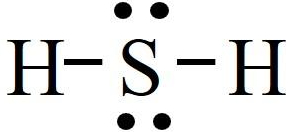 Formation:
H — S — H Sulfur forms two single covalent bonds. - It has two lone pairs of electrons.
- Shape: Bent (V-shaped)
- Ammonia (NH₃)
- Nitrogen has 5 valence electrons.
- Each hydrogen has 1 electron.
- Nitrogen shares electrons with 3 hydrogen atoms → three single bonds.
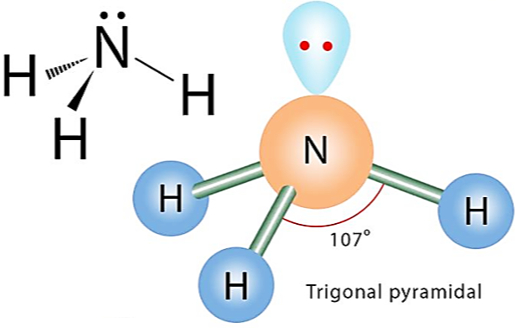
Formation:
- Nitrogen forms three single bonds.
- It has one lone pair of electrons.
- Shape: Trigonal pyramidal
Q.15: Neon (atomic number 10) neither transfers nor shares its valence electrons. Explain.
Solution: Neon has atomic number 10 and its electronic configuration is 2, 8. This means it already has a completely filled outermost shell (octet), which makes it very stable.
Since its valence shell is already full, neon does not need to gain, lose, or share electrons to become stable. Therefore, it neither transfers nor shares its valence electrons and does not usually form chemical bonds.
Neon (atomic number 10) has a completely filled valence shell (2, 8), so it is chemically stable. Hence, it neither gains, loses, nor shares electrons and does not form bonds with other atoms.
Q.16: What if we could see atoms directly? How would it help scientists and what challenges would it cause?
Solution: If we could see atoms directly, it would greatly help scientists because they could clearly observe how atoms are arranged, how they combine, and how chemical reactions take place at the atomic level. This would make it easier to understand chemical bonding, molecular structure, and the exact mechanism of reactions. It would also help in developing new materials and medicines with better accuracy.
However, it would also create challenges. Atoms are extremely small, so observing them directly would require very powerful technology, and it may still be difficult to measure their motion and behaviour precisely. It could also make experiments more complex and expensive. Thus, while it would improve understanding of science, it would also bring technical limitations and challenges.
Q.17: What kind of ion will oxygen (O) form?
Solution: Oxygen has atomic number 8 and electronic configuration 2, 6. It has 6 valence electrons and needs 2 more electrons to complete its octet and become stable.
Therefore, oxygen tends to gain 2 electrons to achieve a stable configuration. When it gains electrons, it becomes a negatively charged ion called an oxide ion.
Final Answer: Oxygen forms a negative ion (O2-) called the oxide ion by gaining 2 electrons to complete its octet.
Q.18: Among magnesium and chlorine, magnesium atom can give two electrons to become Mg2+. However, chlorine can take only one electron to become ________. Now, ________ ion of magnesium and ________ ions of chlorine combine to give magnesium chloride.
Solution: Cl⁻ (chloride ion), one Mg2+ ion, two Cl⁻
Q.19: Show the formation of cations of potassium (K) and calcium (Ca) atoms, and the formation of their corresponding chlorides using diagrams.
Solution:
- Formation of cations
Potassium {tex}({K}) \rightarrow{/tex} Potassium ion {tex}\left({K}^{+}\right){/tex}
Electronic configuration of K: 2, 8, 8, 1
It loses 1 electron to become stable.
K → K⁺ + e⁻
(2,8,8,1) (2,8,8)
Calcium {tex}({Ca}) \rightarrow{/tex} Calcium ion {tex}\left({Ca}^{2+}\right){/tex}
Electronic configuration of Ca: 2, 8, 8, 2
It loses 2 electrons to become stable.
Ca → Ca²⁺ + 2e⁻
(2,8,8,2) (2,8,8) - Formation of chlorides
Potassium chloride (KCI)
K loses 1 electron {tex}\rightarrow {K}^{+}{/tex}
CI gains 1 electron {tex}\rightarrow {Cl}^{-}{/tex}
Calcium chloride ({tex}{CaCl}_2{/tex})
Ca loses 2 electrons {tex}\rightarrow {Ca}^{2+}{/tex}
Each CI atom gains 1 electron {tex}\rightarrow 2 {Cl}^{-}{/tex}ions
Q.20: Illustrate how sodium sulfide (Na2 S) is formed.
Solution: Sodium sulfide {tex}\left({Na}_2 {~S}\right){/tex} is formed by the transfer of electrons between sodium and sulfur atoms.
- Sodium (Na) has electronic configuration 2, 8, 1 and loses 1 electron to form {tex}{Na}^{+}{/tex}.
- Sulfur (S) has electronic configuration 2, 8, 6 and needs 2 electrons to complete its octet, so it gains 2 electrons to form {tex}{S}^{2-}{/tex}.
Since one sulfur atom needs 2 electrons, two sodium atoms each donate 1 electron.
Q.21: Name the following:
- {tex}{CO}_2{/tex} ________
- {tex}{NO}_2{/tex} ________
- {tex}{SF}_{{6}}{/tex} ________
- {tex}{PCl}_3{/tex} ________
Solution:
- Carbon dioxide
- Nitrogen dioxide
- Sulphur hexafluoride
- Phosphorus trichloride
Q.22: Write the formulae for the compounds formed from the following pairs of ions:
- Fe3+ and OH–
- {tex}{K}^{+}{/tex}and {tex}{CO}_3^{2-}{/tex}
Solution:
- {tex}{Fe}^{3+}{/tex} and {tex}{OH}^{-}{/tex}
One {tex}{Fe}^{3+}{/tex} needs {tex}3 {OH}^{-}{/tex}ions to balance charge.
Formula: {tex}{Fe}({OH})_3{/tex} - One {tex}{CO}_3{ }^{2-}{/tex} needs {tex}2 {~K}^{+}{/tex}ions to balance charge.
Formula: {tex}{K}_2 {CO}_3{/tex}
Q.23: What type of chemical bond is present in a solid compound that does not conduct electricity in the solid state but conducts electricity when dissolved in water?
Solution: The compound described does not conduct electricity in the solid state but conducts electricity when dissolved in water. This behaviour indicates that the compound has an ionic bond.
In the solid state, the ions are fixed in position in a crystal lattice, so they cannot move and hence do not conduct electricity. However, when dissolved in water, the ionic compound dissociates into free ions that can move and carry electric current, allowing it to conduct electricity.
Q.24: Metal M, with two electrons in its valence shell (M shell), reacts with oxygen to form a compound that is slightly soluble in water. Predict its:
- formula
- type of bond
- electrical conductivity of its aqueous solution
Solution:
- {tex}{M} \rightarrow {M}^{2+}{/tex}
{tex}{O} \rightarrow {O}^{2-}{/tex} Balancing charges: {tex} {M}^{2+}+{O}^{2-} \rightarrow {MO}{/tex} - Formed by transfer of electrons from metal to non-metal
Ionic bond - The compound dissolves slightly in water and forms ions ({tex}{M}^{2+}{/tex} and {tex}{O}^{2-}{/tex}).
These ions move freely in solution and carry electric current.
So, its aqueous solution conducts electricity (good conductor).
Q.25: Find the molecular mass of nitric acid {tex}\left({HNO}_3\right){/tex}.
Atomic mass-H {tex}=1 {u} ; {N}=14 {u} ; {O}=16 {u}{/tex}.
Solution: {tex}\text { Molecular mass of } {HNO}_3 =(1 \times 1)+(1 \times 14)+(3 \times 16){/tex}
{tex}=1 +14+48{/tex}
{tex}=63 u{/tex}
Q.26: Find the molecular mass of methane (CH4).
Atomic mass – C = 12 u; H = 1 u.
Solution: {tex}\text { Molecular mass of } {CH}_4=(1 \times 12)+(4 \times 1){/tex}
{tex}=12+4{/tex}
{tex}=16 u{/tex}
Q.27: Find the formula unit mass of potassium chloride (KCl).
Atomic mass- {tex}{K}=39 {u} ; {Cl}=35.5 {u}{/tex}.
Solution:
K = 39 u
Cl = 35.5 u
Formula: KCl
{tex}\text { Formula unit mass of } {KCl}=39+35.5{/tex}
{tex}=74.5 u{/tex}
Q.28: Find the formula unit mass of magnesium hydroxide, {tex}{Mg}({OH})_2{/tex}.
Atomic mass- {tex}{Mg}=24 {u} ; {O}=16 {u} ; {H}=1 {u}{/tex}.
Solution:
{tex}{Mg}=24 {u}{/tex}
{tex}{O}=16 {u}{/tex}
{tex}{H}=1 {u}{/tex}
Formula: {tex}{Mg}({OH})_2{/tex}
{tex}{Mg}({OH})_2=1 {Mg}+2 {O}+2 {H}{/tex}
Now calculate:
{tex}\text {Formula unit mass}=24+(2 \times 16)+(2 \times 1){/tex}
{tex}=24+32+2{/tex}
{tex}=58 u{/tex}
Q.29: In a group activity, students place 4.0 g of calcium carbonate with 2.92 g of hydrochloric acid in a closed container. After the reaction is over, they measured 1.76 g of carbon dioxide, 0.72 g of water, and 4.44 g of calcium chloride. Verify whether the Law of Conservation of Mass is obeyed or not.
Solution:
Mass of calcium carbonate {tex}=4.0 {~g}{/tex}
Mass of hydrochloric acid {tex}=2.92 {~g}{/tex}
Total mass of reactants: {tex}4.0 {~g}+2.92 {~g}=6.92 {~g}{/tex}
Mass of carbon dioxide {tex}=1.76 {~g}{/tex}
Mass of water {tex}=0.72 {~g}{/tex}
Mass of calcium chloride {tex}=4.44 {~g}{/tex}
Total mass of products: {tex}1.76 {~g}+0.72 {~g}+4.44 {~g}=6.92 {~g}{/tex}
Compare the total mass of reactants with the total mass of products.
Mass of reactants = Mass of products
Hence, the Law of Conservation of Mass is obeyed.
Q.30: 12 g of carbon combines with 32 g of oxygen to form 44 g of carbon dioxide as per the given equation.
Carbon + Oxygen {tex}\rightarrow{/tex} Carbon dioxide
If 2.4 g of carbon reacts completely with oxygen, how much carbon dioxide will be produced?
Solution: Given that 12 g of carbon reacts with 32 g of oxygen to give 44 g of carbon dioxide.
So, 1 g of carbon will give {tex}=\frac{44}{12} {~g}{/tex} of carbon dioxide
Thus, 2.4 g of carbon will give {tex}=\frac{44}{12} \times 2.4 {~g}{/tex}
{tex}=8.8 {~g}{/tex} of carbon dioxide
Hence, 8.8 g of carbon dioxide will be produced.
Q.31: Sodium chloride (NaCl) contains sodium and chlorine in the mass ratio of 23:35.5. If 46 g of sodium reacts completely, how much chlorine is needed to form NaCl?
Solution: Mass of chlorine required = (35.5 ÷ 23) × 46 = 71 g
Q.32: Molecular mass of water (H2O).
Solution: Atomic mass — H = 1 u; O = 16 u
Molecular mass of H2 O = (1 u × 2) + (16 u × 1) = 18 u
Q.33: Molecular mass of carbon dioxide (CO2).
Solution: Atomic mass — C = 12 u; O = 16 u
Molecular Mass of CO2 = (12 u × 1) + (16 u × 2) = 44 u
Q.34: Formula unit mass of sodium oxide (Na2O).
Solution:
{tex}\text { Atomic mass- } {Na}=23 {u} ; {O}=16 {u}{/tex}
{tex}\text { Formula unit mass of } {Na}_2 {O}=(23 {u} \times 2)+(16 {u} \times 1)=62 {u}{/tex}
Q.35: Formula unit mass of calcium nitrate, {tex}{Ca}\left({NO}_3\right)_2{/tex}.
Solution: Atomic mass- {tex}{Ca}=40 {u} ; {N}=14 {u} ; {O}=16 {u}{/tex}
Formula unit mass of {tex}{Ca}\left({NO}_3\right)_2=(40 {u} \times 1)+\{(14 {u} \times 1)+(16 {u} \times 3)\} \times 2{/tex}
{tex} =164 {u}{/tex}
Q.36: A particular element (A) has one electron in its third shell. There is another element (B) with six electrons in its second shell.
- How many electrons does A tend to give or take to become stable?
- What kind of ion would it form?
- How many electrons does B tend to give or take to become stable?
- What kind of ion would it form?
- If A and B were to combine, what kind of bond would be formed?
- What would be the formula for the compound thus formed?
Solution:
- Element A has 1 valence electron, so it will give 1 electron to become stable (octet in previous shell).
- After losing 1 electron, A becomes a positively charged ion. A⁺ (cation)
- Element B has 6 valence electrons, so it will take 2 electrons to complete its octet.
- After gaining 2 electrons, B becomes a negatively charged ion. B²⁻ (anion)
- A transfers electrons to B
Therefore, an ionic bond is formed. - To balance charges:
2 A⁺ ions balance 1 B²⁻ ion
Formula = A₂B
Q.37: An element {tex}X{/tex} has six electrons in its outer shell and forms a diatomic molecule.
- Why would that be so?
- What kind of bond would it form?
- Draw the structure of the molecule it would form.
- A certain other element Y has two electrons in its second shell. Draw the structure of the molecule that X would form with Y.
Solution:
- Element X has 6 valence electrons, so it needs 2 more electrons to complete its octet (8 electrons).
To achieve stability, two atoms of X share electrons with each other, so each atom can complete its octet. Hence, X forms a diatomic molecule (X2). - Since electrons are shared between two X atoms, the bond formed is a covalent bond (double bond).
- Each X atom shares 2 electrons with the other: :X = X: (Double covalent bond between two X atoms) Each X atom also has 2 lone pairs of electrons.
- Y has 2 electrons in its second shell, so it can lose 2 electrons (forms Y2+ like Mg-type).
X needs 2 electrons, so it gains them (forms X2- like O-type).
Therefore, one Y atom combines with one X atom. Ionic compound formation: Y2+ + X2- → YX
Q.38: You want to design a new ionic compound, where the total positive charge is {tex}6+{/tex} and the total negative charge is {tex}6-{/tex}. Which of the following combinations gives the correct number of ions?
Options:
(1) {tex}2 {Al}^{3+}{/tex} and {tex}3 {Cl}^{-}{/tex}
(2) {tex}3 {Mg}^{2+}{/tex} and {tex}1 {PO}_4^{2-}{/tex}
(3) {tex}2 {Fe}^{3+}{/tex} and {tex}3 {O}^{2-}{/tex} ✅
(4) {tex}3 {Ca}^{2+}{/tex} and {tex}2 {SO}_4^{2-}{/tex}
Explanation: It has equal total positive and negative charges (6⁺ and 6⁻), which is necessary for the formation of a stable ionic compound.
Q.39: Choose the correct statement(s) and correct the false statement(s).
- Elements are made up of molecules and compounds are made up of atoms.
- The molecule of a compound is always made up of two or more atoms of the same kind.
- One molecule of nitrogen gas contains three nitrogen atoms.
- Water is made of two hydrogen atoms, covalently bonded with one oxygen atom.
Solution:
- False statement Statement: Elements are made up of molecules and compounds are made up of atoms. Correction: Elements are made up of atoms or molecules of the same kind, and compounds are made up of molecules formed by two or more different types of atoms.
- False statement Statement: The molecule of a compound is always made up of two or more atoms of the same kind. Correction: The molecule of a compound is made up of two or more atoms of different kinds.
- False statement
Statement: One molecule of nitrogen gas contains three nitrogen atoms. Correction: One molecule of nitrogen gas (N₂) contains two nitrogen atoms, not three. - True statement Water is made of two hydrogen atoms covalently bonded with one oxygen atom.
Q.40: Write the chemical formulae for the following compounds.
- Aluminium nitrate
- Calcium oxide
- Ferric oxide
Solution:
- Aluminium nitrate
Aluminium ion {tex}={Al}^{3+}{/tex}
Nitrate ion {tex}={NO}_3{ }^{-}{/tex} To balance charges: {tex}1 {Al}^{3+}{/tex} needs {tex}3 {NO}_3^{-}{/tex} - Calcium oxide
Calcium ion {tex}={Ca}^{2+}{/tex}
Oxide ion {tex}={O}^{2-}{/tex}
Charges balance in 1:1 ratio - Ferric oxide
Ferric ion {tex}={Fe}^{3+}{/tex}
Oxide ion {tex}={O}^{2-}{/tex}
To balance charges: {tex}2 {Fe}^{3+}\left(6^{+}\right){/tex}and {tex}3 {O}^{2-}\left(6^{-}\right){/tex}
Q.41: Write the formulae of the compounds formed from the following pairs of ions.
- {tex}{Ca}^{2+}{/tex} and {tex}{Br}^{-}{/tex}
- {tex}{Al}^{3+}{/tex} and {tex}{CO}_3^{2-}{/tex}
- {tex}{K}^{+}{/tex}and {tex}{SO}_4^{2-}{/tex}
- {tex}{NH}_4^{+}{/tex}and {tex}{Cl}^{-}{/tex}
Solution:
- One {tex}{Ca}^{2+}{/tex} needs {tex}2 {Br}^{-}{/tex}to balance charge
Formula: {tex}{CaBr}_2{/tex} - LCM of charges {tex}=6{/tex} {tex}2 {Al}^{3+}=6^{+}{/tex}
{tex}3 {CO}_3^{2-}=6^{-}{/tex}
Formula: {tex}{Al}_2\left({CO}_3\right)_3{/tex} - Two {tex}{K}^{+}{/tex}balance one {tex}{SO}_4{ }^{2-}{/tex}
Formula: {tex}{K}_2 {SO}_4{/tex} - Charges balance in 1:1 ratio
Formula: {tex}{NH}_4 {Cl}{/tex}
Q.42: Which of the following, in Fig, correctly represents Cl– ion (Atomic number of chlorine = 17).
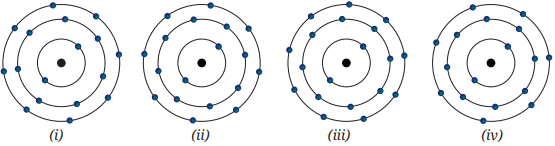
Solution: Step-by-Step Breakdown
- Atomic Number of Chlorine (Cl): 17
- In a neutral Chlorine atom, there are {tex}{1 7}{/tex} protons and {tex}{1 7}{/tex} electrons.
- The electronic configuration is 2, 8, 7.
- Formation of {tex}{Cl}^{-}{/tex}ion:
- The negative sign {tex}(-){/tex} indicates that the atom has gained one electron to achieve a stable octet (noble gas configuration).
- Total electrons in {tex}{Cl}^{-}=17+1={1 8}{/tex} electrons.
- Electronic Configuration of {tex}{Cl}^{-}{/tex}:
- K shell: 2 electrons
- L shell: 8 electrons
- M shell: 8 electrons (Full octet)
- Configuration: 2, 8, 8
Q.43: Determine the formula unit mass of the following substances.
- Ammonium nitrate {tex}\left({NH}_4 {NO}_3\right){/tex}, used as a nitrogen fertiliser, which is essential for plant growth.
- Phosphoric acid {tex}\left({H}_3 {PO}_4\right){/tex}, used to make phosphate fertiliser and detergents.
- Sodium hydrogencarbonate {tex}\left({NaHCO}_3\right){/tex}, used to relieve acidity and helps in digestion.
Solution:
- Ammonium nitrate (NH4NO3)
Step-by-step:
{tex}{N}=2{/tex} atoms {tex}\rightarrow 2 \times 14=28{/tex}
{tex}{H}=4{/tex} atoms {tex}\rightarrow 4 \times 1=4{/tex}
{tex}{O}=3{/tex} atoms {tex}\rightarrow 3 \times 16=48{/tex} Formula unit mass {tex}=28+4+48=80 u{/tex} - Phosphoric acid (H3PO4) Step-by-step:
{tex}{H}=3 \times 1=3{/tex}
{tex}{P}=1 \times 31=31{/tex}
{tex}{O}=4 \times 16=64{/tex} Formula unit mass {tex}=3+31+64=98 u{/tex} - Sodium hydrogencarbonate (NaHCO3) Step-by-step:
{tex}{Na}=23{/tex}
{tex}{H}=1{/tex}
{tex}{C}=12{/tex}
{tex}{O}=3 \times 16=48{/tex} Formula unit mass {tex}=23+1+12+48=84 u{/tex}
Q.44: Write the formulae for the compounds formed by the reaction of:
- Magnesium and nitrogen
- Lithium and nitrogen
- Sodium and sulfur
- Aluminium and oxygen
Solution:
- {tex}{Mg} \rightarrow {Mg}^{2+}{/tex}
{tex}{N} \rightarrow {~N}^{3-}{/tex} balance charges ({tex}{LCM}=6{/tex}): {tex}3 {Mg}^{2+}=6^{+}{/tex}
{tex}2 {~N}^{3-}=6^{-}{/tex}
Formula: Mg₃N₂ - {tex}{Li} \rightarrow {Li}^{+}{/tex}
{tex}{N} \rightarrow {~N}^{3-}{/tex} balance charges: {tex}3 {Li}^{+}=3^{+}{/tex}
{tex}1 {~N}^{3-}=3^{-}{/tex}
Formula: {tex}{Li}_3 {~N}{/tex} - {tex}{Na} \rightarrow {Na}^{+}{/tex}
{tex}{S} \rightarrow {~S}^{2-}{/tex} balance charges: {tex}2 {Na}^{+}=2^{-}{/tex}
{tex}1 {~S}^{2-}=2^{-}{/tex}
Formula: {tex}{Na}_2 {~S}{/tex} - {tex}{Al} \rightarrow {Al}^{3+}{/tex}
{tex}{O} \rightarrow {O}^{2-}{/tex} balance charges ({tex}{LCM}=6{/tex}): {tex}2 {Al}^{3+}=6^{+}{/tex}
{tex}3 {O}^{2-}=6^{-}{/tex}
Formula: {tex}{Al}_2 {O}_3{/tex}
Q.45: Complete the Table by writing the formulae of the compounds formed by the cations on the left and the anions at the top. LiNO3 is given as an example.
Table
| {tex}{NO}_3^{-}{/tex} | {tex}{SO}_4^{2-}{/tex} | {tex}{PO}_4^{3-}{/tex} | |
| {tex}{NH}_4^{+}{/tex} | |||
| {tex}{Li}^{+}{/tex} | {tex}{LiNO}_3{/tex} | ||
| {tex}{Al}^{3+}{/tex} | |||
| {tex}{Cu}^{2+}{/tex} |
Solution:
| Cation \ Anion | NO3– | SO42- | PO43- |
|---|---|---|---|
| NH4+ | NH4NO3 | (NH4)2SO4 | (NH4)3PO4 |
| Li+ | LiNO3 | Li2SO4 | Li3PO4 |
| Al3+ | Al(NO3)3 | Al2(SO4)3 | AlPO4 |
| Cu2+ | Cu(NO3)2 | CuSO4 | Cu3(PO4)2 |
Q.46: 5.3 g of sodium carbonate and 6.0 g of acetic acid react to produce 2.2 g of carbon dioxide, 0.9 g of water, and 8.2 g of sodium acetate. Verify whether the law of conservation of mass is valid.
Solution:
Reactants
- Sodium carbonate = 5.3 g
- Acetic acid = 6.0 g
Total mass of reactants = 5.3 + 6.0 = 11.3 g
Products
- Carbon dioxide = 2.2 g
- Water = 0.9 g
- Sodium acetate = 8.2 g
Total mass of products = 2.2 + 0.9 + 8.2 = 11.3 g
Q.47: If a species has 11 protons, 12 neutrons and 10 electrons then
- what is its atomic number and mass number?
- is it neutral, a cation or an anion? Explain.
- write its electronic configuration.
- name the species.
Solution:
- Atomic number = number of protons = 11
Mass number = protons + neutrons = {tex}11+12=23{/tex} - Protons {tex}=11{/tex}
Electrons {tex}=10{/tex} Since electrons are 1 less than protons, the species has a net positive charge (+1). - Total electrons = 10 So electronic configuration:
2, 8 - Name of the species Atomic number 11 corresponds to sodium (Na).
Since it has lost one electron, it becomes: Sodium ion (Na+)
Q.48: Two elements, A and B, have the following configurations-
A: 2, 8, 5
B: 2, 8, 7
- Which element is more reactive?
- Will A and B form ionic or covalent bonds when they combine? Explain using electron transfer or sharing.
- Predict the formula of the compound they would form.
Solution: Given:
A: 2, 8, 5 → 5 valence electrons
B: 2, 8, 7 → 7 valence electrons
- B is more reactive because it needs only 1 electron to complete its octet, while A needs 3 electrons.
- A needs 3 electrons B needs 1 electron
Instead of complete transfer, they share electrons.
Therefore, they form a covalent bond. - A shares 3 electrons
Each B shares 1 electron
So, one A combines with three B atoms
Formula: AB3
Q.49: Assertion (A): Copper sulfate conducts electricity in the molten state but not in the solid state.
Reason (R): Copper and sulfate ions are fixed in the lattice in molten state, while in solid state they can move freely.
Options:
(1) Both A and R are true and R is the correct explanation of A.
(2) Both A and R are true but R is not the correct explanation of A.
(3) A is true but R is false. ✅
(4) A is false but R is true.
Explanation:
Assertion (A): True
Copper sulfate conducts electricity in the molten state because ions are free to move, but not in the solid state because ions are fixed.
Reason (R): False
The statement is incorrect because it reverses the facts.
- In solid state → ions are fixed in lattice
- In molten state → ions are free to move
Q.50: The species {tex}{ }^{27} {Al},{ }^{80} {Br}^{-}{/tex} and {tex}{ }^{201} {Hg}^{2+}{/tex} have 13, 35 and 80 protons, respectively. How many electrons and neutrons do they have?
Solution:
- {tex}{ }^{27} {Al}{/tex}
Electrons = protons (neutral atom) = 13
Neutrons {tex}={/tex} mass number – protons {tex}=27-13=14{/tex} - {tex} { }^{80} {Br}{/tex}
Extra 1 electron (negative charge) {tex}\text { Electrons }=35+1=36{/tex}
{tex}\text { Neutrons }=80-35=45{/tex} - {tex} { }^{201} {Hg}^{2+}{/tex}
Loss of 2 electrons (positive charge)
Electrons {tex}=80-2=78{/tex}
Neutrons {tex}=201-80=121{/tex}
Q.51: Are there any chemical changes that do not obey the Law of Conservation of Mass?
Solution: No, there are no chemical changes that violate the Law of Conservation of Mass. In all chemical reactions, mass is conserved; it is neither created nor destroyed. Any apparent change in mass usually occurs due to the reaction taking place in an open system, where gases may escape or enter. In a closed system, the total mass of reactants is always equal to the total mass of products.
Class 9 Science Exploration NCERT Solutions
- Exploration: Entering the World of Secondary Science
- Cell: The Building Block of Life
- Tissues in Action
- Describing Motion Around Us
- Exploring Mixtures and Their Separation
- How Forces Affect Motion
- Work, Energy and Simple Machines
- Journey Inside the Atom
- Atomic Foundations of Matter
- Sound Waves: Characteristics and Applications
- Reproduction: How Life Continues
- Patterns in Life: Diversity and Classification
- Earth as a System: Energy, Matter and Life

Test Generator
Create question paper PDF and online tests with your own name & logo in minutes.
Create Now
Learn8 App
Practice unlimited questions for Entrance tests & government job exams at ₹99 only
Install Now