
Ask questions which are clear, concise and easy to understand.
Ask QuestionPosted by Preeti Yadav 5 years, 3 months ago
- 5 answers
Shivansh Kaushik 5 years, 3 months ago
Muddabbir Hussain 5 years, 3 months ago
Posted by Mohd Arshad 5 years, 3 months ago
- 1 answers
Meghna Thapar 5 years, 3 months ago
Gauss’s Theorem Statement:
According to Gauss’s theorem the net-outward normal electric flux through any closed surface of any shape is equivalent to 1/ε0 times the total amount of charge contained within that surface.
Proof of Gauss’s Theorem Statement:
Let the charge be = q
Let us construct the Gaussian sphere of radius = r
Now, Consider , A surface or area ds having having ds (vector)
Normal having the flux at ds:
Flux at ds:
d e = E (vector) d s (vector) cos θ
But , θ = 0
Therefore, Total flux:
C = f d Φ
E 4 π r2
Therefore,
σ = 1 / 4πɛo q / r2 × 4π r2
σ = q / ɛo
Posted by Sanat Mangal 5 years, 3 months ago
- 2 answers
Anushka Kakkar 5 years, 3 months ago
Gaurav Seth 5 years, 3 months ago
The marginal propensity to consume is equal to ΔC / ΔY, where ΔC is the change in consumption, and ΔY is the change in income. If consumption increases by 80 cents for each additional dollar of income, then MPC is equal to 0.8 / 1 = 0.8.
Posted by Mohd Arshad 5 years, 3 months ago
- 1 answers
Gaurav Seth 5 years, 3 months ago
Statement of Gauss"s Theorem : The net-outward normal electric flux through any closed surface of any shape is equal to
1/ε0 times the total charge contained within that surface , i.e.,
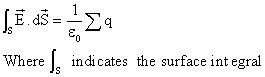
over the whole of the closed surface, q is the algebraic sum of all the charges (i.e., net charge in coulombs) enclosed by surface S.
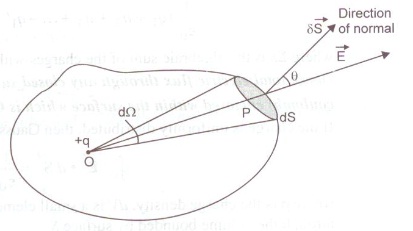
Proof of Gauss"s Theorem :
Let a point charge +q coulomb be placed at O within the closed surface. Let E be the electric field strength at P. Let
OP= r and the permittivity of free space or vaccuum be ε0.
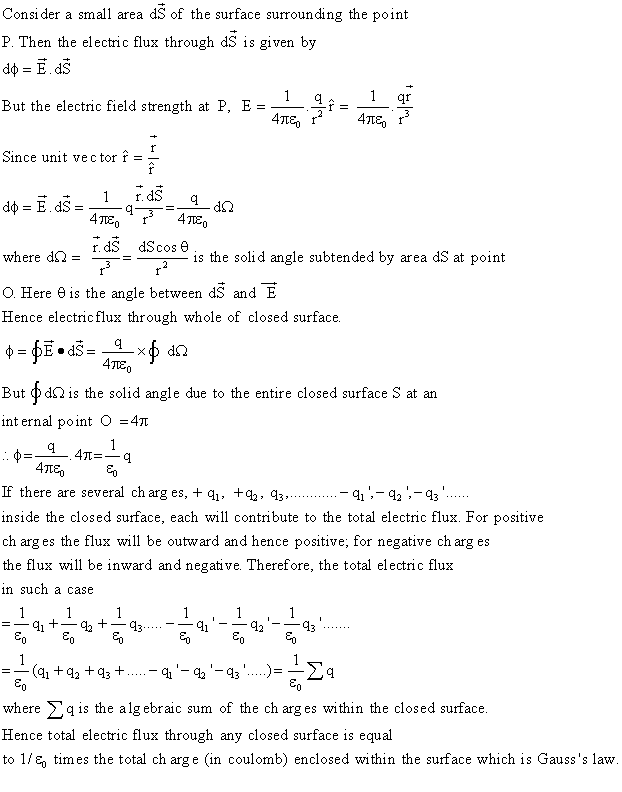 </article>
Posted by Ravi Kant 5 years, 3 months ago
- 1 answers
Meghna Thapar 5 years, 3 months ago
Most of the reaction of fluorine is exothermic because fluorine in its elemental state is considered to be electronegative element in the periodic table of all the elements.
The reaction of fluorine always helps in producing a huge amount of energy with the production of oxygen and water.
Therefore, fluorine is exothermic.
Posted by Gulshan Kumar 5 years, 3 months ago
- 0 answers
Posted by Gulshan Kumar 5 years, 3 months ago
- 0 answers
Posted by Gulshan Kumar 5 years, 3 months ago
- 0 answers
Posted by Bhupender Koli 5 years, 3 months ago
- 1 answers
Posted by Gulshan Kumar 5 years, 3 months ago
- 1 answers
Daya Pal 5 years, 2 months ago
Posted by Gulshan Kumar 5 years, 3 months ago
- 0 answers
Posted by Khushi Sharma 5 years, 3 months ago
- 1 answers
Gaurav Seth 5 years, 3 months ago
The One Child Policy was introduced in 1978 (it came into effect in the year 1979, three years after the death of the legendry leader Mao), by Deng Xiaoping, father of Open Door Policy of China, as an endeavour to control the rapidly increasing population.
Posted by Khushi Sharma 5 years, 3 months ago
- 1 answers
Gaurav Seth 5 years, 3 months ago
Regional economic grouping is one of the major instrument of promoting international trade activities among countries. It focusses on creation of larger economic unit from smaller national economies. Regional and economic groupings such as the SAARC, European Union, ASEAN, G-8, G-20, BRIGS etc are formed to increase economic co-operation among nations in the neighbourhood or those sharing common economic Interests. This is particularly considered essential by developing countries as they all facing competition not only from developed nations but also amongst themselves in the relatively limited economic space enjoyed by the developing world. Besides, co-operation with other economies in our neighbourhood is also required, as all major common economic activities in the region have an impact on overall human development in a shared environment.
Posted by Khushi Sharma 5 years, 3 months ago
- 1 answers
Gaurav Seth 5 years, 3 months ago
Regional economic grouping is one of the major instrument of promoting international trade activities among countries. It focusses on creation of larger economic unit from smaller national economies. Regional and economic groupings such as the SAARC, European Union, ASEAN, G-8, G-20, BRIGS etc are formed to increase economic co-operation among nations in the neighbourhood or those sharing common economic Interests. This is particularly considered essential by developing countries as they all facing competition not only from developed nations but also amongst themselves in the relatively limited economic space enjoyed by the developing world. Besides, co-operation with other economies in our neighbourhood is also required, as all major common economic activities in the region have an impact on overall human development in a shared environment.
Posted by Nikita Mittal 5 years, 3 months ago
- 2 answers
Itz ?? ?? 5 years, 2 months ago
Yogita Ingle 5 years, 3 months ago
|
DNA |
DNAse |
|
1. DNA or Deoxyribonucleic acid is the hereditary material in humans and almost all other organisms. |
1. DNAse or Deoxyribonuclease is an enzyme that catalyses the hydrolytic cleavage of phosphodiester linkages in the DNA backbone. |
|
2. DNA is present in nucleus. |
2. DNAse is present in cytoplasm of the cell. |
|
3. DNA transfers genetic information from one generation to another. |
3. DNAse is an enzyme used to cleave DNA molecules during recombinant DNA technology. |
Posted by Tanisha Shrivastava 5 years, 3 months ago
- 2 answers
Yogita Ingle 5 years, 3 months ago
Refractive index of diamond is 2.42 and the critical angle is 24.40 only. The faces of diamond are cut in such a way that a ray of light entering the diamond suffers repeated total internal reflections (angle of incidence is greater than the critical angle) at different faces and remains confined within the diamond. Thus it sparkles.
Posted by Surabjeet Singh 5 years, 3 months ago
- 1 answers
Yogita Ingle 5 years, 3 months ago
(i) To harmonize the interests of national security and economic policy and to prepare strategic and long-term framework of policy and program, NITI Aayog acts as a think tank of the Union Government.
(ii) By adopting a ‘Bottom-Up Approach’, the NITI Aayog acts in the spirit of cooperative federalism as it ensures equal participation of all states in the country.
Posted by Abhishek Kumar 5 years, 3 months ago
- 5 answers
Posted by Surabjeet Singh 5 years, 3 months ago
- 1 answers
Yogita Ingle 5 years, 3 months ago
Syndicate was the group of powerful leaders in the Congress Party. Lal Bahadur Shastri and later Indira Gandhi were made Prime Minister with the support received from the Syndicate. This group had a decisive say in Indira Gandhi’s first cabinet and in policy formulation and implementation of the government. After the split in the Congress, the leaders of the Syndicate stayed with the Congress (O) but were defeated n the subsequent General Elections.
Posted by Surabjeet Singh 5 years, 3 months ago
- 1 answers
Yogita Ingle 5 years, 3 months ago
The government suspended the Freedom of the Press and implemented press censorship. Electricity to all the major newspaper offices was disconnected to the next day from Emergency and the newspapers were forced to get prior approval for all material to be published. Many journalists were arrested. Newspapers like the Indian Express and the Statesman protested by leaving blank spaces where news items had been censored while magazines like the Seminar and the Mainstream chose to close down while many published through secrecy.
Posted by Raj Raj 5 years, 3 months ago
- 1 answers
Yogita Ingle 5 years, 3 months ago
‘Resource Geopolitics’ is concerned with allocation of distribution of natural resources among the nation states of global arena:
1. It is about who gets what, when, where and how.
2. Inter state rivalry and western geopolitical thinking about resources have been dominated by the relationship of trade, war and power.
Posted by Apoorva Rengasamy 5 years, 3 months ago
- 0 answers
Posted by Raj Raj 5 years, 3 months ago
- 1 answers
Yogita Ingle 5 years, 3 months ago
At the outset, one must say that globalisation is a controversial issue because it impinges both gains and pains. We will first put forward the arguments favouring globalisation.
i. Globalisation is expected to promote efficiency, productivity and, hence, higher economic growth rate. In a controlled and regulated economy, there is no inducement to the industries to become efficient and self-reliant as these are protected from foreign competition through import restrictions and from domestic competition through industrial licensing. Globalisation has one pillar of liberalisation. Liberalisation and the market principles improve the allocative efficiency of resources. This will increase export earnings, allow the inflow of foreign capital and technology. Industries and farm sector, banking and financial sectors are then exposed to international competition. Competition enhances efficiency, productivity and ultimately a better economic growth rate is likely to be achieved.
ii. As far as consumers are concerned, quality goods at the right price will be delivered. This helps to bring down prices. Quality improvement and price reduction will then be enjoyed.
iii. Foreign capital is attracted. It augurs the advent of multinational enterprises (MNEs) who bring modern up-to-date technology in less developed countries. Not only MNCs bring with them modern technology but also it brings investment funds, organisational structure, managerial culture, distribution network, etc. All these create income and employment in the country.
Arguments Against Globalisation:
i. It is feared that globalisation will promote fierce and unhealthy competition. Instead of competition and cooperation, one may argue that MNCs will swallow the domestic producers of poor backward countries overtime. Ultimately, this will cause concentration of economic and political power into the hands of the foreign business enterprises.
ii. Merely opening up the domestic economy without reaching out to foreign markets or helping industries to meet the global challenges has limited the benefits of globalisation without reducing its costs.
Posted by Shreya Mandal 5 years, 3 months ago
- 1 answers
Dinesh Kumar 5 years, 2 months ago
Posted by Sarika Singh 5 years, 3 months ago
- 0 answers
Posted by Sanjana Mazumdar 5 years, 3 months ago
- 1 answers
Gaurav Seth 5 years, 3 months ago
- Provide managers with useful insight into reality.
- Helps in thoughtful decision-making, i.e. scientific decisions.
- Helps in optimum utilisation of resources and effective administration.
- Helps the managers in meeting changing environment requirements.
- Fulfilling social responsibility.
- Basis of management training, education and research
Posted by Ankur Singh 5 years, 3 months ago
- 1 answers
Gaurav Seth 5 years, 3 months ago
The districts of Alsace and Lorraine were under the regime of France. During the Franco-Prussian war (1870-1871) France was defeated and both these districts became the part of Prussia (Germany). Earlier they were reading their own language, i.e. the French.
With the new set up, an order was issued from Berlin to teach only the German in these two districts. M. Hamel was a teacher who had been teaching the French for the last 40 years.
In his last lesson, he told that from the next day the students would be learning the German from a new teacher. They won’t be learning their own most beautiful, clearest and the logical language which is quite foreign to them. In a way he told the significance of their own language and aroused their patriotic feelings. The old villagers too endorsed his views. There came a sudden changes in Franz.
He developed a sort of great disliking for German. He heard and saw the pigeons cooing on the roofs. He immediately remarked : “Will they make them sing in German, even the pigeons ?” It is worthnoting here that the Germans can impose German language on the people of Alsace and Lorraine powerfully but they can’t impose this language on the birds, etc. They can enslave the people but have no authority to compel the cooing pigeons. Any forceful imposition will cease their love for them.
Posted by Amit Kumar 5 years, 3 months ago
- 1 answers
Gaurav Seth 5 years, 3 months ago
Most of the arable land in Champaran was divided into large estates owned by Englishmen and worked by Indian tenants. The chief commercial crop was indigo. The landlords compelled all the tenants to plant three-twentieths or 15 per cent of their holdings with indigo and surrender the entire indigo harvest as rent. This was done by long-term contract. Also, the landlords upon having learned that Germany had developed synthetic indigo, obtained agreements from the sharecroppers to pay them compensation for being released from the 15 per cent arrangement. The sharecropping arrangement was irksome to the peasants and many signed willingly. Those who resisted, engaged lawyers while the landlords hired thugs. In the meantime, the information about synthetic indigo reached the illiterate peasants who had signed and now they wanted their money back.

myCBSEguide
Trusted by 1 Crore+ Students

Test Generator
Create papers online. It's FREE.

CUET Mock Tests
75,000+ questions to practice only on myCBSEguide app

Preeti Yadav 5 years, 2 months ago
0Thank You