
Ask questions which are clear, concise and easy to understand.
Ask QuestionPosted by Shivani Yadav 4 years, 9 months ago
- 1 answers
Posted by Tannu Priya Kumari 4 years, 9 months ago
- 1 answers
Preeti Dabral 4 years, 9 months ago
Qutab Minar is a soaring, 73 m-high tower of victory, built in 1193 by Qutab-ud-din Aibak immediately after the defeat of Delhi's last Hindu kingdom. The tower has five distinct storeys, each marked by a projecting balcony and tapers from a 15 m diameter at the base to just 2.5 m at the top.
Posted by Royal Thakur ? 4 years, 9 months ago
- 0 answers
Posted by Ankit Kumar 4 years, 9 months ago
- 0 answers
Posted by Mahek Patel 4 years, 9 months ago
- 1 answers
Sia ? 4 years, 9 months ago
Outbreeding devices are the mechanisms/processes which the plants adapt to prevent self-pollination.
Outbreeding devices prevent the occurrence of self-fertilization in plants. The outbreeding devices are as follows:
1. Dioecism: Plant has either the male flowers or the female flowers so that self fertilization never occurs.
2. Dichogamy: It is the process of differential maturation of anther and stigma. When stigma becomes receptive before the anther dehiscence, it is called protogyny. When anther dehisces earlier than stigma becomes receptive, it is called protoandry.
3. Herkogamy: It occurs when stigma and anthers are prevented to come in contact separating the space. Either the style gets longer so that pollen cannot reach the stigma or the style gets shorter so that anther dehisce away from the stigma.
Posted by Mahek Patel 4 years, 9 months ago
- 1 answers
Sia ? 4 years, 9 months ago
water pollinated flowers have the following adaptations
- these flowers can float on water surface
- the pollen grains are small and have more volume than its mass
- the stegma is broad to easily capture the flowing p.grains
- pollen grain are resistive to water so that water can not demage
- pollen grain is sticky
Posted by Mahek Patel 4 years, 9 months ago
- 1 answers
Sia ? 4 years, 9 months ago
Pollination is when pollen grains from an anther, the male portion of a flower, are transferred to a female part in the flower, known as the stigma. In order for pollination to be successful, the pollen grains transferred must be from a flower of the same species.
After the pollen grains land on the stigma, they create a pollen tube through the length of the style or stalk connecting the stigma and ovary. Once the pollen tube is complete, the pollen grain will send sperm cells from the grain down to the ovary. When the sperm cells reach the ovary and the egg cells, fertilization will occur, which will result in the formation of the seed. The seed will then be released from the parent plant and will be able to grow into a plant and continue the reproductive cycle using the method of pollination.
Types of Pollination
- Although all flowering plants rely on pollination for reproduction, there is a variation in how plants pollinate. There are two types of pollination, called self-pollination and cross-pollination.
- Self-pollination is the more basic type of pollination because it only involves one flower. This type of pollination occurs when pollen grains from the anther fall directly onto the stigma of the same flower. Although this type of pollination is simple and quick, it does result in a reduction in genetic diversity because the sperm and egg cells of the same flower share genetic information.
- Cross-pollination is a more complex type of pollination that involves the transfer of pollen from the anther of one flower to the stigma of a different flower. This type of pollination results in an increase in genetic diversity because the different flowers are sharing and mixing their genetic information to create unique offspring.
Posted by Mahek Patel 4 years, 9 months ago
- 0 answers
Posted by Mahek Patel 4 years, 9 months ago
- 0 answers
Posted by Mahek Patel 4 years, 9 months ago
- 1 answers
Preeti Dabral 4 years, 9 months ago
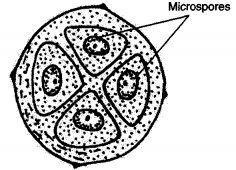
Microsporogenesis: Sporogenous cells fill the whole interior of a microsporangium. They divide with the growth of another and increase their number. Ultimately they are transformed into microspore mother cells which are diploid (possess two genomes or double set of chromosomes). The microspore mother cells or microsporocytes develop an internal layer of callose which breaks the plasmodesmal connections among themselves. The separated mother cells round off and undergo meiosis to produce tetrads of haploid microspores or pollen grains. The phenomena is called microsporogenesis. The pollen grains of a tetrad grow and separate from one another. However, they remain attached forming compound pollen grains in Typha. In Calotropis and related plants, all the pollen grains of another lobe remain united in a single sac called pollinium. Two pollinia of adjacent another are attached to produce a translator.
Posted by Mahek Patel 4 years, 9 months ago
- 0 answers
Posted by Mahek Patel 4 years, 9 months ago
- 1 answers
Preeti Dabral 4 years, 9 months ago
Its significance with reference to its chemical nature are as follows: It is one of the most resistant organic substance which can withstand high temperature, strong acids and alkali. No enzyme that degrades sporopollenin is so far known. This sporopollenin helps the pollen grain to be well preserved.
Posted by Mahek Patel 4 years, 8 months ago
- 1 answers
Preeti Dabral 4 years, 8 months ago
The flower: The flower is the reproductive unit in the angiosperms. It is meant for sexual reproduction. A typical flower has four different kinds of whorls arranged successively on the swollen end of the stalk or pedicel, called thalamus or receptacle. These are calyx, corolla, androecium and gynoecium. Calyx and corolla are accessory organs, while androecium and gynoecium are reproductive organs. In some flowers like lily, the calyx and corolla are not distinct and are termed as perianth.
Parts of a Flower
Each flower normally has four floral whorls, viz., ca1yx, corolla, androecium and gynoecium.
Calyx. The calyx is the outermost whorl of the flower and the members are called sepals. Generally, sepals are green, leaf like and protect the flower in the bud stage. The calyx may be gamosepalous (sepals united) or polysepalous (sepals free).
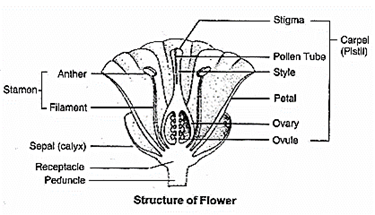
Corolla. Corolla is composed of petals. Petals are usually brightly coloured to attract insects for pollination. Like calyx, corolla may be also free (gamopetalous) or united (polypetalous). The shape and colour of corolla vary greatly in plants. Corolla may be tubular, bell-shaped, funnel-shaped or wheel-shaped.
Androecium
Androecium is composed of stamens. Each stamen which represents the male reproductive organ consists of a stalk or a filament and an anther. Each anther is usually bilobed and each lobe has two chambers, the pollen-sacs. The pollen grains are produced in pollen-sacs. A sterile stamen is called staminode.
Stamens of flower may be united with other members such as petals or among themselves. When stamens are attached to the petals, they are epipetalous as in brinjal, or epiphyllous when attached to the perianth as in the flowers of lily.
The stamens in a flower may either remain free (polyandrous) or may be united in varying degrees. The stamens may be united into one bunch or one bundle (monoadelphous) as in china rose, or two bundles (diadelphous) as in pea, or into more than two bundles (polyadelphous) as in citrus. There may be a variation in the length of filaments within a flower, as in Salvia and mustard.
Gynoecium
Gynoecium is the female reproductive part of the flower and is made up of one or more carpels. A carpel consists of three parts namely stigma, style and ovary. Ovary is the enlarged basal part, on which lies the elongated tube, the style. The style connects the ovary to the stigma. The stigma is usually at the tip of the style and is the receptive surface for pollen grains. Each ovary bears one or more ovules attached to a flattened, cushion-like placenta. When more than one carpel is present, they may be free (as in lotus and rose) and are called apocarpous. They are termed syncarpous when carpels are fused, as in mustard and tomato. After fertilisation, the ovules develop into seeds and the ovary matures into a fruit.
Posted by Divya Kushwah 4 years, 9 months ago
- 1 answers
Posted by Mohammad Sarfraj 4 years, 9 months ago
- 1 answers
Posted by Royal Thakur ? 4 years, 9 months ago
- 0 answers
Posted by Rashdeep Kaur 4 years, 9 months ago
- 1 answers
Khushi Kamboj?❤ 4 years, 8 months ago
Posted by Kanchi Sharma 4 years, 9 months ago
- 2 answers
Preeti Dabral 4 years, 9 months ago
No flow of cash takes place because ‘Short term deposits in Banks’ is a part of cash equivalents.
Posted by Udit Agarwal 4 years, 9 months ago
- 1 answers
Posted by Himani Rajput 4 years, 9 months ago
- 3 answers
Preeti Dabral 4 years, 9 months ago
Life span of an organism is the time period from its birth to its natural death.
Abhishek Kumar Pal 4 years, 9 months ago
Himani Rajput 4 years, 9 months ago
Posted by ?⚡Her?️⚡? 4 years, 9 months ago
- 4 answers
?⚡Her?️⚡? 4 years, 9 months ago
<iframe width="336" height="189" src="https://www.youtube.com/embed/T9c8rAyUmBs?controls=0" title="YouTube video player" frameborder="0" allow="accelerometer; autoplay; clipboard-write; encrypted-media; gyroscope; picture-in-picture" allowfullscreen></iframe>
?⚡Her?️⚡? 4 years, 9 months ago
Posted by Royal Thakur ? 4 years, 9 months ago
- 1 answers
Posted by Khushi Sahani 4 years, 9 months ago
- 1 answers
Anas Khan 4 years, 9 months ago
Posted by Mridula Rai 4 years, 9 months ago
- 1 answers
Preeti Dabral 4 years, 9 months ago
Gender division is a form of hierarchical social division based on social expectation and stereotypes:
- Boys and girls are brought up to believe that the main responsibility of women is housework and bringing up children.
- There is a sexual division of labour in most families where women do all the household chores and men work outside the home.
- Majority of women do some paid work in addition to domestic labour both in rural and urban areas but work is not valued and does not get recognition.
Posted by K Preethi 4 years, 9 months ago
- 1 answers
Preeti Dabral 4 years, 9 months ago
Indian culture is an amalgamation of diverse cultures and traditions influenced by the great Indian history. India is the second most populated country in the world and is also a culturally diverse country. India comprises of 29 different states rich in their own cultures and traditions. Indian culture is the heart of the country and its people.
India’s Rich Culture
Its diverse religions and communities mainly influence Indian culture. India’s diversified culture gathers people of various communities and cultures to celebrate festivals with brotherhood and love.
India is a hub of many multicultural and multi-traditional festivals like Holi, Diwali, Christmas, Guru Nanak, Ganesh Chaturthi, Dussehra, Ramazan, and many more. Each Indian festival unfolds its own cultural and national tale and significance and is celebrated with different customs.
India commemorates three first National festivals- the Republic Day, Independence Day, and Gandhi Jayanti, with great zeal and enthusiasm.
India’s Rich Culture and Heritage
In India, Deity is an essential part of every person’s life. Indians hold different prayers, beliefs, and values. The Hindu tradition and belief system worships and respects Cows, Banyan tree, Neem tree, and Peepal tree as their religious connotations.
India comprises many rivers such as Ganga, Bramhaputra, Yamuna, Narmada, Godavari, and Tapti River, which holds great religious significance and sentiments. The people occasionally worship these rivers.
India homes many sacred and religious places like the Amarnath temple, the Haridwar temple, Vaishno Devi, Badrinath, and Varanasi, which are located in the northern part of the country. However, in the southern region, one can visit the Rameshwaram temple, Sabrimala, and Sringeri that hold great significance.
India holds other significant religious places such as the Somnath Temple and the Dwarkadish Temple in Gujarat. The Siddhi Vinayak Temple in Mumbai is another pure Indian beauty. The famous Golden Temple, located at Amritsar, holds great beauty and importance on the Sikh pilgrimage site in India.
Conclusion
Thus, India is enriched with traditional and modern culture. People have the freedom to practice or follow the religion of their choice.
Posted by Ashadhaya Kaipeng 4 years, 9 months ago
- 1 answers
Preeti Dabral 4 years, 9 months ago
Divine King- There were many rulers whose social origin were obscure, thus to raise their social status many like Kushanas began to portray themselves as divine. For example there is a statue of Kanishka in a temple and it is also displayed in te coins they produce
Posted by Tarun Yadav 4 years, 9 months ago
- 1 answers
Preeti Dabral 4 years, 9 months ago
Guru Nanak Dev did not wish to establish a new religion. He organised his followers into a community. He set up rules for congregational worship (sangat) involving collective recitation. He appointed his disciple Angad as the preceptor (guru) after him. After the death of Guru Nanak Dev, his followers consolidated their own practices and distinguished themselves from both Hindus and Muslims. The practice of selecting Guru was followed for nearly 200 years by his followers.

myCBSEguide
Trusted by 1 Crore+ Students

Test Generator
Create papers online. It's FREE.

CUET Mock Tests
75,000+ questions to practice only on myCBSEguide app

Preeti Dabral 4 years, 9 months ago
0Thank You