
Ask questions which are clear, concise and easy to understand.
Ask QuestionPosted by Rajneesh Kumar 6 years, 7 months ago
- 3 answers
Posted by Rajneesh Kumar 6 years, 7 months ago
- 6 answers
Sandeep Tyagi Sandeep Tyagi 6 years, 7 months ago
Srishti Choudhary ✍⏳ 6 years, 7 months ago
Posted by Rohit Kumar 6 years, 7 months ago
- 2 answers
Gaurav Seth 6 years, 7 months ago
Planning Process
1. Setting Objectives:
– Objectives specify what the organization wants to achieve.
– Objectives can be set for the entire org. & stated to each dept. within the org. very clearly, to determine how all depts. would contribute towards overall objectives.
-Then these have to percolate down to all employees at all levels so that they understand how their actions contribute to achieving objectives.
– E.g. Objective could be to achieve sales, expansion of business etc.
2. Developing Premises:
– Plans are made on the basis of some assumptions.
– These assumptions, which provide the basis for planning, are called premises.
– All managers involved in planning should be familiar w/ them, cuz plans are expected to operate & reach their destination subject to these. They can be:
• Internal premises: Cost of products, capital, machinery, profitability etc.
• External premises: Changes in technology, population growth, competition, govt. policies etc
3. Identifying Alternative Courses Of Action:
– After setting the objectives, managers make a list of alternatives through which the org. can achieve its objectives as there can be many ways to achieve the objectives & managers must know all of them.
– E.g. Sales could be increased through any of the following ways:
• By enhancing advertising expenditure
• Appointing salesmen for door-to-door sales
• By offering discounts
• By adding more product lines.
4. Evaluating Alternative Courses Of Action
– Positive & negative aspects of each &every proposal need to be evaluated to determine their feasibility and consequences in the light of each objective to be achieved.
– E.g. In financial plans, risk-return trade-off are imp. Riskier the investment, higher the returns it is likely to give. To evaluate such proposals, detailed calc. of earnings, taxes, earnings per share etc. should be done.
5. Selecting The Best Alternative
– Real point of decision-making→ Best plan has to be adopted and implemented.
– The ideal plan = most feasible, profitable and with least negative consequences.
– Most plans may not be subjected to mathematical analysis. In such cases, subjectivity & manager‘s experience, judgment and intuition are important to select the most viable alternative.
– Sometimes a combination of plans may be selected instead of one best course.
6. Implementing The Plan
– Concerned with putting the plan into action.
– For implementing the plans, managers start organizing & assembling resources for it.
– E.g. If there is a plan to ↑ production, then more labour, more machinery will be reqd. This step would also involve organizing for more labour and purchase of machinery.
7. Follow Up Action
– This involves monitoring the plans and ensuring that activities are performed according to the schedule.
– Whenever there are deviations from plans, immediate action has to be taken to bring implementation according to the plan or make changes in the plan.
Posted by Shubham Purwal 6 years, 7 months ago
- 1 answers
Gaurav Seth 6 years, 7 months ago
A Limited Liability Partnership or LLP is an alternative corporate business form which offers the benefits of limited liability to the partners at low compliance costs. It also allows the partners to organize their internal structure like a traditional partnership. A limited liability partnership is a legal entity, liable for the full extent of its assets. The liability of the partners, however, is limited. Hence, LLP is a hybrid between a company and a partnership.
Posted by Wansara Ryngksai 6 years, 7 months ago
- 1 answers
Nikunj Sarda 6 years, 7 months ago
Posted by Kaliappan Sk 6 years, 7 months ago
- 1 answers
Sia ? 6 years, 7 months ago
Fleming’s left hand rule states that stretch the forefinger, the central finger and the thumb of your left hand mutually perpendicular to each other. If the forefinger shows the direction of the magnetic field and central finger that of the current, then the thumb will point towards the direction of motion of the conductor.
Posted by Hakim Khan 6 years, 7 months ago
- 0 answers
Posted by Abhishek Barik 6 years, 7 months ago
- 2 answers
Ayushi Jain Xi B 5 years ago
Gaurav Seth 6 years, 7 months ago
Poem:
But now it was all so still! I had counted on the commotion to get to my desk without being seen; but, of course, that day everything had to be as quiet as Sunday morning.
Word Meaning:
counted on: depended upon
commotion: noise and confusion
Explanation:
That day was unusual as there was no such sound coming out of the school and it seemed that the school was closed as it used to be on a Sunday morning. Franz had planned that he would take cover under the commotion and reach the class without being noticed but that did not seem possible.
Posted by Shikha Mishra 6 years, 7 months ago
- 1 answers
Sia ? 6 years, 7 months ago
Garrison towns are basically places where army contingents are posted . It stations troops permanently.
Posted by Rishabh Tripathi 6 years, 7 months ago
- 2 answers
Premesh Tyagi 6 years, 7 months ago
? Natasha Yadav? 6 years, 7 months ago
Posted by Utkarsh Mishra 6 years, 7 months ago
- 0 answers
Posted by Laxmipriya Sahoo 6 years, 7 months ago
- 1 answers
Krishna Yadav 6 years, 7 months ago
Posted by Khushi Yadav 6 years, 7 months ago
- 2 answers
Khushi Yadav 6 years, 7 months ago
Posted by Santy Baralu 6 years, 7 months ago
- 3 answers
Rishabh Rathi 6 years, 7 months ago
Posted by Tannu Madaan 6 years, 7 months ago
- 4 answers
Khushi Yadav 6 years, 7 months ago
Posted by Shikha Das 6 years, 7 months ago
- 3 answers
Premesh Tyagi 6 years, 7 months ago
Poppin Edge 6 years, 7 months ago
Ďãřşháñăã Yadav ? ? ? 6 years, 7 months ago
Posted by Dd D 6 years, 7 months ago
- 1 answers
Shubham Purwal 6 years, 7 months ago
Posted by Kamlesh Kumar 6 years, 7 months ago
- 1 answers
Sia ? 6 years, 7 months ago
Malaria is caused by the protozoan parasite Plasmodium. This disease spreads through the bite of an insect vector, i.e. the female Anopheles mosquito, which feeds on human blood.
Symptoms of Malaria:
(i) Sudden appearance of fever with pain and sensation of cold shivering.
(ii) Temperature rises up to 106°F and patient feels burning hot, inter headache, faster breathing rate and heart beat.
(iii) Fever later comes down with profuse sweating. This occurs either daily at a particular time or is repeated every third or fourth day depending upon the species of the parasite.
(iv) Enlargement of spleen and anaemia occurs.
Posted by Mayank Choubey 6 years, 7 months ago
- 2 answers
Posted by Renu Kathuria 6 years, 7 months ago
- 2 answers
Akshita Singh 6 years, 7 months ago
Posted by Shalini Chauhan 6 years, 7 months ago
- 1 answers
Sia ? 6 years, 7 months ago
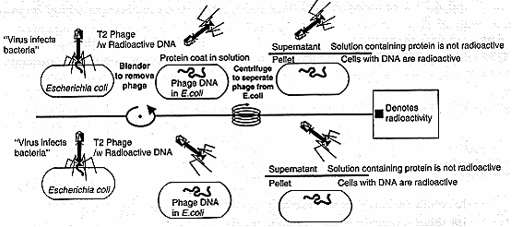
Hershey - Chase Experiment (1952) Hershey and Chase conducted their experiments on the T2 phase, a virus. The phase consists only of a protein shell containing its genetic material. In a first experiment, they labelled the DNA of phages with radioactive phosphorus - 32 (the element phosphorus is present in DNA but not present in any of the 20 amino acids from which proteins are made). They allowed the phages to infect E.coli, then removed the protein shells from the infected cells with a blender and separated the cells and viral coats by using a centrifuge. They found that the radioactive tracer was visible only in the pellet of bacterial cells and not in the supernatant containing the protein shells. In a second experiment, they labelled the phages with radioactive Sulfur-35 After separation, the radioactive tracer then was found in the protein shells, but not in the infected bacteria, supporting the hypothesis that the genetic material which infects the bacteria is DNA.
Posted by Aarav Babu 6 years, 7 months ago
- 10 answers
꧁≪Mämƭå ℭℏᑌĎℎàℜÿ? 6 years, 7 months ago
Ďãřşháñăã Yadav ? ? ? 6 years, 7 months ago
Řøhăň Řąjpůť ✌️✊ 6 years, 7 months ago
Priya Dharshini ? 6 years, 7 months ago
Priya Dharshini ? 6 years, 7 months ago
Priya Dharshini ? 6 years, 7 months ago
Posted by Shubham Singh 6 years, 7 months ago
- 1 answers
Sia ? 6 years, 7 months ago
One of the significant theory in demography is the theory of demographic transition. This theory says that the population growth is directly related to the overall levels of economic development and generally every society follows a typical pattern of development related to population growth. Three basic phases of population growth are there. The first phase is of low population growth in an underdeveloped and technologically backward society. Growth rate in this is low because death rate and birth rate both are very high. That is why difference between the both or net growth rate is low. The third phase is also one of low growth in a developed society where both the birth rate and death rate have been reduced to a great extent and there is very less gap between both of them. But there is transitional stage between the two, which is a movement from a backward to an advanced stage. This stage has a feature of very high rates of growth of population.
Transitional phase is related to population explosion because death rate is brought down quickly through better nutrition, public health and advanced methods of disease control. But birth rate does not reduce to such an extent and that is why growth rate goes high. Many countries are struggling to reduce the birth rate in keeping with the falling death rate.
Posted by Adnan Khan 6 years, 7 months ago
- 1 answers
Ďãřşháñăã Yadav ? ? ? 6 years, 7 months ago
Posted by Ganesh Chand 6 years, 7 months ago
- 1 answers
Sia ? 6 years, 7 months ago
Substance abuse, also known as drug abuse, is a patterned use of a drug in which the user consumes the substance in amounts or with methods which are harmful to themselves or others, and is a form of substance-related disorder.
Posted by Amol Gùpta 6 years, 7 months ago
- 4 answers
Aman Pratap 6 years, 7 months ago
Mayank Choubey 6 years, 7 months ago
Posted by Bhupendra Meena 6 years, 7 months ago
- 1 answers
Sia ? 6 years, 7 months ago
Social change refers to any significant alteration over time in behavior patterns and cultural values and norms. By “significant” alteration, sociologists mean changes yielding profound social consequences.

myCBSEguide
Trusted by 1 Crore+ Students

Test Generator
Create papers online. It's FREE.

CUET Mock Tests
75,000+ questions to practice only on myCBSEguide app

Sia ? 6 years, 7 months ago
No, there will be no grammar
0Thank You