
Ask questions which are clear, concise and easy to understand.
Ask QuestionPosted by Mukan Jangra????? 6 years, 7 months ago
- 16 answers
Miss Mor 6 years, 7 months ago
Miss Mor 6 years, 7 months ago
Mukan Jangra????? 6 years, 7 months ago
Mukan Jangra????? 6 years, 7 months ago
Posted by Amit Singh 6 years, 7 months ago
- 1 answers
Posted by Anushka Sutar 6 years, 7 months ago
- 1 answers
Kalpana Jha 6 years, 7 months ago
Posted by M. B. 6 years, 7 months ago
- 0 answers
Posted by Sunita Gupta Gupta 6 years, 7 months ago
- 3 answers
Yashika Bansal 6 years, 7 months ago
Posted by Shivani Rajput 6 years, 7 months ago
- 0 answers
Posted by Abhishek Singh 6 years, 7 months ago
- 1 answers
Avinash Das 6 years, 7 months ago
Posted by Sunil Yadav 6 years, 7 months ago
- 6 answers
Priya Dharshini ? 6 years, 7 months ago
Ravi Mishra 6 years, 7 months ago
Řøhăň Řąjpůť ✌️✊ 6 years, 7 months ago
Posted by Chandani Ali 6 years, 7 months ago
- 1 answers
Posted by Himanshu Bhasker 6 years, 7 months ago
- 0 answers
Posted by Nandini Dhiman 6 years, 7 months ago
- 0 answers
Posted by Natali Jain 6 years, 7 months ago
- 3 answers
Miss Mor 6 years, 7 months ago
Miss Mor 6 years, 7 months ago
Posted by Dhruv Sethi 6 years, 7 months ago
- 1 answers
Posted by Kamal Pujari 6 years, 7 months ago
- 2 answers
Miss Mor 6 years, 7 months ago
Posted by Best Gaming 6 years, 7 months ago
- 0 answers
Posted by Ajit Patel 6 years, 7 months ago
- 1 answers
Sia ? 6 years, 7 months ago
Two co-axial cylindrical shells A and B of radii a and b are possessed by a cylindrical capacitor. Assume l be length of the cylindrical shell. Due to the introduction of +q charge on the inner cylindrical shell A, equal but opposite charge -q is induced on the inner surface of the outer cylindrical shell B. The induced charge +q on its outer surface will flow to earth if the shell B is earthed.
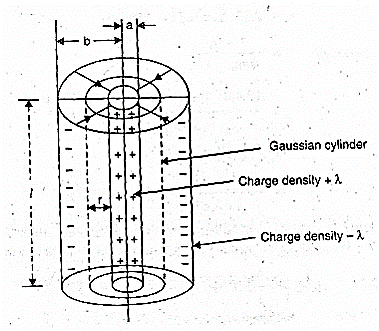
The capacitance of the cylindrical capacitor is given as follows if V is potential difference between the cylindrical shell A and B.
{tex}C = \frac{q}{V}{/tex}
By applying the Gaussian a theorem, we first need to find electric field E in the space between two shells to find out potential difference between the cylindrical shells A and B . Let a cylinder of radius r (such that b > r > a) and length l as the Gauss surface. Charge enclosed by the Gaussian surface is {tex}\lambda{/tex}1 and if {tex}\lambda{/tex} is charge per unit length on the shell A.
The electric flux will cross through only curved surface of the cylinder (Gauss surface). As the area of curved surface of cylinder is {tex}2\pi rl{/tex}, we have by Gaussian theorem.
{tex}\oint E \cdot ds = \frac{q}{{{\varepsilon _0}}}{/tex}
{tex}E \cdot 2\pi rl = \frac{{\lambda l}}{{{\varepsilon _0}}}{/tex}
{tex}E = \frac{\lambda }{{2\pi {\varepsilon _0}r}}{/tex}
The field lines are radial and normal to the axis of charged cylinder.
Posted by Shruti Manek 6 years, 7 months ago
- 2 answers
Posted by Navjot Sandhu 6 years, 7 months ago
- 1 answers
Posted by Juhi Ray 6 years, 7 months ago
- 3 answers
Miss Mor 6 years, 7 months ago
Anshul Pandey 6 years, 7 months ago
Posted by Mohit Joshi 6 years, 7 months ago
- 1 answers
Aryan Gupta 6 years, 7 months ago
Posted by Nitya Vashishtha 6 years, 7 months ago
- 1 answers
Posted by Sayu Yadav 6 years, 7 months ago
- 2 answers
Miss Mor 6 years, 7 months ago
Posted by A. Star Girl 6 years, 7 months ago
- 1 answers
Posted by Manish Kumar 6 years, 7 months ago
- 0 answers
Posted by Anuj Sharma 6 years, 7 months ago
- 1 answers
Aayushi Narang 6 years, 7 months ago
Posted by Nikesh Singh 6 years, 7 months ago
- 2 answers
Posted by Nishanth Gowda 6 years, 7 months ago
- 1 answers
Meghna Thapar 5 years, 9 months ago
Hardy-Weinberg Principle states that allele and genotype frequencies in a population will remain constant unless one or more factors cause the frequencies to change. Hardy-Weinberg formula. p² + 2pq + q² = 1 ; can be used to determine if a populations is in genetic equilibrium. P stands for. So, the factors that affect the Hardy Weinberg principle includes gene flow, genetic drift, mutation, genetic recombination and natural selection. The genetic variation of natural populations is constantly changing from genetic drift, mutation, migration, and natural and sexual selection. The Hardy-Weinberg principle gives scientists a mathematical baseline of a non-evolving population to which they can compare evolving populations.
Posted by Sakshi Chhetry 6 years, 7 months ago
- 1 answers
Sanya Garg 6 years, 7 months ago
Posted by Vijay Yadav 6 years, 7 months ago
- 0 answers

myCBSEguide
Trusted by 1 Crore+ Students

Test Generator
Create papers online. It's FREE.

CUET Mock Tests
75,000+ questions to practice only on myCBSEguide app

Kiran??? Gautam 6 years, 7 months ago
0Thank You