
Ask questions which are clear, concise and easy to understand.
Ask QuestionPosted by Demon King 6 years, 7 months ago
- 1 answers
Posted by Akriti Mishra 6 years, 7 months ago
- 0 answers
Posted by Akriti Mishra 6 years, 7 months ago
- 1 answers
Meghna Thapar 5 years, 9 months ago
- Menstruation: The period—the shedding of the uterine lining. Levels of estrogen and progesterone are low.
- The follicular phase: The time between the first day of the period and ovulation. Estrogen rises as an egg prepares to be released.
- The proliferative phase: After the period, the uterine lining builds back up again.
- Ovulation: The release of the egg from the ovary, mid-cycle. Estrogen peaks just beforehand, and then drops shortly afterwards.
- The luteal phase: The time between ovulation and before the start of menstruation, when the body prepares for a possible pregnancy. Progesterone is produced, peaks, and then drops.
- The secretory phase: The uterine lining produces chemicals that will either help support an early pregnancy or will prepare the lining to break down and shed if pregnancy doesn’t occur.
Posted by Alok Kumar Shah 6 years, 7 months ago
- 1 answers
Pragati Saini 6 years, 7 months ago
Posted by Alok Kumar Shah 6 years, 7 months ago
- 1 answers
Pragati Saini 6 years, 7 months ago
Posted by Oungchuk Gyansapa 6 years, 7 months ago
- 1 answers
Posted by Prabhjot Kaur 6 years, 7 months ago
- 3 answers
Ďãřşháñăã Yadav ? ? ? 6 years, 7 months ago
Ďãřşháñăã Yadav ? ? ? 6 years, 7 months ago
Ďãřşháñăã Yadav ? ? ? 6 years, 7 months ago
Posted by Divyansh Jain 6 years, 7 months ago
- 1 answers
Priya Dharshini ? 6 years, 7 months ago
Posted by Arpit Gaud 6 years, 7 months ago
- 2 answers
Pooja Bhakar 6 years, 6 months ago
Ayushi Khare 6 years, 7 months ago
Posted by Arpita Tiwari 6 years, 7 months ago
- 0 answers
Posted by Aryan Tiwari 6 years, 7 months ago
- 3 answers
Posted by Ayesha Minhaz 6 years, 7 months ago
- 0 answers
Posted by Ayesha Minhaz 6 years, 7 months ago
- 0 answers
Posted by Aman Sahni 6 years, 7 months ago
- 1 answers
Priyaan Sharavanan 6 years, 7 months ago
Posted by Vaibhav Kamboj 6 years, 7 months ago
- 0 answers
Posted by Praveen Kumar 6 years, 7 months ago
- 1 answers
Yashika Bansal 6 years, 7 months ago
Posted by Vijay Yadav 6 years, 7 months ago
- 1 answers
Jk Verma 6 years, 7 months ago
Posted by Vivekanand Yadav 6 years, 7 months ago
- 1 answers
Pragati Saini 6 years, 7 months ago
Posted by Shikha Bhardwaj 6 years, 7 months ago
- 1 answers
Mishra Devesh 6 years, 7 months ago
Posted by Amit Biswas 6 years, 7 months ago
- 0 answers
Posted by Diwakar Kumar 6 years, 7 months ago
- 0 answers
Posted by Rushda Chaudhary 6 years, 7 months ago
- 1 answers
Posted by Prem Kumar 6 years, 7 months ago
- 1 answers
Jagdeep Singh 6 years, 7 months ago
Posted by Bikar Singh 6 years, 7 months ago
- 0 answers
Posted by Daksh Singh 6 years, 7 months ago
- 1 answers
Sia ? 4 years, 10 months ago
Posted by Saswati Thakur 6 years, 7 months ago
- 0 answers
Posted by Munabbar Ali 6 years, 7 months ago
- 0 answers

myCBSEguide
Trusted by 1 Crore+ Students

Test Generator
Create papers online. It's FREE.

CUET Mock Tests
75,000+ questions to practice only on myCBSEguide app

Sia ? 6 years, 7 months ago
A solenoid is a long circular coil containing a large number of close turns of insulated copper wire. When a electric current is passed through the solenoid, it produces magnetic field around it as shown in fig. Magnetic field produced by a current carrying solenoid is similar to the magnetic field produced by a bar magnet. As is clear from the figure, the lines enter from the left side and leave out from the right side. If we look from left side, the current appears to be passing in the coil in clockwise direction and hence it acts as a south pole according to clock rule. If the coil is viewed from right side, the current appears to be in anticlockwise direction. Hence, left-hand side face behaves as if this were a north pole. If the coil is left free, it will point South and North.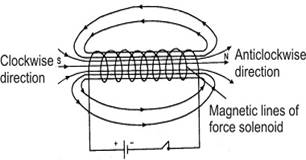
Since the current in the turns of the solenoid flows in the same direction, the magnetic field produced by each turn of the solenoid adds up, giving a very strong resultant field inside the solenoid. Hence, a solenoid may be used in making electromagnets.
0Thank You