
Ask questions which are clear, concise and easy to understand.
Ask QuestionPosted by Ritesh Kumar 6 years, 6 months ago
- 0 answers
Posted by Ritesh Kumar 6 years, 6 months ago
- 2 answers
Posted by Mintu Bez Baruah 6 years, 6 months ago
- 0 answers
Posted by Dharmender Kumar 6 years, 6 months ago
- 2 answers
Minakshi Charan 6 years, 6 months ago
Posted by Tannu Madaan 6 years, 6 months ago
- 4 answers
Posted by Tannu Madaan 6 years, 6 months ago
- 2 answers
Chetna Regar 6 years, 6 months ago
Posted by Tannu Madaan 6 years, 6 months ago
- 3 answers
Posted by Yugratan Kumar 6 years, 6 months ago
- 1 answers
Anjali Jain 6 years, 6 months ago
Posted by Vaishnavi Mishra 6 years, 6 months ago
- 0 answers
Posted by Meena Jadav 6 years, 6 months ago
- 0 answers
Posted by Amul Sharma 6 years, 6 months ago
- 1 answers
Posted by Bhavya Singhal 6 years, 6 months ago
- 1 answers
Devansh Mohan 6 years, 6 months ago
Posted by Bhavya Singhal 6 years, 6 months ago
- 1 answers
Devansh Mohan 6 years, 6 months ago
Posted by Biswanath Majhi 6 years, 6 months ago
- 0 answers
Posted by Priyanka Kataria 6 years, 6 months ago
- 1 answers
Devansh Mohan 6 years, 6 months ago
Posted by Deeya Singh 6 years, 6 months ago
- 1 answers
Yogita Ingle 6 years, 6 months ago
Mutarotation refers to the spontaneous change in the optical rotation of a freshly prepared solution of an optically active compound with time. All monosaccharides exhibit mutarotation in aqueous solutions.
For example: The specific rotation of a freshly prepared solution of alpha-D-glucose gradually decreases from +112 to +52.7 while that of beta-D-glucose increases from +19 to +52.7 with time. This change in specific rotation of an optically active compound in solution with time, to an equilibrium value, is an example of mutarotation.
Posted by Abhishek Gupta 6 years, 6 months ago
- 0 answers
Posted by Utkarsh Mishra 6 years, 6 months ago
- 3 answers
Posted by Vaibhav Singh 6 years, 6 months ago
- 2 answers
Posted by Rahul Bidiyasar 6 years, 6 months ago
- 1 answers
Sohan .G 6 years, 6 months ago
Posted by Bhupendra Singh Bhupendra Singh 6 years, 6 months ago
- 1 answers
Posted by Kunj Parmar 6 years, 6 months ago
- 1 answers
Gaurav Seth 6 years, 6 months ago
According to Gauss’s law, the total of the electric flux out of a closed surface is equal to the charge enclosed divided by the permittivity. The total electric flux through a closed surface is zero if no charge is enclosed by the surface.
- Gauss’s law is true for any closed surface, no matter what its shape or size.
- The term q on the right side of Gauss’s law includes the sum of all charges enclosed by the surface. The charges may be located anywhere inside the surface.
- In the situation when the surface is so chosen that there are some charges inside and some outside, the electric field is due to all the charges, both inside and outside S. The term q on the right side of Gauss’s law, however, represents only the total charge inside S.
- The surface that we choose for the application of Gauss’s law is called the Gaussian surface. The Gaussian surface can pass through a continuous charge distribution.
- Gauss’s law is useful for the calculation of the electrostatic field for a symmetric system.
- Gauss’s law is based on the inverse square dependence on distance contained in the Coulomb’s law. Any violation of Gauss’s law will indicate departure from the inverse square law.
Posted by Diana Sagolsem 6 years, 6 months ago
- 2 answers
Gaurav Seth 6 years, 6 months ago
Answer is: 9650 C
Explanation is given below:
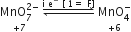
As per the equation, for 1 mole of MnO42-, 1F of electricity is required. Thus, for 0.1 mole of MnO4-, 0.1 F of electricity is required.
Since, 1 F = 96500 C
0.1 F = 0.1 x 96500 C
= 9650 C
Hence, 9650 C of electricity is required to completely oxidise MnO42- to MnO4-
Posted by Sohan .G 6 years, 6 months ago
- 3 answers
Harsh Mishra 6 years, 6 months ago
I know that You'd copied it from Meritnation, Gaurav Bhaiya.....But, I'm not going to do the Same.....
Well, Vandana If you want similar Questions, So You'n try my home website Brainly.... we don't get the exact Q. there but a lot of similar ones..... For Instance :-
<article data-quality-tier="3" data-question-id="2751716" data-z="{"id": "2751716"}" id="question">Q. Light of wavelength 2000 Angstrom falls on a metal surface of work function 4.2 ev. What is the kinetic energy in ev of fastest and slowest photo electron emitted from the surface?

Hope this helps you....
</section>Harsh Mishra 6 years, 6 months ago
Kya Hua Gaurav Bhaiya, Copy karne ke liye exact Answer naheen Mila.....That's why, You're advising us to do the similar Question!!!
Gaurav Seth 6 years, 6 months ago
Take help from similar ques:
Light of wavelength 2500Å falls on a metal surface of work function 3.5V. What is the kinetic energy (in eV) of (i) the fastest and (ii) the slowest electronic emitted from the surface? If the same light falls on another surface of work function 5.5eV, what will be the energy of emitted electrons?
Wavelength of incident radiation (λ) = 2500Å
Work function (W0) =3.5eV
(i) KE of fastest electron =1.47eV
(ii) KE of slowest electron = 0eV
If the same light (having energy 4. 97eV) falls on the surface (of work function 5.5eV), then no photoelectrons will emit.
Posted by Anisha Chettri 6 years, 6 months ago
- 0 answers

myCBSEguide
Trusted by 1 Crore+ Students

Test Generator
Create papers online. It's FREE.

CUET Mock Tests
75,000+ questions to practice only on myCBSEguide app
