
Ask questions which are clear, concise and easy to understand.
Ask QuestionPosted by Ajitha Kumari 3 years, 1 month ago
- 4 answers
Anjan Karthi 3 years, 1 month ago
Posted by Ajitha Kumari 3 years, 1 month ago
- 3 answers
Anjan Karthi 3 years, 1 month ago
Posted by Arnav Thakur 3 years, 1 month ago
- 0 answers
Posted by Ruhani Arora 3 years, 1 month ago
- 2 answers
Anjan Karthi 3 years, 1 month ago
Posted by Ruhani Arora 3 years, 1 month ago
- 5 answers
Yashi Kushwaha 3 years, 1 month ago
Ruhani Arora 3 years, 1 month ago
Posted by Zaid Malik 3 years, 1 month ago
- 1 answers
B.Jasmi Shree 3 years, 1 month ago
Posted by Vishal Sharma 3 years, 1 month ago
- 0 answers
Posted by Siya Chodankar 3 years, 1 month ago
- 1 answers
Posted by Deeshu Gupta 3 years, 1 month ago
- 0 answers
Posted by Muskan Alivi 3 years, 1 month ago
- 2 answers
Posted by Pooja Bijarniya 3 years, 1 month ago
- 2 answers
Ayush Yadav 3 years, 1 month ago
Posted by Payal Kumawat 3 years, 1 month ago
- 0 answers
Posted by Kasak Gill 3 years, 1 month ago
- 3 answers
Aseem Mahajan 3 years, 1 month ago
Posted by Javed Sheikh 3 years, 1 month ago
- 3 answers
Abhi Timus 3 years, 1 month ago
Purnima Nagpal 3 years, 1 month ago
Diksha Jaiswal 3 years, 1 month ago
Posted by Cbse V 3 years, 1 month ago
- 0 answers
Posted by Mohd Sameer 3 years, 1 month ago
- 1 answers
Posted by Tpavitra Rajput 3 years, 1 month ago
- 1 answers
Posted by Kamal Kathayat 3 years, 1 month ago
- 2 answers
Aseem Mahajan 3 years, 1 month ago
Posted by 🤟Royal Thakur 🤟 3 years, 1 month ago
- 5 answers
Posted by Ankur Paul 3 years, 1 month ago
- 4 answers
Preeti Dabral 3 years, 1 month ago
Self-efficacy refers to an individual's belief in his or her capacity to execute behaviors necessary to produce specific performance attainments (Bandura, 1977, 1986, 1997). Self-efficacy reflects confidence in the ability to exert control over one's own motivation, behavior, and social environment.
Anjan Karthi 3 years, 1 month ago
Posted by Sarabjeet Kaur 3 years, 1 month ago
- 1 answers
Posted by Piyush Thapli 3 years, 1 month ago
- 1 answers
Posted by Piyush Thapli 3 years, 1 month ago
- 0 answers
Posted by Maahnoor Quraishi 3 years, 1 month ago
- 2 answers
Preeti Dabral 3 years, 1 month ago
- The electric flux through an area is defined as the electric field multiplied by the area of the surface projected on a plane, perpendicular to the field. Its S.I. unit is voltmeter (Vm) or Newton metre square per coulomb (Nm2 C-1). The given statement is justified because while measuring the flux, the surface area is more important than its volume on its size.
- Electric field inside the shell:
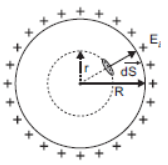
The charge resides on the surface of a conductor. Thus, a hollow charged conductor is equivalent to a charged spherical shell. Let's consider a spherical Gaussian surface of radius (r < R). If E is the electric field inside the shell, then by symmetry electric field strength has the same magnitude Ei on the Gaussian surface and is directed radially outward.
Electric flux through the Gaussian surface is given by,
{tex}=\int_{s} \vec{E}_{i} \cdot d \vec{S}{/tex}
{tex}=\int E_{i} d S \cos 0=E_{i} .4 \pi r^{2}{/tex}
Now, Gaussian surface is inside the given charged shell, so charge enclosed by Gaussian surface is zero.
Therefore, using Gauss's theorem, we have
{tex}\int_{S} \vec{E}_{i} \cdot d \vec{S}=\frac{1}{\epsilon_{0}} \times \text { charge enclosed }{/tex}
{tex}\Rightarrow E_{i} \cdot 4 \pi r^{2}=\frac{1}{\epsilon_{0}} \times 0{/tex}
{tex}\Rightarrow{/tex} Ei = 0
Thus, electric field at each point inside a charged thin spherical shell is zero.
Mayank Chauhan 3 years, 1 month ago
Posted by Rameshwar Pandey 3 years, 1 month ago
- 3 answers
Saini.Satwinder Saini Satwinder 3 years, 1 month ago
Samiran Borthakur 3 years, 1 month ago
Posted by 🤟Royal Thakur 🤟 3 years, 1 month ago
- 5 answers
🤟Royal Thakur 🤟 3 years, 1 month ago
Aseem Mahajan 3 years, 1 month ago
Posted by Aayush Singh 3 years, 1 month ago
- 1 answers
Preeti Dabral 3 years, 1 month ago
r=√(2mqV) / qB
as given alpha particle q=2e=2×1.6×10^-19
V=10^4V
m=6.4×10^-27kg
B=2×10^-3T
r=√(2 × 6.4×10^-27 × 2× 1.6×10^-19 × 10^4) /1.6×10^-19 × 2×10^-3
=√(4096×10^-44) / 64 × 10^-23
=(64 × 10^-22) / (64 × 10^-23)
=10
therefore radius is 10m

myCBSEguide
Trusted by 1 Crore+ Students

Test Generator
Create papers online. It's FREE.

CUET Mock Tests
75,000+ questions to practice only on myCBSEguide app

Navneet Kaur 3 years, 1 month ago
1Thank You