
Ask questions, doubts, problems and we will help you..
Ask questions which are clear, concise and easy to understand.
Ask Question
CBSE, JEE, NEET, CUET
Question Bank, Mock Tests, Exam Papers
NCERT Solutions, Sample Papers, Notes, Videos
Posted by Tehsin Ansari 5 years, 1 month ago (7212326)
- 0 answers
Posted by Abdul Kadir Laskar 5 years, 1 month ago (10070313)
- 0 answers
Posted by Umesh Natekar 5 years, 1 month ago (5379349)
- 3 answers
Shivam Goswami 5 years, 1 month ago (6053975)
Yogita Ingle 5 years, 1 month ago (2577571)
Causes of population of growth:
(1) In older days many deaths occurred due to diseases. But the development in medical sciences has controlled the diseases and brought about decrease in the death rate.
(2) Development in agriculture, better techniques to grow more and better quality food.
(3) Food available at all the times due to better storage conditions. So people do not die of starvation when food is not available.
(4) Man formed houses so that he is protected from wild animals and environment. He is safe from the elements of nature.
Consequences of population growth:
(1) Poverty: If the family is large it will become poor with limited income.
(2) Unhygienic living conditions due to more people living in a small area. This would increase diseases in people.
(3) Housing problem will arise as more houses will be required for the increasing population but they are not built at such a high rate.
(4) Pollution will be an added problem of high population. Large population will cause environmental pollution.
Devil ? 5 years, 1 month ago (3139322)
Posted by Mahakal Jai 5 years, 1 month ago (10070510)
- 5 answers
Divyanshi Jindal 5 years, 1 month ago (10485126)
Tanmay Nagar 5 years, 1 month ago (10051457)
Posted by Aayush Kumar 5 years, 1 month ago (8926016)
- 3 answers
Gaurangi Sharma 5 years, 1 month ago (9219047)
Yogita Ingle 5 years, 1 month ago (2577571)
Force: It is a push or pull on an object that produces acceleration in the body on which it acts. S.I. unit of force is Newton.
Newton’s I law of motion: An object remains in a state of rest or of uniform motion in a straight line unless acted upon by an external unbalanced force.
Newton’s II law of motion: The rate of change of momentum of an object is proportional to the applied unbalanced force in the direction of the-force.
Newton’s III law of motion: To every action, there is an equal and opposite reaction and they act on two different bodies.
Daksh Singh 5 years, 1 month ago (8227015)
Posted by Umesh Natekar 5 years, 1 month ago (5379349)
- 1 answers
Yogita Ingle 5 years, 1 month ago (2577571)
In 1972 Paul Berg began genetic engineering. With the assistance of the lambda phage, he was able to introduce an SV-40 virus gene into a bacterium. Berg is often referred to as ‘Father Of Genetic Engineering’. He received the Nobel Prize in 1980.

Posted by Bharti Kumari 5 years, 1 month ago (9920450)
- 1 answers
Posted by Rithya S 5 years, 1 month ago (10060074)
- 1 answers
Yogita Ingle 5 years, 1 month ago (2577571)
Let's assume the sides of the square garden is x meters
∴ (x + 1)(x + 3) - = 19
=> + 3x + x + 3 -
= 19
=> 4x = 19 - 3 = 16
∴ x = 4
1. Correct Option is c) 4m
2. After Mohan enlarges his garden, Width = 4 + 1 = 5m and Length = 4 + 3 = 7m
According to the problem, the Number of flowers every width side is 5 and that is length side = 7.
∴ Maximum number of flowers that can be planted = 5 x 7 = 35.
∴ Correct Option is b) 35 flowers.
Posted by N . 5 years, 1 month ago (9687397)
- 1 answers
Reefa Khan 5 years ago (10082081)
Posted by Jay Parmar 5 years, 1 month ago (9355926)
- 0 answers
Posted by Varad Ratankumar Huded 5 years, 1 month ago (9020426)
- 1 answers
Posted by Yash Tomar 5 years, 1 month ago (3187401)
- 0 answers
Posted by Varad Ratankumar Huded 5 years, 1 month ago (9020426)
- 2 answers
Varad Ratankumar Huded 5 years, 1 month ago (9020426)
Posted by Charu Muchahary 5 years, 1 month ago (9227386)
- 2 answers
Shalini Yadav 5 years, 1 month ago (10070643)
Pranci Singh 5 years, 1 month ago (10049190)
Posted by Jaan Virk 5 years, 1 month ago (9690429)
- 1 answers
Yogita Ingle 5 years, 1 month ago (2577571)
Growth
- Growth is quantitative.
- Increase in a country's real level of national output which can be caused by an increase in the quality of resources.
- Economic Growth can be measured by an increase in a country's gross domestic product.
Development
- Development is quantitative and qualitative
- Increase in living standards
- Leads to the creation of more opportunities in the sectors of education, healthcare, employment
Posted by Lavanya Lavanya 5 years, 1 month ago (9598321)
- 2 answers
Yogita Ingle 5 years, 1 month ago (2577571)
Advantage of railway..
1.serve as chief mode of transport for both passengers and goods
2.it is a cheap mode of transport for bulky goods
3.forms a major employment sector giving jobs to lakhs of people
4.helps in agricultural development by connecting urban to rural areas..
Disadvantages of railways..
1.faces tough Competition with roadways as road transport can deliver goods at doorstep
2.poor maintenance causes accidents
3 incidents of robberies and loot make them unsafe for journeys
4.lack of cleanliness and hygiene on railway platforms is a major issue
Posted by Sumit Kr Kumar 5 years, 1 month ago (9581537)
- 1 answers
Yogita Ingle 5 years, 1 month ago (2577571)
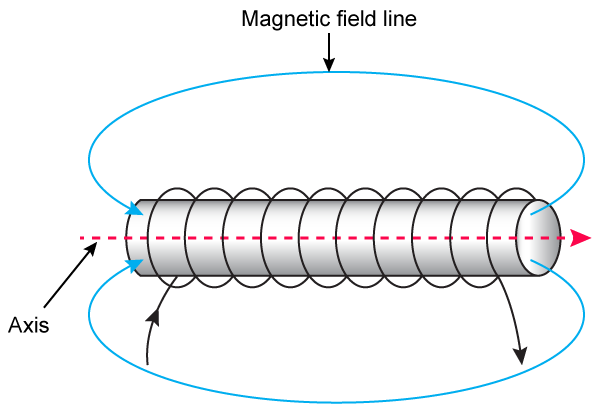
- A coil with many circular close turns of insulated copper wire (like a cylinder as shown above) is a solenoid.
- One end of such a solenoid behaves like the north pole and the other as a south pole.
- Therefore magnetic field due to current in the solenoid is similar to a bar magnet. The fields always emerge out of the North pole and always merge into the South pole
- The field inside the solenoid is uniform.
Posted by Guriikaur G 5 years, 1 month ago (10033895)
- 0 answers
Posted by Divyansh Mishra 5 years, 1 month ago (10064821)
- 5 answers
Nilabja Banerjee 5 years, 1 month ago (8618707)
Kashish ☺️✌️ 5 years, 1 month ago (9102685)
Preetam Ramdurg 5 years, 1 month ago (9573085)
Hansika Chawla 5 years, 1 month ago (10059266)
Posted by Versha Patel 5 years, 1 month ago (8027204)
- 1 answers
Posted by Nitika Nitika 5 years, 1 month ago (9997323)
- 1 answers
Yogita Ingle 5 years, 1 month ago (2577571)
-
Recognise the functional group in the compound. This will determine the suffix of the name
Functional group
suffix
alkane
-ane
alkene
-ene
alkyne
-yne
alcohol
-ol
aldehyde
-al
ketone
-one
carboxylic acid
-oic acid
ester
-oate
The suffix associated with various functional groups.
-
Find the longest continuous carbon chain that contains the functional group (it won't always be a straight chain) and count the number of carbon atoms in this chain. This number will determine the prefix (the beginning) of the compound's name .
Carbon atoms
prefix
1
meth-
2
eth-
3
prop-
4
but-
5
pent-
6
hex-
7
hept-
8
oct-
9
non-
10
dec-
The prefix of a compound's name is determined by the number of carbon atoms in the longest chain that contains the functional group.
-
Number the carbons in the longest carbon chain (Important: If the molecule is not an alkane (i.e. has a functional group) you need to start numbering so that the functional group is on the carbon with the lowest possible number). Start with the carbon at the end closest to the functional group.
-
Look for any branched groups:
- Name them by counting the number of carbon atoms in the branched group and referring totable he group on the main carbon chain. If there is more than one of the same type of branched group then both numbers must be listed (e.g. 2,4 -) and one of the prefixes listed in must be used. Important: If the molecule is an alkane the branched group must be on the carbon with the lowest possible number.
- The branched groups must be listed before the name of the main chain in alphabetical order (ignoring di/tri/tetra).
If there are no branched groups this step can be ignored.
Number
prefix
2
di-
3
tri-
4
tetra-
Table 4.7: Prefixes for multiple substituents with the same name. These apply to multiple functional groups as well.
-
For the alkyl halides the halogen atom is treated in much the same way as branched groups:
- To name them take the name of the halogen atom (e.g. iodine) and replace the -ine with -o (e.g. iodo).
Halogen
name
fluorine
fluoro
chlorine
chloro
bromine
bromo
iodine
iodo
Table 4.8: Naming halogen atoms in organic molecules.
- Give the halogen atom a number to show its position on the carbon chain. If there is more than one halogen atom the numbers should be listed and a prefix should be used (e.g. 3,4-diiodo- or 1,2,2-trichloro-). See <a href="https://intl.siyavula.com/read/science/grade-12/organic-molecules/04-organic-molecules-03#tab:organic:prefix2">Table 4.7</a> for a list of the prefixes.
- The halogen atoms must be listed before the name of the main chain in alphabetical order (ignore di/tri/tetra).
If there are no halogen atoms this step can be ignored.
- To name them take the name of the halogen atom (e.g. iodine) and replace the -ine with -o (e.g. iodo).
-
Combine the elements of the name into a single word in the following order:
- branched groups/halogen atoms in alphabetical order (ignoring prefixes)
- prefix of main chain
- name ending according to the functional group and its position on the longest carbon chain.
</section>
Posted by Sandeep Kaur Sandhu 5 years, 1 month ago (5190764)
- 1 answers
Yogita Ingle 5 years, 1 month ago (2577571)
Development is the pattern of progressive, orderly, and predictable changes that begin at conception and continue throughout life. Development mostly involves changes — both growth and decline, as observed during old age.
Posted by Anugrah K 5 years, 1 month ago (10070113)
- 4 answers
Zayed Abdul Majeed 5 years, 1 month ago (10075800)
Yogita Ingle 5 years, 1 month ago (2577571)
The way we keep track of time can be explained in an algorithm. Algorithms take many forms, anything from a list of pictures or symbols to language or mathematics can be used to make algorithms. Anything that can describe a procedure to solve a problem.
Posted by Sukhwinder Singh 3 years, 11 months ago (10070142)
- 1 answers
Devil ? 2 years, 5 months ago (3139322)
Posted by Akshat Awasthi 5 years, 1 month ago (9657809)
- 3 answers
Posted by Aayush Maurya 5 years, 1 month ago (9941484)
- 2 answers
Rakshak Sherigar 5 years, 1 month ago (9953806)
Yogita Ingle 5 years, 1 month ago (2577571)
The reason for the selection of pea plants for the genetic experiments are
- Easy to grow in the garden.
- The flowers of pea plants are hermaphrodite, i.e flowers have bisexual characteristics.
- Easy to obtain pure breed plant through self-fertilization
- The generation time of pea plants is less.
-
They have excellent disease resistance and have an optimal rate of survival.
Posted by Aayush Maurya 5 years, 1 month ago (9941484)
- 1 answers
Yogita Ingle 5 years, 1 month ago (2577571)
Gregor Johann Mendel conducted experiments on pea plants and proposed the rules of inheritance; based on his observations. Mendel observed that characters are often present in pairs. A pair of contrasting characters is called allele.
Posted by Niharika Gupta 5 years, 1 month ago (10028633)
- 0 answers
Posted by Tehsin Ansari 5 years, 1 month ago (7212326)
- 2 answers
Yogita Ingle 5 years, 1 month ago (2577571)
पांडुलिपि तैयार करने की एक लंबी प्रक्रिया होती थी। इस प्रक्रिया में कई लोग शामिल होते थे। जो अलग अलग कामों में दक्ष होते थे। सबसे पहले पांडुलिपि का पन्ना तैयार किया जाता था जो कागज़ बनाने वालों का काम था। तैयार किए गए पन्ने पर अत्यंत सुंदर अक्षर में पाठ की नकल तैयार की जाती थी। उस समय सुलेखन अर्थात् हाथ से लिखने की कला अत्यन्त महत्त्वपूर्ण मानी जाती थी। इसका प्रयोग भिन्न-भिन्न शैलियों में होता था। सरकंडे के टुकड़े को स्याही में डुबोकर लिखा जाता था। इसके बाद कोफ्तगार पृष्ठों को चमकाने का काम करते थे। चित्रकार पाठ के दृश्यों को चित्रित करते थे। अन्त में, जिल्दसाज प्रत्येक पन्ने को इकट्ठा करके उसे अलंकृत आवरण देता था। तैयार पांडुलिपि को एक बहुमूल्य वस्तु, बौद्धिक संपदा और सौंदर्य के कार्य के रूप में देखा जाता था।
myCBSEguide
Trusted by 1 Crore+ Students

Test Generator
Create papers online. It's FREE.

CUET Mock Tests
75,000+ questions to practice only on myCBSEguide app
