
Ask questions, doubts, problems and we will help you..
Ask questions which are clear, concise and easy to understand.
Ask Question
CBSE, JEE, NEET, CUET
Question Bank, Mock Tests, Exam Papers
NCERT Solutions, Sample Papers, Notes, Videos
Posted by Navuluru Chathrika 5 years ago (9577883)
- 2 answers
Gaurav Seth 5 years ago (2898529)
(i) Nationalism spread when people began to believe that they are all part of the same nation, when they discover some unity that binds them together.
(ii) There were variety of cultural processes through which nationalism captured people’s imagination.
(iii) Allegory of Indian nation—Bharat Mata, helped create an image with which people can identify with the nation.
(iv) Devotion to this mother figure came to be seen as evidence of one’s nationalism.
(v) It was essential to preserve folk traditions, folk tales in order to discover one’s national identity and restore a sense of pride in one’s part.
(vi) National flag designed by Gandhiji as Swaraj flag, represented the Gandhian ideal of self help. Carrying the flag, holding it aloft, during marches became a symbol of defiance.
(vii) Reinterpretation of past also developed the interest of people in nationalist histories.
Posted by Navuluru Chathrika 5 years ago (9577883)
- 3 answers
Gaurav Seth 5 years ago (2898529)
2.
Gandhiji decided to withdraw the ‘Non-Cooperation Movement’ in February 1922 because of the following reasons :
- In 1922, at Chauri-Chaura in Gorakhpur, a peaceful mob turned violent and clashed with the police resulting in the deaths of several policemen.
- Gandhiji felt that the movement was turning violent and satyagrahis needed proper training before they were ready for a mass struggle.
Yogita Ingle 5 years ago (2577571)
Various social groups which joined the movement were
(i) Middle class people in the towns
(ii) Plantation workers
(iii) Peasants in rural areas
(iv) Tribal people
(v) Business class people
Middle Class People in the Towns
In towns, middle class people who consisted of students, teachers and lawyers responded to the clarion call of non-cooperation and boycott. They saw the movement as a passport to freedom from the foreign yoke.
Peasants and Tribals
In various places peasants and tribal also participated in the movement. The movement was launched against the talukdars and landlords. For them Swaraj meant they would not be required to pay land dues i.e., land revenue, and the land they were cultivating would be distributed among them.
Plantation Workers
They participated in the movement with the hope that they would be free to move out of the confined space in which they had been enclosed. They hoped that Gandhi Raj had come and they would get land when they went back home.
Gaurav Seth 5 years ago (2898529)
1.
The different social groups that joined the Non-Cooperation Movement of 1921 were the urban middle class comprising lawyers, teachers and headmasters, students, peasants, tribals and workers.
- Peasants, tribals and workers joined the movement with hopes of self-emancipation. Peasants hoped that they would be saved from the oppressive landlords, high taxes taken by the colonial government.
- Plantation workers, on the other hand, desired freedom to move about and get land in their own villages.
- The middle class joined the movement because the boycott of foreign goods would make the sale of their textiles and handlooms go up.
Posted by Priyansh Yadav 5 years ago (10172024)
- 3 answers
Devil Ninja Gurpanish 5 years ago (10182370)
Himangshu Das 5 years ago (10179623)
Yogita Ingle 5 years ago (2577571)
Let the four angles of the quadrilateral be 3x, 5x, 9x and 13x
3x+5x+9x+13x=360∘ [sum of all angles of the quadrilateral is 360∘]
30x=360∘
x=12∘
Hence, the angles of the quadrilateral are 3×12∘=36∘, 5×12∘=60∘,9×12∘=108∘and13×12∘=156∘
Posted by Sudarshan Rathod 5 years ago (9723216)
- 5 answers
Dabhi Dhavnisha 5 years ago (10026373)
Akash Biswas 5 years ago (10176848)
Akansha Choudhary 5 years ago (10179176)
Yogita Ingle 5 years ago (2577571)
A house is made of brick, stone, cement, hard wood, window glass, and a yard.
Posted by Aarushi Yadav 5 years ago (10155453)
- 2 answers
Gaurav Seth 5 years ago (2898529)
The word “medieval” comes from the Latin words medius and aevum, which means “middle age”. Therefore, when a period is called medieval it means that period which is in the middle of human history. Indian history is divided into three periods, Ancient period, Medieval period and Modern period. The medieval period in India is further divided into the early medieval period (647-1200 CE) and the later medieval period (1200-1700 CE). The medieval period in India saw far-reaching changes in all fields- political, social,cultural and economic.
The medieval period of Indian history is taken to extend from 647 to 1700 CE, i.e., It started with the death of Harshvardhana’s death in 647 CE and declined when the Mughal Empire started breaking up and the British began establishing their power in India in 1700 CE
Yogita Ingle 5 years ago (2577571)
Medieval India refers to a long period of the history of the Indian subcontinent between the "ancient period" and "modern period". It encompasses the 6th to the 16th centuries.
Posted by Navuluru Chathrika 5 years ago (9577883)
- 1 answers
Yogita Ingle 5 years ago (2577571)
Reactions of People : In large scale, people participated in Civil Disobedience Movement with great zeal. They participated in protest march and manufactured salt.
- As the movement spread, foreign cloth was boycotted, liquor shops were picketed.
- Peasants refused to pay revenue and chaukidari taxes.
- Village officials resigned.
- In many places, forest people violated forest laws, going into Reserved Forests to collect wood and graze cattle.
Reaction of Colonial Government :
- The Colonial Government began arresting the Congress leaders one by one.
- Abdul Ghaffar Khan a devout disciple of Mahatma Gandhi was arrested in April 1930.
- Mahatma Gandhi himself was arrested.
- A frightened government responded with a policy of brutal repression.
- Peaceful satyagrahis were attacked. Women and children were beaten.
- About 1,00,000 people were arrested.

Posted by First Name 5 years ago (10129186)
- 5 answers

Yogita Ingle 5 years ago (2577571)
It can be defined as the electrons which are there in degenerate orbitals have a parallel spin and tend to exchange their position. The exchange energy is the energy released when two or more electrons with the same spin-exchange their positions in the degenerate orbitals of a subshell. Exchange energy is nothing but the energy released during this process. When the orbitals are half-filled or completely filled then the number of exchanges is maximum. Therefore, its stability is maximum.
Posted by Navuluru Chathrika 5 years ago (9577883)
- 2 answers
Gaurav Seth 5 years ago (2898529)
The word “Swadeshi” is a Sanskrit word. The literal meaning of the word Swadeshi is : of one’s own country.
Swadeshi movement a part of the Indian Independence movement was a successful strategy to remove the British Empire from power and improve economic condition in India through following principles of Swadeshi or Self-Sufficiency. Strategies of the Swadeshi movement involved boycotting British products and the revival of domestic made products and production technique.
A boycott is a form of consumer activism involving the act of voluntarily abstaining from using, buying or dealing with a person, organisation or country as an expression of protest usually for political reason. During the National Movement it began with the Surrender of titles that the government has awarded and a boycott of civil services, army, police, court and Legislative Council, schools and foreign goods.
Yogita Ingle 5 years ago (2577571)
The main features of 'Boycott Movement' and 'Swadeshi Movement' are as follows:
1. To non-cooperate with the British government and make it collapse.
2. To boycot or cut out buying Brirish goods made in our country.
3. To create India's own goods and buying those only. eg. khadi.(swadeshi goods)
4. To protest the ruling British government and shouting slogans such as 'swatantra Bharat' etc
Posted by Sudha Ranjan 5 years ago (9055724)
- 1 answers
Posted by Navuluru Chathrika 5 years ago (9577883)
- 1 answers
Yogita Ingle 5 years ago (2577571)
Two prominent industrialists were PURSHOTTAM DAS and G.D. BIRLA..
1)The industrialists attacked the colonial control and supported the civil disobedience movement when it was first launched.
2)They gave financial assistance and refused to buy or sell imported goods.
3)But after the failure of Second round table conference,business groups were no longer equally enthusiastic.
4)They were worried about disruption of business.
Posted by Navuluru Chathrika 5 years ago (9577883)
- 1 answers
Gaurav Seth 5 years ago (2898529)
The effects of non-cooperation on the economic front were more dramatised.
- Foreign goods were boycotted and eliminated from the markets.
- Liquor shops were picketed and foreign cloth was burnt in large bonfires.
- The import of foreign cloth reduced to half between 1921 and 1922. The value of these goods drastically dropped from Rs 102 crore to Rs 57 crore.
- In a large number of places, merchants, peasants and traders refused completely to trade in foreign goods or finance foreign trade.
Posted by Asmita Maurya 5 years ago (10001729)
- 2 answers
Yogita Ingle 5 years ago (2577571)
Any parameter that limits the purpose or channel of communication between the transmitter and the receiver is a barrier to communication. A communication barrier may limit or reduce the ease at which we communicate and hence the name barrier. Although the barriers to effective communication may be different for different situations, the following are some of the main barriers:
- Linguistic Barriers
- Psychological Barriers
- Emotional Barriers
- Physical Barriers
- Cultural Barriers
- Organisational Structure Barriers
- Attitude Barriers
- Perception Barriers
- Physiological Barriers
- Technological barriers
- Socio-religious barriers
Gaurav Seth 5 years ago (2898529)
The Barriers to effective communication could be of many types like linguistic, psychological, emotional, physical, and cultural etc.
Psychological Barriers
There are various mental and psychological issues that may be barriers to effective communication. Some people have stage fear, speech disorders, phobia, depression etc. All of these conditions are very difficult to manage sometimes and will most certainly limit the ease of communication.
Linguistic Barriers
The language barrier is one of the main barriers that limit effective communication. Language is the most commonly employed tool of communication. The fact that each major region has its own language is one of the Barriers to effective communication. Sometimes even a thick dialect may render the communication ineffective.
Posted by Navuluru Chathrika 5 years ago (9577883)
- 1 answers
Gaurav Seth 5 years ago (2898529)
1. The decline of the Non-cooperation Khilafat Movement gave rise to the feeling of alienation among a large section of Muslims from the Congress.
2. During the mid-1920s, the very much visible associations of the Congress Hindu religious nationalist groups like the Hindu Mahasabha further created feelings of suspicion and distrust among the members of both the communities.
3. As the relations between Hindus and Muslims worsened, each community organized religious processions with militant fervour, provoking violent clashes and riots in various cities.
Posted by Navuluru Chathrika 5 years ago (9577883)
- 1 answers
Gaurav Seth 5 years ago (2898529)
The Non- Cooperation Movement sought to achieve the following objectives:
(i) To attain self-government within the British Empire if possible & outside if necessary.
(ii) Remedying the 'Khilafat wrong', i.e., the British should adopt a lenient attitude towards Turkey, & restore the old status of the Sultan of Turkey.
Posted by Asmita Maurya 5 years ago (10001729)
- 1 answers
Gaurav Seth 5 years ago (2898529)
Communication is the imparting or exchanging of information by speaking, writing, or using some other medium.
Features of an effective communication system:
1.Principle of clarity, i.e., every point in the communication should be clear having no ambiguity and conveying the same sense and spirit.
2. Principle of attention, i.e., Communication must draw attention of the communicate.
3. Principle of consistency : This principle implies that communication should always be consistent with the plans, objectives, policies and programmes of the organization and not conflicting. Inconsistent messages always create chaos and confusion in the minds of people which is highly detrimental to the interest of the enterprise.
4. Principle of Adequacy : This implies that the information should be adequate and complete in all respect. Incomplete and inadequate information delays actions and destroys understanding and relations. Efficiency of communicator and communicate is also affected.
5. Principle of Integration : Communication is a means to an end and not an end in itself. It should promote co-operation among people at work to achieve the organizational objectives.
6. Principle of Timeliness : Information of ideas should be communicated at the proper time. Any delay in communicating the messages will serve no purpose except to make them (messages) mere historical documents as they lose their importance and effectiveness by the lapse of time.
7. Principle of Informality : Formal communication, however is important in a formal organization but informal communication does not lose its place in the organization. Managers or executives should become much informal in their behaviour with his subordinates. But in certain situations where they are the sole and best judge, informality may be avoided.
8. Principle of Feedback : This is the most important principle of an effective communication system. The communicator must have feedback confirmation from the recipient whether the messages communicated, have been understood in the same sense in which the sender takes it and also whether the recipient is agreed or disagreed the proposal. It helps understand the people.
9. Principal of Communication Networks : Communication networks refer to the routes through which communication flow to the destination person for whom it is meant. A number of such networks may exist in the organization at a given point of time but management should consider the effectiveness of the communication network in the given situation and its effect of the behaviour of the communicate before it finally chooses a network.
10. Principle of Purposefulness : Communication should have a purpose. One's image must improve by his communication. The purpose for which communication was used must be achieved.
11. Principle of Empathetic Listening : This is used to draw out the other person. The goal is to understand the speaker's (sender's) feelings, needs and wants in order to help him solve a problem.
12. Proper Language : Simple and proper language have to be used in communication.
13. Two Way Communication : Effective communication necessitates a minimum of two participants who should interact with each other. In other words, there should be transmission, reception and exchange of ideas from both sides.
Posted by Navuluru Chathrika 5 years ago (9577883)
- 2 answers
Pallavi Negi 2 years, 5 months ago (14457109)
Gaurav Seth 5 years ago (2898529)
Pandit Jawahar Lal Nehru
Answer. It was presided over by Pandit Jawahar Lal Nehru. The historic resolution of Purna Swaraj or Complete Independence was passed.At this session, it was decided to celebrate January 26,1930 as the first Independence Day of India.
Posted by Navuluru Chathrika 5 years ago (9577883)
- 1 answers
Gaurav Seth 5 years ago (2898529)
(1) By the end of the nineteenth century, many Indians began feeling that to instill a sense of pride in the nation, Indian history had to be thought about differently. (2) The British saw Indians as backward and primitive, incapable of governing themselves. (3) In response, Indians began looking into the past to discover Indias great achievements. (4) Many prominant writers wrote about the glorious developments in ancient times when art and architecture, folklores, religion and culture, law and philosophy had flourished. (5) Swadeshi Movement, Non-Cooperation Movement, Khilafat Movement, Swaraj Movement were based on the rich past of our country.
Posted by Navuluru Chathrika 5 years ago (9577883)
- 1 answers
Gaurav Seth 5 years ago (2898529)
‘Salt March’ became an effective tool of resistance against colonialism because :
(i) Mahatma Gandhi found in salt a powerful symbol that could unite the nation.
(ii) Gandhiji sent a letter to Viceroy Irwin stating eleven demands. The most stirring of all was the demand to abolish the salt tax.
(iii) Salt was the most essential item of foods and was consumed by rich and poor alike.
(iv) Irwin was unwilling to negotiate, so Gandhiji started Salt march with 78 volunteers. (On 6th April) he reached Dandi, violated law and made salt. This March developed the feeling of nationalism, people in different parts of the country broke the salt law and manufactured salt and demonstrated in front of government salt factories.
Posted by First Name 5 years ago (10129186)
- 5 answers
Sachi Chauhan 5 years ago (9956776)
Posted by Sindhu Nallapaneni 5 years ago (10178983)
- 2 answers
Posted by Ayush Kumar 5 years ago (10126129)
- 3 answers
Aakash Gupta 5 years ago (9829865)
Sanskriti Bisht 5 years ago (10063418)
Gaurav Seth 5 years ago (2898529)
Cyber safety is the safe and responsible use of information and communication technology. It is about keeping information safe and secure, but also about being responsible with that information, being respectful to other people online, and using good Internet etiquette. It includes body of technologies, processes and practices designed to protect networks, computers, proograms and data from attack, damage or unauthorized access
Posted by Navuluru Chathrika 5 years ago (9577883)
- 3 answers
Minakshi Vasuniya 5 years ago (10171344)
Yogita Ingle 5 years ago (2577571)
The events that led to the Civil Disobedience Movement include:
(i) Arrival of Simon Commission consisting of all British members, in 1928 and their report.
(ii) Successful peasant movement in Bardoli, Meerut and Lahore conspiracy cases in 1929.
(iii) Lahore session of Congress in 1929.
(iv) Nehru report in respect of Indian Constitution.
(v) Demonstrators being brutally assaulted in antiSimon Commission agitation. Industrialists supported this movement because: During the First World War, Indian merchants and industrialists had made huge profits and became powerful. Keen on expanding their business, they now reacted against colonial policies that restricted business activities.
Gaurav Seth 5 years ago (2898529)
The events that led to the Civil Disobedience Movement include:
(i) Arrival of Simon Commission consisting of all British members, in 1928 and their report.
(ii) Successful peasant movement in Bardoli, Meerut and Lahore conspiracy cases in 1929.
(iii) Lahore session of Congress in 1929.
(iv) Nehru report in respect of Indian Constitution.
(v) Demonstrators being brutally assaulted in antiSimon Commission agitation. Industrialists supported this movement because: During the First World War, Indian merchants and industrialists had made huge profits and became powerful. Keen on expanding their business, they now reacted against colonial policies that restricted business activities.
Posted by Peme Mukherjee 5 years ago (9888790)
- 1 answers
Gaurav Seth 5 years ago (2898529)
1. Where did the geese live?
Ans. The geese lived on the top of a tall tree in a forest.
<hr />2. Why did the old bird advise the other birds to destroy the creeper?
Ans. The old bird advised the other birds to destroy the creeper because it could help a hunter to climb up the tree to kill them.
<hr />3. Why did the geese cry, “Help Help”?
Ans. The geese cried for help because they were trapped in the net by the hunter.
|For for click on the given link:
<a href="https://mycbseguide.com/blog/ncert-solutions-for-class-5-english-flying-together/" ping="/url?sa=t&source=web&rct=j&url=https://mycbseguide.com/blog/ncert-solutions-for-class-5-english-flying-together/&ved=2ahUKEwj-8vqPsbTtAhVb4zgGHSdbBvoQFjABegQIAhAC" rel="noopener" target="_blank">NCERT Solutions for Class 5 English Flying Together</a>
Posted by Muskan Maan 5 years ago (9974792)
- 2 answers
Rishu Singh 5 years ago (8783617)
Muskan Janghu 5 years ago (9980158)
Posted by Ayaan Simon Abraham 5 years ago (10130344)
- 1 answers
Posted by Roshan Mandal 5 years ago (9710129)
- 3 answers
Gaurav Seth 5 years ago (2898529)
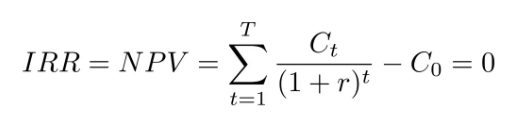
Internal Rate of Return or IRR is a measure in capital budgeting parlance which is used for estimating the profit that can be obtained from the investments.
Internal rate of return is a type of discount rate that is instrumental in making the net present value of all the cash flows from any project equal to zero.
In simple words, it can be referred to as the compounded annual rate of return that can be earned on an investment or a project.
Simple meaning:
The Internal Rate of Return (IRR) is the discount rate that makes the net present value (NPV) ZERO. In other words, it is the expected compound annual rate of return that will be earned on a project or investment.
Gaurav Seth 5 years ago (2898529)
Internal Rate of Return or IRR is a measure in capital budgeting parlance which is used for estimating the profit that can be obtained from the investments.
Internal rate of return is a type of discount rate that is instrumental in making the net present value of all the cash flows from any project equal to zero.
In simple words, it can be referred to as the compounded annual rate of return that can be earned on an investment or a project.
Simple meaning:
The Internal Rate of Return (IRR) is the discount rate that makes the net present value (NPV) ... In other words, it is the expected compound annual rate of return that will be earned on a project or investment.
Yogita Ingle 5 years ago (2577571)
Internal Rate of Return or IRR is a measure in capital budgeting parlance which is used for estimating the profit that can be obtained from the investments.
Internal rate of return is a type of discount rate that is instrumental in making the net present value of all the cash flows from any project equal to zero.
In simple words, it can be referred to as the compounded annual rate of return that can be earned on an investment or a project.
Posted by 7Gtamsa Atwal 5 years ago (9680708)
- 3 answers
Posted by Akshat Gupta 5 years ago (7298111)
- 1 answers
Gaurav Seth 5 years ago (2898529)
A n s w e r
The digestion process takes place in the following steps.
Ingestion
The very first step involves mastication (chewing). The salivary glands, along with the tongue, helps to moisten and lubricate food, before being pushed down into the food pipe.
Mixing and Movement
It involves the process of lubricating and manipulating food and pushing it down the food through the food pipe (using peristalsis), and into the stomach.
Secretion
The stomach, small intestine, liver, and pancreas secrete enzymes and acids to aid the process of digestion. It functions by breaking down food particles into simple components and easily absorbable components.
Digestion
The process of converting complex food particles into simpler substances in the presence of enzymes and acids secreted by different digestive organs.
Absorption
This process begins in the small intestine where most of the nutrients and minerals are absorbed. The excess water in the indigestible matter is absorbed by the large intestines.
Excretion
The process of removing indigestible substances and waste by-products from the body through the process of defecation.
In short, the digestion process consists of the six following steps:
Ingestion ⇒Mixing and Movement ⇒ Secretion ⇒ Digestion ⇒Absorption ⇒Excretion
Posted by Osc Logistics 5 years ago (9134862)
- 2 answers
myCBSEguide
Trusted by 1 Crore+ Students

Test Generator
Create papers online. It's FREE.

CUET Mock Tests
75,000+ questions to practice only on myCBSEguide app

Yogita Ingle 5 years ago (2577571)
1) Nationalism spreads when people begin to believe that they are all part of the same nation.
(2) There were also a variety of cultural processes through which nationalism captured people’s imagination.
(3) On the first place ‘Vande Mataram’ as a hymn was widely sung during the Swadeshi movement in Bengal.
(4) The famous image of Bharat Mata came to be seen as evidence of one’s nationalism.
(5) Folk traditions too inculcate nation’s identity and restore a sense of pride.
(6) Tricolour Flag as icon and symbol unified people and inspired a feeling of nationalism among masses.
2 Thank You