
Ask questions, doubts, problems and we will help you..
Ask questions which are clear, concise and easy to understand.
Ask Question
CBSE, JEE, NEET, CUET
Question Bank, Mock Tests, Exam Papers
NCERT Solutions, Sample Papers, Notes, Videos
Posted by Mankrishan Chadda ?? 5 years ago (10259589)
- 5 answers
Yogita Ingle 5 years ago (2577571)
The carbon dioxide gas enters the leaves of the plants through the stomata present on their surface.
Posted by Ritika Jain 5 years ago (10275195)
- 2 answers
Yogita Ingle 5 years ago (2577571)
For an isosceles right angled triangle each having equal side 'a'
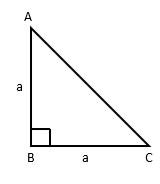
Using Pythagoras theorem,
AC2 = AB2 + BC2 where AB = BC = a
AC2 = a2 + a2
AC2 = 2a2
AC = √2a
Semi perimeter of a triangle ABC = (a + a + √2a)/2 = (√2+1)a/√2
Posted by Avi Saini 5 years ago (10234432)
- 1 answers
Yogita Ingle 5 years ago (2577571)
19वीं शताब्दी में उदारवादी विचारधारा , राजनीतिक रूप से एक ऐसर सरकार पर जोर देता था जो सहमति से बनी हो । फ्रांसीसी क्रांति के बाद उदारवाद निंरकुश शासक और पादरीवर्ग के विशेषाधिकारों की समाप्ति , संविधान तथा संसदीय प्रतिनिधि सरकार का पक्षधर था ।
Posted by Shri Ram 5 years ago (10097237)
- 2 answers
Yogita Ingle 5 years ago (2577571)
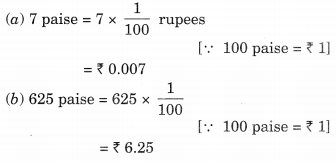
100 paise = 1 Rs
(a) 7 paise = 7 ÷ 100 = 0.07
(b) 625 paise = 625 ÷ 100 = 6.25
Posted by Shri Ram 5 years ago (10097237)
- 2 answers
Posted by Shri Ram 5 years ago (10097237)
- 1 answers
Yogita Ingle 5 years ago (2577571)
Write the following as decimals.
(a) Three tens and eight-tenths = <i> </i> 3 x 10 + 8 x 1/10 = 30 + 0.8 = 30.8
(b) Fifteen point seven= Fifteen point seven = 15.7

Posted by Shri Ram 5 years ago (10097237)
- 1 answers
Yogita Ingle 5 years ago (2577571)
5 Hundreds + 3 Tens + 8 Ones + 4 Tenths
= 5 x 100 + 3 x 10 + 8 x 1 + 4 x 1/10
= 500 + 30 + 8 + 4/10
= 538 + 4/10 = 538.4
Posted by Isha,???????????????❤️❤️?? Isha 5 years ago (10266333)
- 5 answers
Posted by Viren Saharan 5 years ago (10268905)
- 0 answers
Posted by Anushika Singhal 5 years ago (10015442)
- 4 answers
Posted by Shaina Ansari 5 years ago (10136772)
- 1 answers
Yogita Ingle 5 years ago (2577571)
Khelo India Programme is a national yojana/scheme for the development of sports in India. It was launched in the year 2018 by the then Sports Minister Col. Rajyavardhan Singh Rathore in Delhi. This program has been launched to improve the sports culture in India.
Aimed at mainstreaming sports as a tool for national development, economic development, community development and individual development, the Union Cabinet approved the execution of the revamped ‘Khelo India’ program by consolidating the ‘Rajiv Gandhi Khel Abhiyan’ (formerly called the ‘Yuva Krida & Khel Abhiyan’), the ‘Urban Sports Infrastructure Scheme’ and the National Sports Talent Search System Programme’. The program strives to promote “Sports for Excellence” as well as “Sports for All”.
Posted by Pragati Kaushik 5 years ago (7728369)
- 2 answers
Yogita Ingle 5 years ago (2577571)
Civilization comes from the Latin word 'civis' meaning someone who lives in a town. When people are civilised, they live in large well-organised groups like town, not in small tirbes or isolated family groups. In civilisations, people live together in communities and grow crops.
Posted by Iakjeet Kaur 5 years ago (10274682)
- 1 answers
Yogita Ingle 5 years ago (2577571)
The ideology of liberalism allied with Nationalism in the following ways:
(i) Liberalism stood for freedom for the individual and equality of all before law.
(ii) It emphasized on the concept of government by consent.
(iii) It stood for the end of autocracy and clerical privileges.
(iv) It believed in a constitution and representative government through Parliament.
(v) It emphasized the inviolability of private property.
Posted by Iakjeet Kaur 5 years ago (10274682)
- 1 answers
Yogita Ingle 5 years ago (2577571)
The term liberalism' comes from the Latin root liber which meant to be free.
1. In the political sense, liberalism stood for freedom for the individual and equality of all before the law. It emphasised on the end of aristocracy and clerical privileges, a constitution and representative government through parliament and the inviolability of private property, drawing its basic foundation from the French Revolution.
2. From the very beginning, universal suffrage i.e. voting rights were granted only to the property-owning men, excluding men without property and all women. However, throughout the nineteenth century and early twenties, many movements were organised demanding equal political rights.
3. In the economic sense, liberalism stood for the freedom of markets and the abolition of state-imposed restrictions on the movement of goods and capital. People often attempted to go beyond the state restrictions such as the formation of a customs union by Prussia in 1834 which abolished tariff barriers and no. of currencies from 30 to 2. The creation of railway networks further stimulated national unification and the wave of economic nationalism in all contributed towards strengthening wider national sentiments.
Posted by Madhur Bhatia 5 years ago (9868387)
- 5 answers
Posted by Sujata Sahani 5 years ago (10234474)
- 1 answers
Posted by Naveen Chaudhary 5 years ago (10261916)
- 3 answers
Posted by Sangeeta Ojha 5 years ago (10198666)
- 4 answers
Posted by Chennai Royals Royal 5 years ago (9838280)
- 2 answers
Chennai Royals Royal 5 years ago (9838280)
Posted by Ravi Tech 5 years ago (8948156)
- 1 answers
Suraj Pratap Singh 5 years ago (10004057)
Posted by Manyashri K 5 years ago (10188020)
- 1 answers
Yogita Ingle 5 years ago (2577571)
(i) Initially, primary sector was the main economic activity.
(ii) Dueto improved methods of farming, productivity of agriculture sector increased. Therefore, more persons were taking up other activities like trading, transport, army, administration etc.
(iii) Secondary sector (or manufacturing sector) became the most important sector for production and employment, over a long period of time. This was a shift from primary to secondary sector as more and more factories were started.
(iv) In developed countries a further shift from secondary sector to tertiary sector is observed in past 100 years. Major portion of the working population is engaged in service sector.
In conclusion, in developed economies, tertiary sector has gained an important position.
Posted by Nikunj Sharma G 5 years ago (10274711)
- 1 answers
Posted by Rishitha Rishitha 5 years ago (9178921)
- 2 answers
Ankit Raj 5 years ago (10221391)
Rupali Sahu 5 years ago (10163384)
Posted by Payal Sharma 5 years ago (10265449)
- 5 answers
Posted by Astha Garg 5 years ago (10078146)
- 5 answers
Gaurav Seth 5 years ago (2898529)
True
- Inclusion in physical education increases social skills of students with disabilities.
- Inclusion is needed to increase motor skills of students with disabilities.
- A disabled student gets equal chance to participate in age-appropriate activities so, it increases the confidence level.
- Typical students get a chance to increase friendships with disabled children.
- Inclusive education provides an opportunity for typical students to go beyond tolerance to acceptance and advocacy.
- Inclusive education enables a student to increase their knowledge and acceptance based on the “contact theory”. Through frequency, meaningful and pleasant interactions, changes in attitude can occur.
Posted by Divyanshi Priya 5 years ago (10274604)
- 2 answers
Yogita Ingle 5 years ago (2577571)
578 x 161
Rounding off 578 to the nearest hundreds, we get 600
And, rounding off 161 to the nearest hundreds, we get 200
Therefore, 600 x 200 = 1,20,000
Posted by Astha Garg 5 years ago (10078146)
- 1 answers
Yogita Ingle 5 years ago (2577571)
Inclusion in education refers to a model wherein students with special needs spend most or all of their time with non-special (general education) needs students. ... Inclusion rejects but still provides the use of special schools or classrooms to separate students with disabilities from students without disabilities.
Posted by Vyomesh Kumar Pandey 5 years ago (9017966)
- 2 answers
Deepak Khoth 5 years ago (10287597)
Yogita Ingle 5 years ago (2577571)
- राष्ट्रीय लक्ष्यों के आलोक में राज्यों की सक्रिए भागीदारी के साथ राष्ट्रीय विकास प्राथमिकता क्षेत्रों और रणनीति का साझा दृष्टिकोण विकसित करना।
- निरंतर आधार पर राज्यों के साथ संरचित समर्थन पहलों और तंत्रों के माध्यम से सहकारी संघवाद को बढ़ावा देना। इस बात को स्वीकारना की मजबूत राज्य, मजबूत राष्ट्र का निर्माण करता है।
- गांव स्तर पर विश्वसनीय योजना तैयार करने और सरकार के उच्च स्तर पर उत्तरोत्तर इनको एकत्र करने के लिए तंत्र विकसित करना।
- यह सुनिश्चित करना कि जो क्षेत्र खास तौर पर नीति आयोग को दिए गए हैं,उनमे आर्थिक रणनीति और नीतियों में राष्ट्रीय सुरक्षा के हितों को शामिल किया गया है।
- हमारे समाज के कुछ वर्गों, जिन पर आर्थिक प्रगति से पर्याप्त रूप से लाभान्वित न होने के का खतरा हो, पर विशेष ध्यान देना।
- रणनीतिक और दीर्धकालिक नीति एवं कार्यक्रम की रूपरेखा और पहलों का डिजाइन तैयार करना और उनकी प्रगति एवं प्रभावकारिता पर नजर रखना। निगरानी और प्रतिक्रिया से मिली सीख का प्रयोग बीच में किए जाने वाले अनिवार्य सुधारों समेत नए सुधारों में किया जाएगा।
Posted by Pragati Kumari 5 years ago (9807451)
- 1 answers
Yogita Ingle 5 years ago (2577571)
2×⅔×⅔+⅛
= 4/3 ×⅔+⅛
= 8/9 +⅛
= [8(8) + 1(9)]/72
= (64 + 9)/72
= 73/72
Posted by Prashant Kumar 5 years ago (10107457)
- 0 answers
myCBSEguide
Trusted by 1 Crore+ Students

Test Generator
Create papers online. It's FREE.

CUET Mock Tests
75,000+ questions to practice only on myCBSEguide app

Brijesh Satapathy 5 years ago (10269380)
0 Thank You