State and Society up to 1000 CE – NCERT Solutions Class 9 Social Science (New) Understanding Society includes all the questions with solutions given in the NCERT Class 9 Social Science Book Understanding Society textbook.
NCERT Solutions Class 9
English Kaveri Hindi Ganga Sanskrit Sharada Maths Ganita Manjari Science Exploration Social Understanding SocietyState and Society up to 1000 CE – NCERT Solutions
Q.1: How did society and state organise themselves prior to 1000 CE?
Solution: Prior to 1000 CE, society and the state evolved from small, kin-based tribal clans into large, sophisticated empires. Political power shifted from nomadic leadership to centralized territorial kingdoms, while societies structured themselves through complex occupational hierarchies, religious traditions, and agricultural or trade-based economies.
Q.2: How did states and societies emerge and spread to different parts of the Indian subcontinent?
Solution: States and societies in the Indian subcontinent emerged through a gradual shift from semi-nomadic, kinship-based tribal groups to complex, territorial agrarian states. This transformation was driven by the adoption of iron technology, agricultural expansion, revenue extraction, and the incorporation of diverse local tribes into a broader cultural framework.
Q.3: How did the ideas of dharma and chakravarti samrāt help create unity in social values and governance, and promote the idea of the Indian subcontinent as one political entity?
Solution: The concepts of Dharma and Chakravarti Samrāt established a cohesive moral framework and a universal political ideal across the subcontinent. By subordinating royal power to ethical duties (Dharma) and envisioning an all-encompassing universal monarch (Chakravarti), ancient thinkers promoted the geographical expanse of India as a single, interconnected political and spiritual entity.
Q.4: How did different social, administrative, and occupational groups take shape over time and come together culturally?
Solution: Groups took shape as growing populations, agriculture, and trade demanded specialized labor, such as metalworking and weaving. These specific roles evolved into localized hereditary communities. Administrative needs also created bureaucratic and ruling classes. They unified culturally through shared religious traditions, festivals, marriage practices (endogamy), and merchant guilds (shrenis) that maintained social order.
Q.5: How did political organisation change from the Vedic period to the age of large empires such as the Mauryas and the Guptas? Explain the administrative system of the early Indian states.
Solution: Political organisation in India changed from small tribal groups in the Vedic period to large and centralised empires like the Mauryas and Guptas.
During the Vedic period, people lived in janas (tribes) led by a raja (chief). His powers were limited by assemblies like the sabha and samiti, where important decisions were discussed.
Later, janas developed into janapadas and mahajanapadas. Under the Mauryas, administration became highly organised and centralised. The king was the supreme authority and was assisted by ministers and officials. The empire was divided into provinces and districts.
The Guptas followed a more decentralised system. Provinces, districts, and villages were administered by officials and local bodies. Thus, early Indian states developed from tribal organisations into complex administrative systems.
Q.6: Describe the role of the king, important officers, and the methods used to govern large territories.
Solution: In early empires, the king was the supreme head of state, responsible for defending the realm and dispensing justice. Kings relied on specialized officers-like the Chief Treasurer (Samaharta) for revenue, and the Commander-in-Chief (Senapati) for defense. Vast territories were governed by dividing them into provinces, districts, and villages, utilizing loyal governors, local assemblies, and extensive spy networks.
Q.7: After studying this chapter, what do you think were the most important features of the state and society in India before 1000 CE?
Solution: The most important features of the state and society in India before 1000 CE were their complex political organisation, social structure, and cultural richness. Politically, India evolved from kin-based clans (janas) to territorial kingdoms (janapadas and mahajanapadas), and later to large empires like the Mauryas, Guptas, and Cholas. These empires had well-organised administrative systems with provinces, districts, and village units, and were supported by councils of ministers and local assemblies.
Socially, Indian society was structured around the varna and jati systems, which organised people by occupation and community. While early Vedic society was more flexible, over time, social roles became more fixed, but there was still some social mobility. Women played important roles in family, economy, and culture, though their status changed over time.
Culturally, India saw the development of major religious and ethical ideas like dharma (duty and righteousness) and the concept of the chakravarti samrat (universal ruler), which promoted unity. Education, literature, and arts flourished, with famous texts like the Vedas, Mahabharata, and Sangam literature. The economy was based on agriculture, trade, and guilds, supported by advanced irrigation and trade networks. These features created a dynamic, diverse, and enduring civilisation that influenced later periods.
Q.8: What do early texts such as the Rig Veda, Arthaśhästra, and the Mahābhärata reveal about political and social life?
Solution: Early texts like the Rig Veda, Arthaśāstra, and Mahābhārata provide valuable insights into the political and social life of early India.
The Rig Veda shows that society was organised into janas (clans) led by a rājā (chief), and that important decisions were made in assemblies like the sabha and samiti. Social life was based on kinship ties, and occupations were flexible, with people often having different jobs within the same family. The Rig Veda also mentions the early varna system, but it was not rigidly based on birth.
The Arthaśāstra, written by Kautilya, describes a more advanced political system with a king, council of ministers, and a well-organised administration. It highlights the importance of law, order, and efficient governance, and explains that the state was made up of seven parts, including the king, ministers, army, and territory. The text also stresses the need for the king to act ethically and for the welfare of his people.
The Mahābhārata discusses ethical conduct, justice, and the duties of rulers. It teaches that kings should protect their subjects and ensure justice, and that dharma (righteousness) is central to both rulers and society.
Together, these texts reveal that early Indian society valued participation, justice, ethics, and flexible social roles, and that political life evolved from clan-based systems to complex kingdoms and empires.
Q.9: What can we learn from early Indian society about varna and the role of women?
Solution: Early Indian society shows that the varna system gradually changed from a flexible social division into a more rigid structure. The role of women also changed over time, with increasing restrictions on their social status and participation in public life.
Q.10: Explain how assemblies like sabhā and samiti limited the power of the rājā. Which modern institutions perform similar functions today?
Solution: Assemblies like the sabhā and samiti played an important role in limiting the power of the rājā (king) during the Vedic period. The sabhā was a smaller assembly made up of select elites and mainly served a judicial function, helping to settle disputes and advise the king. The samiti was a larger assembly that represented the broader population and focused on policy decisions and political affairs. Both assemblies provided a platform for discussion and decision-making, which meant that the king could not rule alone or make all decisions by himself. Instead, he had to consult these assemblies and consider their opinions, ensuring that the interests of the people were taken into account. This system helped to check the king’s authority and encouraged people’s participation in governance.
In modern times, similar functions are performed by parliaments, legislative assemblies, and courts. For example, in India, the Lok Sabha and Rajya Sabha (Houses of Parliament) make laws and hold the government accountable, while the judiciary ensures justice and checks the misuse of power. These institutions, like the ancient sabhā and samiti, limit the power of leaders and protect the rights of the people by involving representatives in decision-making.
Q.11: What do the terms varna and jāti refer to in early Indian society? How were they different, and what factors may have contributed to the formation of various jātis?
Solution: In early Indian society, varna referred to the four broad, theoretical social classes (Brahmins, Kshatriyas, Vaishyas, Shudras). Jāti referred to localized, occupation-based sub-castes defined by birth.
Factors Contributing to the Formation of Jātis
- Occupational Specialization: As the economy grew, new trades, crafts, and professions developed (e.g., metalworkers, weavers), leading practitioners to organize into localized guilds and eventually distinct jātis.
- Intermarriage: The social blending of different varnas (especially through hypergamy) produced offspring that were often categorized into new, specialized jātis in ancient legal texts.
- Tribal Integration: As the expanding agricultural society absorbed indigenous and forest-dwelling tribes, these distinct tribal communities were integrated into the broader Hindu social structure as separate jātis.
- Migration: Communities that migrated to new geographic regions or adapted to different local environments often formed distinct cultural and occupational identities.
Q.12: Why do you think education in early India emphasised both knowledge and moral values? How might this have benefited society?
Solution: Ancient Indian education integrated knowledge with moral values-such as truth, self-reliance, and respect for nature-to promote holistic human development, not just intellectual growth. This ensured that educated individuals used their skills responsibly, fostering a peaceful, balanced, and sustainable society without succumbing to destructive ambition or greed.
Integrating these principles yielded profound benefits for early Indian society:
- Social Harmony: Core values like Ahimsa (non-violence) and Seva (service) helped minimize societal conflicts, encouraging empathy and community cooperation.
- Environmental Balance: Students were taught to respect all creations and appreciate the delicate balance between humans and nature, ensuring sustainable ways of living.
- Ethical Leadership: Gurukuls emphasized duty and humility over power. This produced leaders and administrators who prioritized the welfare of the public over selfish interests.
Q.13: What might have been the advantages and challenges of ruling a large empire in the absence of modern communication systems?
Solution: Ruling a vast empire without modern tech meant relying on slow travel, like horses and ships. Major challenges included delayed orders, vulnerable borders, and rebellious governors. To survive, rulers faced major advantages: they built great roads and let local leaders solve everyday problems.
The Challenges
- Slow Travel: Messages moved at the speed of a horse or ship. If a crisis happened, news took weeks or months to reach the capital.
- Rebellion Risks: Distant governors had great power. Without quick communication, they could easily break away and form their own empires.
- Vulnerable Borders: Invaders could attack borders before armies were notified.
- Cultural Division: Large empires included many groups. Without shared fast media, unifying laws and languages was very hard.
The Advantages
- Strong Local Power: To cope with delays, rulers divided empires into smaller pieces (like provinces). They gave local leaders power to handle local laws, taxes, and trade on the spot.
- Better Infrastructure: Empires built excellent road networks to move messengers and armies. These same roads boosted trade and tied distant regions together.
- Independence: Because local leaders made quick, on-the-ground choices, daily life ran smoothly without constant approval from the main ruler.
Q.14: Many ideas about governance come from texts composed by scholars and advisors of the king. What might be some limitations of relying only on such sources?
Solution: Relying only on royal advisors and scholars limits our understanding of history because these texts are heavily biased. They focus on the ideal rules the king should follow, not the messy reality of how people actually lived. These sources largely ignore the voices of women, commoners, and rural communities.
Think of these texts like a highlight reel of a sports game that is filmed and narrated by the coach.
- The Ideals vs. Reality: Court advisors write about how the system works on paper, such as taxes and laws. However, they often hide the everyday struggles of normal people, like poverty, local disputes, or how the king’s policies hurt everyday life.
- Elite Bias: Since scholars worked directly for the king, their writings naturally protect the ruler’s power. Think of this like a movie star writing their own autobiography-they leave out their mistakes and highlight their best traits to look perfect to the public.
To understand history fully, historians look for other clues. They study archaeological digs, local taxes, temple records, and even common folktales to see how normal people really survived.
Q.15: Read the source and answer the questions:
The Nāśhik cave inscription (2nd 2nd century CE) of Ușhavadāta records:
“Uṣhavadāta, son of Dinika, son-in-law of king Nahapāna… has bestowed this cave on the Saṁgha generally; he has also given a perpetual endowment, three thousand-3000 kāhāpaṇas, which, for the members of the Samgha of any sect, and any origin dwelling in this cave, will serve as cloth money and money for outside life (kuśhana); have been invested in guild dwelling at Govadhana-2000 in a weavers’ guild, interest one pratika (monthly) for the hundred, (and) 1000 in another weaver’s guild, interest three quarters of a padika (monthly) for the hundred.”
- What does this source tell us about the economic role of guilds? (1)
- Why were guilds trusted with money deposits? (1)
- Identify the donor and the donees from the given source. (2)
Solution:
- The source shows that guilds played an important economic role by accepting money deposits and providing interest on them. They also helped in managing financial resources.
- Guilds were trusted because they were organised, reliable institutions that managed funds and provided regular interest payments.
- The donor is Uṣhavadāta, son of Dinika and son-in-law of king Nahapāna. The donees are the members of the Samgha (Buddhist monastic community) of any sect or origin who lived in the cave. The endowment was meant to support their needs, such as clothing and daily expenses.
Q.16: Mark and locate on the map of India the following important centres: Pāțaliputra, Nāśhik, Ujjayinī, Vikramśhila, Kānchipuram, Mathurā, Rājgṛiha.
Solution: Here are the important centres and their locations on the map of India:
- Pātaliputra – Located near modern-day Patna in the state of Bihar (eastern India). It was the capital of the Mauryan and Gupta empires.
- Nāśhik – Found in the state of Maharashtra (western India), north of Mumbai. It is famous for its ancient caves and religious significance.
- Ujjayinī (Ujjain) – Situated in Madhya Pradesh (central India). It was a major political, commercial, and cultural centre.
- Vikramśhila-Located in Bihar, near the present-day town of Bhagalpur. It was an important Buddhist university.
- Kānchipuram – In the state of Tamil Nadu (southern India), near Chennai. It is known for its temples and as a centre of learning.
- Mathurā – Found in Uttar Pradesh (northern India), near the Yamuna River. It is an ancient city with religious and historical importance.
- Rājgriha (Rajgir) – Also in Bihar, close to Patna. It was an ancient capital and a significant site for both Buddhism and Jainism.
To mark these on a map:
- Pāțaliputra, Vikramśhila, and Rājgriha are all in Bihar (eastern India).
- Nāśhik is in Maharashtra (west).
- Ujjayinī is in Madhya Pradesh (central).
- Kānchipuram is in Tamil Nadu (south).
- Mathurā is in Uttar Pradesh (north).
These centres were important for administration, religion, education, and trade in early Indian history.
Q.17: Prepare a short presentation or poster on one of the following-
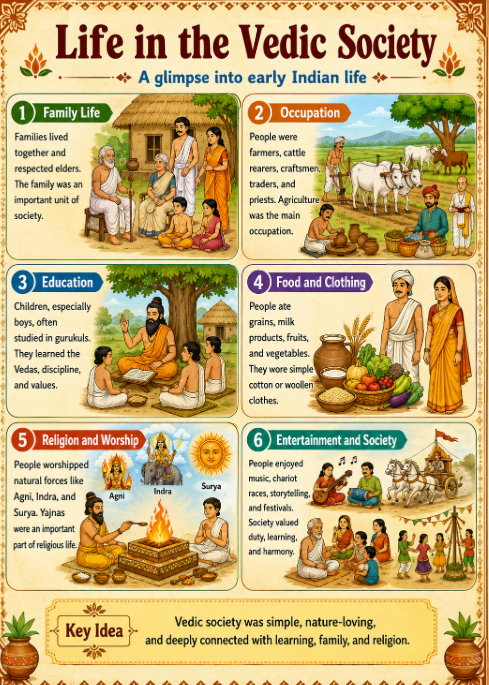
- Life in the Vedic society
- Early education system (gurukula)
- Trade and guilds in early India
- Role of women in early Indian society
Solution:
- Vedic society was based on families (kula) and clans (jana), with most people living in villages. The four varnas divided social roles, but occupations were flexible in the early period. Assemblies like sabhā and samiti helped in decision-making. Women participated in education and religious rituals. People worshipped nature gods and followed dharma, valuing knowledge, justice, and harmony.
- Education in early India took place in gurukulas, where students lived with their guru. They studied the Vedas, grammar, mathematics, science, arts, and practical skills. Along with knowledge, students learned discipline, respect, and moral values. The system focused on character-building and preparing responsible citizens.
- Trade was important to early India’s economy. Routes like the Uttarapatha and Dakshinapatha connected different regions and promoted the exchange of goods and ideas. Guilds (shrenis) of traders and artisans managed trade, maintained quality, fixed prices, and provided loans. They also supported public works and religious activities, helping economic growth.
Class 9 Social Science (New book) NCERT Solutions
- Understanding Social Science
- Shaping of the Earth’s Surface
- Atmosphere and Climate
- Early Humans and Beginning of Civilisation
- State and Society up to 1000 CE
- Democracy
- Elections
- Building Blocks in Economics: The Problem of Choice
- The Price Puzzle: What Drives the Market Edit

Test Generator
Create question paper PDF and online tests with your own name & logo in minutes.
Create Now
Learn8 App
Practice unlimited questions for Entrance tests & government job exams at ₹99 only
Install Now