Somebody’s Mother – NCERT Solutions Class 8 English (Poorvi) includes all the questions with solutions given in the NCERT Class 8 English (Poorvi).
NCERT Solutions Class 8
English Poorvi Hindi Malhar Maths Ganita Prakash Science Curiosity Social Exploring SocietySomebody’s Mother – NCERT Solutions
Q.1: Recall a time you helped someone. Write two words describing:
- What were your feelings after you did so?
- What might have been the feelings of the person whom you helped?
Solution:
- Happy, proud
- Grateful, relieved
Q.2: Work in pairs. Read the words given below. Circle the words you would associate with an elderly person, and underline the words you would associate with a school student. Share the reasons for your choices with your classmates and teacher.
Solution:

Q.3: Read the lines.
The woman was old and ragged and grey
And bent with the chill of the Winter’s day.
Select the suitable meaning of ‘ragged’ as used in these lines. There are four other meanings given below. Discuss with your classmates and teacher.
- (of clothes) old and torn; synonym: shabby
a ragged jacket - Having an outline, an edge, or a surface that is not straight or even
a ragged coastline - Not smooth or regular; not showing control or careful preparation
I could hear the sound of his ragged breathing.
Their performance was still very ragged. - (Informal) very tired, especially after physical effort
The elderly man was ragged after climbing the stairs.
Solution:
(of clothes) old and torn; synonym: shabby – a ragged jacket
Explanation: In this context, the word “ragged” is used to describe the woman’s appearance. She is also described as old, grey, and bent with the chill, which suggests poverty, weakness, and worn-out clothing. Therefore, “ragged” most likely refers to her wearing old and torn clothes.
Q.4:
Arrange the events of the poem in the correct order of occurrence. Share your answers with your classmates and teacher.
- The boy returned to his friends, feeling proud of what he had done.
- The old woman stood alone at the crossing, hesitant to move.
- A group of schoolboys passed by, playing and laughing.
- The boy offered to help the old woman cross the street.
- The woman prayed for the boy who helped her.
- The children hurried past the old woman without offering help.
- The woman placed her hand on the boy’s arm, and he guided her safely across the street.
- The boy thought about his own mother and hoped someone would help her one day.
Solution:
(ii) The old woman stood alone at the crossing, hesitant to move.
(iii) A group of schoolboys passed by, playing, and laughing.
(vi) The children hurried past the old woman without offering help.
(iv) The boy offered to help the old woman cross the street.
(vii) The woman placed her hand on the boy’s arm, and he guided her safely across the street.
(i) The boy returned to his friends, feeling proud of what he had done.
(viii) The boy thought about his own mother and hoped someone would help her one day.
(v) The woman prayed for the boy who helped her.
Q.5: The central theme of the poem ‘Somebody’s Mother’ is ________. (kindness and empathy/adventure and courage)
Solution:
The central theme of the poem is kindness and empathy.
Q.6: The tone of the poem ‘Somebody’s Mother’ is ________. (humorous and playful/sympathetic and hopeful)
Solution:
The tone of the poem is sympathetic and hopeful.
Q.7: The poem ‘Somebody’s Mother’ is written in couplets with _____________ lines in each stanza.(four/two)
Solution:
The poem is written in couplets with two lines in each stanza.
Q.8: The structure of the poem ‘Somebody’s Mother’ gives a rhythmic flow that reflects both the ________. (narrative and emotions/story’s pace and message)
Solution:
The structure of the poem gives a rhythmic flow that reflects both the narrative and emotions.
Q.9: The poem ‘Somebody’s Mother’ follows a rhyme scheme of ________. (AABB/ABAB)
Solution:
The poem follows a rhyme scheme of AABB.
Q.10: Pick examples from the poem ‘Somebody’s Mother’ for the following poetic devices.
- Simile
- Alliteration
- Repetition
Solution:
- Simile: “Came the boys like a flock of sheep” (compares boys to a flock of sheep using “like”).
- Alliteration: “Hailing the snow piled white and deep” (repeats the “w” sound).
- Repetition: “Somebody’s mother” (repeated to emphasise the woman’s importance).
Q.11: Complete the following sentences appropriately, explaining the imagery.
The poem ‘Somebody’s Mother’ uses imagery to describe scenes of a bustling street. We know this by the phrase ________.
Solution:
“the crowded street”, which helps us imagine a busy and noisy place full of people.
Q.12: The line ‘The street was wet with a recent snow’ suggests a cold and ________ weather, emphasising the woman’s helplessness.
Solution: uncomfortable
Q.13: Complete the following sentence with a suitable reason.
The poet repeats the phrase Somebody’s mother because it ________.
Solution:
reminds us that the old woman is also a loved and cared-for person, deserving kindness and respect, just like anyone else’s mother.
Q.14: Complete the analogy:
The old woman : vulnerable and neglected :: The young boy : ________.
Solution:
kind and compassionate.
Q.15: Read the given extract and answer the questions that follow.
The woman was old and ragged and grey
And bent with the chill of the Winter’s day.
The street was wet with recent snow
And the woman’s feet were aged and slow.
- What does the phrase ‘ragged and grey’ refer to?
- The woman’s emotional state that day.
- The woman’s old and worn-out appearance.
- The weather conditions of the particular day.
- The colour of the street and the surroundings.
- Complete the following sentence with a suitable reason:
The woman was ‘bent’ with the chill of the Winter’s day because she was ________. - Identify the fact and opinion from the following sentences:
A. The street was wet with recent snow.
B. The woman was too weak to cross the street on her own. - Why do you think the woman’s feet were described as ‘aged and slow’?
Solution:
- The woman’s old and worn-out appearance.
- old and weak, and the cold made her hunch over.
- A. Fact – describes an observable condition
B. Opinion – assumes her weakness - The young boy’s actions were driven by kindness and empathy.
Q.16: Read the given extract and answer the questions that follow.
He guided the trembling feet along,
Proud that his own were firm and strong.
Then back again to his friends he went,
His young heart happy and well content.
- What does the contrast between the ‘trembling feet’ of the old woman and the ‘firm and strong’ feet of the boy emphasise?
- Fill in the blank given below by selecting the correct option from the brackets.
- The poem tells us that the boy was ‘proud’ that his feet were strong.
- This tells us that the boy was ________. (arrogant about being strong/grateful for his ability to help)
- What is the boy most likely to tell his friends on getting back?
- I’m so glad I could help her.
- I’m worried about her safety.
- I’m surprised she forgot to thank me.
- I’m thankful for all your support.
- Rectify the false sentence given below.
The young boy’s actions were driven by a logical decision.
Solution:
- The difference in their age and physical strength showing the boy’s ability to help her.
- The poem tells us that the boy was “proud” that his feet were strong.
- A. I’m so glad I could help her.
- The young boy’s actions were driven by kindness and empathy.
Q.17: What might be the old woman’s fears as she waited for a long time at the crossing? Answer with reference to the poem ‘Somebody’s Mother’.
Solution:
She might have feared falling, being hit by carriages or horses, or being ignored in the slippery street.
Q.18: How does the poet show the helplessness of the old woman? Support your answer with evidence from the poem. Answer with reference to the poem ‘Somebody’s Mother’.
Solution:
The poet shows her helplessness by describing her as “old and ragged and grey,” “bent with the chill,” and having “aged and slow” feet. The lines “She stood at the crossing and waited long, / Alone, uncared for” show she was ignored and afraid to move.
Q.19: Why does the boy decide to help the old woman? What does this tell us about him? Answer with reference to the poem ‘Somebody’s Mother’.
Solution:
The boy helps because he feels empathy, thinking of his mother. This shows he is kind, caring, and respectful.
Q.20: How was the boy’s approach towards the old woman different from that of the other boys in the group? Answer with reference to the poem ‘Somebody’s Mother’.
Solution:
The other boys hurried past without helping, while the boy stopped, offered help, and guided her safely, showing kindness.
Q.21: Justify the appropriateness of the title of the poem ‘Somebody’s Mother’.
Solution:
The title “Somebody’s Mother” is appropriate because it emphasises the woman’s value as a loved mother, inspiring the boy’s kindness and her prayer for him.
Q.22: What does the poem suggest about the role of empathy and humanity in society? Answer with reference to the poem ‘Somebody’s Mother’.
Solution:
The poem suggests that empathy and humanity, like helping others, make society kinder and show that everyone deserves care and respect.
Q.23: The grid given below has the antonyms of the words from the text. Locate these words in the grid horizontally, vertically, and diagonally. One example has been done for you. You may refer to a dictionary.
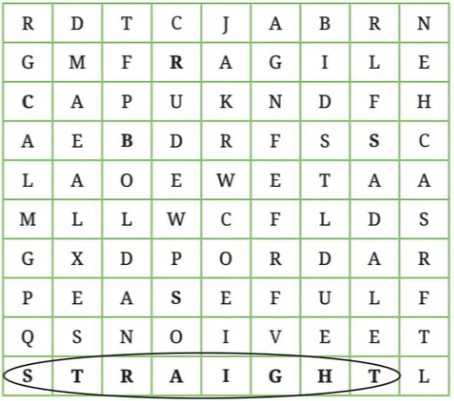
Solution:
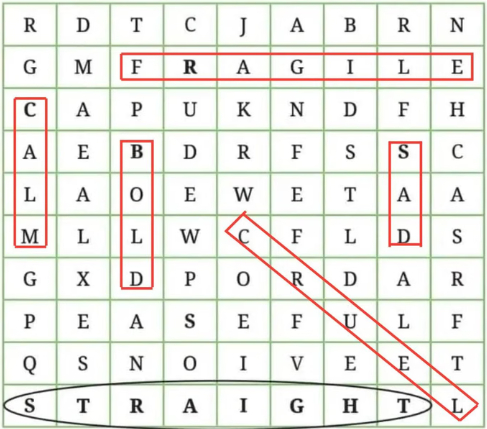
Q.24: Match the words from the text given in Column 1 with the underlined phrases in Column 2.
| Column 1 | Column 2 |
| 1. hastened | (i) The mother heard the baby move slightly in the cradle at night. |
| 2. heeded | (ii) It is our duty to give support to the poor. |
| 3. stir | (iii) The students worked quickly to complete the project and submit it on time. |
| 4. lend | (iv) All the boxes were kept in a heap at one place. |
| 5. piled | (v) They came forward to help us when we were in need. |
| 6. offered | (vi) The stranded people were brought to safety because they paid attention to our advice. |
Solution:
| Column 1 | Column 2 |
| 1. hastened | (iii) The students worked quickly to complete the project and submit it on time. |
| 2. heeded | (vi) The stranded people were brought to safety because they paid attention to our advice. |
| 3. stir | (i) The mother heard the baby move slightly in the cradle at night. |
| 4. lend | (ii) It is our duty to give support to the poor. |
| 5. piled | (iv) All the boxes were kept in a heap at one place |
| 6. offered | (v) They came forward to help us when we were in need. |
Q.25: In the poem, the poet uses the idiom ‘lend a hand’, which means ‘help somebody’. Some more idioms using ‘hand’ are given in Column 1. Match these idioms with their meanings in Column 2. You may refer to a dictionary.
| Column 1 | Column 2 |
| 1. get out of hand | (i) do something new |
| 2. try your hand at something | (ii) applaud somebody |
| 3. give somebody a free hand | (iii) work together |
| 4. give somebody a big hand | (iv) become difficult to control |
| 5. work hand in hand | (v) be very busy |
| 6. have your hands full | (vi) allow somebody to do something with full freedom |
Solution:
1 – (iv), 2 – (i), 3- (vi), 4 – (ii), 5 – (iii), 6 – (v)
Q.26: Complete the following analogy by filling in the blanks with the correct words from the poem.
- ________ : winter :: heat : summer
- hurt : ________ :: old : aged
- whispered : shouted :: humble: ________
- eyes : ________ :: legs : walk
- having a lot of money : wealthy :: densely packed people : ________
Solution:
- cold : winter :: heat : summer
- hurt : harm :: old : aged
- whispered : shouted :: humble : proud
- eyes : see :: legs : walk
- having a lot of money : wealthy :: densely packed people : crowded
Q.27: You will listen to a woman read the special broadcast of the news. As you listen, arrange the pictures in the correct sequence of the events that took place.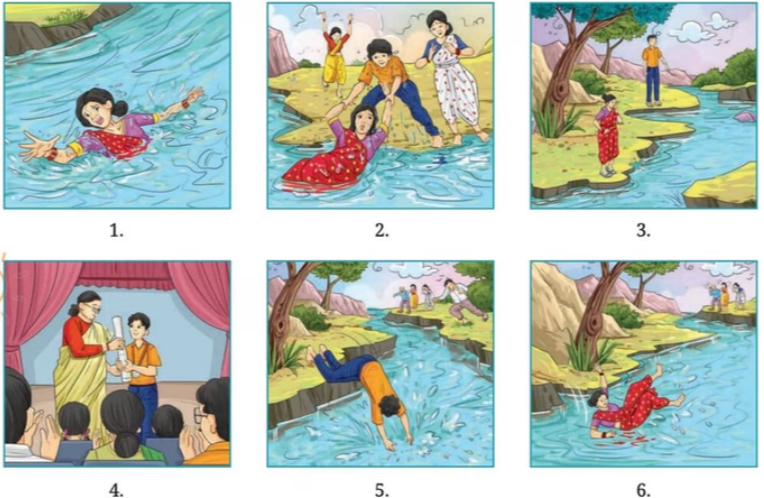
Solution:
{tex}3 \rightarrow 6 \rightarrow 1 \rightarrow 5 \rightarrow 2 \rightarrow 4{/tex}
Q.28: You will once again listen to the special broadcast of the news. As you listen, complete the following sentences with one to three exact words.
- The woman was having a difficult time staying afloat due to the ________.
- Rohan leapt into the river to save the woman without any ________.
- Rohan’s act of bravery was witnessed by ________.
- Rohan was honoured at the Vigyan Bhawan for his incredible courage and _________________.
- Rohan proved that when it comes to saving lives, age is _________________.
Solution:
- strong currents
- hesitation
- several onlookers
- selflessness
- just a number
Q.29: Read aloud the list of words from the poem that end in ‘-ed’. As you read, focus on the final sound of each word and place them in the appropriate columns. One example has been done for you.
| /id/sound | {tex}/ {d} /{/tex} sound | {tex}/ {t} /{/tex} sound |
| ragged | heeded | paused |
Solution:
This is a classroom activity. Read the words and sort them by their “-ed” sound. Example:
/t/ sound: helped, passed, placed
/d/ sound: guided, hailed, bowed
/ɪd/ sound: waited, contented
Q.30: Write a diary entry of a day you helped someone in need. Remember to include the following points while writing it.
{tex}\checkmark{/tex} Start with a sentence describing the day.
{tex}\checkmark{/tex} Mention whom you helped.
{tex}\checkmark{/tex} Explain the situation in which the other person needed help.
{tex}\checkmark{/tex} Add the place and time of the day when the situation arose.
{tex}\checkmark{/tex} Describe how you helped the other person.
{tex}\checkmark{/tex} Describe the reaction of the person you helped.
{tex}\checkmark{/tex} Mention how you felt during and after helping the person.
{tex}\checkmark{/tex} Conclude by mentioning why you would do something like this again.
You may begin like this:
26 April 20xx, Saturday
8:00 p.m.
Dear Diary,
Today, I feel was a special day…
Solution:
26 April 2025, Saturday
8:00 p.m.
Dear Diary,
Today was a special day because I helped an elderly neighbour, Mrs. Sharma. In the afternoon, at around 2:00 p.m., I saw her struggling to carry heavy grocery bags near our apartment gate. She looked tired and was moving slowly. I offered to carry her bags to her house on the second floor. She smiled and thanked me warmly, saying she felt relieved. I felt happy and proud while helping her, and afterwards, I felt joyful knowing I made her day easier. I would help again because it feels good to be kind and make someone smile.
Yours,
[Your Name]
Q.31: Work in groups of four. Find out the names of countries that refer to their country as ‘motherland’ and a few others as ‘fatherland’. Share your findings with your classmates and teacher.
Solution:
Motherland: India, Russia, Bangladesh
Fatherland: Germany, Norway, Iceland
Q.32: Make a gratitude card for your mother/grandmother to thank her for at least five things that she does for you. Also write two things that you would do regularly to help them. Use recycled material to make and decorate the card.
Solution:
Example Response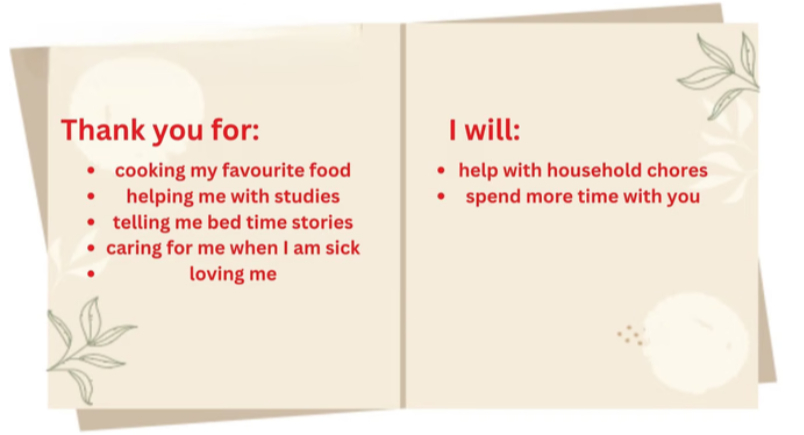
NCERT Solutions Class 8 English Poorvi
- The Wit that Won Hearts
- A Concrete Example
- Wisdom Paves the Way
- A Tale of Valour: Major Somnath Sharma and the Battle of Badgam
- Somebody’s Mother
- Verghese Kurien – I Too Had A Dream
- The Case of the Fifth Word
- The Magic Brush of Dreams
- Spectacular Wonders
- The Cherry Tree
- Harvest Hymn
- Waiting for the Rain
- Feathered Friend
- Magnifying Glass
- Bibha Chowdhuri: Women in Indian Science

Test Generator
Create question paper PDF and online tests with your own name & logo in minutes.
Create Now
Learn8 App
Practice unlimited questions for Entrance tests & government job exams at ₹99 only
Install Now