Reproduction: How Life Continues – NCERT Solutions Class 9 Science Exploration includes all the questions with solutions given in NCERT Class 9 Science Exploration textbook.
NCERT Solutions Class 9
English Kaveri Hindi Ganga Sanskrit Sharada Maths Ganita Manjari Science Exploration Social Understanding SocietyReproduction: How Life Continues – NCERT Solutions
Q.1: When does a farmer prefer asexual or sexual methods of reproduction for crops production?
Solution: Farmers prefer asexual reproduction when they want to produce a large number of identical plants in a short time. This method ensures that desirable traits such as high yield or disease resistance are preserved, as the offspring are genetically identical to the parent.
On the other hand, farmers prefer sexual reproduction when they want to introduce variation in crops. Sexual reproduction leads to genetic diversity, which can help in developing new varieties that are more resistant to diseases or better adapted to environmental conditions.
Thus, asexual reproduction is used for uniformity and rapid multiplication, while sexual reproduction is used for variation and improvement of crops.
Q.2: Why do you think most complex animals and flowering plants use sexual reproduction, while many simple organisms, like yeast and hydra mainly reproduce asexually?
Solution: Most complex animals and flowering plants use sexual reproduction because it produces genetic variation, which helps organisms adapt to changing environmental conditions and increases chances of survival. Complex organisms also have specialised reproductive systems that support sexual reproduction.
On the other hand, simple organisms like yeast and hydra mainly reproduce asexually because it is a faster and simpler process that requires only one parent. It allows rapid multiplication in stable environments where variation is not essential.
Thus, complex organisms prefer sexual reproduction for variation and adaptability, while simple organisms prefer asexual reproduction for quick reproduction.
Q.3: In a china-rose (hibiscus or gudhal) plant, a pollen tube grows and continues through the style after pollen lands on the stigma. Which process is about to happen next?
Solution: After the pollen tube grows through the style and reaches the ovule, the next process that occurs is fertilisation. In this process, the male gamete from the pollen fuses with the female gamete (egg) present in the ovule to form a zygote.
Thus, the process about to happen next is fertilisation.
Q.4: Look at the pictures (Fig) of calotropis (madar) seeds and dandelion seeds given below. Can you guess what kind of seed dispersal these seeds are adapted for?
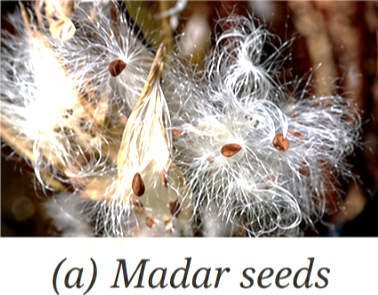
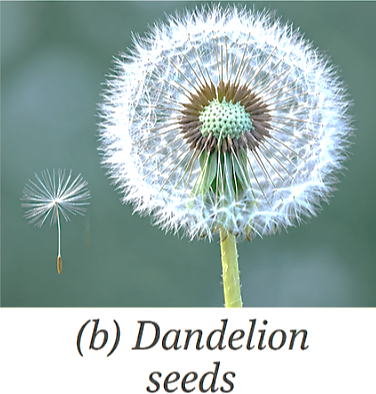
Solution: The image shows dandelion seeds, which are dispersed by wind. These seeds are produced after sexual reproduction in plants, where fertilisation leads to the formation of seeds.
Dandelion seeds are light and have hair-like structures that help them travel long distances by wind, ensuring wider distribution and growth of new plants.
Thus, it represents seed formation and dispersal, which are parts of sexual reproduction in plants.
Q.5: A farmer plants two varieties of maize side by side, but notices that seeds form only when pollen from one variety reaches the stigma of the other. What type of pollination is this?
Solution: The type of pollination described is cross-pollination.
In this case, pollen from one variety of maize reaches the stigma of another variety, leading to seed formation. This involves transfer of pollen between different plants of the same species, which is the characteristic feature of cross-pollination.
Thus, the process is cross-pollination.
Q.6: Why do animals with external fertilisation generally produce more eggs than animals with internal fertilisation?
Solution: Animals with external fertilisation produce more eggs because the chances of fertilisation and survival of offspring are very low. The eggs and sperms are released into the environment (usually water), where many may be destroyed by predators or unfavorable conditions.
In contrast, animals with internal fertilisation have higher chances of successful fertilisation and protection of the developing embryo inside the body, so fewer eggs are needed.
Thus, external fertilisation requires the production of more eggs to ensure that at least some survive and develop into adults.
Q.7: In animals, which fertilisation method the gametes are more protected?
Solution: Gametes are more protected in internal fertilisation.
In this method, fertilisation occurs inside the body of the female, which provides a safe environment. The gametes are protected from external factors such as predators, temperature changes, and drying out.
Thus, internal fertilisation ensures better protection of gametes compared to external fertilisation.
Q.8: Ravi suddenly notices that he is growing taller rapidly, his shoulders are broadening, and his voice cracks. What stage of life is he entering?
Solution: Ravi is entering the stage of puberty.
Puberty is the phase of life during which the body undergoes rapid physical changes such as increase in height, broadening of shoulders, and change in voice. These changes indicate the beginning of adolescence and the development of reproductive maturity.
Thus, Ravi is entering puberty (adolescence).
Q.9: Rina’s period occurs every 28 days. Her last period was on the 5th of March. On which day is she most likely to get her next period?
Solution: The menstrual cycle is 28 days.
Last period = 5th March
Add 28 days:
From 5th March to 31st March {tex}=26{/tex} days
Remaining days {tex}=2{/tex} days in April
Next period = 2nd April
Q.10: A human zygote has just formed. How many chromosomes does it have?
Solution: A human zygote has 46 chromosomes.
This is because it is formed by the fusion of male and female gametes during fertilisation. Each gamete contributes 23 chromosomes, so the zygote contains 23 + 23 = 46 chromosomes.
Q.11: What protective devices can be used during sexual activity to reduce the spread of STIs?
Solution: The main protective devices used during sexual activity to reduce the spread of sexually transmitted infections (STIs) are condoms.
Condoms act as a barrier method, preventing direct contact and exchange of body fluids between partners, thereby reducing the risk of transmission of infections such as HIV, gonorrhoea, and syphilis.
Q.12: If a couple uses oral contraceptive pills but not condoms, which risks remain and why?
Solution: If a couple uses oral contraceptive pills but not condoms, the risk of sexually transmitted infections (STIs) still remains.
This is because oral contraceptive pills only prevent pregnancy by controlling ovulation, but they do not act as a barrier to stop the exchange of body fluids. Therefore, infections such as HIV, gonorrhoea, and syphilis can still spread.
Q.13: In many animals, the young ones can walk or find food soon after birth but human babies are completely dependent for a long time. What might be some advantages and disadvantages of this for humans as a species?
Solution: In humans, babies are dependent for a long time after birth.
Advantages:
- Allows more time for brain development and learning.
- Helps in acquiring complex skills, language, and social behaviour.
- Leads to better care and protection from parents.
Disadvantages:
- Requires long-term parental care and resources.
- Higher risk if proper care is not provided.
- Slower independence compared to other animals.
Q.14: A flower’s anthers are removed before it matures. Later, pollen from another plant of the same species is dusted onto its stigma and seeds are produced. Which process has been ensured here?
Options:
(1) Self-pollination
(2) Cross-pollination ✅
(3) Fertilisation
(4) Tissue culture
Explanation: Removing the anthers prevents self-pollination. When pollen from another plant of the same species is placed on the stigma, it ensures that pollination occurs between different plants.
This process is called cross-pollination.
Q.15: Arrange the following stages of sexual reproduction in plants in the correct order:
- Pollen germination on stigma
- Fertilisation
- Pollination
- Formation of zygote
Solution: (iii) Pollination → (i) Pollen germination on stigma → (ii) Fertilisation → (iv) Formation of zygote
Q.16: Assertion (A): The zygote formed after fertilisation immediately attaches to the uterus wall.
Reason (R): The uterus wall is always prepared to receive the zygote.
Options:
(1) Both A and R are true and R is the correct explanation of A.
(2) Both A and R are true but R is not the correct explanation of A.
(3) A is true but R is false.
(4) A is false but R is true. ✅
Explanation: Assertion (A) is False: A zygote does not immediately attach to the uterus wall. Fertilization typically occurs in the fallopian tube (specifically the ampullary region). Following fertilization, the zygote undergoes several mitotic divisions (cleavage) as it travels toward the uterus over several days, transforming into a structure called a blastocyst before implantation occurs.
Reason (R) is True: The uterus prepares itself every month to receive a potentially fertilized egg. Under the influence of hormones like estrogen and progesterone, the uterine lining (endometrium) thickens and becomes richly supplied with blood and nutrients to support a developing embryo.
Q.17: Why does asexual reproduction produce offspring that are genetically identical to the parent?
Solution: Asexual reproduction produces genetically identical offspring because it involves only one parent and occurs through mitotic cell division. There is no fusion of gametes and no mixing of genetic material. As a result, the offspring receive an exact copy of the parent’s DNA, making them genetically identical (clones).
Q.18: Explain why the menstrual cycle stops during pregnancy.
Solution: The menstrual cycle stops during pregnancy because after fertilisation, the zygote implants in the uterus. The body then releases hormones (like progesterone) that maintain the uterine lining (endometrium) to support the developing embryo.
Since the uterine lining is not shed, menstruation does not occur during pregnancy.
Q.19: Why are flowers that bloom at night white or light in colour as compared to flowers that bloom during the day?
Solution: Flowers that bloom at night are usually white or light in colour because they need to attract pollinators in low light conditions. Light-coloured flowers are more visible in the dark and often have a strong fragrance to attract insects like moths.
In contrast, day-blooming flowers use bright colours to attract pollinators like bees in sunlight.
Thus, night-blooming flowers are light-coloured to ensure effective pollination in the absence of daylight.
Q.20: Why do vegetatively propagated plants tend to be more vulnerable to diseases than sexually reproduced plants?
Solution: Vegetatively propagated plants are more vulnerable to diseases because they are genetically identical (clones). Since there is no variation, if a disease affects one plant, it can easily affect all others in the same way.
In contrast, sexually reproduced plants show genetic variation, which increases the chances that some plants may be resistant to diseases.
Thus, lack of variation makes vegetatively propagated plants more susceptible to diseases.
Q.21: If all flowers in a type of plant were only capable of self-pollination, how would it affect the genetic diversity over several generations? Explain.
Solution: If all flowers in a plant species were capable of only self-pollination, the genetic diversity would decrease over several generations.
This is because self-pollination involves the transfer of pollen within the same plant, so there is very little mixing of different genetic material. As a result, offspring remain quite similar to the parent.
Due to reduced variation, the plants may become less adaptable to environmental changes and diseases over time.
Q.22: A farmer wants to produce a large number of genetically identical plants quickly. Suggest suitable reproduction methods and explain why they are effective.
Solution: The farmer should use asexual reproduction methods, especially vegetative propagation such as cutting, layering, grafting, or tissue culture.
These methods are effective because:
- They produce genetically identical plants (clones).
- They require only one parent.
- They allow rapid multiplication in a short time.
- Desirable traits are preserved without variation.
Q.23: Suresh prepares slides with pollen grains in different sugar concentrations (0%, 2.5%, 5%, 7.5%, 10%) to study the germination of pollen.
- What are the different hypotheses which can be tested using this set-up?
- What parameters should be kept the same in this set-up?
Solution:
- Hypotheses that can be tested:
Pollen germination depends on sugar concentration.
There is an optimum sugar concentration at which maximum pollen germination occurs.
Very low or very high sugar concentrations reduce pollen germination. - Parameters to be kept the same:
Type and age of pollen grains
Temperature and environmental conditions
Volume of solution used
Time allowed for germination
Method of slide preparation
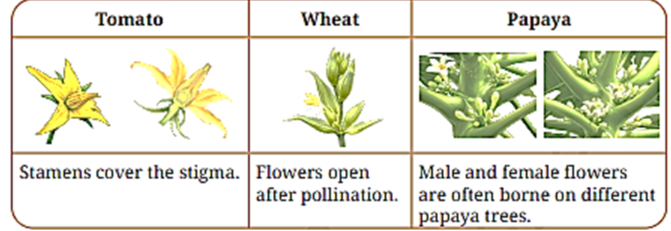
Q.24: Look at the picture given below and think in line with the given prompts and find out which type(s) of pollination might have been followed in these flowers -
Solution:
- Tomato
Observation: The prompt states “Stamens cover the stigma.”
Pollination Type: Self-pollination (specifically Autogamy).
Explanation: Because the male parts (stamens) physically enclose the female part (stigma) within the same flower, the pollen is almost certain to land on the stigma of the same flower. - Wheat
Observation: The prompt states “Flowers open after pollination.”
Pollination Type: Self-pollination (specifically Cleistogamy).
Explanation: Since the flowers remain closed until after pollination has occurred, no outside pollen can enter. The flower is forced to pollinate itself using its own pollen before it even blooms. - Papaya Observation: The prompt states “Male and female flowers are often borne on different papaya trees.” Pollination Type: Cross-pollination (specifically Xenogamy).
Explanation: Papaya is a dioecious plant, meaning an individual tree is either strictly male or strictly female. Because the male and female reproductive organs are on entirely different plants, the pollen must be carried by an external agent (like wind or insects) from one tree to another.
| Plant | Key Feature | Type of Pollination |
| Tomato | Stamens enclose the stigma | Self-pollination |
| Wheat | Pollination occurs in closed flowers | Self-pollination (Cleistogamy) |
| Papaya | Different trees for male/female flowers | Cross-pollination |
Q.25: In the lower Himalayan region of northern India, apples are an important cash crop that contribute significantly to farmer’s livelihoods. The fruit yield in apple cultivation is declining continuously, associated with climate change and a significant decline in the population of natural pollinators. A researcher-farmer group set up two experimental apple orchards at two distinct locations: Places A and B. In apple orchards at Place A, they allowed natural pollinators Percent to pollinate the flowers of the apple. In apple orchards at Place B, they applied mixed farming techniques of beekeeping. Along with honey, the farmer yielded apples. The yield of apples is depicted in Fig. in terms of fruit setting (number of fruits/the total number of corresponding fruit-bearing branches) and fruit drop (premature falling of developing fruits) in the two types of experimental places of apple orchards.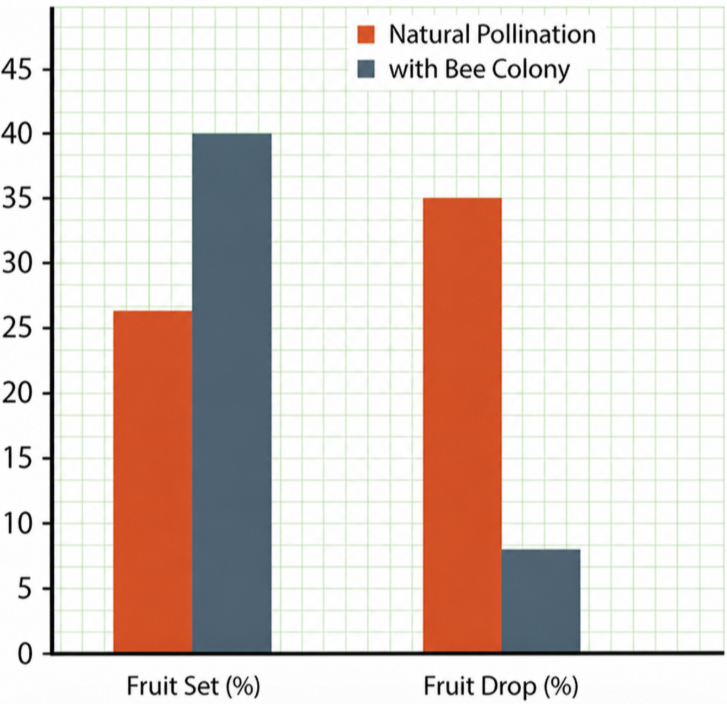
- What are the hypotheses the researcher-farmers group has thought of for this investigation? (1)
- What are the different parameters in the experiment? (1)
- Compare and analyse the data of two experimental orchards Places A and B, in terms of high yields of apple fruits. (2) OR Based on your analysis, what do you infer from the data? (2)
Solution:
- Hypotheses:
- Use of beekeeping (managed pollinators) increases pollination efficiency.
- Increased pollination leads to higher fruit setting and lower fruit drop.
- Decline in natural pollinators reduces apple yield.
- Parameters in the experiment:
- Independent variable:
- Type of pollination (natural pollinators vs beekeeping)
- Dependent variables:
- Fruit setting (number of fruits formed),
- Fruit drop (premature falling of fruits)
- Controlled variables:
- Type of apple plants
- Soil conditions
- Climate conditions
- Irrigation and farming practices (kept same as far as possible)
- Independent variable:
- Comparison and analysis:
- Place A (natural pollinators):
- Lower fruit setting
- Higher fruit drop
- Overall lower yield
- Place B (with beekeeping):
- Higher fruit setting
- Lower fruit drop
- Overall higher yield
- Place A (natural pollinators):
Q.26: A student claims, “In humans, ovulation always happens on day 14 of the menstrual cycle”. Critically examine this claim and state whether the claim is correct or not. Give at least two reasons for your answer.
Solution: The given claim is not correct.
Reasons:
- Variation in cycle length:
The menstrual cycle is not always 28 days; it can vary (about 21–35 days). Ovulation usually occurs about 14 days before the next period, not necessarily on day 14. - Individual differences:
Factors like stress, illness, diet, and hormonal changes can affect the timing of ovulation, causing it to occur earlier or later.
Q.27: Does a unicellular organism like amoeba or yeast ever ‘grow old’? When it divides, it produces almost two identical copies. So, does ageing happen at all?
Solution: Unicellular organisms like Amoeba and yeast do not show ageing in the same way as multicellular organisms. When they divide, the parent cell splits into two new cells, so there is no clear “old” individual left behind.
However, ageing can still occur at the cellular level. In some cases (like yeast), one cell may retain older cell components and show signs of ageing over time.
Class 9 Science Exploration NCERT Solutions
- Exploration: Entering the World of Secondary Science
- Cell: The Building Block of Life
- Tissues in Action
- Describing Motion Around Us
- Exploring Mixtures and Their Separation
- How Forces Affect Motion
- Work, Energy and Simple Machines
- Journey Inside the Atom
- Atomic Foundations of Matter
- Sound Waves: Characteristics and Applications
- Reproduction: How Life Continues
- Patterns in Life: Diversity and Classification
- Earth as a System: Energy, Matter and Life

Test Generator
Create question paper PDF and online tests with your own name & logo in minutes.
Create Now
Learn8 App
Practice unlimited questions for Entrance tests & government job exams at ₹99 only
Install Now