
Ask questions, doubts, problems and we will help you..
Ask questions which are clear, concise and easy to understand.
Ask Question
CBSE, JEE, NEET, CUET
Question Bank, Mock Tests, Exam Papers
NCERT Solutions, Sample Papers, Notes, Videos
Posted by Dhanuka Meena 5 years, 4 months ago (9720171)
- 2 answers
Posted by Raman Baghel 5 years, 4 months ago (8678766)
- 0 answers
Posted by Nitish Sinha 5 years, 4 months ago (9436740)
- 3 answers
👌Aditya 👌 👌Kumar👌 5 years, 4 months ago (8928481)
Rashmi Naik 5 years, 4 months ago (9665879)
Yogita Ingle 5 years, 4 months ago (2577571)
- These are unicellular microscopic organisms similar to animals that can move about to capture food and are heterotrophic in nature.
- They are mostly aquatic in nature.
- Amoeba, paramecium are some examples of protozoa.
Posted by 1234 5678 5 years, 4 months ago (9733009)
- 0 answers
Posted by Rohit Pal 5 years, 4 months ago (9768365)
- 0 answers
Posted by Rani Mishra ??? 5 years, 4 months ago (6444305)
- 1 answers
Yogita Ingle 5 years, 4 months ago (2577571)
The Directive Principles constitute a very comprehensive social, economic and political programme for a modern and welfare state.
These principles emphasises that the State shall try to promote welfare of people by providing them basic facilities like shelter, food and clothing.
Unlike Fundamental Rights, the Directive Principles of State Policy (DPSP) are non- binding in nature which means they are not enforceable by the courts for their violation.
However, the Constitution itself declares that ‘these principles are fundamental in the governance of the country and it shall be the duly of the state to apply these principles in making laws’. Hence, they impose a moral obligation on the state authorities for their implementation.

Posted by Mo Nuj 5 years, 4 months ago (9152316)
- 2 answers
Aarav Pathak 5 years, 4 months ago (9770796)
Yogita Ingle 5 years, 4 months ago (2577571)
The most important points of difference between the Rigveda and the modern books is that today books are written and read. The Vedas were memorized by students, and later passed on to the later generations by speaking, listening and then memorizing.
Posted by R. Udhaya Kumar Udhaya 5 years, 4 months ago (9676157)
- 1 answers
Posted by Akhifa Sheik 5 years, 4 months ago (9708134)
- 1 answers
Gaurav Seth 5 years, 4 months ago (2898529)
strong nuclear force= in such force the particle are kept close to each other and has short range... hence are not easy to separate easily. Its main job is to hold together the subatomic particles of the nucleus.
weak nuclear force= in such type of force the particles r kept at a large distance and has a large range... hence easy to separate them.it is the interaction that interacts on subatomic particle.
Posted by Dhanyasri Sudhakar 5 years, 4 months ago (4825655)
- 3 answers
Posted by ~@Kanchi Jawla 5 years, 4 months ago (9746879)
- 0 answers
Posted by Payal Suryawanshi 5 years, 4 months ago (9685780)
- 1 answers
Gaurav Seth 5 years, 4 months ago (2898529)
Work energy theorem states that the change in kinetic energy of an object is equal to the net work done on it by the net force.
Let us suppose that a body is initially at rest and a force  is applied on the body to displace it through
  along the direction of the force. Then, small amount of work done is given by

Also, according to Newton's second law of motion, we have

where a is acceleration produced (in the direction of force) on applying the force. Therefore,

Now, work done by the force in order to increase its velocity from u (initial velocity) to v (final velocity) is given by

Hence, work done on a body by a force is equal to the change in its kinetic energy.
Posted by Shivani Gupta 5 years, 4 months ago (4235079)
- 2 answers
Muskan Maan 5 years, 2 months ago (9974792)
Shumayla Rayeen ? 5 years, 4 months ago (6301396)
Posted by ~@Kanchi Jawla 5 years, 4 months ago (9746879)
- 1 answers
Posted by Ekta Chaurasia 5 years, 4 months ago (8936584)
- 2 answers
Sahil Panchal 5 years, 2 months ago (9345893)
Anya Jain 5 years, 3 months ago (9803048)
Posted by Krishna Gupta 5 years, 4 months ago (9768212)
- 2 answers
Vidushi Malik 5 years, 4 months ago (9775735)
Shubhadarshi Tiwari 5 years, 4 months ago (8399915)
Posted by Mantasa Khan 5 years, 4 months ago (9768184)
- 5 answers
Posted by Mantasa Khan 5 years, 4 months ago (9768184)
- 1 answers
Posted by Ankit Kumar 5 years, 4 months ago (9768193)
- 2 answers
Anjali Singh 5 years, 4 months ago (7940333)
Posted by Salina Khan 5 years, 4 months ago (9479300)
- 2 answers
Yogita Ingle 5 years, 4 months ago (2577571)
The world was intrigued by the young pharaoh,the world's most famous mummy that is King Tut was an enigma for people. Little had been understood about how the young ruler died more than 3,300 years ago and his death continued to be a lingering medical mystery that pushed people to try and solve it. Tourists would descend on the tomb to pay their respects to the dead king, captivated by legends of his immense wealth and gilded face mask on the outer coffin lid, a face that seemed to launch their imaginations. Some would read from the guidebooks in a reverential whisper while others would just stand silently pondering upon the untimely death of the pharaoh in his late teens or thinking about the pharaoh's curse. Trying to conjecture about the death and misfortune which befell those who disturbed him and if it was really true. His death was enshrouded in mystery and they wanted to look beyond the veil to arrive at the truth about it. F
Posted by Divyanshi Sheoran 5 years, 4 months ago (9563434)
- 1 answers
Posted by Diksha Kashyap 5 years, 4 months ago (8192373)
- 1 answers
Gaurav Seth 5 years, 4 months ago (2898529)
“There are five critical domains in a child’s development,” said Dianna Fryer, Joint Base San Antonio-Randolph Child Development Program training and curriculum specialist. “Those domains are social, emotional, physical, cognitive and language.”
The five critical domains inform the JBSA CDPs’ approach to early childhood education, but they also can provide a blueprint for parents as they facilitate their children’s development.
Posted by Moin Qureshi 5 years, 4 months ago (9396338)
- 1 answers
Posted by Chandnita Saini 5 years, 4 months ago (9381261)
- 1 answers
Yogita Ingle 5 years, 4 months ago (2577571)
1. Related with the daily life of the people: The local self-bodies are directly related with the daily life of the people. There is no area of the citizen's life which is not connected with these institutions. These institutions perform the functions related to education, sanitation, public health, industry, etc., and try to tackle the day-to-day problems of the local people.
2. Right solution of the local problems: In a big country like India, there live the people belonging to different religions, languages, caste and customs. There are different types of problems in the different parts of the country. The Union Government or the State Governments are unable to know the local problems of the citizens. Only the local people know the local problems and they can suggest the right solution to the local problems. In this way the local self-bodies play an important role.
3. These bodies lessen the workload of Central and State Governments: In the big countries like India where the population is in millions and the area is very vast, the Central Government and the State Governments have many other important works and problems to solve. Therefore, they may not have much spare time to attend to the local problems. A need arises for local bodies well versed with the nature of the local problems who can solve these problems and lessen the burden of Central and State governments.
Posted by Salina Khan 5 years, 4 months ago (9479300)
- 1 answers
Yogita Ingle 5 years, 4 months ago (2577571)
The world was intrigued by the young pharaoh,the world's most famous mummy that is King Tut was an enigma for people. Little had been understood about how the young ruler died more than 3,300 years ago and his death continued to be a lingering medical mystery that pushed people to try and solve it. Tourists would descend on the tomb to pay their respects to the dead king, captivated by legends of his immense wealth and gilded face mask on the outer coffin lid, a face that seemed to launch their imaginations. Some would read from the guidebooks in a reverential whisper while others would just stand silently pondering upon the untimely death of the pharaoh in his late teens or thinking about the pharaoh's curse. Trying to conjecture about the death and misfortune which befell those who disturbed him and if it was really true. His death was enshrouded in mystery and they wanted to look beyond the veil to arrive at the truth about it. F
Posted by Ankit Jangid 5 years, 4 months ago (9394666)
- 1 answers
Posted by Munavvar Munavvar Hussain 5 years, 4 months ago (9765595)
- 3 answers
Elvis Jovin 5 years, 4 months ago (9579707)
Posted by Riya Mangang 5 years, 4 months ago (9293948)
- 2 answers
Tulasi Biswal 5 years, 4 months ago (9705743)
Yogita Ingle 5 years, 4 months ago (2577571)
An idiom is a phrase with a meaning that cannot be understood from the meanings of its individual words. Here are some examples of idioms:
- to be fed up with (=to be tired and annoyed with something that has been happening for too long)
- to rub someone the wrong way (=to irritate or annoy someone)
- to do something by the skin of your teeth (=to complete something, but not well. “She passed the test by the skin of her teeth” means she received a very low grade, but not low enough to fail.)
A proverb is a short and popular saying that gives advice about how people should behave or that expresses a belief that is commonly thought to be true. Here are some examples of proverbs:
- Don’t cry over spilled milk. (=Don’t get upset about something that has already happened and cannot be undone.)
- People who live in glass houses shouldn’t throw stones. (=Don’t criticize other people for their faults if you have faults too - and everyone does.)
- A stitch in time saves nine. (=Fixing a problem right away will take less time than fixing it later on.)
Posted by Jeevan B. K 5 years, 4 months ago (9767948)
- 2 answers
Yogita Ingle 5 years, 4 months ago (2577571)
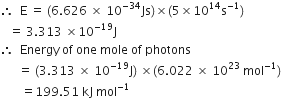
energy = number of photons * energy in one photon
= n h v
= 6.023 × 10²³ × 6.626 × 10⁻³⁴ × 5 × 10¹⁴ Joules
= 199.54 kJoules
Gaurav Seth 5 years, 4 months ago (2898529)
Calcualte the energy of one mole of photons of radiation whose frequency is 5 x 10¹⁴Hz.
<hr />A n s w e r ;
Energy (E) of one photon = hv
Here, h = 6.626 x 10⁻³⁴ Js
v = 5 x 10¹⁴ s-1
Posted by S Sibiraj 5 years, 4 months ago (9461316)
- 1 answers
Gaurav Seth 5 years, 4 months ago (2898529)
Answer:
The value=1
Step-by-step explanation:
∠B=90°
∠A=∠C
Hyp= AC
Other sides= BC, AB
sinA= BC/AC
cosA=AB/AC
sinC= AB/AC
cosC= BC/AC
Using Pythagoras Theorem
AC²=BC²+AB²
sinA cosC+cosA sinC
=BC/AC*BC/AC +AB/AC*BC/AC
=BC²/AC² +AB²/AC²
=AB²+BC/AC²
=AC²/AC²
=1
myCBSEguide
Trusted by 1 Crore+ Students

Test Generator
Create papers online. It's FREE.

CUET Mock Tests
75,000+ questions to practice only on myCBSEguide app

Manan Jain 📚📚📚✔✔ 5 years, 4 months ago (2083802)
2 Thank You